Amira Armenta (Colombia/Netherlands) has a degree in Latin American history from the Université de Jussieu (Paris).
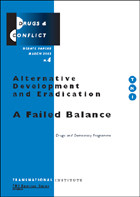
A Failed Balance
Alternative Development programmes, aimed at encouraging peasants to switch from growing illicit drugs-related crops, are a good idea. The record of success, however, is a sorry one. Decades of efforts to reduce global drug supply using a mix of developmental and repressive means, have failed.
This Drugs & Conflict debate paper elucidates the analysis TNI contributed to a high-level international policy conference to evaluate 25 years of Alternative Development, convened by the German government and the United Nations Drug Control Programme (UNDCP) in January 2002.
TNI argues for a reconceptualisation of the strategy – delinking alternative development from the threat of forced eradication and law enforcement, and guaranteeing peasants the support required for a sustainable alternative future. Furthermore, our experts urge the application of the concept of Harm Reduction as the basis for a rational and pragmatic drug policy.
This concept has been applied successfully in many countries, especially in Europe, but till now only on the consumption side of the story. The authors of this booklet argue it is high time that Harm Reduction principles be applied to the production side of the equation.
A significant breakthrough was achieved at the German conference, with the final declaration stating, 'Alternative Development should neither be made conditional on prior elimination of drug crop cultivation nor should a reduction be enforced until licit components of livelihood strategies have been sufficiently strengthened.” While there is still a long way to go in achieving just and effective drugs policies, this does represent an important shift away from the crude ‘carrot and stick’ approach to peasant producers, which has ao undermined alternative development efforts to date.
TNI Drugs and Democracy Programme Coordinator
Martin Jelsma is a political scientist who has specialised in Latin America and international drugs policy. In 2005, he received the Alfred R. Lindesmith Award for Achievement in the Field of Scholarship, which stated that Jelsma "is increasingly recognized as one of, if not the, outstanding strategists in terms of how international institutions deal with drugs and drug policy."
In 1995 he initiated and has since co-oordinated TNI's Drugs & Democracy Programme which focuses on drugs and conflict studies with a focus on the Andean/Amazon region, Burma/Myanmar and Afghanistan, and on the analysis and dialogues around international drug policy making processes (with a special focus on the UN drug control system). Martin is a regular speaker at international policy conferences and advises various NGOs and government officials on developments in the drugs field. He is co-editor of the TNI Drugs & Conflict debate papers and the Drug Policy Briefing series.
Director of Acción Andina Colombia
Ricardo Vargas Meza is a Sociologist with a Masters in Social Philosophy from the National University of Colombia. He is an author, among other texts of Fumigation and Conflict: Anti-drugs policies and the delegitimisation of the Colombian state (Tercer Mundo, TNI and Acción Andina, December 1999); Drugs, Armed Conflict and Alternative Development (Acción Andina Colombia, June 2003, Bogotá); Narcotrafficking, war and anti-drug policies (Acción Andina Colombia, Novib - Oxfam The Netherlands, June 2005); Alternative Development in Colombia and Social Participation: Proposals for a change of strategy (DIAL, September 2010, Bogotá).
Vargas writes frequently for various publications and journals, both in Colombia and internationally. He also does international consultancy on issues of development, illegality and security.
Researcher, Drugs and Democracy Programme
Tom Blickman (1957) is an independant researcher and journalist, based in Amsterdam. Before coming to TNI he was active in the squatters and solidarity movements in Amsterdam. He worked for Bureau Jansen & Janssen, a research institute on intelligence and police matters. Now he specialises in International Drug Control Policy and Organised Crime as a researcher at TNI's Drugs & Democracy Programme.
Also by Amira Armenta
- Conflict, poverty and marginalisation July 2011
- Buying the present selling the future October 2010
- Eradications and conflict in Colombia May 2008
- FARC was niet de enige optie voor Tanja September 2007
- On Politics and Drugs: A Look at the Recent Events August 2006
Upcoming events
-
EU in Crisis
May 2012
Brussels, Belgium


![image[node-id]](http://www.tni.org/sites/www.tni.org/files/imagecache/4teaser-small/reports-images/graphic1.gif)

![image[node-id]](http://www.tni.org/sites/www.tni.org/files/imagecache/4teaser-small/reports-images/landgrab.jpg)
![image[node-id]](http://www.tni.org/sites/www.tni.org/files/imagecache/4teaser-small/reports-images/green-economy_page_01.jpg)
![image[node-id]](http://www.tni.org/sites/www.tni.org/files/imagecache/4teaser-small/reports-images/brazilsugarcanepath.jpg)