
From Golden Triangle to Rubber Belt?
In the Kokang and Wa regions in northern Burma opium bans have ended poppy cultivation, but have caused chronic poverty and food insecurity as a result.
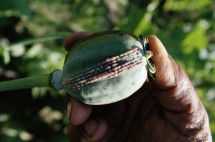
In the Kokang and Wa regions in northern Burma opium bans have ended over a century of poppy cultivation. The bans have had dramatic consequences for local communities. They depended on opium as a cash crop, to buy food, clothing, and medicines.
The bans have driven poppy-growing communities into chronic poverty and have adversely affected their food security. Very few alternatives are being offered to households for their survival. The Kokang and Wa cease-fire groups have implemented these bans following international pressure, especially from neighbouring China. In return, they hope to gain international political recognition and aid to develop their impoverished and war-torn regions.
The Kokang and Wa authorities have been unable to provide alternative sources of income for ex-poppy farmers. Instead they have promoted Chinese invest-ment in monoplantations, especially in rubber. These projects have created many undesired effects and do not significantly profit the population.
Conclusions & Recommendations
• The opium bans have driven communities into chronic poverty and have adversely affected their food security and access to health care and education.
• The Kokang and Wa authorities have promoted Chinese investment in mono-plantations, especially in rubber. These projects are unsustainable and do not significantly profit the population.
• Ex-poppy farmers mainly rely on casual labour and collecting Non-Timber Forest Products as alternative source of income.
• Current interventions by international NGOs and UN agencies are still limited in scale and can best be described as “emer-gency responses”.
• If the many challenges to achieving viable legal livelihoods in the Kokang and Wa regions are not addressed, the reductions in opium cultivation are unlikely to be sustainable.
About the authors
Tom Kramer
Tom Kramer (1968) is a political scientist and with over 15-years of working experience on Burma and its border regions, which he has visited regularly since 1993.
His work focuses on developing a better understanding of the drugs market in the region as a whole, the relationship between production and consumption, and alternative development (AD). Together with the Drugs and Democracy Programme, Kramer has created a regional network of local researchers, and is also carrying out advocacy towards policy makers in the region for more sustainable and human drug policies.
Since 2005 Kramer also works on Afghanistan, with a focus onthe relationship between drugs & conflict, and the involvement of western security forces in counter narcotic activities. Apart from his work for TNI, he is also a writer and freelance consultant, specializing on ethnic conflict and civil society in Burma. He has carried out field research and written reports for a wide range of international NGOs, institutes and UN organisations.
Recent publications from Drugs and Democracy
De wankelende ‘Weense consensus’ over drugsbeleidNederland is met zijn drugsbeleid in de achterhoede terecht gekomen. Zo zijn Uruguay en de Amerikaanse staten Washington en Colorado, met hun besluit de cannabismarkt van teelt tot gebruik te legaliseren, Nederland voorbijgestreefd. |
Between Reality and AbstractionAt the International Conference on Alternative Development (ICAD), held 15-16 November 2012 in Lima, the Peruvian Government continued to insist on the relevance of “Alternative Development (AD),” with particular emphasis on the so-called San Martín “miracle” or “model.” |
The illicit drugs market in the Colombian agrarian contextThe distribution of land and its unjust use are the major causes of violence in Colombia. For this reason land issues are the starting point of current peace talks between the Santos government and the FARC guerrillas |
Bogotá’s medical care centres for drug addictsThe opening in September 2012 of the first centre for drug addicts in Bogota is a welcome first step towards more humane and effective drug policies in Colombia’s capital city, but to be effective needs to be integrated into proper overall drugs strategy. |


