
Human Rights in Niassa Province The Human Rights Impacts of Tree Plantations in Niassa Province, Mozambique
Regions
How do the treeplantations in Niassa province impair the rights of peasant communities? And what are the recommendations to the different actors involved?
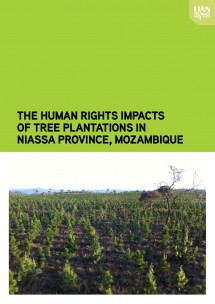
This study investigates the impairing of the rights of peasant communities through the establishment of tree plantations in Niassa province, Mozambique. More particularly, it looks at the impacts of the operations of Chikweti Forests of Niassa on the local population in the districts of Lago, Lichinga and Sanga.
In order to do so, it presents an introductory chapter on the general context of Mozambique and the legal framework. This legal framework will serve as a basis on the analysis of the findings of this study using a human rights approach. It contains an overview of national and international provisions relevant to the case. This includes Mozambican national legislation and policies, as well as standards under international human rights law. Regarding the latter, it puts a particular focus on extraterritorial obligations (ETOs), recently clarified by the Maastricht Principles on Extraterritorial Obligations, and includes provisions related to access to land and related resources, as contained in the Voluntary Guidelines on the Responsible Governance of Tenure of Land, Fisheries and Forests.
After this general chapter, the study will analyze large-scale investment in Mozambique with a particular focus on forestry projects. In this context, special attention will be given to the promotion of tree plantations by the Mozambican government and the donor community. A description of the development of tree plantations in the province of Niassa will then be followed by the analysis of a particular investment project, namely the establishment of eucalyptus and pine plantations by the company Chikweti Forests of Niassa. Finally, this study contains a set of recommendations to the different actors involved in the impairing of the rights of peasant communities.
The study is largely based on an investigation carried out by the Mozambican National Peasants’ Organization, UNAC (União Nacional de Camponeses), the results of which have been published in the report Estudo de Caso sobre o Impacto da Aquisição de Terras em Grande escala para a Produção de Monoculturas (Eucalipto e Pinho) pela Chikweti Forests of Niassa in May 2012. This report is largely based on field research in Niassa province. The information was gathered through individual and focus group interviews with focal groups with members of local communities in the districts of Lago, Lichinga and Sanga, as well as through interviews with other stakeholders, including authorities at provincial and district levels, the company Chikweti Forests of Niassa, Malonda Foundation and civil society organizations (CSOs): União Provincial dos Camponeses de Niassa (UPCN), Rede das Organizações para o Ambiente e Desenvolvimento Sustentável (ROADS), União dos Camponeses e Associações de Cooperativas (UCA) e Associação Rural de Ajuda Mútua (ORAM). The investigation also included the analysis of all relevant documents, and especially of relevant laws and regulations.
Further information for the present study was gathered during a field visit by FIAN International to Niassa in May/ June 2012. Additional research has been done by FIAN Netherlands and the Transnational Institute (TNI), FIAN Norway, FIAN Sweden and IGO from Poland.
Pages: 44