
Systems Overload Drug Laws and Prisons in Latin America
An unprecedented one-year comparative study on the impact of the drug laws and prison systems in eight Latin American countries – Argentina, Bolivia, Brazil, Colombia, Ecuador, Mexico, Peru and Uruguay – reveals that drug laws have contributed to the prison crises these countries are experiencing. The drug laws impose penalties disproportionate to many of the drug offenses committed, do not give sufficient consideration to the use of alternative sanctions, and promote the excessive use of preventive detention.
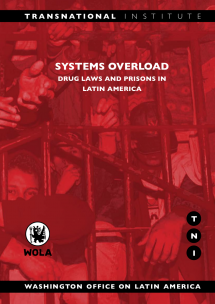
Study reveals alarming pattern in imprisonment for drug crimes in Latin America
The weight of the law falls on the most vulnerable individuals, overcrowding the prisons, but allowing drug trafficking to flourish
Depriving a person of his or her liberty is one of the most formidable powers of any state. The way in which states exercise this power, striking a balance between the duty to guarantee public safety and the obligation to respect fun- damental human rights, is of the utmost importance. The operation of the justice system has repercussions for society as a whole.
The so-called “war on drugs” waged in the last four decades has had an enormous impact on the workings of national justice and prison systems in Latin America. In order to identify these impacts more specifically, the Transnational Institute (TNI) and the Washington Office on Latin America (WOLA) brought together a group of experts from eight Latin American countries to examine the human costs of current drug laws, identifying who is behind bars and the repercussions of incarceration for them, their families, and their communities.
This report covers the situation in Argentina, Bolivia, Brazil, Colombia, Ecuador, Mexico, Peru, and Uruguay, summarizing the results of the research team’s findings on the relationship between drug legislation and the prison situation in their respective countries. In all these countries, the emphasis placed by drug control efforts on criminal sanctions has given rise to a significant increase in the number of persons incarcerated for drug offenses. The enforcement of severe laws for drug offenses has not only been ineffective in curbing the production, trafficking, and consumption of illicit substances, but has generated enormous negative consequences, including overwhelming caseloads in the courts, overcrowding in the prisons, and the suffering of tens of thousands of persons behind bars for small-scale drug offenses or simple possession. The weight of the drug laws has been felt with greater force among the most disadvantaged and vulnerable sec- tors of society.
Each country study offers an overview of the historical development of the legislation and of the current drug laws, as well as a description of the institutional structures responsible for enforcing drug laws and managing the prison system. Each study also analyzes the available data on the prison situation – including the levels of overcrowding – and the characteristics of the prisoners themselves, including socioeconomic status, the percentage of inmates behind bars on minor charges and the number of large- scale traffickers, and the percentage incarcerated for simple possession or use.