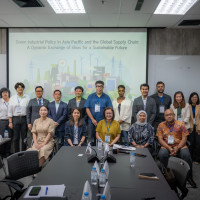
Green Industrial Policy and the Global South – Challenges and Opportunities in the BRICS Countries Workshop report
The event “Green Industrial Policy and the Global South – Challenges and Opportunities in the BRICS Countries” took place on July 3–4, 2025, at the Union of Engineers of Rio de Janeiro, bringing together researchers, government representatives, trade union leaders, and civil society organizations. The initiative was jointly organized by the Rebrip Industry Working Group, the Transnational Institute (TNI), Transforma (Unicamp), and the Institute for Strategic Studies on Oil, Natural Gas, and Biofuels (Ineep).
Article de


Report
The central objective of the meeting was to deepen collective reflection on how countries of the Global South—particularly the BRICS+—can develop green industrial policies that reconcile economic development, environmental sustainability, and social justice.
The opening session featured remarks by Gonzalo Berrón, from the TNI, who emphasized the importance of building strategic thinking from the Global South and the opportunity represented by the BRICS+ for the formulation of new political agendas. He was followed by Daniel Chavez, coordinator of the TNI Green Industrial Policy Lab, who presented the conceptual foundations of Green Industrial Policy (GIP), defining it as a set of public policies aimed at reorienting productive structures toward sustainable and sovereign models. Chavez highlighted that the global energy transition is taking place amid multiple crises—economic, environmental, and geopolitical—and that Southern countries face higher costs and more limited access to green technologies and patents, which reinforces the need for their own strategies.
The first discussion block focused on the analysis of the global economic situation and BRICS+ initiatives.
Adhemar Mineiro, from Rebrip, discussed the bloc’s trajectory since its creation as a reaction to the postwar international order and highlighted its growing internal heterogeneity. He pointed out that, although expansion toward BRICS+ has taken place with little transparency, it reflects the Global South’s search for greater global prominence. Mineiro also noted that Brazil’s priorities within the group involve reforming global governance, promoting financial cooperation, advancing the energy transition, and deepening regional integration—yet there are both political and structural limitations to their implementation.
Next, Pedro Rossi, from the Global Fund for a New Economy, analyzed the transition of global capitalism and the difficulties faced by Latin America and Africa within globalization. In his view, the BRICS+ represent a space for experimentation and transformation, especially amid the crisis of neoliberalism and the rise of right-wing alternatives. Rossi argued that green industrial policy must go beyond a purely technological agenda and incorporate reflections on development, sovereignty, and inequality.
Felipe Antunes, from the IMF, underscored the challenges facing Brazil’s presidency of BRICS+, including integrating new members and strengthening the bloc as a defender of multilateralism. He mentioned concrete advances, such as joint declarations on taxation and IMF reform, while also pointing to the need for stronger political coordination. Ticiana Alvares, from Ineep, added that the crisis of unipolar hegemony and global value chains opens space for multipolarity, of which BRICS+ is an expression. For Brazil, she defended the recovery of productive autonomy and the use of the energy transition as a development instrument, considering the country’s already diversified energy matrix.
The ensuing debate brought together specialists such as Giorgio Romano Schutte, Loricardo de Oliveira, Agamenon Oliveira, Mayra Juruá, and others, who converged on the view that Brazil must formulate a consistent national project capable of linking regional integration, energy sovereignty, and industrial policy. The internal asymmetries within the bloc and the need to strengthen the State’s role as the coordinating agent of public policies were also emphasized.
The second block focused on the analysis of green industrial policies in Brazil.
Felipe Machado, from the Ministry of Development, Industry, Commerce, and Services (MDIC), presented the New Industry Brazil (NIB) plan, which reinstates sustainability as a guiding principle and adopts missions aimed at addressing social and environmental challenges. He listed measures such as the More Production Plan, green economy funds, the MOVER sustainable mobility program, and the Brazilian Emissions Trading System (SBCE). According to Machado, these actions, though limited, mark a resumption of state protagonism and open room for new forms of financing and technological innovation.
Elias Jabbour, from UERJ, discussed the importance of understanding industrial policy as the outcome of political and ideological choices. Comparing the Brazilian and Chinese models, he emphasized the central role of the State and public enterprises in coordinating development and innovation. For him, Brazil still operates under strong financialization, which restricts its ability to plan and invest in strategic sectors.
José Sérgio Gabrielli, from Ineep, addressed the energy transition in BRICS countries, highlighting the diversity of profiles among them and their different degrees of dependence on fossil fuels. He noted that, in Brazil’s case, the focus should be on renewable fuel consumption chains rather than solely on production, capitalizing on the country’s already high renewable energy rate.
The subsequent debate addressed issues such as energy sovereignty, institutional strengthening of the State, and the risks of financializing climate policies. It was emphasized that the green transition should serve as a tool for reindustrialization, not technological dependence, and should be articulated with development, labor, and innovation policies.
The third block, focused on strategies and public policy actions, explored how the State can take advantage of the opportunities presented by the BRICS+ context.
Daniel Chavez, from the TNI, structured his intervention around three pillars of Green Industrial Policy: the reduction of polluting industries, production oriented toward the public interest, and the promotion of global ecological justice. For him, the green transition in the Global South requires targeted credit policies, the strengthening of public services, and the reorientation of financing through development banks.
Fernando Amorim, from Rebrip, argued that sustainable finance must be subordinated to state strategy and that the BRICS Bank (NDB) should play a catalytic role in the transition, going beyond the traditional multilateral bank model.
André Tokarski, from Ineep, presented a critical analysis of national instruments such as MOVER and the carbon market, noting that the former remains limited to the automotive sector and the latter risks reproducing neocolonial logics. He called attention to the lack of integration between the NIB and state-owned companies, particularly Petrobras, and defended the strengthening of the national science and innovation system.
Verena Hitner, from the Ministry of Science, Technology, and Innovation (MCTI), emphasized the political costs of coordinating GIP in Brazil and the importance of building a future-oriented vision that ensures social legitimacy for public policies. She also highlighted that technological and digital sovereignty constitute a new strategic axis and that sectoral planning must be replaced by participatory and integrated planning.
The final debate of the block reinforced the perception that the absence of a national development project is the main barrier to industrial policy in Brazil. Participants such as Suzana van der Ploeg and Gabrielli pointed out that both the State and society remain excessively dependent on the private sector, even in the production of knowledge and innovation. There was consensus that technological transformation must serve workers and the public interest, requiring minimum pacts and social cohesion.
The fourth and final block focused on civil society strategies to influence the debate on green industrial policy.
Graciela Rodriguez, from Rebrip, analyzed the Brazilian and global political context, describing it as adverse and fragmented. She defended the need to rebuild social cohesion and collective awareness in the face of digital networks’ influence and the rise of the far right. She proposed that issues such as shorter working hours, the appreciation of free time, gender and racial equality, and regional integration should be at the center of industrial policy.
Iago Montalvão, from Transforma, emphasized civil society’s role in elevating the level of public debate and disputing narratives. He suggested that the group gathered at the event could help bring industrial and ecological issues back to the center of the national agenda and address the relationship with the productive sector and the role of the State.
Gonzalo Berrón, from the TNI, highlighted the importance of developing a new theory of development from the Global South, capable of articulating strategic thought and public policy.
During the closing session, participants presented recommendations and proposals for continuing the discussions.
Soniamara Maranho, from the Movement of People Affected by Dams (MAB), stressed the need to resume grassroots political education and to build an international policy of solidarity and sovereignty.
Fernando Amorim presented the project “International Trade, Regional Integration, and Reindustrialization in the Context of Climate Change”, developed by Rebrip’s Industry Working Group, which aims to strengthen regional production chains and discuss the role of critical minerals.
Felipe Araújo, from Senge-RJ, advocated for building popular sovereignty from the grassroots, for Latin American integration, and for reestablishing the State’s role as a planner. Other participants, including Giorgio Romano, Loricardo de Oliveira, Cristiane Tiemi, and Jorge Saraiva, reinforced the importance of political education, student engagement, and the strengthening of popular communication.
The event concluded with consensus on the urgency and complexity of the green transition in the Global South. It became evident that the challenge goes beyond technological or economic dimensions—it is fundamentally political. Discussions underscored the need for a national sustainable and sovereign development project that aligns the State, society, and the productive sector, overcoming financialization and prioritizing public benefit over private interest. The strengthening of South–South cooperation, particularly within the BRICS+ framework, was recognized as a strategic path toward building alternatives and enhancing Brazil’s agency.
In summary, the meeting highlighted that the construction of a transformative Green Industrial Policy depends on a broad social pact, coordinated state planning, and a long-term vision combining productive autonomy, social justice, and environmental sustainability. The recognition of the interdependence between politics, economy, and ecology—alongside the emphasis on social participation and regional integration—forms the foundation upon which a new development paradigm can be built from the Global South.

Summary
1. Introduction and Objectives
The event brought together academics, trade unionists, policymakers, and civil society representatives to discuss Green Industrial Policy (GIP) strategies in Global South countries—particularly within the BRICS+—with the goal of integrating sustainable development, social justice, and ecological transition.
2. Global Context and BRICS+
The first discussion block addressed transformations in the world economy and the role of BRICS+ in this scenario.
Adhemar Mineiro emphasized the bloc’s counter-reformist nature in response to the post–World War II global order and its potential as an alternative platform, despite internal asymmetries.
Pedro Rossi argued that the green transition requires a rethinking of the development model and that BRICS+ could offer a transformative path amid the global capitalist crisis.
Felipe Antunes underlined that Brazil’s presidency seeks to strengthen multilateralism and consolidate the bloc’s governance.
Ticiana Alvares pointed out the crisis of multilateralism and the urgent need to rebuild Brazil’s autonomy and productive self-sufficiency.
The debate highlighted that Brazil needs a clear national project, stronger regional integration, and internal alignment on its development goals. Internal asymmetries within BRICS+ and Brazil’s lack of political coordination were viewed as central obstacles.
3. Green Industrial Policies in Brazil
The second block focused on New Industry Brazil (NIB) and the role of the State.
Felipe Machado (MDIC) presented recent policies incorporating sustainability, such as the Plano Mais Produção (More Production Plan), the Critical Minerals Fund, the MOVER program, and the Brazilian Emissions Trading System (SBCE). These measures, though still limited, signal a renewed appreciation for state intervention.
Elias Jabbour (UERJ) compared the Brazilian model to the Chinese one, advocating for a strategic and planned State while criticizing the persistence of financialization.
José Sérgio Gabrielli (Ineep) analyzed the energy transition among BRICS countries, highlighting Brazil’s unique situation—with a predominantly renewable energy mix—and argued for focusing on renewable fuel consumption chains rather than merely on production.
During the debate, participants stressed the need for energy sovereignty, state strengthening, and the fight against the financialization of climate policy. The green transition must serve national development rather than perpetuate external dependencies.
4. Public Policy Strategies and Actions
The third block addressed state instruments and strategies for the Global South.
Daniel Chavez (TNI) defined Green Industrial Policy as a response to the ecological and social limits of the Northern model, structured around three pillars:
(1) reducing environmentally harmful industries,
(2) producing for public benefit, and
(3) achieving global ecological justice.
Fernando Amorim (Rebrip) argued that BRICS+ financial governance must be restructured to prioritize sustainable development, with a catalytic role for the BRICS Bank (NDB).
André Tokarski (Ineep) critically assessed initiatives like MOVER, the carbon market, and the lack of integration between NIB and state-owned enterprises such as Petrobras.
Verena Hitner (MCTI) emphasized the need for a national plan with social legitimacy and a digital and technological sovereignty agenda.
The discussions underscored the urgency of an articulated national vision that aligns the State, science, and society around a sovereign development project.
5. Societal Strategies and Social Cohesion
The final block brought together representatives from civil society.
Graciela Rodriguez (Rebrip) warned about social fragmentation and the role of digital networks in political demobilization, calling for renewed social cohesion and proposing concrete measures such as:
- valuing labor and reducing working hours;
- incorporating gender and race equality into industrial policies;
- strengthening regional integration and a sovereign foreign policy.
Iago Montalvão (Transforma) stressed the need to radicalize public debate and build a national project linking labor, ecology, and industry.
Gonzalo Berrón (TNI) concluded that progressivism in the Global South must develop a new theory of development, capable of integrating strategic thinking and transformative public policy.
6. Final Recommendations
The closing session presented practical actions and collective pathways.
Soniamara Maranho (MAB) proposed reviving popular political awareness and drawing inspiration from China’s long-term planning strategy.
Fernando Amorim (Rebrip) presented a project on regional integration, reindustrialization, and critical minerals.
Felipe Araújo (Senge-RJ) advocated for popular sovereignty from the grassroots and South American integration as strategic priorities.
Other participants—including OPEB, CNM-CUT, and the Tricontinental Institute—suggested engaging youth, workers, and grassroots communication networks in public policy formulation and narrative-building.
7. Conclusions
The event consolidated a common diagnosis:
- The green transition is political before it is technical.
- The Global South must design its own GIP, centered on sovereignty and social justice.
- Brazil needs a national sustainable development project that unites the State, society, and the productive sector.
- South–South cooperation and Latin American integration are fundamental.
- It is essential to overcome financialization and prioritize public benefit over private interest.
In summary, the conference reaffirmed that the central challenge is to formulate a long-term strategic vision for green development in Brazil and the Global South, based on productive autonomy, state planning, democratization, and social cohesion.
Building a transformative Green Industrial Policy requires a broad social pact, coordinated state action, and a long-term perspective combining economic independence, social justice, and environmental sustainability.
Recognizing the interdependence between politics, economy, and ecology—and emphasizing social participation and regional integration—lays the foundation for a new development paradigm emerging from the Global South.
Creditos
Autores
Mas como esto
-
Fecha de publicación:
-
Green Industrial Policy in Asia Pacific and the Global Supply Chain A Dynamic Exchange of Ideas for a Sustainable FutureFecha de publicación: