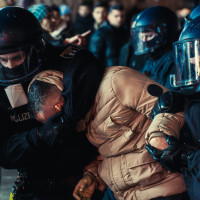
Gaza as a Line of Truth How Media, Civil Society, and the Political Left Became Complicit in Repressing Palestine Solidarity in Germany
Regiones
The final part in the Solidarity under Siege series, this longread examines how Germany’s media, NGOs, and political left responded to Gaza; not with resistance, but complicity. Through repression, silence, and smear campaigns, Palestine solidarity became a defining fault line exposing the contradictions of Germany’s progressive institutions.
Longread de


Credit: Faisal Yassin
We are not welcome in the German spaces. We’ve seen that when there was the largest anti-racist demo, and there was a block against AfD, and there was supposed to be a bloc for Palestine, we were kicked out. And we were also kicked out from the queer demos years ago. Just to speak as queers against the Pinkwashing of Palestine, or speak about Palestine with the environmental movement against greenwashing of settler colonialism in Palestine, this was not allowed.
The moment you bring Israel into any topic, you’re out. The moment you start to become anti-Israeli policies – and anti-genocide, anti-colonial regimes and anti-apartheid – or speak about it, you’re out. This tells a lot about how Palestine became kind of the line between right and wrong, the line between: are you human or are you evil? Are you part of the orientalist, or are you part of those who are decolonising? Yeah, it is Palestine that became not only the line of truth, but a litmus test of our shared humanity and our individual and collective commitment to the ongoing struggle for liberation.
Majed
In the aftermath of 7 October, institutions typically associated with liberal democratic values, such as university leaders, certain sections of the press, the left-leaning political establishment and even the climate justice and other civil society movements, have been largely silent on Israel’s genocide in Gaza and failed to resist Germany’s authoritarian shift. Worse, in many cases they have actively enabled it. This longread is based on research conducted up to the autumn of 2025, with minor updates integrated around the date of publication.

Credit: Faisal Yassin
The role of the Media: Manufacturing Consent for genocide abroad and repression at home
- Start Portrait: Hebh Jamal, Palestinian journalist and activist -
On 7 October, there was this video that I made basically trying to counter a lot of the German narrative and specifically also state that I think military resistance against Israeli military infrastructure is protected by international law. I said decolonization is necessary. They attempted to criminalize me over these statements and because I said, ‘From the river to the sea, Palestine will be free.’
I, of course, fought back and I actually won. So, the prosecutor completely dropped the charges. But that also doesn't matter because even though what I said was completely legal, the political elite in every single newspaper, like the BILD, thinks that they could call me a Jew hater, Israel hater, which they did just the other day.
And even the Anti-Semitism Commissioner of the German state of Hessen has this whole campaign against me, basically comparing me to a Nazi on his social media. There's absolutely no political nuance. It just doesn't matter. It doesn't matter if what you say is legal, it doesn't matter if what you say can be contextualised.
German broadcasters that are writing in English have a very different terminology than German broadcasters that are writing in German. If you look at Deutsche Welle English and Deutsche Welle in German – it's almost a completely different department, completely different news organization. And I think that's intentional. It's almost as if people don't really know, want people to know what's going on inside this country and what people are telling each other.
- End PORTRAIT -
Language has power. Much has been written about how German outlets have played a direct role in manufacturing consent for a genocidal war by consistently minimising the genocide and the violence inflicted upon Palestinians. Israeli state narratives are treated as default truths, while Palestinian testimonies are doubted, framed as extremist, or simply ignored. The deaths of Palestinian children are buried beneath euphemisms, the killing of 250 Palestinian journalists and media workers (as of January 2026)1 is met with little solidarity from their German counterparts.
This double standard extends deeply into domestic politics. Antisemitism accusations are used as a rhetorical weapon to discipline public discourse, silence Palestinian voices, and stifle solidarity. While this tendency was clear in the media long before 7 October 2023, it was not always this pronounced. As traced by Samantha Carmel,2 until the 1980s, it was still possible in West Germany to support Palestinian self-determination and present that support as a moral lesson drawn from the Holocaust. Politicians like former Chancellor Helmut Schmidt and journalists like Spiegel founder Rudolf Augstein openly criticised Israel’s policies without repercussions for their career.3 Augstein, for example, warned against unconditional support for Israel and insisted that past Jewish suffering could not justify present-day Israeli violence against Palestinians.4 Today, such statements would be unthinkable in mainstream German media. It has become nearly impossible to apply universal moral lessons from Nazi crimes to Israel, since the Holocaust is framed as an exceptional crime that – by definition – can never be repeated.
The first two and a half years of the genocide have shown that Germany’s media are systematically eroding journalistic standards. This is the case not only for right-wing outlets but also for those perceived as mainstream or even left-leaning. They have engaged in doxxing and smear campaigns, racialisation and ‘othering’ of Palestinians, Arabs and Muslims, casting Palestinians and their allies as the threat, and the state that bombs, occupies, and kills as the victim. In so doing, they justify and sustain the political repression against genocide opponents, and fuel anti-Palestinian and anti-Muslim racism.
Axel Springer
The Axel Springer media empire, owner of outlets like the widely read right-wing tabloid Bild as well as WELT, Politico Europe, and Berliner Morgenpost, plays a central role in normalising anti-Palestinian repression and criminalising dissent in Germany. Springer’s commitment to the Israeli state is structurally embedded in the company. One of its five mission statements, further sharpened following 7 October, explicitly supports ‘Israel’s right to exist’ (while other countries are not mentioned),5 and its CEO Mathias Döpfner has gone even further. In a now-infamous leaked quote published by Die Zeit, Döpfner summarised his political worldview with the phrase ‘Zionismus über alles’ (Zionism above everything else). This echoes the banned Nazi slogan ‘Deutschland über alles’ (Germany above everything else).6
The Green MP Jürgen Trittin even praised Springer’s rigid stance, calling for similar alignment across all publishing houses and political parties. His declaration blurred the line between media independence and state propaganda, which prompted Germany’s journalists’ union (DJV) to issue a warning against political interference in press freedom.7
The racist portrayal of the Barbakh family in the media
The impact of Springer’s ideology can be felt across German media, particularly in the case of the Barbakh family, a group of Palestinian refugees from Gaza living in Berlin who in 2024 and 2025 were the target of an extended smear campaign because of their political activism.8 For months, major German outlets – including WELT, Bild, Focus, and the Berliner Zeitung – routinely depicted the family as a dangerous ‘Gaza clan’,9 using racialised language and othering to paint them as violent, foreign, and inherently criminal. Rather than focusing on verified facts, articles made sweeping claims, suggesting links to Hamas or portraying the family as a threat to Berlin, with little or no substantiation.10 This dehumanising coverage included the publication of a video showing the arrest of a 16-year-old family member, with WELT claiming that the family ‘makes no secret of their hate for Israel’.11 The reports drew serious concern from media watchdogs and human rights groups. Berliner Zeitung journalist Carola Tunk was accused of repeatedly contacting a minor from the Barbakh family via social media, without parental permission and despite the child clearly stating that he did not wish to speak with her.12 She reportedly stalked him digitally and physically, sent him personal questions and tried to locate his whereabouts. This violates both the German Press Code (Pressekodex) and the UN Convention on the Rights of the Child.13 Despite this, Berliner Zeitung published content identifying the minor by name and associating him with the sensationalised label ‘Gaza Mohammed’, referring to him as the ‘star of the Pali scene of Neukölln’,14 language that reinforces racialised stereotypes and strips him of individual dignity. On 18 March 2025, the German Press Council found that a BILD article violated the German Press Code by publicly identifying some of the family members.15
This media harassment feeds directly into a wider system of state repression and deportation threats. Several members of the Barbakh family, including minors, have reportedly been issued with deportation notices by German immigration authorities.
Springer outlets have also targeted political activists and public servants. Elisa Baş, a young climate justice activist and spokesperson of Fridays for Future, was vilified by Bild and other Springer outlets for sharing someone else’s criticism of Josef Schuster, the head of the Central Council of Jews in Germany, in her Instagram story.16 Schuster, in a guest commentary for Bild, had described Palestine supporters as ‘barbarians among us’ and said that ‘something must happen’.17 Unlike hundreds of Palestine supporters, he was never charged with incitement.
Springer media has also contributed to the public shaming and professional downfall of Melanie Schweizer, a former civil servant and advisor in the German Ministry of Labour and Social Affairs, as well as former parliamentary candidate for MERA25.18 She was dismissed after Bild ran a smear campaign against her, accusing her of ‘hatred of Israel’ based on social media posts criticising Israel’s military actions in Gaza. She was never contacted for comment, and her posts, many of which were not even public, did not breach any laws.19
ARD
In October 2023, a leaked internal memo from Germany’s largest public broadcaster ARD, whose nightly news programme Tagesschau reaches almost 10 million viewers or 12% of the German population, revealed detailed instructions for reporting on Israel’s war on Gaza.20 Journalists were advised to avoid phrases like ‘escalation’ or ‘spiral of violence’ that might contextualise Hamas’ attacks, and instead adopt terminology aligned with Israeli state framing. An internal ARD glossary dated 18 October 2023 instructs journalists to avoid terms like ‘Hamas fighters’, mandating instead the use of ‘terrorists’.21 The document goes further by categorising any comparison between Israel’s actions in Gaza and the Holocaust, or even referring to Israel as a colonial power, as antisemitic.22 Furthermore, ARD stated that the chant ‘From the river to the sea, Palestine will be free’ is a criminal offence, incorrectly claiming it calls for the ‘annihilation of Israel’.23
In November 2024, after a football match between Dutch Ajax and Israel’s Maccabi club in Amsterdam, Maccabi supporters rioted in the city, chanted anti-Arab slogans, attacked a taxi driver, tore down Palestinian flags, and thus provoked violent clashes with local residents.24 International media coverage framed the incident primarily as an antisemitic attack or even ‘pogrom’ against Israeli football fans, ignoring eyewitness reports and video evidence that revealed a very different picture.25 The Dutch photographer Annet de Graaf, who filmed Maccabi supporters attacking a Dutch person, later discovered that Tagesschau was one among many news channels that had used her video out of context, misrepresenting the sequence of events to portray Maccabi fans as the victims rather than the aggressors.26 Following public pressure, Tagesschau issued a rare public apology to de Graaf, acknowledging the misuse of her footage but never explaining to its audience what it actually showed. It instead replaced the video with a different one without changing the biased reporting.27
Other media outlets
Der Spiegel, a popular weekly with a long tradition of shaping political opinion, has likewise contributed to the smearing of Palestinian solidarity.28 A 2024 protest by 85 students at Berlin’s FU was surrounded by an equal number of journalists. Among the deluge of inflammatory coverage, a Spiegel TV segment stood out for its misleading and dangerous rhetoric. It falsely framed the protest as ‘against Jews’,29 while ignoring the fact that several Jewish students had co-organised and spoken at the event against genocide. The video zoomed in on one queer student’s personal Instagram, showing a swimsuit photo and publishing his account name, an act that led to right-wing harassment and threats. The student's Jewish identity was omitted from the reporting.30
In December 2024, internal whistle-blowers at Deutsche Welle (DW) exposed a culture of pro-Israel bias and open hostility to Palestinian perspectives.31 At least 13 staff members and freelancers reported being targeted for their political views.32 Internal documents reportedly include ‘comebacks’ for anchors to use during live interviews with ‘pro-Palestinian voices’, including instructions on how to deflect or challenge any mention of Israeli war crimes. A spokesperson from Deutsche Welle, responding to this research, said “We emphasize that our programs meet journalistic standards of plurality, impartiality and unbiased reporting. In accordance with our law, our programs as a whole must enable viewers to form their own opinions independently and must not show any bias in favor of any party or other political association, religious community, professional group or interest group. We regularly review our programs against these standards and correct our content if necessary.”
On 1 March 2024, the day after Israeli soldiers opened fire on around 1,000 starving Palestinians attempting to get food for their families,33 the mainstream Berlin regional daily Tagesspiegel, which has been ranked as the highest quality regional paper in the country,34 published an article that smeared two Berlin-based pro-Palestinian activists. It falsely portrayed them as inciters of violence and antisemitism by quoting statements about Palestinian self-defence out of context.35 The article pits them against so-called ‘moderate’ activists and dangerously includes their full names, faces, and workplaces, exposing them to potential harassment. In response, activists launched the ‘Doxxing is not Journalism’ campaign, protesting outside Tagesspiegel’s Berlin.36
Even taz, a daily newspaper often associated with progressive politics, failed to uphold journalistic principles when covering Gaza. On 9 March 2025, when more than 48,000 Palestinians had been killed by Israeli attacks,37 it published an op-ed titled ‘The Power to Define Genocide,’ in which the author claimed that accusations of genocide against Israel were ‘baseless’ and driven by ‘anti-Israel sentiment’. The piece dismissed reports from Gaza as emotional manipulation, argued that the civilian death toll was Hamas's fault, and concluded that only Hamas could be accused of genocidal intent.38

Credit: Faisal Yassin
Silence and ignorance: NGOs, the climate movement and other movements
Anything that gets state funding in Germany and expresses support for Palestine in a way that could really make any change could be entirely defunded. And it’s unfortunately very difficult for ordinary Germans to disagree because at the end of the day, it’s going to be their jobs, it’s going to be where they go to work and where they go to school and where they go to university. So where are the spaces for them to express dissent or support there? There isn’t an infrastructure to do that unless they’re on the streets, and unless they are paying attention and consume international media.
Hebh Jamal
Before 2023, Germany's climate justice movement had gained international visibility for its mass mobilisations and civil disobedience campaigns. But while climate groups speak the language of justice and global solidarity, many of them failed or refused to show solidarity with Palestinians facing environmental destruction, settler colonialism, and now, genocide.
As bombs rained down on Gaza in late 2023 and early 2024, killing tens of thousands of Palestinians, most of Germany’s best-funded, most-visible climate groups remained silent. Nowhere was this more visible than in the split between Fridays for Future Germany (FFF Germany) and its international parent organisation. After Greta Thunberg publicly posted a photo of herself holding a ‘Stand with Gaza’ sign,39 and Fridays for Future International shared statements referring to genocide and apartheid in Palestine, German media and political actors responded with predictable outrage. The German Environment Minister Steffi Lemke condemned the statements as ‘unspeakable’40 and damaging to the climate movement. Luisa Neubauer, the public face of FFF Germany, quickly distanced herself from Thunberg, expressing ‘disappointment’ that she had not said ‘anything concrete about the Jewish victims’ of 7 October.41 FFF Germany’s official account posted that it did not share the views of its international counterpart and declared that the international account ‘does not speak for us’.42 In the movement in general – with exceptions of some more progressive local groups –, discussions about Palestine were routinely been avoided, postponed, or outright blocked. However, the consistent movement-internal advocacy, especially by activists of Colour or migrants, means that the discourse in the movement has slowly shifted. In an interview from December 2025, Neubauer said that it was a mistake, that FFF Germany had refrained from “further highlighting Palestinian suffering”.43
Many German climate NGOs have close ties to political parties, particularly the Greens, and depend on public funding. This creates structural disincentives to take controversial positions on foreign policy or human rights issues, especially when they involve Israel and Palestine. The effect has been a narrowing of what it is politically acceptable to say, and a depoliticisation of climate discourse itself. Instead of challenging root causes of the climate crisis such as militarism, colonialism, or extractivism, much of the German climate mainstream remains focused on technical solutions and market reforms.
Nevertheless, this depoliticisation has prompted the emergence of alternative climate groups, particularly since 7 October 2023. Many of these are led by Black, Indigenous, and People of Colour (BIPOC), and explicitly frame climate justice as inseparable from anti-racism and anti-colonial struggles. Groups such as BIPOC 4 Future, Debt for Climate, and Klima4Palestina have organised separate events, protests, and climate strikes that incorporate Palestinian solidarity as a core principle.
The marginalisation of Palestinian solidarity was not confined to the climate movement; it extends across Germany’s broader progressive and left-liberal spaces, including union-led protests, anti-austerity coalitions, and even anti-racist and anti-fascist campaigns. While many of these initiatives claim to stand for social justice, anti-racism, or intersectional values, their handling of Palestine often exposed deep contradictions.
One example is the Unkürzbar protest held in Berlin on 22 February 2024. Organised by the Berlin branch of the public service union ver.di under the slogan ‘Berlin ist unkürzbar – Umverteilung jetzt!’ (‘Berlin is uncuttable – Redistribution now!’), the protest was framed as a response to sweeping cuts in sectors such as education, social work, culture, and mobility. However, when demonstrators attempted to highlight how these austerity measures are embedded in a broader authoritarian trend that includes censorship of Palestine solidarity and escalating militarisation, their presence was met with resistance and repression.44
While Germany has witnessed significant mobilisations against the far-right AfD, these movements have often marginalised or excluded pro-Palestinian voices. In January 2024, mass demonstrations erupted across Germany in response to revelations about a secret high-level meeting with right-wing politicians discussing mass deportations. These protests, drawing hundreds of thousands, were framed as defending democracy and pluralism. However, what was glaringly absent was a clear expression of solidarity with those currently most targeted by racist policies and practices: people of colour standing in solidarity with Palestinians.45 While one protest specifically listed antisemitism as a form of racism to be opposed, it did not mention Islamophobia, despite the fact that Muslims, together with migrants of Colour, are the main targets of the AfD, which is also staunchly pro-Israel.46 One person commented later: ‘After the nationwide anti-fascism demos, while white people were congratulating each other, Arabs were checking on each other. Business as usual’.47
NGOs
---Start Portrait: Elias,48 working in a left-leaning German climate NGO---
When 7 October came, they didn’t say anything about it – just general silence – and they found it very difficult to speak up, or, I would say, took a somewhat anti-Deutsch or Zionist stance in expressing solidarity with Israel. It really reinforced the impression that this is a German organisation that has its own line – and that their own survival and existence are more important to them than taking a strong position or standing up for their values, or even showing that there are any values at all that have to do with climate justice and solidarity and the kinds of things they normally pride themselves on.
A very popular argument was also that if you speak out on this issue – on ‘the conflict,’ as it was always called (never war, never occupation, never apartheid – those words were always completely avoided to create some kind of distance and the illusion that we are dealing with two equal sides) then you would have to speak out on every conflict in the world. So, the uniqueness of this conflict in relation to colonialism simply wasn’t recognised. I think this also reveals a certain complicity in the genocide, because it shows that, somehow, there seems to exist the right in German society not to be informed, or a special right to look away – and in doing so, to help the ‘Jewish people’, or the state of Israel.
Whenever statements on Palestine are being drafted, the people involved were dragged into year-long internal processes. There is always something deemed more important, and the issue keeps being postponed, with endless excuses for why it cannot be addressed. In organisations that are almost entirely white, it feels as if is barely any empathy for those directly affected by the violence. The normalisation of war and death in these regions creates a major barrier for anyone attempting to show solidarity.
This is scary, especially given that the same German characteristic of looking away helped silence people during the Nazi rule and instead blame the victims. The media tell people what to think. And at some point you start feeling like you’re the crazy one when again and again you tell people that they should get their information elsewhere.
---End of Portrait---
Palestinian solidarity work in Germany has also faced obstacles from various sectors of the organised civil society. This includes NGOs that now operate under growing pressure to distance themselves from anything deemed critical of Israel as not to lose state funding. As a result, many adopt vague or overly restrictive policies that effectively silence Palestinian voices.
It seems unlikely that this could save them anyway: Chancellor Friedrich Merz, the leader of Germany’s CDU, has taken steps that could affect NGO funding. In February 2025, Merz's CDU/CSU parliamentary group submitted a comprehensive inquiry to the federal government, consisting of 551 questions concerning the funding and political neutrality of various NGOs, including many that have taken a Zionist or no stance at all on Palestine.49
In December 2023, the German government quietly cut all federal funding to six Palestinian non-government organisations without making a public announcement or offering an explanation.50 Among the organisations was Al-Haq, a prominent Palestinian human rights group that had submitted testimony to the International Criminal Court, which later contributed to the ICC issuing an arrest warrant for Israeli Prime Minister Benjamin Netanyahu. Although Israel labelled these NGOs as terrorist-affiliated in 2021, the claims were widely rejected at the time – including by Germany and France – as baseless.51 Nevertheless, Germany now halted cooperation entirely.
Later on, Germany also quietly cut funding for the Israeli organisations Zochrot and New Profile. Zochrot, which promotes public education about the Nakba and advocates for the right of return for Palestinians, lost about a quarter of its annual budget. New Profile, a volunteer movement that supports Israeli conscientious objectors, lost about half of its total funding. While the German authorities gave no official justification for the cuts, the timing strongly suggests a link to the Bundestag’s November 2023 ‘Never Again Is Now’ resolution.

Credit: Faisal Yassin
Too little, too late: Die Linke and the Left political establishment
Just when a strong political force was most needed to oppose Germany’s complicity in genocide and the escalating repression of civil liberties, the party from which such a stance was most expected remained silent. For years, the main German left-wing party Die Linke and its affiliated Rosa Luxemburg Stiftung (RLS) have failed to uphold their claimed anti-imperialist, anti-racist, and internationalist principles whenever it comes to Palestine.52 Die Linke has often aligned itself with the broader state consensus on Israel, suppressing dissenting voices within its ranks, adopting ambiguous or conservative rhetoric, and distancing itself from Palestinian civil society demands. The RLS, a publicly funded foundation with the stated aim of supporting emancipatory politics, mirrored this silence and even contributed to marginalising Palestinian perspectives internally.53 This failure has had serious consequences: young activists of colour, anti-racist movements, and long-standing supporters of Die Linke have become increasingly disillusioned.54 The party's credibility as a force for justice and international solidarity has been gravely damaged.
After the beginning of the genocide, Die Linke’s leadership issued a one-sided statement on 11 October solely blaming Hamas for the escalation.55 Rather than correcting course as Israel’s genocidal intentions became ever more obvious, party leaders continued to clamp down on internal dissent. Co-chair Martin Schirdewan proclaimed his solidarity with Israel in a rally on 22 October, even as the death toll in Gaza mounted.56 RLS’s failures echoed those of the party. On 19 October, the Foundation posted a statement by its Tel Aviv office director that completely omitted the escalating massacres in Gaza.57 In contrast, in a leaked letter from November 2023 Palestinian staff in RLS’s Palestine and Jordan office criticised the Foundation’s ‘systematic suppression of Palestinian voices and the perpetuation of the oppressor’s narrative’.58 Expressions of solidarity were discouraged or outright banned. Even as colleagues and family members of staff were killed or displaced in Gaza, the Foundation suppressed their ability to speak.59
Pressure from progressive streams in the party to adopt stronger language calling for a ceasefire was voted down at the party conference in November,60 and their programme for the 2024 EU parliamentary elections, while condemning Russia, failed to mention Israel and Gaza.61 Christine Buchholz, a long-time MP and member of the more radical initiative Socialism from Below criticised Die Linke’s inability to take a clear stance. In an interview in January 2024, she said that the party’s position was ‘absolutely inadequate, as it tries to maintain a balance between criticism of Israel and criticism of Hamas’.62 The party, she argued, had moved away from its internationalist tradition and was more concerned with coalition-building than with principle.
In April 2024, the Linke Berlin party congress refused to pass a motion condemning the police storming of the Palestine Congress and the violent dismantling of the protest camp in front of the parliament.63 While some local Berlin branches supported the motion, the majority rejected it on procedural grounds. Prominent party figures such as former senators and parliamentary group members Klaus Lederer and Elke Breitenbach even signed the appeal of the so-called ‘Alliance against Antisemitic Terror,’ which accused the Palestine Conference of trivialising terror and of antisemitism.64 The response to these decisions was damning. Activists and party members across Germany accused Die Linke of siding with state repression, failing to defend basic civil rights, and remaining silent in the face of genocide. They argued that the party's credibility as a voice for justice and liberation had collapsed.
In October 2024, internal tensions within Die Linke’s Berlin branch reached breaking point. Prominent figures, including Lederer and Breitenbach, resigned from the party, citing irreconcilable differences over antisemitism and Israel/Palestine.65 This split followed repeated failures to resolve disagreements at the Berlin state party congress.
In December 2024, the party leadership initiated expulsion proceedings against Ramsis Kilani, a prominent Palestinian-German activist in Berlin, for allegedly bringing the party into disrepute – allegations of antisemitism based on ‘snippets from social media distorted by right-wing journalists’.66 In contrast, it took members of the party until May 2025 to formally demand the exclusion of Brandenburg’s antisemitism commissioner Andreas Büttner, a former CDU and FDP member who denied the genocide in Gaza and supported Israel’s annexation of the Golan Heights.67 In January 2024, Die Linke did condemn the German cessation of payments to UNRWA, but did so claiming that this would only make Hamas more popular.68
While the election programme for the 2025 federal elections69 did condemn Israel’s ‘brutal war crimes’ and call for the ICC warrant against Netanyahu to be implemented, this was again in a context of equating oppressor and oppressed. The programme failed to use the term ‘genocide’, instead calling it a ‘war’, at a point when even mainstream NGOs like Amnesty were using the term genocide.70
A turning point?
After the relative success of the party in the February federal elections, things seemed to shift slightly. Despite leadership repression, dissent continued to grow within the party. In March 2025, MEP Carola Rackete, who had publicly distanced herself from Greta Thunberg’s pro-Palestinian stance in November 2023, now became the first major elected German politician to use the word ‘genocide’, calling out the EU’s (but not Germany’s) complicity.71
However, since then internal fractures seem to have only deepened. The party board member Ulrike Eifler was attacked for sharing an image with the slogan ‘All united for Free Palestine’.72 The leadership pressured her to delete the post, reportedly after in turn being pressured by Bild. Eifler refused to apologise, insisting that her intent was to draw attention to the suffering of Palestinians in Gaza.
On 10 May 2025, the national party congress adopted a motion replacing the IHRA definition of antisemitism with the Jerusalem Declaration on Antisemitism (JDA) – a landmark decision. The motion also condemned the use of the IHRA definition to justify censorship, repression, and denial of funding. The Rosa Luxemburg Stiftung had criticised the IHRA definition in a 2019 report, yet it took the party until 2025 to act on this.73
Developments since have been equally schizophrenic and characterised by the ongoing struggle between a largely Zionist leadership and historic figures and progressive elements in the party’s lower ranks or local and state branches, as well as the many young activists that joined the party in recent years.74 Die Linke supported a pro-Gaza mass demonstration and finally calls the genocide what it is.75 This stands in stark contrast to the repeated revocation of critical resolutions by state branches or its youth wing76 and the expulsion of anti-colonial activists.77

Credit: Faisal Yassin
Conclusion
This longread has shown that despite presenting themselves as defenders of human rights and global justice, many German progressive movements, NGOs, and its main Left political party adopted internal policies and public positions that mirror government positions when it comes to the genocide in Palestine. The disciplining of its own members and failure to take a clear public stand created a vacuum at a moment when voices of solidarity were urgently needed, helping to normalise violence against Palestinians in Gaza and against their allies in Germany.
This took place in a broader media environment that has largely abdicated its role as a critical watchdog: Instead of questioning these repressive shifts, Germany’s media has helped to legitimise them. It has played a central role in doxxing activists, framing Palestinians and their allies as a racialised threat, and recycling unverified claims while treating Israeli state narratives as default truths. Mainstream coverage routinely erases the context of genocide, occupation, and apartheid, while domestically framing protests as ‘extremist’ and any opposition as antisemitic. Notably, this double standard is not limited to right-wing outlets, but is echoed across public broadcasters and liberal newspapers.
The consequences are tangible. As this section shows, movements have broken apart and activists have been publicly smeared; pro-Palestinian groups have been kettled at anti-austerity demonstrations or policed off the stage at anti-racist rallies; climate activists have been told not to speak about Gaza. Palestine is the threshold of acceptability even among those who consider themselves progressive.
Yet, the section also shows the cracks in this consensus. Public trust in the media is waning. Along with the slow shift in German public opinion about the genocide itself, an increasing number of citizens seem to be recognising biased media reporting. A poll conducted by the German public broadcaster NDR in August 2024 revealed that 48% of the German population expressed little to no trust in the media’s coverage of Gaza,78 while another poll by the Bertelsmannstiftung from May 2025 showed that 44% of respondents think German media coverage favours Israel, while only 7% said it favours Palestinians.79
Furthermore, new forms of organising have emerged, from BIPOC-led climate groups to radical queer blocs, that insist on refusing the division between anti-racism at home and anti-colonialism abroad. The repression described here is real and escalating, but so too is the resistance.
Creditos
Autores
This is the fifth longread in a series of five based on the Transnational Institute’s report Solidarity under Siege: Germany’s Repression of the Palestine Movement. The first part can be found here. The report draws on the insights of interviews with seven activists from the Palestinian solidarity movement, including Palestinians and German, Muslim and Jewish people, among other (overlapping) identities, who shared their trust, stories and time with the author. At their request, pseudonyms have been used for some of these activists.
Mas como esto
-
Solidarity under Siege Germany’s repression of the Palestine MovementFecha de publicación:
-
Germany’s Crackdown on Palestine Solidarity Solidarity under Siege Series: IntroductionFecha de publicación:

-
Germany’s support for the Israeli occupation and genocide Solidarity under Siege series: Part IIFecha de publicación:
-
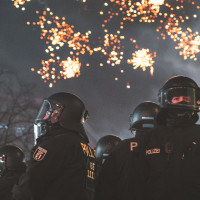
The Pillars of Repression Solidarity under Siege series: Part IIIFecha de publicación:
-
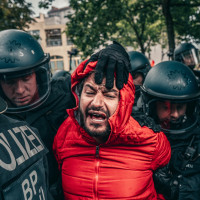
Deportable Dissent The Weaponisation of Migration Policy in Germany’s Crackdown on Palestine SolidarityFecha de publicación: