
EU Military Spending until 2027 Factsheet 1 | From ‘Peace Project’ to Arms Investor
Regiones
Discover how the European Union’s military spending has expanded dramatically in recent years, reshaping priorities, budgets, and policies across Europe. Download the factsheet for key figures, funding mechanisms, and insights into the shift from a self-described “peace project” to a major investor in defence and arms production.
Descargar PDF
At its inception, and for a long time afterwards, the European Union has been presented as a peace project, built around values like human rights and diplomacy. Before 2014 the EU budget included no dedicated military spending, although some developments had already started to chip away at that image, such as funding for ‘security’ research and off-budget instruments for military missions.
Since 2017, the EU has rapidly expanded its military role, built up new institutional infrastructure, and increased its support for the arms industry. The current seven-year EU-budget, the Multiannual Financial Framework (MFF) 2021–27, is the first to include significant military spending. The EU’s response to Russia’s full-scale invasion of Ukraine in 2022 has accelerated and broadened European militarisation, including the introduction of several ad-hoc and temporary funding instruments.
This shift comes at a price. NATO-Chief Mark Rutte openly admitted in 2025 that “spending more on defence means spending less on other priorities”, before telling the European Parliament money needs to be diverted from “pensions, health and social security systems” toward military priorities.1 But redirecting tax money into weapons will not solve the social, economic, ecological, and political crises facing Europe and the world. On the contrary, it deepens them: by fuelling arms races, genocide, climate destruction and displacement, by starving public services of resources, and by entrenching militarised responses to problems that are fundamentally political. Reversing this course requires a broad, cross-movement response that rejects militarisation and demands that public money be redirected from Warfare to Welfare.
Under the MFF 2014–20, the EU spent €591 million on two pilot programmes: the Preparatory Action for Defence Research (PADR) and the European Defence Industry Development Program (EDIDP). Both were precursors of the European Defence Fund and financed projects in military research and development (R&D). In 2017, the scope of the Instrument contributing to Stability and Peace (IcSP), originally set up to fund conflict prevention and peacebuilding efforts, was expanded to also cover non-lethal military and security equipment for military actors in non-EU-countries.2
The costs of EU military operations under the Common Security and Defence Policy (CSDP) were covered via the Athena Mechanism (2004-21), an off-budget intergovernmental fund pooling contributions from Member States. For more than two decades, these missions – active across Europe, Africa and Asia – have been deployed largely beyond public view, with little democratic oversight or judicial accountability.
Military funds under the Multiannual Financial Framework 2021–27
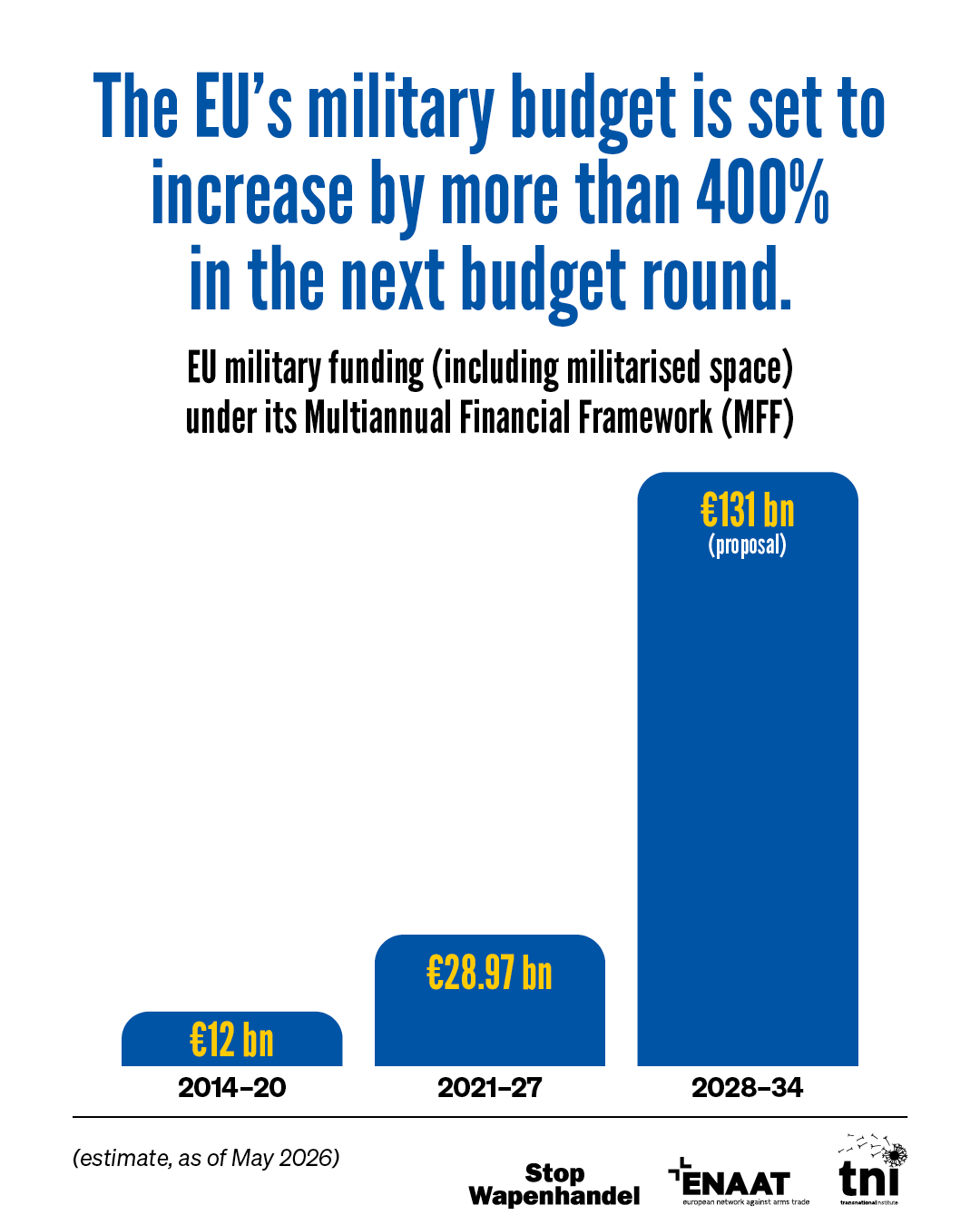
The MFF 2021–27 originally earmarked €13.19 billion for military and security spending3, mainly for the European Defence Fund and military mobility projects. That figure grew sharply after Russia’s full-scale invasion of Ukraine, which prompted the EU to rapidly increase its militarisation and war preparation. This lead to a series of new funding instruments and initiatives, as well as opening up civil funding programmes to include military and dual-use purposes.
European Defence Fund (EDF)
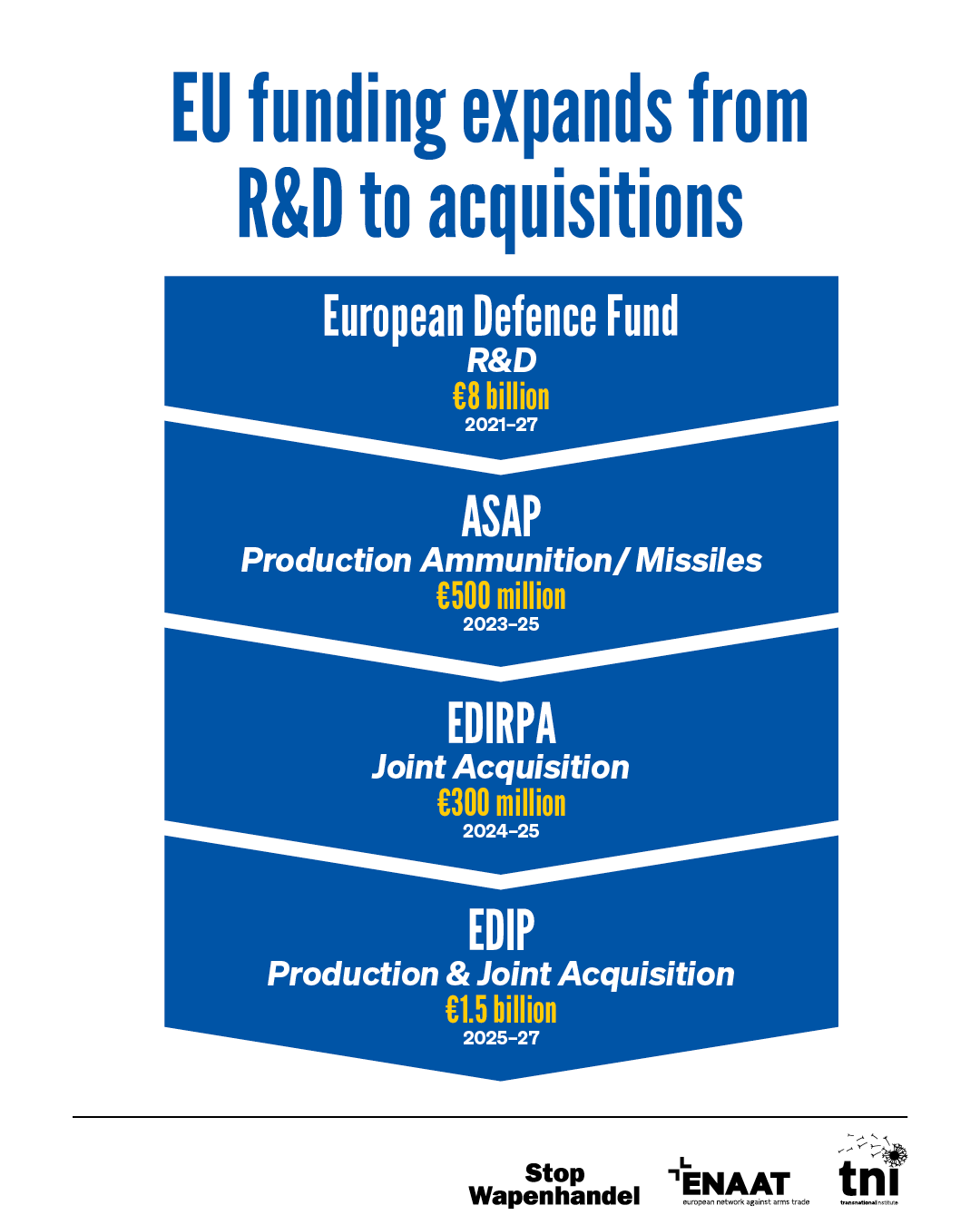
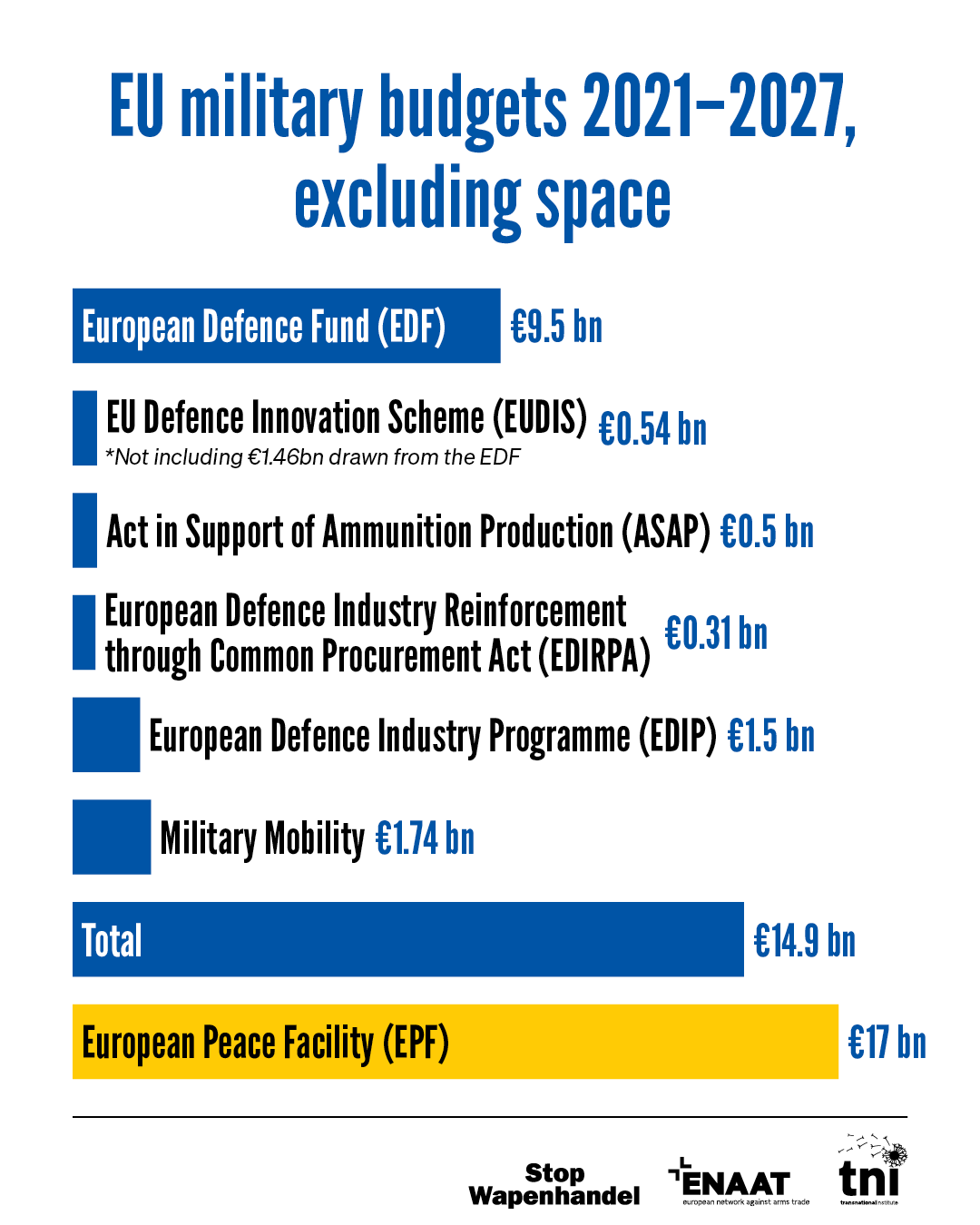
The EDF was established as the main military instrument within the MFF 2021–27, with an initial budget of €8 billion. It funds research and development (R&D) of arms and military technologies by providing project grants to consortia of companies, research institutes, and (military) authorities through annual thematic calls. Some of these are directly connected to joint projects between member states as part of the Permanent Structured Cooperation (PESCO) framework.
The EDF was established on the basis of an advisory report from an official ‘Group of Personalities’ appointed by the European Commission. The group was dominated by representatives of large EU arms companies. The fund’s first three years show that these companies have also profited the most: Almost a quarter of the funding went to the three largest EU arms producers, Airbus, Leonardo and Thales. Following the mid-term review of the MFF in 2024, the budget of the EDF was increased by €1.5 billion, dedicated to a new instrument called STEP (see below). Part of the total EDF budget is directed toward specific initiatives (see EUDIS and AGILE below), aimed at channelling funding to particular research or development projects, or at increasing support to small and medium-sized companies and start-ups.
EU Defence Innovation Scheme (EUDIS)
EUDIS supports the arms industry through a range of measures, including R&D grants and access to equity, aiming to help them bring their products to the market. Its main goal is to broaden access to the European Defence Fund, primarily for small and medium-sized companies and start-ups. It was established in 2022 with a budget of €2 billion, of which €1.46 billion was drawn from the EDF. It features a so-called ‘spin-in’ element which encourages companies to take results from civilian EU-funded R&D programmes and apply them to the defence sector.4
EUDIS also includes the Defence Equity Facility, through which the European Investment Fund (EIF) invests in private funds that back small and medium sized companies in the EU or Norway developing ‘innovative’ military technologies.5 Its total budget is €175 million for 2024–27.
Act in Support of Ammunition Production (ASAP)
This EU programme was designed to ramp up ammunition production capacity across Europe, help Member States refill their stocks, and support ammunition deliveries to Ukraine. Launched in 2023 with a budget of €500 million, 31 projects were selected targeting five supply chain ‘bottlenecks’: explosives, powder, shells, missiles, and testing and reconditioning certification. The programme is managed by the European Commission (Directorate-General Defence Industry and Space).
European Defence Industry Reinforcement through Common Procurement Act (EDIRPA)
This EU programme aimed at incentivising member states to cooperate on arms procurement, meaning to jointly plan and purchase weapons systems. The programme ran from 2024 to 2025 with a total budget of €310 million, including €10 million from Norway. Responding to calls focused on common procurement of air and missile systems, surface-to-surface ammunition and platforms, and the replacement of outdated systems, five projects each received a €60 million grant.
ReArm Europe/Readiness 2030
In March 2025, the European Commission launched a strategic plan called Rearm Europe, later renamed Readiness 2030, with the goal of mobilising up to €800 billion to strengthen European military infrastructure through five key components:
- creating fiscal space by allowing Member States to significantly increase their military spending without having to adhere to EU fiscal rules regarding standard debt-to-GDP limits;
- a new instrument to provide loans to EU member states for military investment (see SAFE below);
- redirecting existing funds, like cohesion policy programmes, toward military-related investments;
- expanding access to private finance by accelerating the Savings and Investment Union, pooling citizens’ savings for investments;
- lifting European Investment Bank lending restrictions on lending for military production.
Security Action for Europe (SAFE)
SAFE will provide up to €150 billion in long-maturity loans to Member States requesting financial assistance for military investment. It forms the first pillar of the ReArm Europe Plan/Readiness 2030.
European Defence Industry Programme (EDIP)
Running from 2026-27, this programme is linked to the European Defence Industry Strategy (EDIS) and focuses on increasing EU military production capacity and support to the Ukrainian arms industry. The budget is €1.5 billion, of which €300 million is dedicated to the Ukraine Support Instrument (USI). Other key components are Industrial Reinforcement Actions (IRAs), which aim to scale up production and address supply chain bottlenecks, with €700 million reserved for this purpose. A first call with a June 2026 deadline focuses on energetic components, including explosives and warheads as well as securing raw material access for EU production, and missiles, explosives and bombs for Ukraine.6
Programme for agile and rapid defence innovation (AGILE)
Announced by the European Commission in March 2026, this programme comprises a €115 million budget, reallocated from existing instruments7, ‘to bring disruptive defence technology from the lab to the field at record speed’. AGILE is intended to start funding 20–30 projects from early 2027 onward, with a focus on accelerating the development, testing, and sale of military ‘innovations’ and their market uptake. Like other temporary instruments, AGILE is intended to serve as a bridge toward a longer-term successor programme under the next MFF.8
European Peace Facility (EPF)
The EPF is an off-budget funding mechanism. It was established alongside the current MFF in 2021 in order to circumvent EU law that forbids EU budget funds from being used to finance military operations. It thus stands in clear contrast to the spirit of the EU treaties. The EPF finances military aid to EU partner countries and covers the common costs of EU military missions, succeeding the Athena Mechanism. After Russia’s full-scale invasion of Ukraine in February 2022, the EPF became one of the EU’s main instruments for funding military support to Ukraine. To date it has provided €6.4 billion for military equipment and €362 million for the EU Military Assistance Mission which trains Ukrainian soldiers9, raising the initial budget of €5.7 billion to over €17 billion.
Non-military funds under the 2021–2027 MFF used for military purposes
Connecting Europe Facility
Since 2021, the Connecting Europe Facility, the EU’s fund for (cross-border) infrastructure investments, has been used to fund military mobility projects. Between 2021–2024, it financed 95 selected dual-use infrastructure projects with a total of €1.7 billion.10 In 2025, the European Commission presented a Military Mobility Package as part of the Defence Readiness 2030 plan, with the European Parliament adding €10 million to the 2026 EU budget for its implementation.11
Border and internal security funding
While not strictly classifiable as military spending, several instruments for border security and control and for internal security are partly used to fund militarised responses in those areas. This includes the Internal Security Fund (ISF) and the Integrated Border Management Fund (IBMF), in particular its Border Management and Visa Instrument (BMVI), as well as the budget for the EU’s border agency Frontex and spending on border externalisation. The latter includes donations of military and security equipment to non-EU-countries, for example under the EU Emergency Trust Fund for Africa (EUTF), the Neighbourhood, Development and International Cooperation Instrument (NDICI), and migration deals with various non-EU countries. Several of these instruments received additional funding during the MFF mid-term review.12
Cohesion Fund
The Cohesion Fund is a long-standing EU instrument to support Member States with lower gross national incomes per capita to strengthen the economic, social and territorial cohesion of the EU.13 Following the mid-term review of the MFF, this fund was opened up to military projects.14 In March 2026, the Commissioner responsible for cohesion policy stated that about €11.9 billion had been redirected to so-called dual-use investments in ‘drones, space assets and military mobility’.15
Regulation to stimulate defence-related investments within the EU budget
Adopted in 2025 and sometimes referred to as the ‘mini-Omnibus for defence’, this regulation amends five key EU programmes to redirect tax payer money to military and dual-use applications, with the aim of strengthening the EU arms industry. In addition to changes to the EDF, the regulation predominantly focuses on opening up civilian funding instruments such as the Digital Europe Programme and the Connecting Europe Facility to allow military and dual-use projects.16 One notable change to the EDF is the opening up of funding to Ukrainian entities, without binding Ukraine to the EU Common Position on Arms Exports.17 Under the existing Strategic Technologies for Europe Platform (STEP), a new “defence tech” pillar was introduced to channel funding from existing instruments towards the arms industry. This includes a dedicated allocation within the European Defence Fund (EDF), whose budget was increased for this purpose.18
Military and security companies have been drawing increasing amounts of EU research funding since Framework Programmes 6 (2002–06, pilot projects) and 7 (2007–13). While Horizon Europe, the current and ninth Framework Programme, was initially presented as funding purely civilian research (despite the obvious potential military applications of many security-related projects), the 2025 EU regulation officially opened it up to include dual-use research. This was done by creating a specific European Innovation Council (EIC) Accelerator to support dual-use and arms companies.
European Investment Bank and access to private finance
There has been sustained pressure from military actors, arms companies and governments on private investors such as banks and pension funds to put more money into arms production and abandon ethical investment policies that exclude the sector. Within the space of a few years, the European Investment Bank has shifted from a highly restrictive stance on military financing to a dedicated Security and Defence Industry Action Plan (2024), allocating billions of euros to strengthen the production capacities of the EU arms industry.
Member States’ military spending
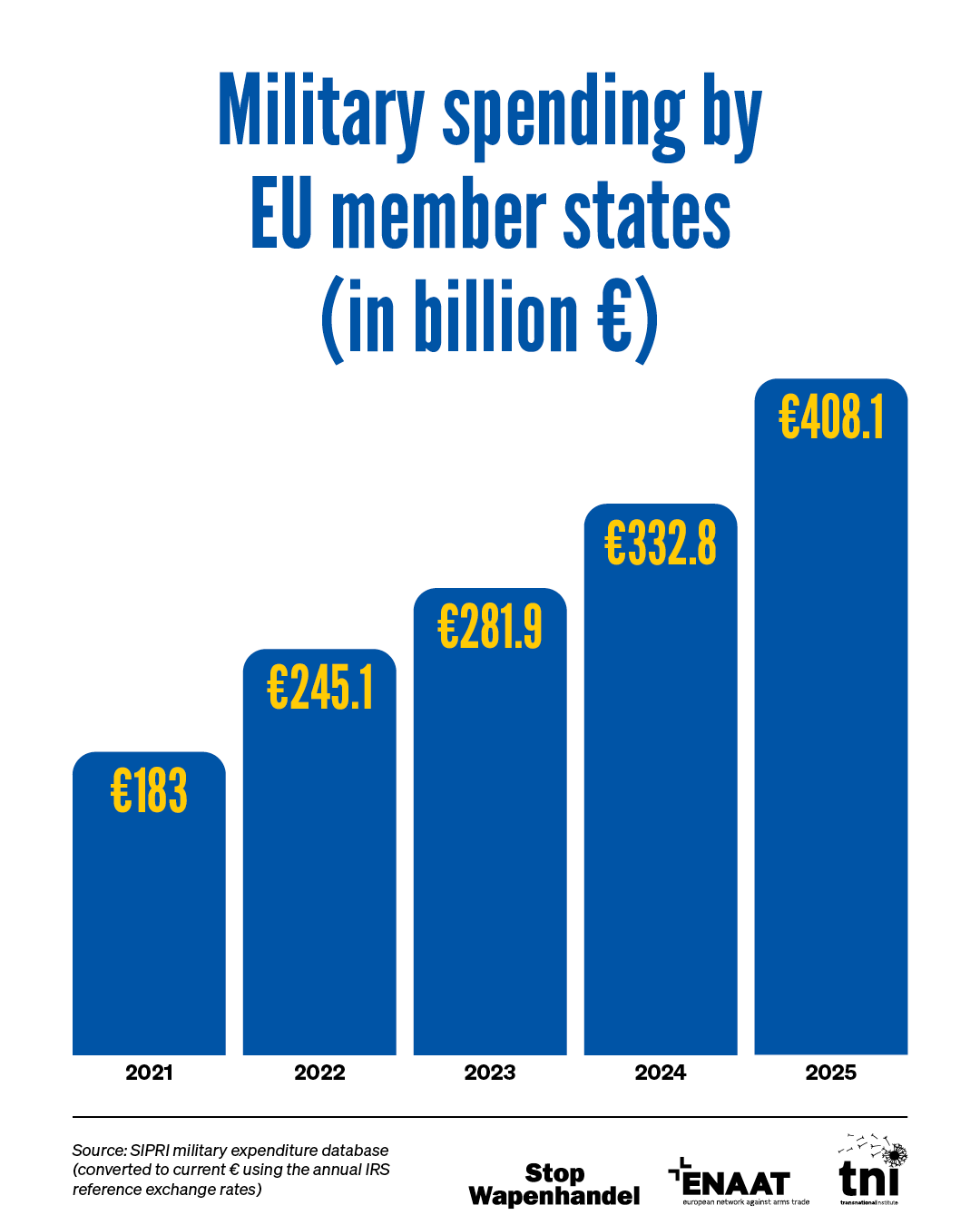
A significant part of the new EU (funding) instruments and policies that were introduced during the current MFF are meant to stimulate member states to increase their military spending and invest more in the arms industry. At the 2025 NATO Summit, EU member states that are also NATO members pledged to adhere to the new ‘NATO norm’ of spending 5% of their GDP on defence and security, with 3.5% earmarked for direct military spending and 1.5% for broader investments such as infrastructure. Non-NATO EU countries follow the trend of significant military spending increases.
Arms industry profits
According to the EU, most new measures under the MFF 2021–27 aim to increase the government demand for arms. However, they also include substantial support to the military and security industry. Arms companies profit not only from additional spending, but also from being given priority treatment in broader policy areas such access to raw materials and components, and from exemptions to rules and regulations on for example the environment, security and labour rights. Arms companies have also been embraced as partners in policy-making, and treated as experts, giving them considerable influence over the decisions that affect them.
One stated goal of many of these support measures is to make the EU arms industry more competitive. This means increasing EU ‘strategic autonomy’ and reducing its reliance on US arms companies, but also increasing arms exports to countries outside the EU. This is reinforced by parallel efforts to loosen arms export controls and restrictions, including through the Transfer Directive, which is part of the 2025/26 Defence Readiness Omnibus. These measures could open the door to increased EU arms exports to controversial destinations, including countries waging war or violating human rights.
Creditos
En colaboración con
- Stop Wapenhandel
- European Network Against the Arms Trade (ENAAT)
Disclaimer: Funded by the European Union. Views and opinions expressed are however those of the author(s) only and do not necessarily reflect those of the European Union. The European Union can not be held responsible for them.
Descargar PDF
Mas como esto
