
Military and related spending in the MFF 2028–34 proposal Factsheet 2
Regiones
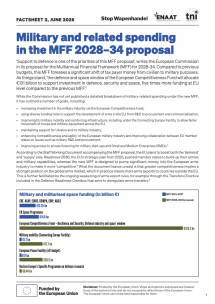
What does the EU’s proposed 2028–2034 budget mean for military spending, public investment, and future priorities? Download the factsheet to explore key funding plans, budget shifts, and the projected expansion of EU support for the military, security, and the arms industry.
Descargar PDF
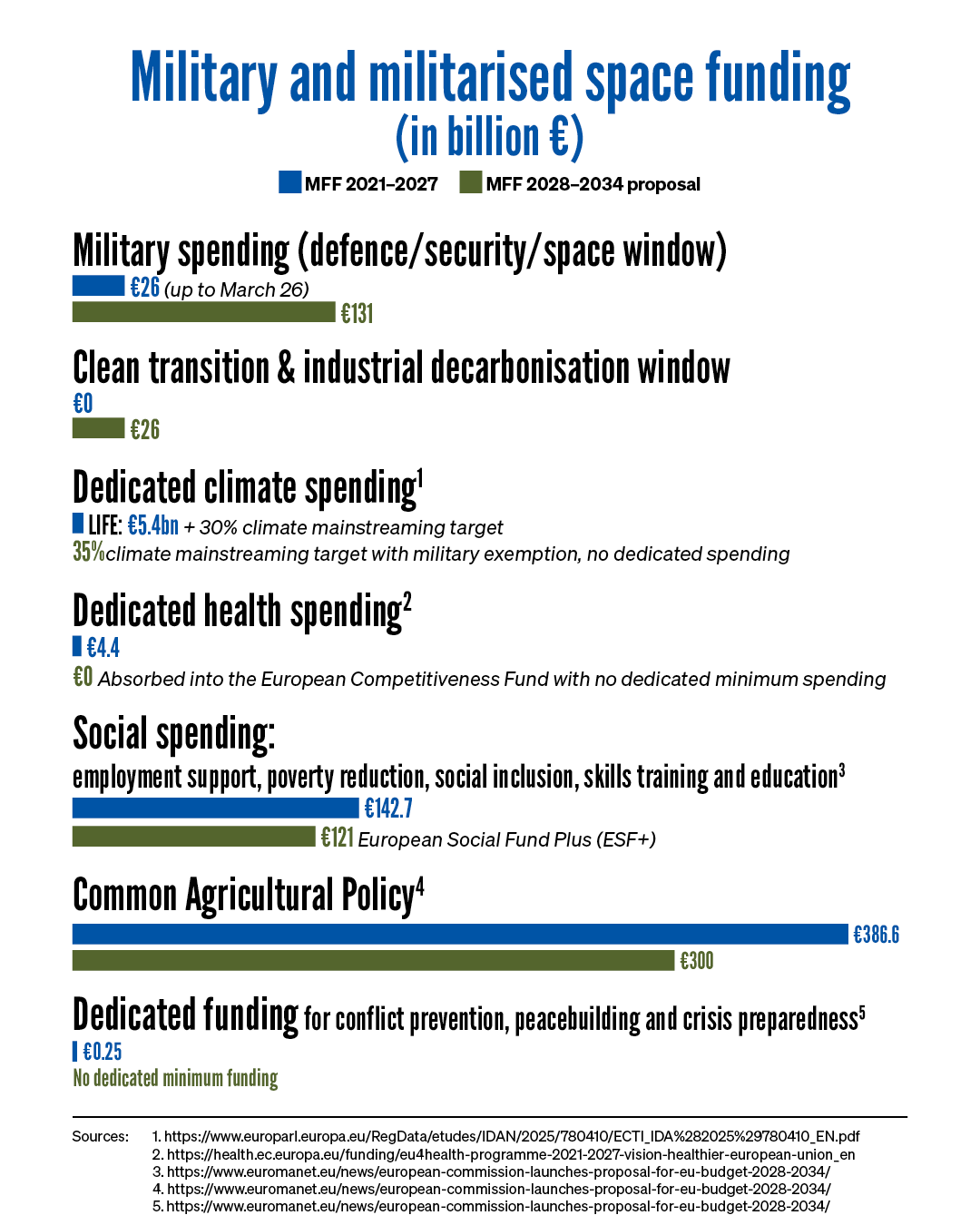
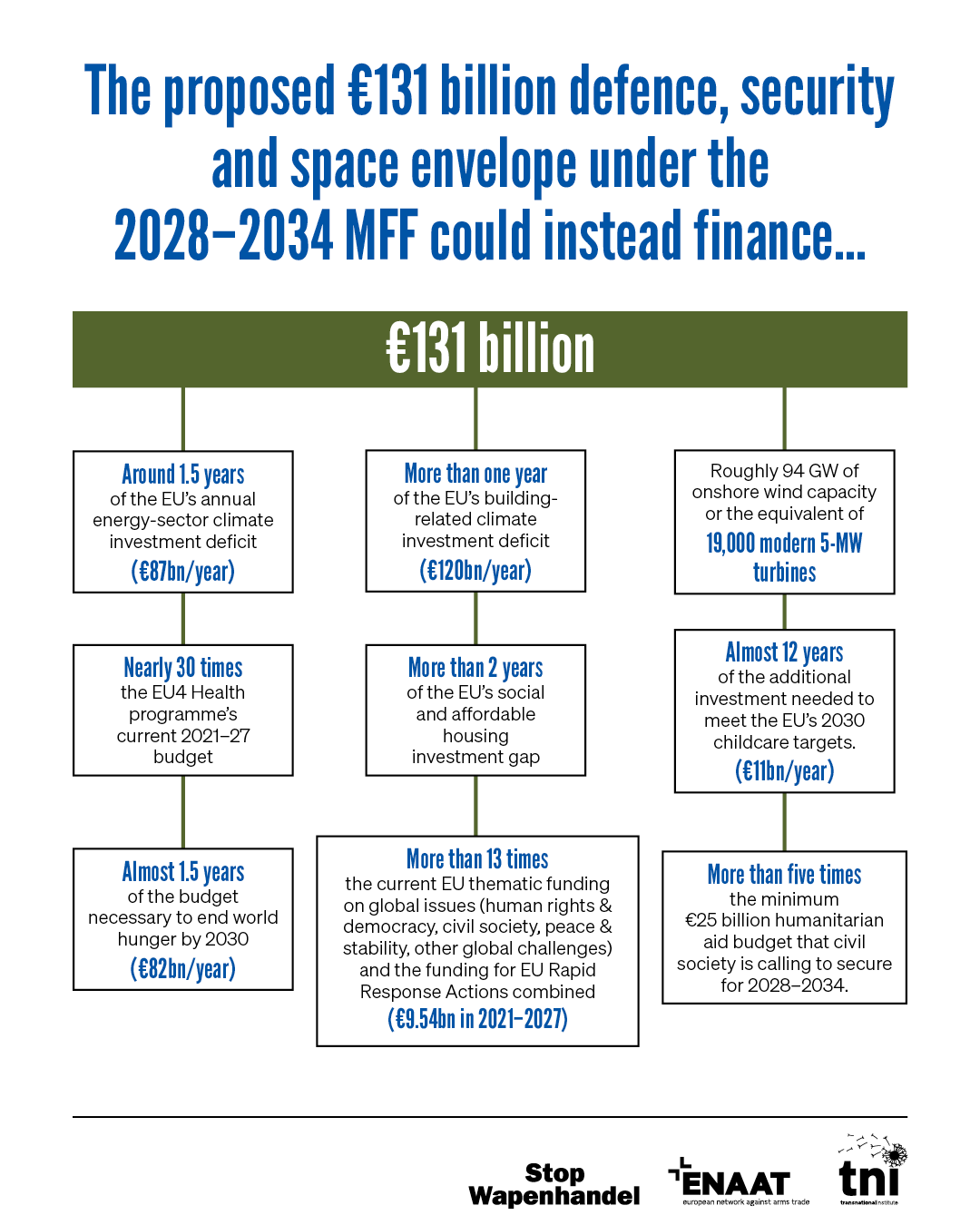
‘Support to defence is one of the priorities of this MFF proposal’, writes the European Commission in its proposal for the Multiannual Financial Framework (MFF) for 2028-34. Compared to previous budgets, this MFF foresees a significant shift of tax payer money from civilian to military purposes. As things stand, ‘the defence and space window of the European Competitiveness Fund will allocate €131 billion to support investment in defence, security and space, five times more funding at EU level compared to the previous MFF.’1
While the Commission has not yet published a detailed breakdown of military-related spending under the new MFF, it has outlined a number of goals, including:
- increasing investment in the military industry via the European Competitiveness Fund;
- using diverse funding tools to support the development of arms in the EU, from R&D to procurement and commercialisation;
- improving EU military mobility and reinforcing infrastructure, including under the Connecting Europe Facility, to allow faster
- movement of troops and military equipment across the EU;
- maintaining support for Ukraine and its military industry;
- enhancing ‘competitiveness and agility’ of the European military industry and improving collaboration between EU member
- states on issues such as military R&D and procurement;
- improving access to private financing for military start-ups and Small and Medium Enterprises (SMEs).2
According to the Staff Working Document accompanying the MFF proposal, the EU plans to boost both the ‘demand’ and ‘supply’ side. Readiness 2030, the EU’s strategic plan from 2025, pushed member states to build up their armies and military capabilities, whereas the next MFF is designed to pump significant money into the European arms industry to make it more ‘competitive’.3 What the document leaves unsaid is that greater competitiveness implies a stronger position on the global arms market, which in practice means more arms exports to countries outside the EU. This is further facilitated by the ongoing weakening of arms export rules, for example through the Transfers Directive included in the Defence Readiness Omnibus that aims to deregulate arms transfers.4
Funding instruments
European Competitiveness
Fund The fragmented military spending under the current MFF, with its ad hoc measures and scattered funding pots, will largely be replaced by the European Competitiveness Fund, an overarching “framework to operate as an investment capacity to bolster European competitiveness in technologies and strategic sectors critical to the EU competitiveness”.5 The ECF will fund military technologies at every stage, from early research to actual deployment. It is described as flexible, with a mix of grants, guarantees, and other financial instruments that can subsidise both the arms industry’s production capacity and governments’ weapons purchases, and an emphasis on increasing cooperation and joint projects.6
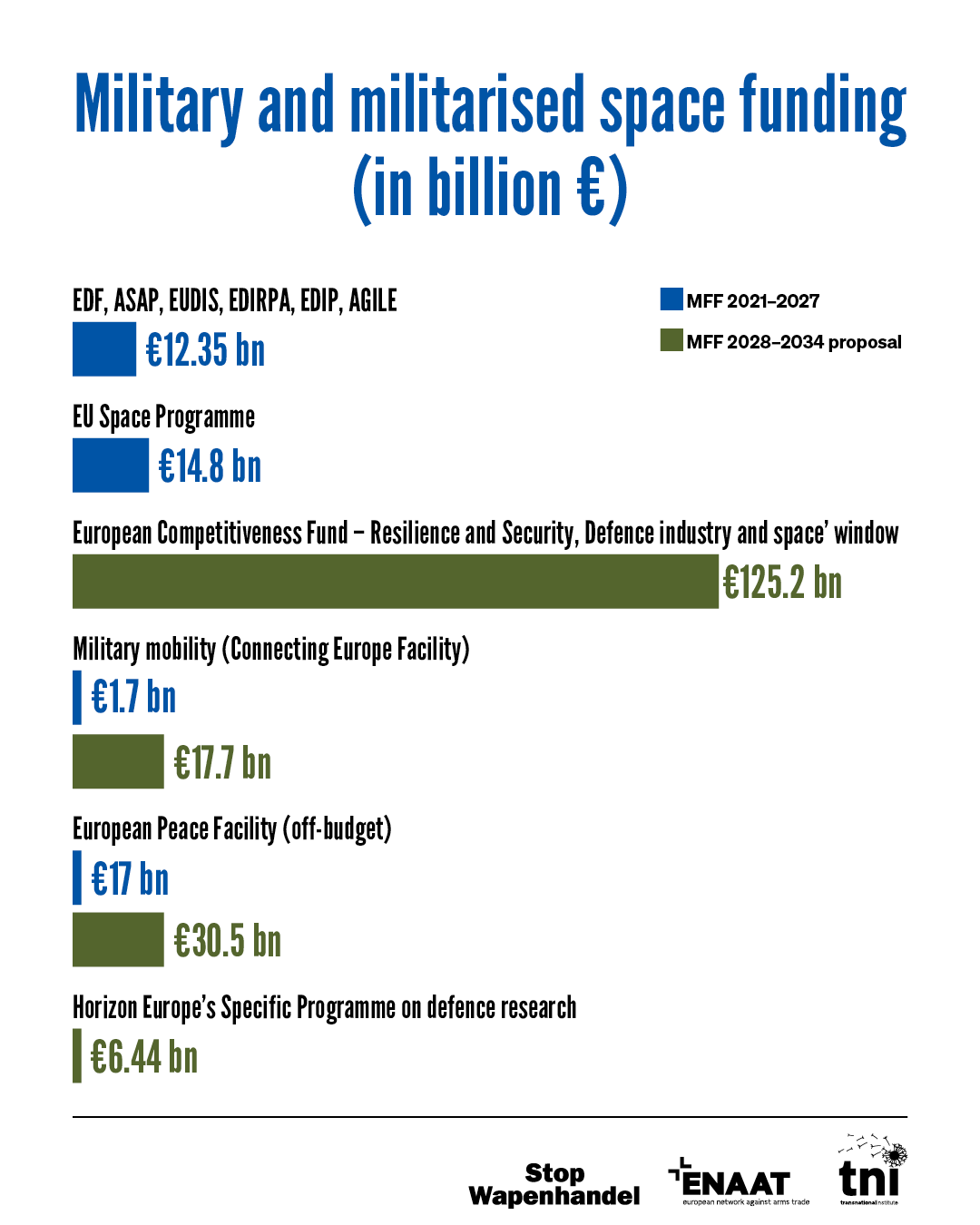
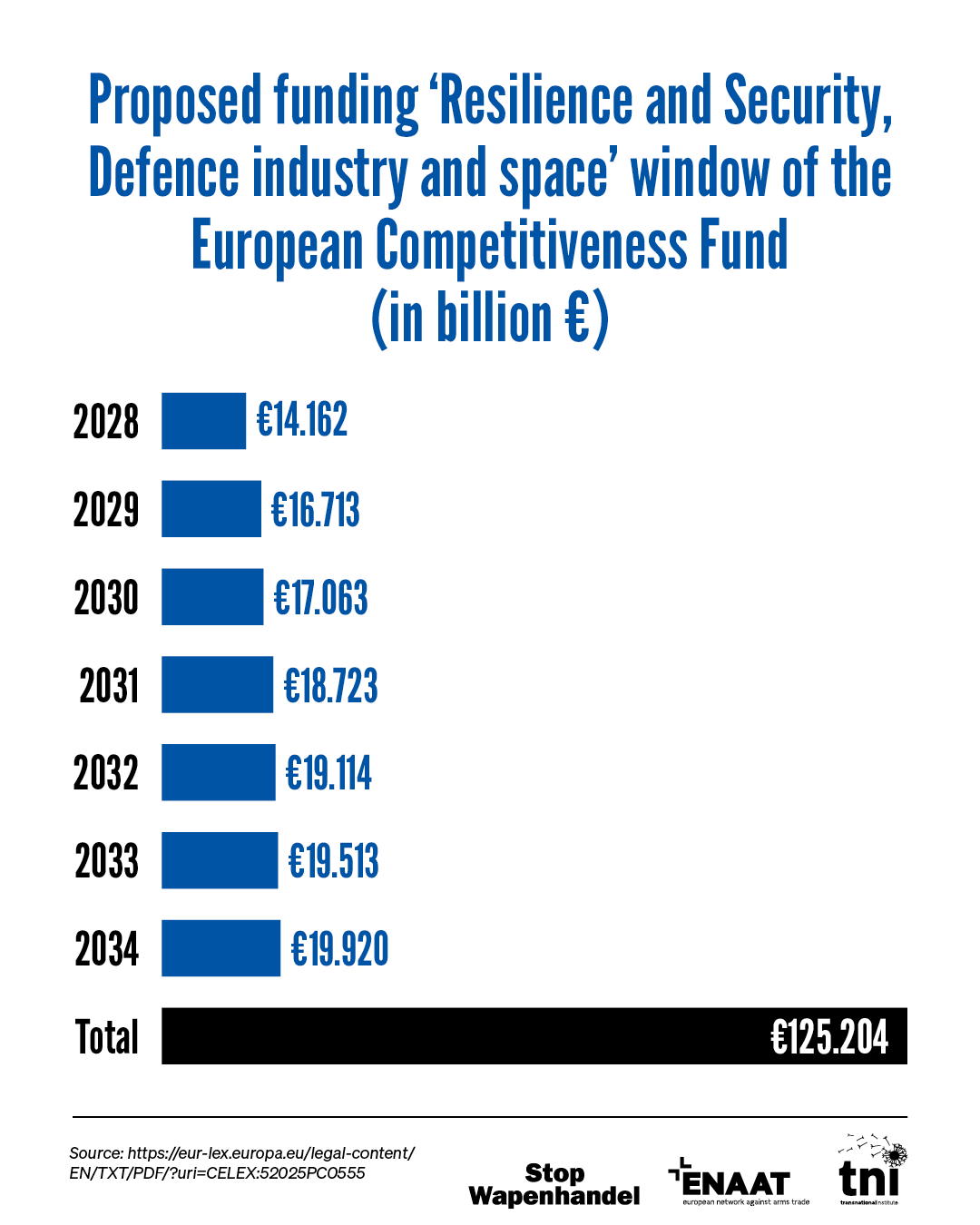
The proposed budget for the ‘Resilience and Security, Defence Industry and Space’ window is €125.2 billion, which constitutes over half of the ECF’s total budget of €234.3 billion. A wide range of activities are eligible for funding under this window, including ‘the development, industrialisation, procurement or deployment of a European Defence Project of Common Interest’; research, development and innovation; the establishment and expansion of arms factories, the establishment of ‘defence industrial readiness pools of defence products’ (meaning strategic reserves); and (joint) procurement of arms and equipment that enables military mobility. The ECF also pays special attention to civil-military synergies and dual-use technologies, and aims to connect the arms industry better with other industries.
The proposal considers the Ukrainian arms industry essential for European security and aims to strengthen it on equal footing with EU companies. However, unlike EU states, Ukraine is not bound by the EU Common Position on Arms Exports. The country has a controversial track record in this area, having supplied arms to Ethiopia, DR Congo and Myanmar among other problematic destinations.7 In 2026, Ukraine announced it will severely scale up arms exports, signing several deals (mainly for drones) with countries including Saudi Arabia and the UAE.8
Horizon Europe
The EU’s overarching funding program for research and development (R&D) will continue as Horizon Europe, with a total proposed budget of €175 billion. Out of this, €6.44 billion is dedicated to a novel Specific Programme on defence research. Although nominally part of Horizon Europe, this programme is not governed by Horizon Europe’s rules. Instead it falls under the regulation on the European Competitiveness Fund. As a consequence, rather than pursuing the general objectives of research and knowledge creation of Horizon Europe, the Specific Programme aims to ‘foster the competitiveness, efficiency and innovation capacity’ of the European arms industry. On top of this dedicated programme for military research, arms companies will also be eligible to profit from the €38.79 billion reserved for innovation more broadly under the European Innovation Council.9
Cohesion Funds
The option to use cohesion funding, a long-standing EU instrument to support Member States with lower gross national incomes per capita, for military or dual-use projects remains under the new European Fund for Economic, Territorial, Social Cohesion, Agriculture and Rural, Fisheries and Maritime Prosperity and Security. It includes specific goals to strengthen the EU arms industry and military mobility. There is no estimate yet how much of the total foreseen budget of €865 billion will go to ‘Europe’s defence capabilities and security’, one of the five main pillars of the fund.10
Connecting Europe Facility: military mobility
The Connecting Europe Facility (CEF) will continue under the next MFF, and will once again include funding for military mobility, especially for ‘largescale movements of troops and heavy equipment and material at short notice.’ In practice, this means repurposing parts of the trans-European transport network for dual civilian and military use.11 The focus lies on four EU Priority Military Mobility Corridors: North Sea-Baltic (through central Europe), Rhine-Alpine (North Sea to the Mediterranean), Atlantic (connecting Western European ports) and Orient/East-Med (Central Europe to Eastern Mediterranean ports). The total proposed budget for the CEF is €81.43 billion, of which €17.65 billion are earmarked for military mobility. This would mean a tenfold increase compared to the current MFF, where the entire €1.7 billion budget was already completely allocated by early 2024.
European Peace Facility and support to Ukraine
The European Peace Facility will continue to fund EU operations with military aspects and provide military funding to third countries. It is again located outside the official EU budget in order to circumvent the treaty provision that prohibits using EU budget funds for military purposes. Its proposed budget is €30.5 billion, almost twice as much as in the 2021-27 period. For support to Ukraine, up to €100 billion may be mobilised under the pillar Global Europe, but actual figures will depend on how the war develops.12
Other budgets
The arms industry can also count on continued EU funding for border security and control as well as internal security. The proposed budget for EU border guard agency Frontex doubles to €11.9 billion. A further €15.4 billion are proposed for border management, including foreseen budget increases to the Border Management and Visa Instrument of the Integrated Border Management Fund and the Internal Security Fund.13
Border externalisation remains an objective under the proposed Global Europe instrument for EU external action. Paradoxically, in its own Impact Assessment Report of Global Europe, the European Commission notes that “[m]ultilateral organisations affirm that localising the SDGs [Sustainable Development Goals] agenda, investing in conflict prevention, livelihoods and basic development is as important for Europe’s security as defence spending and significantly less costly.”14 That assessment directly contradicts an MFF that dramatically cuts funding for development and diplomacy while pouring hundreds of billions into war preparation and the arms industry.
Military exemptions from climate spending rules
A regulation accompanying the MFF establishes a budget expenditure tracking and performance framework and other horizontal rules for the Union programmes and activities, including a ‘do no significant harm’ (DNSH) and a gender equality principle.15 It also sets an overall target of spending at least 35% of the total MFF budget on climate action and environmental objectives. However, military and security spending is explicitly exempted from this climate target, severely reducing EU spending towards this aim.
Under the same regulation, military and security activities are also exempted from the ‘do no significant harm’ principle as applying it is deemed ‘not feasible or appropriate’. The European Commission argues that this will reduce costs for both the EU and arms companies because of a lower administrative and reporting burden. In its own analysis, however, the Commission acknowledges that these exemptions “may nonetheless result in not applying DNSH to projects with potentially environmentally harmful effects.”16 In other words, spending that is most likely to harm humans and the environment is freed from any obligation to demonstrate it will not.
Ongoing Negotiations
In April 2026, the Budget Committee of the European Parliament adopted its position on the MFF proposal of the European Commission. The majority of the committee supported the proposal, including the sharp increases in military spending, and even called for slight funding increases for military mobility and the European Competitiveness Fund on top of an overall 10% budget increase.17 The European Council will discuss the MFF again at its meeting on 18 and 19 June 2026, based on an initial proposal by the Cypriot presidency.18
The enormous increase in military spending proposed under the next MFF, together with the rapidly growing military expenditures of Member States, will mostly benefit the arms industry, fuel wars and genocides around the world, and divert urgently needed money away from other priorities. The expansion of military infrastructure and support for the arms industry speak to the EU’s ambition of becoming an ‘autonomous’ military power bloc. The alleged threat from Russia and the political course of the United States under Trump are cited as the main justification. Yet these arguments do not align with the facts: the combined military spending and capabilities of EU Member States already far exceed those of Russia, which has not been able to defeat Ukraine after more than four years of aggressive warfare. More fundamentally, military deterrence does not offer a route to genuine security. It locks societies into permanent threat, militarisation and arms races, while leaving the political roots of conflict unresolved.
Meanwhile, the EU as a peace project is fading further from view. Dialogue and diplomacy are being sidelined, even though these are precisely the areas in which the EU historically claimed to distinguish itself from ruthless imperial powers. The billions now set to be poured into guns and bombs could instead support efforts rooted in global peace, justice, social wellbeing and ecological security.
Creditos
En colaboración con
- Stop Wapenhandel
- European Network Against the Arms Trade (ENAAT)
Disclaimer: Funded by the European Union. Views and opinions expressed are however those of the author(s) only and do not necessarily reflect those of the European Union. The European Union can not be held responsible for them.

Descargar PDF
Mas como esto
