From Turtle Island to Palestine Resisting settler colonialism and genocide
Temas
Canada's Indian Act and Israel's siege of Gaza share the same logic. Ellen Gabriel of the Kanien'kehá:ka draws on five centuries of resistance to show what Palestinian and Indigenous struggles have in common — and why that matters.

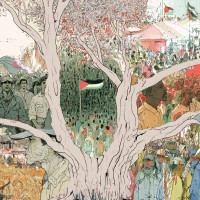
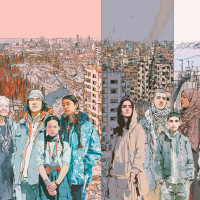
Illustration by Fourate Chahal El Rekaby
For the past two years, the world has been witnessing Israel’s live-streamed genocide of the Palestinian people in Gaza. That what is taking place is a genocide has been affirmed by numerous human rights experts, including United Nations (UN) special rapporteurs and representatives of human rights organisations. In line with this view, South Africa’s ongoing case before the International Court of Justice (ICJ) accuses Israel of violating the 1948 Genocide Convention. The UN member states that continue to support Israel have therefore been – and continue to be – complicit in an ongoing genocide, in contradiction of their legal and moral obligations. This has been well-documented by the UN Special Rapporteur on the occupied Palestinian territories, Francesca Albanese, and other UN agencies.1 Israel’s genocide in Palestine exposes the hypocrisy at the core of the UN system, and of the settler-colonial powers to which it caters.
The ongoing genocide also underlines the clear parallels that exist between the experiences of the Indigenous peoples of Turtle Island2 and those of Palestine, who both suffer at the hands of settler-colonial regimes. The colonial strategies used against the Indigenous peoples of Turtle Island mirror those used against Palestinians: land dispossession, apartheid, criminalisation of their daily practices, dehumanisation, and ultimately genocide.
Like Palestinians under siege in their homeland, the Indigenous peoples of Turtle Island understand what it is to experience oppression which suffocates their daily lives. They too experience attacks against their right to exist as a people, and the destruction of their homelands.
In Canada, children were kidnapped and placed into so-called educational institutions that were actually prisons and labour camps, especially in the early days of the Indian Residential School system (IRSS). Indigenous communities endured oppression and occupation brutally imposed by the Royal Canadian Mounted Police (RCMP) as they implemented Canada’s Indian Act – an oppressive method of apartheid which Canada exported to South Africa, whose government took inspiration from the Canadian system to establish their own system of apartheid. These measures, alongside military tactics like ‘divide and conquer’, were part of colonial attempts to erase Indigenous history and presence from our ancestral lands.
Indigenous peoples in North America have long lived under the Indian Act band council system, amendments to which, enacted in 1924, criminalised all Indigenous traditional forms of governance. Despite this, there are many Indigenous peoples on Turtle Island today, like the Haudenosaunee or Iroquois Confederacy, who continue to practice traditional forms of governance.
Like Palestinians under siege in their homelands, we understand what it is like to be trapped under a ‘reserve’ system3 that is designed to oppress Indigenous peoples and to produce their gradual extinction. On Turtle Island and beyond, Indigenous peoples – just like the Palestinians – struggle to fight colonisers and oppressors who have unlimited resources, which they use to maintain a despotic rule.
Other means adopted to cause our extinction as distinct peoples were strategies to assimilate us into Canada’s melting pot. In this process, as we lose our distinct cultures and languages, we also lose our rights to our homelands, which in turn enables the coloniser to claim absolute jurisdiction over the land and its peoples.
Like Palestinians, we Indigenous peoples of the Americas must constantly defend and advocate to protect our homelands. In both contexts, the coloniser always plays the victim and fails to accept accountability for their brutality in dispossessing us. And just as Palestinians remain under constant attack, so settler society on Turtle Island has never stopped its attacks upon Indigenous peoples, through low-intensity warfare, in the form of colonial policies and laws that are applied by law enforcement entities.
Canadian officials, including Prime Minister Sir John A. Macdonald (1878–1891) and Superintendent of Indian Affairs Duncan Campbell Scott (1913–1932),4 early on identified the ‘Indian problem’ as something they sought to solve. They infamously tried to do this by eliminating Indigenous culture altogether. One way they tried to do this was by ‘taking the Indian out of the child’, a policy they enacted by systematically targeting the family unit. Children were forcibly removed from their families and placed into IRSS schools. Within these institutions, Indigenous children were brutally punished for speaking their languages or practising their cultures, in a deliberate effort to beat their identities out of them. The IRSS was responsible for widespread physical, psychological and sexual abuse at the hands of the school staff and religious orders, who worked diligently to ‘assimilate’ Indigenous children through religious indoctrination and the imposition of colonial ideology. Sometimes these children paid for these assimilation policies with their lives, as is evident in the search for those children who never returned home, who were buried in unmarked graves throughout former Canadian IRSS graveyards.
Like early European explorers, today’s settler colonisers continue to justify their land grabs through archaic colonial laws that deny our rights to our lands, as Indigenous peoples. Even when we do win in colonial courts, bureaucrats and politicians challenge court decisions, leaving Indigenous peoples vulnerable to racists who believe their rights supersede Indigenous peoples’ rights.
According to the Yellowhead Institute's report, ‘Braiding framework for health accountability’,5 there can be no reconciliation without systemic transformation. The report insists that for healing from genocide to begin, health structures must be Indigenous-led, culturally relevant, and informed by the historical trauma of colonisation. Despite this, profound funding inequities continue to perpetuate a colonial stranglehold on ‘health and healing’, leaving Indigenous-led initiatives forced to fight for mere survival. In light of this, the Yellowhead Institute identifies Canada as an unwilling partner in reconciliation, one that actively upholds the colonial status quo.
Since the 2015 Truth and Reconciliation Commission’s Calls to Action, Canada has exhibited an apathetic response to genuine ‘reconciliation’, contradicting its own legal obligations under human rights conventions, declarations, and even domestic laws, such as the Constitution Act, 1982.
The coloniser understands that the relationship to the land is the foundation of Indigenous laws, cultures, languages and philosophies. As Paulo Freire stated in his book Pedagogy of the Oppressed,6 the oppressor must convince the ‘natives’ that the colonisers’ ways, religion, laws and culture are superior, and hence must be embraced. Freire provides a description of the coloniser’s violent nature – taken from German-American psychoanalyst and social psychologist Erich Fromm – to explain how colonisers have a negative, possessive attitude to the land:
The necrophilous person can relate to an object – a flower or a person – only if he possesses it: hence a threat to his possession is a threat to himself; if he loses possession he loses contact with the world… He loves control and in the act of controlling he kills life.7
A settler state grants itself impunity in the crimes against humanity committed against Indigenous peoples because it cruelly controls every aspect of its subjects’ daily lives. It creates and imposes colonial laws upon Indigenous peoples without our consent. It persistently denies Indigenous peoples the right to be a part of decision-making processes, perpetuating the colonial attitude that Indigenous peoples are wards of the state. Indigenous peoples are forced into biased colonial courts which demand that Indigenous peoples prove they have occupied their lands from time immemorial. Settlers are given more rights than the First Peoples of this land, through colonial laws and policies. Indigenous peoples know we will never be considered as equals within the settler society, as long as racist and oppressive laws remain.
Life under occupation means sacrificing part of your being, your soul, your spirit, while resisting your own erasure. Today, our homelands are controlled by a society that is unwilling to accept the fact that they are settlers, and that the land they occupy belongs to the First Peoples of Turtle Island. Ours is a history denied, where rights depend upon the ‘good will’ of the occupier / coloniser. We the colonised must constantly try to justify our existence in a society that views us as a ‘problem’. The challenges to our struggle for survival and the assertion of our rights are linked to colonial laws created by the elites of society, who have at their disposal unlimited resources.
What the occupier refuses to accept is that Indigenous peoples are within their rights to defend their unceded homelands and to protect the people of their nations.
The right to self-defence (which, of course, is not a licence to kill, murder and maim) is denied to Indigenous peoples who seek to resist colonisation.
Our ancestors were forced to go underground and to work in secret in order to transmit knowledge, including oral histories, traditional teachings, and languages, and to sustain our relationship with Mother Earth. This connection to Mother Earth remains part of what strengthens our resistance and our resolve to continue our resistance. We understand that we are part of nature, not above it, and that all things that exist on this beautiful planet are our relatives. From the waters to the fish, to the green plants and trees, to the birds, to the languages, to the sky world, we are obliged to ensure that present and future generations enjoy access to the beauty and resources of Mother Earth. Our ancestral teachings inform all of the decisions we make today, which will have impacts upon future generations.
In capitalistic settler societies, like Canada, the USA and Israel, many people are disconnected from all that is precious and sacred. These societies commodify the natural world, leading to an artificial world that is heavily reliant on technologies that destroy the environment; this includes a dangerous level of surveillance. These are societies that are blindly rushing towards disaster for life on Mother Earth, as their hunger for unsustainable technology threatens the world’s biodiversity and as they recklessly pursue ever-increasing growth.
From the bombing of Gaza to other forever wars, the impacts on the climate mean the world is now experiencing a crisis in all aspects of life. Our elders have warned us that we must prepare to survive and face more natural disasters, and that we must increase the strength of our food sovereignty systems. If we care about our children, we must be willing to sacrifice our comfort for their survival.
The UN report on the ‘Guiding Principles on Business and Human Rights’8 sets the:
global standard for preventing and addressing the risk of adverse impacts on human rights involving business activity, and they provide the internationally-accepted framework for enhancing standards and practices with regard to business and human rights.9
While corporations pay lip service to these Guiding Principles, human rights take a backseat to shareholders’ profits. Those with deep pockets can callously violate human rights with impunity, as the UN does not have any enforcement mechanisms to protect the environment and human rights. Such is the case with Canadian mining companies, whose brutality against Indigenous peoples in Latin America has been documented by organisations like Mining Watch. Meanwhile, ordinary citizens struggle to feed their families, pay their bills and survive in the face of the ever-increasing cost of living.
The Universal Declaration of Human Rights (UDHR) was created to protect individuals from the ‘scourges of war’ after World War Two and the Holocaust. Its aim was to establish human rights as universal and inalienable.10 It states:
Whereas recognition of the inherent dignity and of… the equal and inalienable rights of all members of the human family is the foundation of freedom, justice and peace in the world.11
However, the fascism that emerged during the two world wars has not been eliminated. It is disheartening to see the silence of the UN and the ignorance of world democracies in the face of ongoing genocide. The UN’s ability to uphold human rights is restricted by vetoing countries at the Security Council, whose members have poor human rights records themselves.
In Gaza and in Palestine, as on Turtle Island and beyond, Indigenous peoples struggle to fight the colonisers and oppressors, who have unlimited resources, which they use to maintain the status quo of a hierarchy of despots. Through a global culture that is fixated on the use of violence to obtain profits, citizens of the world have been indoctrinated into accepting bloodshed and violence as normal. Why should this not be the case? After all, Western countries were founded on racist doctrines and genocidal acts.
Indigenous peoples of Turtle Island face attacks against our right to exist as peoples. From the destruction of our homelands and waters to the genocide of our peoples, colonial capitalism is the root cause of our struggle.
Article 3 of the UDHR states: ‘Everyone has the right to life, liberty and the security of person’. It also goes on to state (in its preamble) that ‘it is essential, if man is not to be compelled to have recourse as a last resort to rebellion against tyranny and oppression… that human rights should be protected by the rule of law’.12 But these are just words. Unless they become part of our daily lives, from the educational system to the courts, they will remain aspirations that exist only on paper, never enacted as law.13
When the United Nations Declaration on the Rights of Indigenous Peoples (UNDRIP) was passed by the UN General Assembly on 13 September 200714 Indigenous peoples celebrated this as a monumental achievement. The Declaration did not create new rights for Indigenous peoples but validated our rights as distinct peoples whose rights and existence did not need approval from colonisers. In fact, articles within the UNDRIP comprise international customary law that recognises our rights to self-determination and sovereignty, which have always existed pre-contact.
Despite the fact that the UNDRIP is now a consensus document, certain UN member states continue to see Indigenous peoples as a threat to their investments. These states have been actively undermining the UNDRIP in various UN fora, attempting to weaken its meaning, even as Indigenous peoples’ rights are now part of international human rights laws. Hence, discussions on the full and effective participation by traditional Indigenous governments in UN meetings have met resistance, since the colonial structure of the UN requires Indigenous peoples to be, in essence, passive participants in UN discussions. Any outcome document in which Indigenous peoples’ voices are included should be supported by states, to ensure their voices are heard in the final conclusions of all reports.
As sovereign nations who have never surrendered our rights to our homelands, we have the jurisdiction and authority to control what happens in our homelands. Indigenous peoples have the right to withhold their consent from extractive projects in their homelands. This is not a veto, but a right to decide and control our own destiny, including the lives of present and future generations.
Canada and the US have not adequately atoned for the kidnapping and forced disappearance of Indigenous children under the IRSS. Monetary compensation is part of the restitution involved in reconciliation, but real restitution must go further than that. The promotion of Indigenous human rights is necessary. Just as Palestinians have the right to self-determination, so too do all peoples with a land base, language, culture, and their own governance structures.
Unfortunately, the genocide of Turtle Island is not mentioned by states at the UN that have a history of genocide. Although Canada ratified the Rome Statute, otherwise known as the ‘crimes against humanity law’, in 2000, the International Criminal Court’s jurisdiction does not consider Canada’s IRSS as a genocide, given that it occurred before the law entered into force, on 1 July 2002.
Meanwhile, domestic laws are unable to address the genocide committed by Canada and the crimes committed in Indian Residential Schools. The Truth and Reconciliation Commission’s Calls to Action state that Canada committed a cultural genocide against Indigenous peoples. However, there is no legal definition of ‘cultural genocide’ in the Genocide Convention, as this term was removed from the original draft by settler-colonial states like Canada and the USA. Indigenous peoples on Turtle Island have been working to rectify this.
International human rights laws state that certain types of behaviour are unacceptable during wartime, and that civilians, hospitals, schools and places of worship must be protected during warfare. However, as we have witnessed during the genocide in Gaza, Israel continues to ignore the rule of law and continues to enjoy the decades-long impunity given to it by its fellow colonial states. Take, for example, the Convention on the Rights of the Child: it is unthinkable that anyone would disagree that a child has the right to food, safety, education and to learn in their own language and culture, but Israel has consistently ignored this convention by bombing schools and children’s hospitals and forcing famine conditions on Gaza.
It is disturbing to witness the decay of the human rights system. The kidnapping of Palestinian children, who then languish in Israeli prisons, is also a crime against humanity, but one that the UN has done little to stop, despite their mandate to protect children from human rights abuses. Likewise, it is unacceptable that world leaders who have been complicit are not held accountable for their lack of action to prevent and stop the genocide in Gaza. The UN General Assembly could have done something decades ago to prevent it.
The genocide in Gaza reveals the colonial powerhouses’ willingness to hide the truth and to criminalise a vulnerable people in order to steal their lands.
As philosopher and gender studies scholar Judith Butler states in her book Frames of War, some lives are more grievable than others:
One way of posing the question of who ‘we’ are in these times of war is by asking whose lives are considered valuable, whose lives are mourned, and whose lives are considered ungrievable.15
The level of energy needed to overcome the twin systems of White supremacy and capitalism is great. As history has shown, defeating these systems is possible, but it will take time. It will take a global mindset shift, whereby people come to understand all the suffering in this world that is inflicted by settler colonialism.
Truth telling, in this case, comes before reconciliation, restitution and reparations. Reconciliation requires the courage to sit in uncomfortable situations, to acknowledge the past and its impacts today. What does the promotion of Indigenous human rights look like? How do we live in peace and leave a legacy that will benefit future generations? Giving up is not an option for Indigenous peoples. Just as Indigenous peoples on Turtle Island continue their struggle, so has Palestine demonstrated to the world that life is sacred, and that the Palestinians’ struggle is dedicated to a life of peace, security and dignity for all.
Witnessing the colonisers discuss publicly what they think Gaza and the rest of Palestine should look like, without Palestinian involvement, is painfully familiar for Indigenous peoples. Such discussions come straight from the settler-colonial playbook, which assumes that ‘they’ know what’s best for us.
While whole volumes can be filled with cases of crimes against humanity committed on Turtle Island and in Palestine, the fact remains that as long as the courts belong to the colonisers, we are vulnerable to more brutality and colonial dispossession. For Indigenous peoples, home is more than a building; it is Mother Earth who is the floor, the sky that is our roof; our relatives are the trees, the birds, the medicines – all that comprises the natural world is home.
And so it is international human rights to which we turn to try to seek reparations. While Canada may appear to recognise Indigenous customary laws, it still has a long way to go in its respect for them, and to understand how to integrate these laws into settler-colonial society.
Indigenous peoples of Turtle Island are dependent upon our Indigenous languages to reinforce our kinship to the natural world. Our ceremonies and honouring of all the natural life cycles of Mother Earth have helped us survive colonisation and genocide. If future generations are to survive what is coming, we must encourage our youth to embrace this perspective.
Education allows our children and youth to understand and develop a relationship with the land, to appreciate its worth and its importance for our health and well-being. The youth must understand the language of the land, in which our identities are grounded. They must learn patience, traditional knowledge, and the courage to sit in uncomfortable situations: together, transmitting the collective understanding that we are not separate from the natural world but a small part of it. It is not solely for the survival of Mother Earth that we adhere to these teachings, as she will survive long after humankind becomes extinct: it is for the survival of our species, and the legacy we leave for future generations.
As a society, we are ordered by the government to let the ‘experts’ guide us, and to accept that it is the government’s job to handle our governance. But what about justice?! If judges, lawyers and ordinary citizens do not know the history of their own state, how will they be able to address long-standing historical land disputes? How can there be peace in a society that is apathetic to the injustices happening in its own backyard?! If people are not aware of what their human rights are, how can they protect them?
Today, mining companies and resource corporations have been given more rights than Indigenous peoples, all for the sake of the ‘national interest’. Meanwhile, Bill C-5, the Building Canada Act, defies the rule of law, in that the government did not conduct any consultations with Indigenous peoples or the general public before it was passed.
Like Stephen Harper before him, Prime Minister Mark Carney has veered towards the colonial ‘status quo’, and has revealed the Liberal government’s attitude towards ‘reconciliation’ to be entirely hypocritical. Since the IRSS apology, Canada and its provinces have paid lip service to respecting Indigenous peoples’ human rights, and to reconciliation. But as Amnesty International Canada outlined in their 2004 ‘Stolen Sisters’ report, the social problems of Indigenous communities have always been rooted in colonialism.
From the man camps near reserves to the issue of murdered and missing Indigenous women, there is no reconciliation. The maintenance of business as usual where Indigenous issues are concerned sends a message to the public that we, as Indigenous peoples, are disposable. And so the genocide continues.
History has shown that the people can take back power from tyrants and despots through revolution. But in order to succeed we must remain vigilant about the protection of our rights and the rights of the natural world. We must affirm that all human beings have universal rights. We must look at the earth as our mother, know that her health impacts our health and so we must collectively care for her and all our relations.
Indigenous peoples have always been on the frontline of resistance to land dispossession, especially resource extraction. Our lands, health and well-being are threatened by unfettered development, and in particular by resource extraction. By violently implementing a distorted interpretation of the rule of law, the settler coloniser tries to silence our dissent.
During the 1990 crisis in Kanehsatà:ke and Kahnawà:ke, for example, Canadian and Quebec politicians categorised the Kanien'kehá:ka as criminals, and the Warrior Society as a terrorist group. Meanwhile, mobs of settlers in Chateauguay rioted and threw rocks at people from Kahnawà:ke who were evacuating their community, while the police looked on. A siege was placed on both Kanehsatà:ke and Kahnawà:ke as police erected checkpoints. They violated our fundamental human rights by blocking food, medicine, baby diapers and the free flow of people seeking to enter the territory.
It is evident that Palestinians, like the people in Kanehsatà:ke and Kahnawà:ke, stand in the way of settler profits, and of oligarchs and their shareholders. It does not matter that 70% of victims killed in Gaza have been women and children. The colonial playbook remains the same: control of the land and her people must be exercised at any cost. Indeed, fears that development may be blocked by Indigenous peoples led the RCMP to create a specialised police force to deal with Indigenous protests.
Gaza has not only become a litmus test for the future of a global society, it has exposed how apathetic settler societies are in regard to human rights violations.
International human rights law has been said to be the cornerstone of democracy. Yet, like most Indigenous peoples, Palestinians under occupation in a so-called democratic country are not included in the decisions that directly affect their lives. Our cultures and our identities, as Indigenous peoples, are commodified and appropriated by settler societies, which seek to erase our presence in our homelands.
The international system may be flawed, delicately resting as it does upon the will of states to act in good faith and remain accountable for their actions, but holding states accountable in regard to human rights law is more important than ever. If Indigenous peoples across Turtle Island and those in Palestine are to achieve justice for the crimes against humanity committed against them, they must continue to seek legal remedies and bring criminal states (like Israel) to justice.
Settler states claim sovereignty in heinous ways in order to safeguard their investments and future economic prosperity. After destroying Indigenous peoples’ lands, languages and cultures, and eradicating any semblance of our identities, settler states claim terra nullius to declare their sovereignty over our homelands. The history of the occupation in the Americas parallels the history of Palestine.
Indigenous peoples across the world have, for centuries, studied the land in order to survive. Every aspect of Indigenous identity is based on land-based teachings of traditional knowledge, on which our languages, cultures and governance are based. We use this knowledge to maintain and nurture a good relation with the land and her people. Together, we create songs and ceremonies to honour all our relations. All of these practices helped us build a unique way of life and love for the land, which helped us survive centuries of colonisation.
But how does one survive when the colonisers are constantly changing the rules, laws and goals?
How do you protect your children when the occupier has unlimited resources to control all aspects of your life?
The hypocrisy that Palestine has exposed is deep – and yet, Indigenous peoples in Canada have been immersed in it for generations.
As the First Peoples of Turtle Island and survivors of the genocide of the Americas, we have always lived under an authoritarian regime. Here, a federal law known as the Indian Act of 1876 forced Indigenous peoples into the band council system, in direct opposition to their traditional forms of governance, which were made illegal around the same time. That law still stands today.
Unity among the people is the biggest threat to autocrats. Ordinary citizens must speak out against atrocities committed in their name.
If we are to have peace and security, we must find the courage to defy despots and tyrants. If we stay silent we will doom future generations to a dystopic world that, until this point, has only been seen in the movies. The faces not yet born deserve a better life than what awaits them today.
Peace requires both love and compassion, courage and strength, respect and care for ourselves, others, and all our relations in the natural world. As we enter deeper into a world that is dependent upon extraction and exploitation, we need only look to the past for the teachings that can guide present and future generations to survive in kinder and more sustainable ways.
Skén:nen – wishing you peace.
Appendix
Katsi’tsakwas Ellen Gabriel was one of the Eminent Elders of the Palestine Tribunal on Canadian Responsibility held in Ottawa, Canada, on 14–15 November 2025. The following is the text of her speech before the tribunal.16
Speaking my language is a form of resistance. A resistance that has been ongoing for over 500 years. The genocide of the Americas is the longest-running genocide in the world. Yet it is never spoken about by scholars. In fact, at a genocide conference at McGill University around 2003, one of the organisers had asked me to attend. I was working at First Peoples’ House and I said, ‘you know, they're talking about genocides, but they're not talking about the genocide of our people, of Indigenous people in the Americas’. And she said, ‘if you talk about that, you will be laughed at’. So, the dehumanisation of academia continues.
And I want to thank everybody who has presented, especially in particular the witnesses from Gaza who have told us about their stories and their pain and the suffering. And I want to express my condolences. I want to thank the students for being the conscience of society, for telling their elders that they are not doing their jobs, that they are hypocrites. I want to thank them for their courage and their bravery, for standing up against fascism and White supremacy, because this is what it is about.
United Nations has fine words on paper, and I agree with my fellow elder here, Khaled, who has talked about the disappointment of the United Nations. United Nations has opened the door for Indigenous peoples, but we are getting a lot of resistance in furthering our rights. For me, the law that is most important is Mother Earth's law. In our philosophies, in our constitution, which has survived colonisation, we talk about everything that we do today is for the faces not yet born. And they are looking up at us from the earth because we are all from the earth. We contain her DNA. We contain the water’s DNA. In fact, the DNA that’s inside of us is also in trees and the stars. And it’s that realisation of our place in this universe that has been forgotten.
The dehumanisation of Indigenous people – and when I say Indigenous people, I include Palestinians – is necessary for colonisation to succeed, to divide and conquer, to silence the voices using violence. Canada is no different than Israel in how it’s treated Indigenous people. Canada continues colonisation; it is not a thing of the past. And so when I see Palestinians, and I think it was this week or last week, I saw a young boy in Gaza talking about, ‘You can send all your military towards us. You can do what you like to us, but this will always be our land.’ And it’s these old souls who are young children who are teaching us what resilience is about, who are teaching us about what is really important.
From the media to universities, institutions who have been complicit in this genocide – they should be held accountable for what they are doing, not when this is over, because we don’t know when that's going to end, but now, today, yesterday, they should be held accountable. Take away all their licences because they are not doing an adequate job. They have never done an adequate job. In fact, CBC took off the comments section for Indigenous stories because there was so much racism in Canada against Indigenous people. We are still the disposable people.
And so when I see Palestine and what is happening there, I see our people. I see Indigenous people and our struggle – our centuries-old struggles to protect our lands, to protect our peoples. I see them, and I see them in us, that we are fighting the most fearful people in the world. Because if you have to buy the loyalty of people, then it’s not real loyalty. It’s coercion. And the continuation of the dehumanisation must end.
The Truth and Reconciliation Commission’s Calls to Action – it’ll be 10 years next month. How many of those 98 Calls to Action do you think have been fulfilled by Canada? As the Yellowhead Institute has said, ‘Canada has been an unwilling partner in reconciliation’. They don’t want reconciliation because that would mean we get our land back. And then we would welcome those Palestinians if they wanted to come to Turtle Island and we would welcome them, regardless of what the Minister of Immigration says.
We are spiritual beings, as Richard Falk had mentioned at the beginning of this [session]. And I was very happy to hear that, because as spiritual beings, we recognise the humanity of others. And when we lose that spiritual understanding, we lose ourselves in the dehumanisation of others. I hope that Canada will live up to its self-proclaimed human rights advocacy. I hope that we will see a free Palestine in my lifetime. I hope that we can visit Palestine, a free Palestine, and go with the farmers as they pick olives, to dance with them, because we are talking about the pain and suffering and we have ignored the richness of that culture that has allowed them to sustain themselves and to sustain who they are as Palestinian people – a people with a right to defend itself, a right to defend its homelands, a right to defend everything that is precious to them.
And for those of you who have spoken here today, I thank you. And I wish that all of Canada could have been listening to hear the truth, because the truth is the biggest threat to these colonisers, just as the truth of Canada’s genocide and the United States’ genocide against Indigenous peoples is not even spoken about. And it wasn't just Canada. It was Great Britain. It was Spain. It was Portugal. And in contemporary times, it’s all the countries of the world coming to Turtle Island to take our resources and contaminate our land so that future generations will not be able to enjoy that.
And that’s what we need to think about: What kind of world do we want future generations – those faces that are looking up at us and one day will be born – what are we going to say to them? We have to say, ‘we thought of you’, because someone thought about us in previous generations, so that we could get to this point where we are today.
So, in our language, we say, ‘[a phrase in the Kanien’kéha language]’, we bring our minds together so that we have one heart and one mind that is fighting this oppression. So niawenhkó:wa the organisers, niawenkó:wa to everybody. That means ‘thank you’, a big thank you.
Skén:nen (peace).
Thó nikawén:nake (these are my words).
Thank you.
Towards Palestinian Liberation
View the collection-
Fecha de publicación:
-
Introduction: The long and arduous road to a liberated Palestine Reclaiming anti-colonial resistance and solidarityFecha de publicación:
-
Framing Palestine Israel, the Gulf states, and American power in the Middle EastFecha de publicación:
-
Palestine in a world of struggle The role of Palestinians in Third World solidarityFecha de publicación:
-
Sustainability fantasies/genocidal realities Palestine against an eco-apartheid worldFecha de publicación:
-
Out-Organise the Enemy! Eqbal Ahmad and the liberation of PalestineFecha de publicación:
-
African attitudes to, and solidarity with, Palestine From the 1940s to Israel’s Genocide in GazaFecha de publicación:
-
Failing Palestine by failing the Sudanese Revolution Lessons from the intersections of Sudan and Palestine in politics, media and organisingFecha de publicación:
-
“The condition for freedom is for the Egyptian masses to take to the streets” Egypt’s centrality in the struggle for PalestineFecha de publicación:
-
Vietnam, Algeria, Palestine Passing on the torch of the anti-colonial struggleFecha de publicación:
-
From Global Anti-Imperialism to the Dandelion Fighters China’s Solidarity with Palestine from 1950 to 2024Fecha de publicación:
-
India, Israel, Palestine New equations demand new solidaritiesFecha de publicación:
-
Yalla, Yalla, Abya Yala Reaching out to Palestine from Latin America in times of genocideFecha de publicación:
-
From the Favelas and Rural Brazil to Gaza How militarism and greenwashing shape solidarity with Palestine and resistance in BrazilFecha de publicación:
-
From Turtle Island to Palestine Resisting settler colonialism and genocideFecha de publicación:
-
Fecha de publicación: