The Pillars of Repression Solidarity under Siege series: Part III
Regiones
Germany presents itself as a defender of human rights, constitutional freedoms, and as committed to protecting the right of diverse political expression. Yet since 7 October 2023, expressions of solidarity with Palestinians facing genocide have been answered by a sharp escalation of repression across the country. This longread maps the “pillars” of that crackdown: legal changes and criminalisation, protest bans and police violence, cultural censorship and funding cuts, and workplace consequences that turn dissent into a personal risk. Together, these measures illustrate form a repressive infrastructure in Germany which criminalises almost any effective form of solidarity with Palestine and threatens broader civil liberties.
Longread de


Photo: Faisal Yassin.
My name is Majed Abusalama. I was born and raised in Jabalia refugee camp in the Gaza Strip. I moved to Berlin in 2015 because it is the biggest Arab city outside the Middle East, and it has the largest Palestinian community in Europe as well. I thought I would just come home because my people are there.
But of course, I started working on the political movement of migrants and refugees and anti-racist movements in Germany. And at the same time, there was an escalation every year in terms of censorship and the intimidation that we as Palestinians, migrants, refugees, Arabs and Muslims, and those who are of colour felt.
They imprisoned dozens who were just protesting for their families back home. They forbid us for weeks to go out in the streets to demonstrate … I think they violated every law that they preach about, especially those they preach about when you apply for naturalisation. They [say] you have to respect freedom of speech. They don’t respect us. You have to respect the right to protest, the right to assembly, they don’t even do that.
Majed Abusalama, Co-founder Palestine Speaks

Photo: Faisal Yassin.
Legal changes, the abuse of the judiciary, and the criminalisation of a movement
Since 7 October 2023, Germany has made several legal changes, non-binding resolutions, and started a massive wave of prosecution against pro-Palestinian activists. This trend is not new but it has been hugely accelerated. The legal infrastructure in Germany is slowly becoming a full-fledged apparatus of surveillance, censorship, and criminalisation, spanning education policy, immigration law, university governance, and penal enforcement. This has led to Germany’s freedom to protest being downgraded to ‘narrowed’ in 2023 and then to ‘obstructed’ in 2025 in the Civicus Monitor, an annual ranking that measures civic freedoms.1
One troubling trend is the reliance on non-binding resolutions by the German parliament, something already tested out with a resolution in May 2019 that declared that the BDS movement is antisemitic.2 The BDS movement, launched in 2005 by a group of Palestinian activists, is a non-violent global campaign inspired by the South African anti-apartheid movement aimed at pressuring Israel through boycotts, divestment and sanctions to comply with international law.3 Pressured by Israel, the German state equates boycotts of Israel with antisemitism and the May 2019 resolution called for denying public funding to organisations that support BDS, effectively limiting the scope of political activism and nonviolent protest against Israeli government actions in Germany.
The strategy was picked up again after 7 October 2023. Two resolutions in November 2024 and January 2025 intend to criminalise and stigmatise almost any criticism of Israel by labelling it antisemitic, and to ensure that those too critical of Israel will be cut off from state funding and removed from the education and academic system (see Table 1 below). Using non-binding resolutions is a strategic choice since they cannot be challenged in court as officially, they are only meant to be expressions of opinions of the parliament. If they could be challenged, they would probably be found to contradict the constitution. However, they carry enormous de facto weight, empowering institutional actors to punish, exclude, or stigmatise dissenting individuals without needing to pass controversial laws or face public debate, and have had a massive chilling effect on civil society and academia. The result is a dual-track regime: formal legal standards appear intact, while informal political directives reshape the landscape of rights and responsibilities.
Timeline 1: Important legal changes and resolutions after 7 October 2023
| Legal change/Incident | Date |
| Berlin's Senator for Education issued a directive banning expressions of solidarity with Palestine in schools. The ban included wearing the Keffiyah, which contravenes rights set out in the UN Convention on the Rights of the Child (Art. 29), which allows them to express their own identity in schools. It further encompassed displaying ‘Free Palestine’ stickers or chants, and showing maps of Israel in Palestinian colours. These actions were framed as threats to school peace and as ‘propagandist’ support for terrorism, even if they fall short of criminal liability. The guidelines, distributed across Berlin’s educational institutions, call for teachers to respond to misconduct with either educational measures (e.g. warnings, extra work, parental involvement) or, if deemed necessary, disciplinary measures (such as written reprimands, temporary suspension, or even expulsion), or even reporting such activities, potentially involving police and confiscation of students' phones.4 | 13.10.2023 |
| Germany's Minister of the Interior reaffirmed the ban on Hamas, and also banned Samidoun, a Palestinian prisoner solidarity network, in Germany. The bans prohibit all activities associated with these organisations, including public demonstrations, use of their symbols, and any online presence. Participation in or support for either group is considered a criminal offence. Displaying symbols linked to them is also illegal; some cases, such as the use of the slogan ‘From the river to the sea’, now fall into a legal grey area, with courts expected to determine their status. Following the bans, law enforcement carried out raids in five federal states, confiscating items such as IT equipment, posters, and funding appeals connected to the groups.5 | 02.11.2023 |
| Germany enacted a revised citizenship law that mandates a prior ‘antisemitism check’ for applicants and rules out granting citizenship to anyone deemed ‘antisemitic’ or not committed to Germany’s raison d’état of unconditional support for the Israeli state. The criteria for antisemitism rely on the problematic IHRA definition that conflates anti-Zionism with antisemitism. Liking a social media post with slogans like ‘From the river to the sea’ or one that accuses Israel of murdering children could be enough for applicants to be denied citizenship. Dual citizens are not immune either since German law allows authorities to revoke citizenship up to ten years after it was granted, though the threshold for doing so remains high and largely untested.6 | 26.06.2024 |
| The German parliament, with support of all parties, passed the resolution ‘Never Again Is Now – Protect, Preserve, and Strengthen Jewish Life in Germany’, introducing sweeping measures targeting individuals and organisations critical of Israel or found to be supporting the BDS movement. The resolution calls for those identified as antisemitic (according to the IHRA definition) to be excluded from public funding, banned from participating in publicly funded events, and denied institutional cooperation. It also calls for permanent exclusion from schools and universities, even if the person’s work is unrelated to Palestine. While the resolution is non-binding and therefore cannot be legally challenged, it had a chilling effect across civil society, where many organisations rely on state funding. The resolution effectively shrinks freedom of speech, academic freedom, and the autonomy of public institutions.7 | 07.11.2024 |
| The German parliament passed another resolution on antisemitism, this time specifically targeting educational institutions. Titled ‘Resolutely countering antisemitism and hostility towards Israel in schools and universities and securing free discourse space’, it calls for a broad set of interventions: expanding one-sided state-funded research and education on Judaism and Israel that excludes Palestinian history; monitoring and preventing ‘boycott, delegitimisation, and demonisation’ of Israel in schools and universities; and increasing cooperation between academic institutions and police and intelligence services. The resolution welcomes past efforts to withhold funding from critics of Israeli policy and urges further restrictions on access to public funding and institutional platforms for individuals or groups deemed antisemitic under the IHRA definition. The resolution exerts political pressure on universities and threatens the consensus of academic autonomy and pluralism that has existed in Germany since after World War II and is enshrined in the constitution. In practice, it will probably lead to dismissals of academics who are outspoken critics of Israel’s apartheid regime or have called for boycotts.8 | 29.01.2025 |
The obsession with a slogan
The slogan ‘From the river to the sea, Palestine will be free’ probably emerged in the 1960s,9 predating Hamas, and has long been a symbol of Palestinian national identity and aspiration. It has been used by a wide range of secular and democratic movements, and, until recently, was rarely considered controversial. Yet in Germany, the phrase has become the object of aggressive and contradictory attempts at criminalisation.
In November 2023 the German Federal Ministry of the Interior issued a sweeping ban on the slogan, claiming it was a symbol of Hamas, which Germany designates a terrorist organisation. It declared the phrase a call to destroy Israel, regardless of the speaker’s intent or political affiliation. As Berlin-based journalist Nathaniel Flakin notes: ‘So when you say ‘Israel’, the listener hears ‘Jews’’ regardless of the context or who is speaking. But the real antisemitism lies in equating Jews with Israel, not in the slogan itself’.10
The implications of the criminalisation were immediate and far-reaching. One of the most high-profile legal cases involved Ava M., a 22-year-old Berlin activist of Iranian descent. In August 2024, she was fined €600 for chanting the slogan at a protest. The judge claimed that the chant implied support for every act carried out by Palestinian militants on 7 October. Her second trial, scheduled for 22 August, was postponed. Outside the courtroom, supporters were detained – for chanting ‘From the river, to the sea’.11 The enforcement of the ban went to almost absurd levels. In April 2025, during a registered protest outside the Irish Embassy in Berlin, an Irish citizen was arrested for speaking Irish. Although no language restrictions were listed in the protest’s official permit, police informed organisers shortly before the event that Irish would be banned. A planned Irish-language speech was cancelled, and police also demanded to inspect the music playlist, banning Arabic music and inspecting it for lyrics referring to bodies of water.12
However, enforcement was blatantly one-sided. In a video from December 2023, pro-Israel protesters are seen holding up an Israeli flag at Berlin’s Humboldt University and mockingly calling: ‘From the river to the sea, that’s the only flag you’re gonna see’. The cameraman approaches police, asking them to intervene against the forbidden slogan, but they refuse, saying it is permissible.13
In other federal states, the legality of the phrase has been interpreted differently, with a court in Mannheim affirming in 2024 that the phrase may be interpreted in ‘myriad ways’ and should be protected under the German constitution’s guarantee of free expression.14 It is to be seen how the matter will finally be settled judicially.
Meanwhile, lawfare is being used against activists for acts that should arguably fall under freedom of expression, further leading to a chilling effect. The legal aid association 3ezwa e. V. estimates that there will be around 12,000 criminal proceedings against Palestine solidarity activists in the coming four years, with costs ranging from €12 million to €14 million.15 Many of these cases are dropped before trial, and even when they reach court, many end in acquittals or small fines. Pointing out that the process itself is intended to be the punishment, lawyer Alexander Gorski has likened the use of lawfare to “psychological warfare” intended to wear down and silence activists16.
The Court Observer Hannah Rainer has documented over 40 trials involving Palestine activists in Berlin since mid-2024. In an interview with junge Welt17 she reports that most concern minor charges, like resisting police or trespassing during sit-ins at universities, but take place in high-security courtrooms usually reserved for organised crime or murder charges and involve disproportionate measures: body searches, confiscated notebooks, and denial of toilets for spectators. The trials rarely end in conviction, often falling apart once video evidence is presented, and it often becomes clear that rather than being the perpetrators, the accused were in fact the victims of police violence and acted in self-defence. But by then, reputational and professional damage has been done. ‘Social workers with no criminal history leave a protest and suddenly face a criminal charge that could cost them their job or residency’.
The German state is no longer enforcing laws to protect rights with respect to Palestine solidarity but bending legal frameworks to serve its political goals. The use of lawfare against activists is clearly meant to frighten people and set precedents. It seems that the state is using the Palestine movement to test different strategies of surveillance and repression and is gearing up to use these measures on other movements as well. As the lawyer Nadija Samour argues, this is part of a larger project to reconfigure German national identity in a way that aligns with militarism and the pursuit of global influence. The government’s rhetorical commitment to international law is highly selective: while it invokes legal principles to silence dissent at home, it hesitates to apply the same principles when they are focused on geopolitical allies. Or, as observed by two academics, Anna Younes and Hanna Al-Taher, ‘Germany’s liberal freedom can only work with the Other’s non-freedom’.18
Finally, the judicial changes specifically target people seen as not being German, as the next instalment of this series will detail, which reveal an inbuilt racism at the core of how the German legal and political systems operate.
Relacionados


Photo: Faisal Yassin.
Police violence and the repression of protests
The Palestine Congress was a turning point. After the initial two weeks when basically all demonstrations were prohibited, it became a bit more relaxed. But at the end of March or the beginning of April 2024 police violence again increased massively. I think one of the triggers was the Palestine Congress.
It had sold 800 tickets, and there were 2,500 police officers in full riot gear at the venue. They looked like a small army. Even after the Congress was shut down, the police ran after people to the subway.
The following Sunday they stormed the Palestine Camp in front of the Bundestag (German parliament building) and that's when I thought, this is the worst police violence ever, it cannot get worse than that. And then it got worse every week. At some point things like pepper spray, kicks into the abdomen and lower part of the body, house searches for absurd reasons such as likes on Instagram, pulling people out of restaurants, all this became normal. If I go to a demonstration now I take a bag with a change of clothes, saline solution and masks against the pepper spray.
It became clear that raids can happen to anyone, at any time, while earlier they only happened to extremely engaged activists. Many people started deleting everything from their laptops and phones, keeping videos from demonstrations on hard drives they deposited at neighbours’ houses, not even in your own car, and becoming careful who they talk to.
And the Berlin Mayor Kai Wegner has demonised the Palestine movement and the Palestine Congress. Every time photos of police violence make the rounds, he thanks the police for their work.
Amir (a pseudonym)
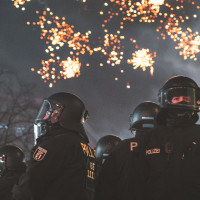
Police brutality has long been a structural feature of German society, disproportionately affecting racialised communities – especially Palestinians and those perceived to be Arab or Muslim. After 7 October this violence intensified, escalated and was normalised under the banner of national security and a crackdown on supposed antisemitism. In the weeks and months that followed, policing practices in Germany reached new extremes: peaceful protestors were dragged across streets, children and pregnant people were assaulted, and entire neighbourhoods were subjected to racialised lockdowns. While Palestine supporters were cast as violently attacking the police in the mainstream media, in reality it was often the police attacking them rather than the other way around.19
Between 7 October and 19 November 2023 alone, the German authorities banned at least 99 Palestine solidarity protests.20 This follows a longstanding trend of banning demonstrations in support of Palestinian self-determination, opposition to the Israeli occupation, or broader criticism of the State of Israel that have been in place in Germany for years. Protest bans then and now were justified using the rhetoric of public order and ‘antisemitic incitement’, even when a call for a protest makes no reference to antisemitism or violence or an event is organised be a Jewish group. The mere possibility that a demonstration might include offensive speech was enough to ban it pre-emptively.21 In effect, this means criminalising not actions but assumptions. Protest bans – often declared minutes before gatherings – allowed the police to justify violent dispersals. The enforcement of these bans was disproportionately targeting racialised areas like Sonnenallee in Neukölln.
Despite German law prohibiting direct police engagement with children under 14 years of age, many minors were caught up in these crackdowns. Children were reportedly detained for waving flags, playing with marbles or displaying maps of Palestine from 1947 to the present day; one child was arrested for allegedly striking an officer’s helmet with a flagpole while sitting on his father’s shoulders. A 10-year-old boy was chased by officers in riot gear.22 A 68-year-old man in a wheelchair was dragged across the pavement by riot police.23 People were beaten, hospitalised, and then charged with assaulting the very police who attacked them.
In Berlin alone, thousands have been violently arrested or dispersed for engaging in constitutionally protected activities, such as holding signs, wearing keffiyehs, or expressing grief for victims in Gaza.24 In the name of fighting antisemitism, Jewish anti-Zionist activists were assaulted, spat on, or arrested for carrying signs reading ‘Jews Against Genocide’, wearing the Star of David in the colours of the Palestinian flag or wearing a kippah with a watermelon motif. As one article noted, quoting Philip Roth: ‘It is too ridiculous to be taken seriously, and too serious to be ridiculous’.25
This surge in violent repression cannot be separated from broader processes of militarisation. The transformation of German policing into an increasingly militarised force has been noted by many activists and commentators. Checkpoints, preventative raids, disproportionate force, and racial profiling have become everyday realities not only for protesters but for entire racialised communities. The brutalisation of protest is just one expression of a deeper authoritarian drift, in which dissent and political speech are criminalised. The crackdown has also revealed how quickly Germany’s already restricted civic space can be closed entirely. Through vague allegations of ‘incitement’, ‘disorder’, or ‘unauthorised symbols’, the state has acquired an alarming capacity to silence political speech.
The Palestine Congress
The Palestine Congress (Palästina Kongress), supposed to be held in Berlin from 12 to 14 April 2024, was a significant event organised by a coalition of Palestinian, Jewish, and international groups. The conference aimed to address and raise awareness about the genocide in Gaza and Germany’s complicity through its military and political support to Israel.
In the lead-up to the event, organisers faced numerous obstacles, including venue cancellations due to police pressure, frozen bank accounts, and a media smear campaign labelling the conference as a gathering of ‘Israel haters’ and ‘terror apologists’. Nevertheless, the conference commenced with an opening speech by Palestinian journalist Hebh Jamal.
Hundreds of attendees were blocked at a checkpoint announced only two hours before the event; those allowed entry were capped at 250, including dozens of militarised officers and media crews selectively admitted by the police. Outside, 2,500 police officers were mobilised, creating an atmosphere resembling a military zone, and attendees were harassed.
The authorities declared the event a Versammlung in geschlossenen Räumen (indoor assembly) without prior notice, granting the police expanded powers to storm the venue against the organisers’ will. Shortly after the event began, police mounted the stage, cut the power supply, and shut down the live stream, effectively ending the conference. Attendees faced harassment, and several were arrested, including a young Jewish activist holding a placard reading ‘Jews against Genocide’.
In an unprecedented move, the German authorities issued a one-year Betätigungsverbot (ban on political activity) against the keynote speakers – the former Greek Finance Minister Yanis Varoufakis, the renowned British-Palestinian surgeon Dr Ghassan Abu-Sittah, and the Palestinian writer Salman Abu-Sittah – barring them from speaking in Germany, even via video. This measure, previously used almost exclusively against Islamic State operatives, was unprecedented in this context.
Dr Ghassan Abu-Sittah was detained on arriving at Berlin Airport, interrogated for hours, and deported. He was informed that participating in the conference, even via video, would be considered a criminal offence punishable by a prison sentence of up to one year. He was subsequently banned from entering Germany and the entire Schengen zone, a decision later overturned by a German court.
The shutdown of the Palestine Congress and the measures taken against its participants have been widely criticised as a severe infringement on freedom of speech and assembly. Human rights organisations and activists have condemned the actions as indicative of the German authorities’ increasingly authoritarian approach towards pro-Palestinian advocacy.26 In November 2025, 18 months after the fact, Berlin’s Administrative Court ruled that the dissolution and prohibition of the congress had been illegal.27

Photo: Faisal Yassin.
Cultural censorship, funding cuts, and deplatforming
I know artists who have no problems in a lot of places around the world, at the Venice Biennale, at New York's best museums – and then Frankfurt cancels them, and this was even before 7 October. I know hundreds of personal stories, most of these cases don’t even become public. The censorship is not new at all. Like, nowhere close to being new – it’s just heightened.
Jamila (a pseudonym)
Since 7 October 2023, Germany has witnessed a staggering wave of cultural, academic, and financial repression targeting individuals and institutions that have expressed solidarity with Palestinians or criticised the Israeli state. Within just a few weeks, artists, scholars, students, and entire organisations faced censorship, cancelled events, funding cuts, and professional retaliation – often for minor actions such as signing a petition years ago or posting contextual analysis on social media. This is taking place in a country where the cultural sector is deeply dependent on public funding, and where state ministries, political foundations, and city governments play a decisive role in determining which voices are amplified and which are silenced.
By the end of October 2023 alone, Diaspora Alliance, a progressive Jewish-led international organisation combating antisemitism and its instrumentalisation, had documented 25 new cases of public sanctions or retracted invitations – almost as many as had been recorded in the preceding nine months. According to a count by the ‘Archive of Silence’, a crowdsourced digital project documenting instances of silencing people because of their solidarity with Palestine, nearly 200 people or events were cancelled, blocked from broadcasting, lost exhibition space, or faced administrative persecution in Germany within the first year after 7 October, 43% of which were from the Arts and Cultural sector.28 At least 62% of these acts of silencing affected people with Black, Indigenous, and People of Colour (BIPoC), Muslim, Arab, Middle Eastern, Palestinian or Jewish heritage, highlighting once again the racialised dimension of the ongoing crackdown. While this trend builds on longer-standing policies such as the Bundestag’s 2019 anti-BDS resolution, the post-7 October landscape has seen a dramatic intensification in scope, speed, and severity.
Among the most emblematic cases is that of Francesca Albanese, the UN Special Rapporteur for the Occupied Palestinian Territories, whose planned lecture at the FU Berlin in February 2025 was abruptly cancelled. The stated reason was ‘security concerns’, but the decision came after heavy political pressure from Berlin’s mayor, government officials, and the Israeli ambassador – who accused the university of being a ‘training camp for Hamas supporters’.29 Police reportedly considered arresting Albanese, and at least 22 police vehicles were deployed around the new venue that ultimately hosted her.30 Reflecting on the experience, Albanese stated:
‘In my three years of speaking about Palestine in around twenty countries, I’ve never encountered anything like in Germany. The real pressure isn’t just on me – it’s on Germans themselves. This is outright censorship and self-censorship. I was shocked by the level of repression at the event I was part of. For the first time in three years, I felt fear. And I’ve lived with security protection, received death threats, yet I’ve never felt this way. In Germany I sensed something profoundly disturbing – an atmosphere reminiscent of historical accounts of fascism, where people fear speaking out.’ 31
Such incidents are part of a broader trend, as can be seen from Table 2, which shows a detailed timeline of incidents of cultural censorship, funding cuts, and deplatforming. Palestinian voices and those speaking up in solidarity with them are not simply excluded, but actively erased. Events are cancelled not only for what is said, but often because of who is speaking.
Table 2: Timeline of cultural censorship, funding cuts, and deplatforming
| What happened? | When? |
| Malcolm Ohanwe, a Black German-Palestinian journalist, was publicly dropped by the Franco-German public broadcaster Arte after posting a Twitter thread that placed the 7 October attack in the broader context of Israeli occupation, the siege of Gaza, and the suppression of Palestinian resistance.32 | 08.10.2023 |
| During a visit to Berlin, the US Senator Bernie Sanders, one of the world’s most prominent Jewish politicians, faced political backlash after stating that ‘the targeting of civilians is a war crime, no matter who does it’. Despite his being a Zionist who has refused to call a genocide a genocide,33 Saskia Esken, head of Germany’s Social Democratic Party, cancelled a planned meeting with him.34 | 12.10.2023 |
| The Palestinian author Adania Shibli was disinvited from the Frankfurt Book Fair, apparently not for anything she said or did, but simply for being Palestinian. 35 | 16.10.2023 |
| The Maxim Gorki Theatre in Berlin cancelled the performance of ‘The Situation’, a play directed by the Israeli director Yael Ronen. In its public statement, the theatre wrote that ‘war is a big simplifier’ and claimed that the attack by Hamas left it with no choice but to side with Israel. In response, Karim Daoud, one of the Palestinian actors in the play, whose two brothers have been imprisoned by Israel for eight years, responded with a statement calling the Gorki Theatre a ‘disappointment’ and its stance of siding with the oppressor ‘shameful’.36 | 23.10.2023 |
| The artist Candice Breitz, together with the literary scholar Michael Rothberg, had planned a symposium on German memory culture and the relationship between antisemitism and racism. The event was cancelled by the Federal Agency for Civic Education, which is overseen by the German Ministry of the Interior. The agency claimed that following the 7 October attacks and Israel’s assault on Gaza, it was no longer possible to conduct the discussion in a ‘constructive and respectful’ manner and cited a period of mourning and solidarity with Israel as justification. Candice Breitz, a South African Jewish artist based in Berlin, has long faced a significant backlash in Germany for her critical stance on Israeli policies.37 | 30.10.2023 |
| The University President in Kassel shut down a student-led vigil for a student who had travelled home to Gaza and was killed together with his family in an Israeli bombardment. Although the university initially approved the event on condition that it should not be ‘politicised’, it interrupted and cancelled the vigil after speakers mentioned the war in Gaza. ‘We lost a friend, and he did not die in a natural catastrophe, we should be allowed to mention the war as the cause of his death’, says one of his friends and organisers.38 | 02.11.2023 |
| The entire 2024 Biennale for Contemporary Photography in the Rhine-Neckar region was cancelled after the organisers objected to Facebook posts by one of the curators, the Bangladeshi photojournalist Shahidul Alam. The posts, made after 7 October, included comparisons between the war in Gaza and the Holocaust and accused Israel of committing genocide against Palestinians. The organisers claimed the posts contained ‘content that can be read as antisemitic and antisemitic content’.39 | 22.11.2023 |
| The Heinrich Böll Foundation, affiliated with the German Greens, withdrew from an award ceremony honouring the Jewish Russian-American writer Masha Gessen after Gessen compared the Gaza Strip to Nazi-era Jewish ghettos. Gessen had been awarded the Hannah Arendt Prize for Political Thought. Following widespread international criticism of this act of censorship, the Foundation tried to repair its image by hastily organising a public discussion with Gessen to deny allegations of silencing dissent. | 14.12.2023 |
| The Egyptian filmmaker Mohammad Shawky Hassan revealed that a Berlin gallery, Haus am Lützowplatz, had demanded prior approval for some writing in Arabic he intended to include in a group exhibition of Berlin Senate grant recipients. Hassan was told that no public writing could be shown unless a translation was provided in advance and vetted by the gallery and its ‘cooperation partners’, allegedly due to city funding requirements. His proposal to paint parts of the wall in the colours red, green, and black was also rejected. On principle, Hassan refused to submit his work for pre-approval.40 | 24.02.2024 |
| The Palästina Kongress (Palestine Congress) in Berlin was violently shut down by heavily armed police shortly after it began (see main text). | 13.04.2024 |
| The philosopher Nancy Fraser, internationally renowned for her work on critical theory, was disinvited from receiving the prestigious Albertus Magnus Professorship at the University of Cologne. Fraser had signed the open letter ‘Philosophy for Palestine’, which the university claimed conflicted with its ‘solidarity with Israel’ stance. Fraser, whose invited lectures had nothing to do with the Middle East, criticised the decision as a dangerous signal for academic freedom in Germany. She warned against what she called a rising ‘philosemitic McCarthyism’, in which political loyalty to Israel is used as a litmus test to police scholars’ speech and associations.41 | 12.05.2024 |
| The University of Heidelberg cancelled a planned lecture featuring Palestinian journalist Hebh Jamal and fellow activist Mahmud Abu-Odeh, citing concerns about potential ‘political agitation.’ The cancellation followed a smear campaign initiated by pro-Israel groups and amplified by German media outlets. The controversy centred on a video Jamal had posted on 7 October 2023, in which she contextualised the Hamas attacks within the broader history of Israeli occupation. Despite the university's decision, Jamal delivered her lecture to a crowd of 250 people outside the campus, turning the cancellation into a larger public discourse on academic freedom and the suppression of Palestinian voices in Germany.42 | June 2024 |
| The Heinrich Böll Foundation commissioned the Israeli writer Tomer Dotan Dreyfus to contribute to an online dossier on being Jewish in Germany after 7 October. Dreyfus submitted an article highlighting the rise in censorship on the pretext of combating antisemitism – and the Foundation refused to publish it.43 | September 2024 |
| On 21 October 2024, Katina Schubert and Martin Schirdewan initiated expulsion proceedings against Ramsis Kilani from the German party Die Linke. They justified the move by accusing him of violating the party’s principles, specifically pointing to his alleged breach of the party’s commitment to a two-state solution and to what they termed ‘Israel’s right to exist’. Despite Kilani's rebuttals and clarifications, the Landesschiedskommission (District Arbitration Commission) of Die Linke proceeded with his expulsion in December 2024. The commission acknowledged that there were no allegations of antisemitism against Kilani and that he had not intentionally harmed the party. However, they cited the media controversy surrounding his activism as detrimental to the party’s reputation.44 | 21.10.2024 |
| The British artist and author James Bridle had their €10,000 Schelling Architecture Foundation award rescinded shortly before the ceremony, after it emerged that they had signed an open letter supporting a boycott of Israeli cultural institutions. The Foundation cited Germany’s recently passed Bundestag resolution ‘Never Again is Now: Protect, Preserve and Strengthen Jewish Life in Germany’, which explicitly calls for withholding support from anyone associated with BDS or criticism of Israel’s right to exist. While the Foundation admitted that Bridle’s views were not antisemitic, it claimed that calls for boycotts were incompatible with Germany’s historical responsibility. The decision was widely criticised, especially given the Foundation's own history: it is named after Erich Schelling, a former Nazi Party and SA member.45 | 18.11.2024 |
| The management of the Altonale Kunstherbst festival in Hamburg cancelled the planned exhibition Hearts of Gaza, which featured drawings by children from Gaza. Although the organisers initially framed the exhibition as a way to highlight the suffering of children ‘on both sides’ of the conflict, they later announced its cancellation, claiming they wanted to prevent any ‘political instrumentalisation’ of the event. Earlier, the exhibition had already been banned from a venue in Erfurt, following pressure from local politicians and a so-called anti-fascist group.46 | 21.11.2024 |
| The Free University of Berlin (FU) cancelled a planned event featuring Francesca Albanese, UN Special Rapporteur for the occupied Palestinian territories, citing ‘security concerns’ and the ‘controversy’ surrounding her visit. The cancellation followed intense political pressure from Berlin’s Mayor Kai Wegner (CDU), Science Senator Ina Czyborra (SPD), and the Israeli ambassador (see main text).47 | 12.02.2025 |
| In October 2023, the office in Tunis of the Friedrich Ebert Stiftung (FES), a political foundation affiliated with the centrist Social Democrats (SPD) party, published a social media post expressing solidarity with Palestine amid Israel’s war in Gaza. The post was removed the following day following directives from FES headquarters in Berlin, which imposed restrictions on such expressions of solidarity. This decision led to significant backlash from local partners. Fifteen participants of FES's youth academy programme publicly announced their withdrawal from the programme, citing the Foundation's actions as a violation of its stated commitment to human rights and democratic values.48 | 02.11.2023 |
| Just before the Palestine Congress in mid-April, the state-owned Berliner Sparkasse froze the bank account of Jewish Voice for Peace’s German chapter, citing unspecified ‘regulatory reasons.’ This was not the first time the group faced financial repression; its account was also frozen in 2019 due to its support for BDS.49 | 28.03.2024 |
| A Berlin district shut down the girls’ centres Alia and Phantalisa, community spaces offering support, empowerment, and educational/recreational programmes for girls and young women and ended the service contracts of their feminist umbrella organisation, FRIEDA Frauen*zentren e.V., with immediate effect. The closures were justified on the grounds that staff members had attended Palestine demonstrations and the Palestine Congress. The decision has been widely criticised as racist and politically repressive. The affected centres provided vital spaces for young people in the neighbourhood, particularly for racialised and marginalised girls, and were staffed primarily by women of colour. Reports suggest the closures were triggered by denunciations to the Berlin Senate, allegedly from pro-Zionist, anti-German social workers.50 | 19.04.2024 |
| The renowned artist Nan Goldin gave a speech at an opening of her retrospective at a Berlin art gallery condemning Israel’s genocide and criticising Germany's repression of Palestinian solidarity. The speech met with an immediate backlash from German officials. Hermann Parzinger, president of the Prussian Cultural Heritage Foundation overseeing the museum, called Goldin's remarks ‘unbearable and dangerously trivialising’. Despite the criticism, Goldin’s speech resonated with many attendees, including pro-Palestinian activists who chanted in support, leading to the interruption of museum director Klaus Biedenbach’s subsequent address. Claudia Roth, Germany’s Culture Minister, condemned the disruption, stating that such behaviour is ‘absolutely unacceptable and an attack on the museum and cultural work’.51 | 22.11.2024 |
| Germany quietly cut funding for the Israeli organisations Zochrot and New Profile, following earlier de-funding of Palestinian NGOs. Zochrot, which promotes public education about the Nakba and advocates for the right of return for Palestinians, lost about a quarter of its annual budget. New Profile, a volunteer movement that supports Israeli conscientious objectors, lost about half of its total funding. While the German authorities gave no official justification for the cuts, the timing strongly suggests a link to the Bundestag’s November 2023 ‘Never Again Is Now’ resolution. Zochrot was previously asked to clarify its position on the concept of a ‘Jewish and democratic state’. Staff described the decision as politically motivated censorship and criticised Germany’s double standards, noting that support was withdrawn from groups actively promoting justice and open debate, while the German government continues to claim it upholds peace and feminist foreign policy. According to reporting by Deutsche Welle, Germany’s decision was not isolated. At least 15 human rights organisations – mostly Palestinian – have lost German federal funding during that time, indicating the politicisation of development funding. Many of them had longstanding partnerships with German development institutions.52 | December 2024 |

Photo: Faisal Yassin.
Livelihood as leverage: workplace consequences of Palestine solidarity
‘I was forced to change positions in my company (under the threat of being fired if I don't agree) after a photo of me at a Palestine protest was featured on the title page of a prominent right-wing newspaper with a headline calling us Jew haters.
I later sued the journalist who took the photo of me despite my clearly telling him that I did not consent, but I lost the case. I also lost all my trust in the German media. There are no journalistic standards anymore. Especially the Axel Springer company [see below for more information] is doing so much of dehumanising reporting, calling people Jew haters because they protest against a genocide.
Amir, a pro-Palestine activist53
‘I was also fired from the Jewish Museum in Berlin—you know, I was one of the very few individuals who actually self-identify as Jewish working in the Jewish Museum, where the entire administration is not Jewish, and they tell me how the world should unfold from my perspective. I found it quite telling.’
Udi Raz, activist with Jewish Voice for Peace
In the aftermath of 7 October 2023, political speech in Germany in relation to Palestine has not only been censored in the cultural and academic sphere, but increasingly punished through professional and economic means. People who expressed solidarity with Palestinians or spoke up against the genocide have faced being sacked, contract cancellations, and career-ending smear campaigns driven by right-wing media outlets that violate journalistic standards and ethics and target certain individuals.
This shows that activism can have material consequences, with the message being sent being ‘speak out, and you will pay’. A social media post, a signed petition, or a comment at work can lead to someone losing their livelihood, professional accreditation, or future job prospects. Each dismissal is meant to signal to workers, artists, and intellectuals that Palestine solidarity comes with a price.
The effects of this repression are far-reaching. Self-censorship has become common, especially in state-funded institutions or sectors dominated by powerful media and political networks. Workers, particularly those with marginalised and racialised backgrounds, are forced to choose between their values and their economic security.
The Fördergeld-Affäre and the crackdown on universities
Universities, traditionally seen as spaces for critical thought and dissent, have issued top-down declarations of unconditional support for Israeli institutions, while remaining silent on, or even punishing, expressions of solidarity with Palestinians.54 On campus, this coincided with heavy-handed policing of Gaza-related protests. The Berlin police cleared a pro-Palestinian encampment at FU Berlin on 7 May 2024, after the university filed complaints and suspended lectures; Reuters reported tents dismantled and protesters being removed, while the university later acknowledged an open letter by the FU faculty sharply criticising the police operation.55 Similar clearances followed elsewhere in the city, including the parliament lawn (26 April 2024) and at Humboldt University, where over 100 people were detained.56 In response, hundreds of academics signed an open letter urging Berlin university leadership to refrain from calling police on their own students.57
Within days, the backlash began. In mid-May, the right-wing tabloid Bild published a sensationalist article branding the signatories as ‘Die Universitäter’, a derogatory play on Universität (university) and Täter (perpetrators).58 In June 2024, media outlets revealed internal emails that showed that officials from the Federal Ministry of Education and Research (BMBF), then led by Bettina Stark-Watzinger, had launched an internal review to examine whether signatories should face funding consequences. Specifically, the Ministry explored whether it could revoke grants or disqualify these academics from serving as reviewers, and whether the content of the letter could have criminal implications –the scandal widely dubbed the Fördergeld-Affäre.59
Stark-Watzinger denied ordering the probe and instead dismissed her State Secretary.60 An internal audit report published in September 2024 failed to solve the core question of whether the minister herself initiated or was aware of the politically motivated scrutiny of dissenting academics.61 Many scholars and civil society actors continue to demand transparency and accountability. What is clear, however, is that a basic act of defending academic freedom in Germany in 2024 triggered surveillance, retaliation, and attempts at censorship from the highest levels of government.
Conclusion
Germany’s unwavering support for Israel’s genocide in Gaza is mirrored by a sweeping crackdown on Palestine solidarity at home. Over decades, authorities have set up a legal-political architecture that intentionally conflates anti-Zionism with antisemitism and can easily be deployed to deflect any criticism of Israel. The state has responded to such criticism with criminalisation, lawfare, police violence, censorship, de-platforming, as well as economic pressure against activists. As a consequence, Germany has changed in discernible ways. Civic space has narrowed as cultural, academic and municipal institutions place restrictions on who may speak and what can be said. Governance has become more securitised, with policing powers and militarism bleeding into everyday life. Platforms, funding, and, as the next longread in this series will show, even residence and citizenship now hinge on adherence to state-defined narratives.
Creditos
Autores
This is the third longread in a series of five based on the Transnational Institute’s report Solidarity under Siege: Germany’s Repression of the Palestine Movement. The first part can be found here and the second part here. The report draws on the insights of interviews with seven activists from the Palestinian solidarity movement, including Palestinians and German, Muslim and Jewish people, among other (overlapping) identities, who shared their trust, stories and time with the author. At their request, pseudonyms have been used for some of these activists.
Mas como esto
-
Solidarity under Siege Germany’s repression of the Palestine MovementFecha de publicación:
-
Germany’s Crackdown on Palestine Solidarity Solidarity under Siege Series: IntroductionFecha de publicación:

-
Germany’s support for the Israeli occupation and genocide Solidarity under Siege series: Part IIFecha de publicación: