Essential Concepts of Land Politics An A-Z Guide
Essential Concepts of Land Politics: An A–Z Guide is now freely available in Open Access.
Taking a broad view of land across the rural–urban continuum, this book advances a holistic understanding of land politics as inseparable from the politics of food, climate, labour, citizenship, and geopolitics. It brings together 67 key concepts that shape contemporary debates on land, offering readers an accessible guide to the ideas, processes, and struggles at the heart of this growing field.
The book demonstrates how land has long been central to both productive and social reproductive activities, underpinning the continual renewal of life and society. Rather than presenting concepts as fixed or neutral, the authors show how they are politically contested and evolve within changing historical and social contexts.
Grounded in the perspectives of Critical Agrarian Studies and the scholar-activist tradition, Essential Concepts of Land Politics provides an essential resource for students, researchers, activists, and policymakers seeking to better understand the dynamics of land, power, and social transformation.
Autores
Autores


Preface
This book is a collection of key concepts on the politics of land. The definitions and meanings we offer for the entries in this book are not technical nor are they politically neutral; rather, they are politically biased. Our ideas are from broadly Critical Agrarian Studies perspectives (Edelman and Wolford 2017; Akram‑Lodhi et al. 2021; Borras 2023; Shattuck et al. 2023) and are framed from a scholar‑activist tradition (Aguiar et al. 2023; Borras and Franco 2023), which means taking the side of the exploited and oppressed.
This book takes a broad view on land, across the rural and urban corridor, although it has a heavier emphasis on the rural. It is a book that makes a coherent and original argument as to how best to understand the politics of land. It can be seen from two perspectives. On the one hand, it is a book that advocates for a holistic view of the politics of land, as an aggregation of land and global social life, and argues that this view can be achieved by bringing selected keywords together so that the sum is greater than its parts. On the other hand, it is a book that offers selected key concepts related to land that are described and examined individually, leading in turn to a bigger and more systematic understanding of land politics. In short, this book argues that a big concept such as land politics can only be fully understood when seen from its disaggregated parts, and at the same time, while each of these parts stands on its own as a separate object of scientific inquiry, they can only be fully understood when seen from the totality that they constitute together.
The main argument of this book is that land has been and remains central to productive and social reproductive activities of humanity for the sustenance of life. Land has multiple meanings to diverse social classes and groups linked through various social relations. How land is controlled, by whom, through what institutional mechanisms, for how long and for what purposes, are some of the questions that animate fierce political contestations around the issue of land control. Such questions have increased in intensity and extent since the contemporary global land rush kicked in around two decades ago. If our starting point is social justice and ecological sustainability, the most urgent questions become how can these be achieved through what kind of land politics? Globally, land remains highly concentrated in the hands of a few dominant classes and social groups, and the state. Land politics must be democratized, but how can this be done in the current context? We address these questions by putting together a description of selected keywords, each of which is written in a way that shows how contested the meaning of that term or concept is in reality.
A key assumption in this book is that the politics of land is made up of building blocks in the form of key concepts. These key concepts evolve, both in the sense that they are politically contested and in the changing broader context within which they are embedded. For example, the meaning of ‘land reform’ has evolved and been contested through time from one society to another. The key concepts in this book are therefore not discussed in a random way but rather framed from a political economy perspective of contestation over land control.
We locate this book in the fields of Critical Agrarian Studies. In this context, land forms a thread in multiple closely related themes, each of which has its own field of studies. More specifically, a broad guiding intellectual and political question behind the framing of this book is how land politics have shaped and been shaped by different spheres of social life, that is, the politics of food, climate, labour and citizenship, as well as geopolitics. We aim to address this question by using conceptual building blocks in the form of keywords in the context of recent political developments, especially the contemporary global land rush. By looking at the parts, we hope to see the whole; by looking at the whole, we hope to reach a deeper understanding of the parts.
In order to deepen and broaden our understanding of the politics of land, this book takes as its immediate context the recent global land rush. The land rush has put the issue of land front and centre in many debates about the future of humanity, from food to energy, from climate to environment. Yet, this is not a book about the land rush; rather, it is a book about a wider issue—the politics of land. It focuses on ‘rural land’, not in an isolationist way, but in relation to the urban.
During the past decade, multiple global crises—involving food, fuel, energy, the environment, climate, finance, labour mobility and migration, and governance—have unfolded from and converged in a common logic: the crisis of large‑scale, fossil‑based, financialized industrial development. The symptoms of the crises include the fact that a billion people go hungry, although the global supply of food is more than enough to feed everyone; the continuing dependence on fossil‑based energy which aggravates climate crises; the increasing role of global finance capital and indebtedness in everyday life; the rise of jobless economic growth, inequality, and mass discontent of citizens over their conditions.
State and corporate responses to these crises have largely been based on the assumption that, worldwide, there are marginal, under‑utilized, empty, and available lands that can be put to efficient use to produce more food and other commodities as well as renewable energy (e.g., biofuel and hydropower). It is assumed that this land can open investment frontiers, generate employment and lead to economic development. This is hailed by neoclassical and new institutional economists as a ‘quadruple win’ for the state, corporations, citizens, and the environment.
It is this assumption that facilitated the recent global commodity rushes for food, feed, fuel, renewable energy, and carbon through nature conservation. All these require a supply of biomass such as soya, sugarcane, corn, palm oil, or trees. The commodity rushes required abrupt and extensive changes in land use and ‘land politics’—in other words, the process of determining who gets what land and how, how much they get, for what purposes, and with what implications. In turn, this has led to what has been popularly referred to as ‘global land grabbing’ or the ‘global land rush’.
The direct impact of these commodity rushes and emerging commodity and land frontier‑making on the half of the world’s population who live and work in rural areas has been far‑reaching, especially in terms of recasting access to space and natural resources. The indirect spillover effects on the (peri‑)urban world are known only partially. Equally important, and even less well understood, is the likelihood that the commodity and land rushes have interacted with, that is, shaped and been shaped by—the five spheres of global social life around food, climate politics, geopolitics, labour, and nation‑state and citizenship.
Past commodity and land rushes, occurring across various phases of pre‑neoliberal capitalism, were numerous and cyclical; they were also sectoral, often localized, intended to open new commodity and land frontiers, and extractive in character. While recent commodity and land rushes represent continuities with past cycles, there are significant differences. In our view, the recent commodity and land rushes were not simple episodic spikes in capitalist commodity markets but have caused, led to, or unleashed regime changes within commodity and land politics as well as in the five spheres of global social life.
For those who saw the solution to global crises as the ‘proper’ use of supposedly marginal, empty, and available land, the land rush was viewed as a rare opportunity for the world economy. In the hands of ‘efficient users’, such land could be exploited to double food production by 2050, promote land‑based climate change mitigation and adaptation, and create investment alternatives for finance capital after the financial crisis of 2007–2008, among other things. The neoclassical economics assumption about ‘marginal lands’ is directed at ‘monetarily low value’ production systems such as shifting cultivation and pastoralism and lands that are not yet fully privatized. These defining factors shaped the geopolitics, agronomy, and political economy of the land rush. Moreover, each sectoral commodity rush ushered in its own array of actors; for example, the biofuel rush attracted those involved in energy, chemicals, auto and aviation, transport, banks, pension funds, food and agribusiness, machinery companies, and others.
But change in land use implies radical changes in land control and associated resources such as water. As a consequence, the commodity rushes have disrupted existing land politics. State actors exploited and contributed to the frenzy by manoeuvring to transform lands into a commodity, recasting rules on land politics. Numerous individual and mafia‑like groupings of entrepreneurs, ‘pioneers’, brokers, thieves, scammers, and swindlers joined in. Initial impacts of the land rush on local communities and societies in general have been significant, albeit differentiated and uneven within and across societies. The land rush fanned the flames of inter‑ethnic tension and xenophobia across the world. Multilateral institutions took note and took action. In 2011, the World Bank reported on the land grabs and recommended a ‘code of conduct’ for corporations.
Studying the impacts of specific land deals often entails looking at the implications for social relations around property, labour, and livelihood; this is the general method that is dominant in the current scholarship. While this is clearly important, other impacts of commodity and land rushes are frequently overlooked. If we want to understand the broader meanings and implications of commodity and land rushes, then it is vital that we examine their impacts far beyond the immediately affected communities, by inquiring into the possible structural, institutional, and political shifts in commodity and land regimes and their relation to the five spheres of social life. This is because the kind of social change that unfolds depends largely on the kind of interaction that occurs between social structures and institutions and across systems. There are no predetermined outcomes in these three‑way dynamic processes. The limits and possibilities of multiple regime transitions (in commodity and land regimes and the five spheres of social life) are partly dependent on the nation‑state’s performance of its two permanent but contradictory tasks: facilitating capital accumulation, while maintaining a historically determined minimum level of political legitimacy (in James O’Connor’s terms). Studying commodity and land rushes allows us to see and understand possible regime transformations that may be triggered not only within commodity and land politics but also in the five spheres of global social life, and how the latter, in turn, have reconfigured commodity and land regime transitions.
We build on our ongoing work on how socially just and ecologically sustainable policies can be advanced by putting together five key agendas for deep social reforms based on the principles of social justice around the redistribution, recognition, and restitution of wealth and power within and across societies, the regeneration of human–nature relations, and issues of representation in state–society politics. Together, these will be referred to as the 5Rs. Policies of redistribution are necessary to address the existing mald‑ istribution of wealth and power, including land access. Policies of recognition are needed to protect the rights of peoples, especially vulnerable groups such as ethnic minorities, women, and youth, where these rights are threatened, including their right to access space, territory, and resources. Policies of restitution are needed to restore access to rights to peoples that have been stripped of them; this will include access to space, territory, land, and natural resources for those expelled from their communities, or social and health insurance for those deprived of such measures. In contrast to dominant economic perspectives, policies of regeneration combine social, political, economic, ecological, and cultural dimensions of social reforms, recognizing, for instance, that land has multidimensional meanings for people, and cannot be reduced to simple economic valorization. Policies based on the principle of regeneration aim to reintegrate narrow reform agendas, such as commodity and land regime transformations, within the broader spheres of human global social life. All the four Rs may exist only on paper if there is no sufficient social force that would fight for them and institutional mechanisms that would facilitate such political struggles in favour of the exploited and the oppressed. Representation, especially of the working people with diverse land questions, is key. We use the 5Rs and concepts such as land regime and land regime democratization both as an analytical lens to understand the contradictions and limits to existing mainstream land policies and politics, and as normative political reference points to see how land politics can be carried out if social justice and ecological sustainability are to be attained. A focus on the 5Rs, land regime, and land regime democratization will ultimately help us to see whether existing sectoral and fragmented approaches to land issues, policies, and politics contribute in any significant way to societal transformations towards a social justice‑based and ecologically sustainable future.
Saturnino M. Borras Jr. and Jennifer C. Franco
The Hague, the Netherlands
Creditos
Autores
Saturnino M. Borras Jr. is a Professor of Agrarian Studies at the International Institute of Social Studies (ISS) in The Hague and is part of the Erasmus Chairs program of Erasmus University Rotterdam, the Netherlands. He is also an associate at the Transnational Institute (TNI) and a Distinguished Professor at the China Agricultural University in Beijing. He was the Editor‑In‑Chief of the Journal of Peasant Studies for 15 years, until 2023. He is the co‑editor of The Oxford Handbook of Land Politics (2025).
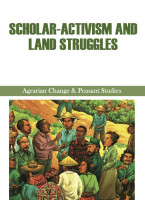
Jennifer C. Franco is a researcher at the Transnational Institute (TNI) Myanmar‑ In‑Focus programme, the Netherlands and an Adjunct Professor at the China Agricultural University in Beijing. She is the co‑author of Scholar‑Activism and Land Struggles (2023) and co‑editor of The Oxford Handbook of Land Politics (2025).
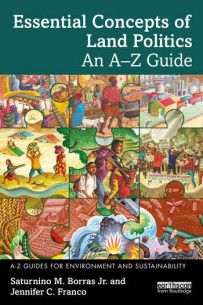
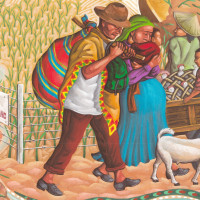
Designed cover image: Cover image is from the paintings of Federico ‘Boy’ Dominguez of the Philippines. The graphic design of the cover is by John B. Tan
First published 2025 by Routledge 4 Park Square, Milton Park, Abingdon, Oxon OX14 4RN and by Routledge 605 Third Avenue, New York, NY 10158 Routledge is an imprint of the Taylor & Francis Group, an informa business
© 2025 Saturnino M. Borras Jr. and Jennifer C. Franco
The right of Saturnino M. Borras Jr. and Jennifer C. Franco to be identified as authors of this work has been asserted in accordance with sections 77 and 78 of the Copyright, Designs and Patents Act 1988.
The Open Access version of this book, available at www.taylorfrancis.com, has been made available under a Creative Commons Attribution-Non-Commercial-No Derivative Licence (CC-BY-NC-ND) 4.0 International license.
Trademark notice: Product or corporate names may be trademarks or registered trademarks, and are used only for identification and explanation without intent to infringe.
British Library Cataloguing‑in‑Publication Data A catalogue record for this book is available from the British Library
ISBN: 978-1-032-65845-2 (hbk)
ISBN: 978-1-032-65841-4 (pbk)
ISBN: 978-1-032-65843-8 (ebk)
DOI: 10.4324/9781032658438
The Open Access version of this book was funded by Erasmus University Rotterdam.
For Product Safety Concerns and Information please contact our EU representative GPSR@ taylorandfrancis.com. Taylor & Francis Verlag GmbH, Kaufingerstraße 24, 80331 München, Germany.
Mas como esto
-
The politics of land Introducing an important new collectionFecha de publicación:
-
Fecha de publicación:
-
Fecha de publicación:
-
Fecha de publicación:
-
Digging Deeper An IntroductionFecha de publicación: