Orlando Letelier – History and memory
Temas
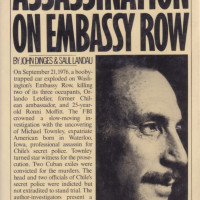
TNI's second director, Orlando Letelier, was assassinated in Washington DC on 21 September 1976. Fifty years later, the political significance of that crime remains undiminished. So too, perhaps more surprisingly, does the personal loss.
Article de


Museum of Memory and Human Rights, CC BY-SA 3.0 <https://creativecommons.org/licenses/by-sa/3.0>, via Wikimedia Commons
Orlando Letelier was many things. He served Salvador Allende's government in Chile in several capacities, including as ambassador and minister. He was a musician, a father, and a steadfast opponent of dictatorship. Pinochet ordered his assassination in one of the most brazen acts of political violence ever carried out on US soil. But how Letelier is remembered by those who met him—even briefly—tells us something about not only what we remember, but how.
Anniversaries often prompt us to revisit the past. As events recede, our relationship with them changes. Immediate grief gradually gives way to historical interpretation; lived experience becomes collective memory, and eventually history. Every generation asks different questions of the past, and every generation finds different meanings in it.
When I arrived at TNI, few of the people working regularly with the institute had actually known Orlando. Alongside our colleagues at our sister institute, the Institute for Policy Studies (IPS) in Washington DC, TNI had spent years seeking justice for Letelier and IPS staff member Ronni Moffitt, who was killed alongside him in the same car bomb attack. Like many people of my generation, I first encountered Orlando largely through official investigations, political histories, and the familiar imagery of the Cold War—an era too often remembered through the aesthetics of espionage rather than the brutality of political repression.
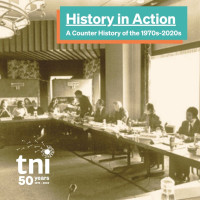
It wasn't until 2024, while researching and writing History in Action, TNI's five-part podcast marking our fiftieth anniversary, that I began to understand how immediate Orlando's loss still feels to those who knew him.
His time at TNI was remarkably brief. Appointed director early in 1976, he spent much of that year travelling between Washington and Europe. The documentary record of his work for TNI occupies only a handful of archival files, now held at the International Institute of Social History in Amsterdam. There are few photographs and fewer recordings.
A researcher relying on those archives alone could easily conclude that Orlando's role in TNI's history, though important, was relatively limited. The interviews told a different story.
Preparing History in Action meant conducting dozens of interviews and listening through hours of often chaotic, poorly labelled archival recordings. Together with Shaun Matsheza and Daria Gorshenina, I spoke with many people who had been involved with TNI during its earliest years.
Again and again, Orlando emerged not simply as an effective political leader, but as someone who left a lasting impression on almost everyone he encountered.
TNI's founders had ambitious hopes for the new institute. It was an experiment with few precedents, and one whose spirit we still try to honour today. Looking back over fifty years, perhaps TNI's greatest achievement has not been any single book or campaign, but its ability to bring people together across movements, disciplines and continents.
That ability rests on political commitment, intellectual rigour and solidarity. It also depends on qualities that rarely appear in annual reports or publications: generosity, hospitality, curiosity, friendship and joy.
Those qualities surfaced repeatedly in the interviews. Susan George is rightly remembered as an extraordinary intellectual and an uncompromising voice for justice. Yet people also remembered her elegance, warmth and mischievous sense of humour. Similar memories recur across conversations about TNI's directors, fellows and staff. Taken together, they suggest that these weren't incidental personal traits. They became part of the organisation's culture.
Again and again, people described Orlando in those same terms. He treated everyone with attention and curiosity. He listened carefully, seemingly convinced that everyone had something worth teaching him. He loved literature, played the guitar, and relished long conversations. None of this was entirely new to me.
What surprised me was the emotion. Nearly fifty years later, many of the people we interviewed still struggled to speak about him without becoming visibly moved. Some had only known him for a matter of months. Others had met him only a handful of times. Yet they remembered, with remarkable consistency, how he had made them feel.
Archives preserve decisions, correspondence and institutions. Oral histories preserve something else: how people inhabited those institutions, and how they shaped the lives of those around them. Eventually, memories fade, witnesses disappear, and the archive becomes all that remains. But before that happens, oral history allows us to recover dimensions of the past that no official record was ever designed to capture.
Yes, Orlando led a public life of enormous consequence. He is remembered as charismatic, handsome and courageous; as a devoted father and committed public servant. But what emerged most clearly from those interviews was something quieter. He made people feel seen. It is difficult to imagine a more enduring legacy for someone whose work was rooted in solidarity.
When Pinochet's regime stripped Letelier of his Chilean citizenship, he replied:
I was born a Chilean,
I am a Chilean,
I will die a Chilean.
They, the fascists, were born traitors,
live as traitors,
and will be remembered forever as fascist traitors.
As we mark fifty years since Orlando Letelier and Ronni Moffitt were murdered, there will rightly be renewed attention to their political lives and to the struggle for justice that followed. But the conversations recorded for History in Action offered another reminder. Institutions are shaped not only by ideas and decisions, but by the people who embody them. Some legacies are measured in publications, campaigns or victories. Others endure in the cultures they help create, carried forward in memories that, for a while at least, can tell us things no archive ever will.
Creditos
Autores
Mas como esto
-
History in Action A counter history by the Transnational InstituteFecha de publicación:
-
Fecha de publicación:
-
Fecha de publicación:
-
Transcript of Orlando Letelier's Speech at the Felt Forum Madison Square Garden, 10 September 1976Fecha de publicación: