Land, Forests and the Struggle for Survival A Three-Decade Journey in Ye Chaung Phya (Bee Ree)
Regions
A Commentary by Kun Wood*
Land is vital in the struggle of the Mon people for survival, political freedom and human rights. Protection and ownership, however, have fallen victim to the cycles of conflict since Myanmar’s independence in 1948. In this eyewitness commentary, Kun Wood analyses the challenges and loss felt by Mon people, both farmers and those displaced by civil war, in the Bee Ree region since the 1995 ceasefire of the New Mon State Party with the military regime. New land policies and the adoption of restitution, redistribution and regeneration principles offer hope. But there is still a long way to go.

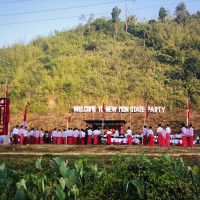
Photo credit: Kun Wood
“When we first arrived in that region, the forests were dense, wildlife and fish were abundant, and the weather was extremely cold during the winter. It was also an area where malaria was very prevalent. I remember frequently falling ill with malaria; even today, I can still recall the bitter taste of the medicine provided by the clinic. At that time, the land and forests existed in their natural state, quite unlike how they appear today.” From the author’s journal
Introduction
So much has changed in the world over the past few decades, including the quality and condition of the landscapes in which people live and all the life – human and non-human – that is connected to it. How human societies see and relate to these landscapes has changed too.
This is especially the case in Myanmar. Here land is not only a symbol of ethnic identity for the indigenous people but also an absolute necessity for their survival. Disputes over land have been a driving force behind nearly 80 years of civil war in the country. People rely on the land to cultivate crops and trees to generate income for their livelihoods. Without land, it is as if their lives are lost. Land represents more than just sustenance; it is a heritage passed down through generations.
The Mon, a people of long history and culture, believe that land is a foundation upon which all living and non-living things depend. For us, land and the Mon people are inseparable. Land is essential for our economy, health, education, social welfare, and it is a legacy that must be handed down to future generations.
This commentary is an account of how life and land evolved from the 1990s onward in the Ye River headwaters area of Mon State, a territory known as the Ye Chaung Phya region. Mon State is well known for its vast rubber plantations, but in the Ye Chaung Phya region rubber cultivation is less common compared to other areas of the state, while betel nut plantation is more prevalent.
The author is a local resident who arrived in the Ye Chaung Phya region with their parents in 1995 to live in a camp for displaced people until 2006. The account is based on personal lived experience as well as interviews with current residents and migrant workers currently living in Thailand and Malaysia.
Brief background
Following the fall of the Mon Kingdom of Hanthawaddy, the Mon Revolution was reborn in 1948, with the aims of national equality, the right to self-determination, and the establishment of a federal union alongside other ethnic nationality peoples in the country. Founded in 1958, the New Mon State Party (NMSP) has been the main revolutionary armed organisation that the Mon people have historically relied upon. For a long time, the NMSP participated in the revolutionary struggle alongside other ethnic armed groups.
Then in 1995, the group signed a ceasefire agreement with the military regime of the SLORC (State Law and Order Restoration Council). As part of this agreement, the Mon population under self-administration became scattered across five, non-contiguous pockets of NMSP control. One of those areas was Ye Chaung Phya, generally referred to as “Bee Ree” in the Mon language after the river which flows to Ye town.
Ye Chaung Phya is important to the NMSP. It is also a significant place for many Mon people. It is an ideal location for rebuilding the lives of those who have faced various hardships due to many reasons. It is a place where rehabilitation efforts were carried out together with the Mon people after the NMSP entered the “legal fold” (“exchanged arms for peace”) in 1995. The Ye Chaung Phya (Bee Ree) area thus holds deep meaning that goes beyond mere rehabilitation; it is a place where the dreams, lives and homes of the Mon people are reborn. Many Mon people have a dream to live under our Mon autonomy and authority. This land is part of that dream. It is the land where we the Mon people would like to live. Bee Ree is not just a piece of land. It is the land we can call our “Homeland”.
The Ye Chaung Phya region has seen profound change over the decades since Myanmar’s independence in 1948. Over the long course of civil war with its many damages and impacts, the Mon people lost vast amounts of ancestral land and were forced to flee their homes in different parts of the country. As a result, many Mon civilians became victims of the conflict and had to abandon lands held by their families for generations.
A significant wave of land confiscations then occurred in Mon State between 1990 and 2010. The primary actor in these seizures was the Burma military (Tatmadaw or Sit-Tat), often for the purpose of battalion expansion and accompanied by many human rights violations. Other actors involved in land seizures included domestic and foreign companies as well as various government departments.
Who were the people arriving in the Ye River headwaters?
Following political instability during 1988-92, marked by widespread human rights violations and forced labour, over 10,000 people arrived at the Thai-Myanmar border. Some ended up in refugee camps in Thailand. Others have struggled for survival for decades since as undocumented migrant workers in the Thai economy.
Mi San Nwe (56) is currently a migrant worker living with her family in Kanchanaburi, Thailand. She works as an undocumented sugarcane harvester. She left her village in Mon State even before 1995 due to the poor political situation. Despite working in multiple jobs, her earnings only cover daily food, leaving no savings to return home. She dreams of a stable home where she can feel a sense of belonging:
“Of course I want to go back to my village, but I can't yet. My life is sinking here while I keep working. Here, I am just a guest. They only feed you if you can work. If one plantation doesn't work out, we move to the next. There is no permanent place to stay, not even a permanent bed.”
Despite the 1995 ceasefire agreement between the NMSP and the SLORC regime, human rights violations in Mon State persisted, and continue even now until today. While many people fled to Thailand in the 1990s as refugees or migrant workers like Mi San Nwe, others arrived in Mon State’s Ye Chaung Phya region. Most who ended up in Ye Chaung Phya were ethnic Mon. But during the 1990s the new arrivals also included people who identified as Dawei, Bamar, Karen and Pa-O. Some had fled due to the civil war. Others arrived seeking relief from various other kinds of crises, including land loss and humanitarian emergency. They came looking for a place that felt like home, such as Nai Hayu (67):
“Our old village wasn't safe; they [the Tatmadaw] seized people for portering. We lived in fear. We believed that, if the NMSP established a resettlement area here, we would be safe and could earn a living. When I came, the children were small and the journey was difficult. We had to walk, carrying bundles in one hand and children in the other. It was hard, but we were happy.”
These arrivals in the early 1990s came from all walks of life, though most were landless. They included farmers, carpenters, shopkeepers, teachers, medics and businesspeople – some fleeing with nothing but the clothes on their backs. Over 90 per cent of them owned no land at the time. As Mi Ree (67) recalls:
“When we arrived, there were no motor roads. We walked for three or four days. This place was a dense forest with massive trees and no shops. We had to carry our own rice and cook along the way. In winter, it was freezing and malaria was rampant. You would just shiver with fever. We came because we wanted to build a new life near the NMSP. We were exhausted by the fear we faced living in other parts of Mon State. We just wanted to plant a small orchard and survive.”
Early settlement and land distribution
The first arrivals settled along the riverbanks and in areas where cultivation was relatively easy. They cleared wild land to plant upland rice (mountain rice). Due to transportation difficulties, seeds were extremely scarce. As word spread that the NMSP had established a safe haven, more conflict-affected people arrived. To manage the growing population, the NMSP began partitioning land. People built houses using bamboo and small timber wood that they collected from the forest. They planted food crops in their residential plots, including Mi Chin (75):
“I remember cutting bamboo and everyone helping each other build houses. I was young then with four children. We grew vegetables next to the house. We could forage for fish and meat since there was nowhere to buy food and we had no money anyway. Everything has changed now.”
At that time, the forests were pristine, with trees so large it took two or three people to encircle them. Because of the thick forest canopy, the climate was very cold and the rainfall was abundant. The soil was rich, natural virgin land, teeming with biodiversity and wildlife. One didn't need to buy food; you could fish in the stream or hunt. Even if you had money, there were no markets. A trip to Ye town took a day and a night by foot. In the rainy season, travelling up the Ye River by boat was dangerous due to the many rock formations and rapids. Despite this, the river remained the lifeblood for transportation, survival and social connection.
To help with the new arrivals, humanitarian groups provided some aid – medicine, warm clothes, mats, fish paste, salt and rice – but it was never quite enough. In the deep forest, almost everyone contracted malaria. Some died. According to Mi Mi (30), who experienced this:
“When I first arrived, the fever was indescribable. Coldness in your very bones followed by shaking. Malaria was terrible. Luckily, there were clinics that gave us medicine – those 'head-splitting' pills (mefloquine and chloroquine). They made your head spin so much you felt upside down. It was cold, and they told us to bathe to break the fever. Just thinking about that medicine makes me dizzy again.”
As the population grew, food security then became a challenge. To survive, the people needed land to cultivate. Around 1995, the NMSP began a formal land distribution process. Village leaders, those with local geographical knowledge and NMSP officials led the discussions. Subsequently, they distributed tracts of natural forest land to every family.
In response, some people initially refused the land because they lacked the seeds, capital and labour to clear such dense jungle. At the same time, shortly after the ceasefire, the NMSP permitted timber extraction in the region. Before the timber was cut, bamboo and rattan were harvested first. Some individuals were also more interested in the timber and rattan trade than in long-term farming. Those who declined their land plots would jokingly be told they had to "pay" a chicken and a bottle of liquor to the community.
Initially, land wasn't divided by exact acreage but by natural landmarks. For example, one person would own the side of a mountain where the water drained south, and another would own the side where it drained north. The first crops planted were upland rice, followed by bananas, with betel nut trees planted alongside the bananas. The soil was so fertile that the rice was excellent and full of flavour.
Not everyone, however, could maintain the demands of farming. Clearing the forest required tools and stamina, and planting required capital. Those with a little investment would plant upland rice the first year, followed by bananas, betel nut and rubber in the second and third years. Those struggling financially stayed with a cycle of upland rice. But, as the same plots were used repeatedly, the soil quality and rice yields began to drop. As Nai Shwe (47) recounts:
“When we first got the land, the rice was great. We didn't have to plant much, and the taste was wonderful. Later, I noticed the rice didn't taste the same. I think the soil lost its 'flavour’, and the mountains are becoming bare now.”
Once the available land was exhausted, the cycle would then begin again on the same plots. According to Mi Bray (56):
“When we arrived, the NMSP gave us land. Using a little bit of capital and the rice support from the Mon Relief and Development Committee, we prioritized planting a betel nut orchard. My husband sometimes went to work on timber rafts to earn extra money. He’d work the orchard, but if someone called him to help float logs, he’d go. Here, we don't have to pay much for the clinic or school fees. We thought that once the betel nut trees bore fruit, our family would be self-sufficient. Now we have over 3,000 trees. It’s enough for us to live on – as long as the price of betel nut stays good.”
When land was distributed, the NMSP’s Department of Agriculture and Forestry issued land receipt certificates. To obtain this certificate, a fee of 50 Kyats was required. In more recent years, the cost for a land grant document has risen to 5,000 Kyats.
At the time of initial distribution, the NMSP did not have a comprehensive formal land policy. Since August 1972, however, the party has maintained a fundamental land principle: “The tiller must own the land.” According to this principle, farmers have the right to own the land they cultivate, the right to increase crop yields, and the freedom to transfer or sell their land.

Photo credit: Kun Wood
The timber industry: economic opportunity and the environmental cost (1995–2013)
The timber industry was inextricably linked with land distribution. In the early days, the main village consisted of about 50 to 60 households. Few people were engaged in timber work in 1995. But the numbers of those arriving solely for business – rather than fleeing conflict – grew steadily between 1995 and 2010. They came specifically for timber extraction. Most of these newcomers were Mon, with minorities of Karen, Bamar and nationalities from other regions, largely hailing from Mon and Karen States. This diverse influx included timber merchants, loggers, raft pilots and elephant mahouts for hauling logs. As the area was under NMSP control, permission for timber extraction had to be obtained from the party. According to Daw Mee (67), a former timber worker:
“When we started, timber was 4,000 Kyats per ton, with a tax (royalty) of 1,500 Kyats per ton. Small-scale timber production existed even before the village was fully established. When the timber business was eventually restricted, the transient workers returned to their homes, but the displaced persons stayed to plant orchards. They passed these orchards down to their children and grandchildren. Back then, daily wages were 50 Kyats for working at sawmills or as day labourers. There were no big companies then; people worked at a slow, manageable pace. Timber was transported by raft until the motor road arrived between 2006 and 2010.”
To support the industry, the NMSP granted timber rights to both local residents and outsiders, generating significant tax revenue for the party. Villagers were initially happy as money circulated freely; piloting timber rafts was a lucrative way to earn a living. Rafts were floated from the village down to Ye town. But, while this improved family livelihoods, the urban elite often had more opportunities. Local villagers lacked the significant capital required for large-scale timber operations and could not compete with wealthy investors. Consequently, many locals became labourers for outside investors.
Over time, the licensing shifted from small-scale local operations to granting permits to outside companies. While most timber investors had little interest in land ownership, some wealthy individuals bought up prime locations. Generally, however, those in the timber trade remained focused on extraction rather than agriculture. Mi Wu (36) also used to work in the timber extraction:
“As a local, the NMSP’s decision to allow timber extraction was good, but since we lacked capital, the profits didn't stay with us as much as expected. We did the hard labour. Floating timber rafts means risking your life; if something goes wrong, you can die. People from outside had the cash to invest. My husband drank, so very little of the money from a raft trip ever made it home. Far from investing in an orchard, we struggled just to have enough to eat.”
As Daw Mee (67) recollects:
“In the past, we only took large logs, about 18 feet long. A single tree could yield 10 to 15 tons of timber. Some was sold in Anan Bone (the current village), while others were floated to Ye by raft. From there, merchants would take it to other towns. We mostly sold to our regular customers in Ye; we didn't sell elsewhere because the checkpoint fees were too high. Some timber went to Asin to be used for fishing boats, and some went to sawmills in Ye to be processed into finished products for sale.”
While the NMSP did not explicitly mention timber production in its public ceasefire agreements with the military government (SLORC: subsequently SPDC), the industry flourished post-ceasefire. The NMSP likely viewed timber as a means to support regional development and fund the party's requirements. However, the exact extent of the profits gained since 1995 remains unclear. Furthermore, calling it “development” is debatable because the extraction came at a high cost – not just for the people, but for the environment and climate.
The evidence is stark. The vast forests of the past have vanished. Today it is difficult to even find a tree stump, and the streams are no longer clear and clean.
Timber operations and landowners
Although the NMSP distributed land, the party could not provide agricultural support. Consequently, many people stuck to upland rice farming because there was enough land for it at the time. Some families managed both orchards and timber rafting, investing their timber earnings into their farms. Timber provided quick, easy cash, but many raft workers returned with little savings. Between 1999 and 2000, floating a ton of timber to Ye earned between 5,000 and 30,000 Kyats, depending on the wood's density.
As transportation improved between 1995 and 2000, the population grew, and the village footprint expanded from 60 houses to nearly 100 by the year 2000. New arrivals began applying to the NMSP for land to cultivate. Unlike the early days when people were indifferent to land, these newcomers specifically came to establish long-term orchards. Since perennial crops like betel nut take six to seven years to harvest, farmers needed alternative income to survive the waiting period. By 2009, the village had grown further to approximately 300 households. With better roads came access to saplings, fertilizers and pesticides. While only a few early settlers had enough capital to become fully self-sufficient through betel nut farming, more than half the population owned land but lacked long-term crops, relying instead on the cycle of clearing "wild land" for upland rice.
By 2010, land prices had also markedly risen. Under NMSP land rules, land could be sold or inherited. Thus newcomers generally began buying plots where trees were mid-way through their growth cycle, even if they weren't yet bearing fruit. Plots near the village were particularly high in demand. But some families facing financial hardship were forced to mortgage their land grants to wealthier individuals.
The situation, however, changed the same year when the military regime unsuccessfully tried to pressure the NMSP to transform into a Border Guard Force. Many residents fled to nearby areas in fear, and they only returned once negotiations stabilized. Subsequently, although the NMSP had permitted timber extraction since 1995, the party leadership halted all operations in the Ye River headwaters in 2013 due to the severe deforestation. According to Mi Ree (56), a former timber worker:
“They let the Htoo Company work for about two years and then the timber was closed. Villagers weren't allowed to work it anymore. When it was given to the company, villagers lost their rights. If they had let the villagers continue, we might still be working today. Now, the closure makes it difficult even to get wood to build a house.”
It has now been 11 years since the timber ban took complete effect. The community has dispersed. Some people have gone to Thailand, others to different regions in Myanmar for work, and many have become day labourers. Only those with established orchards have remained, relying entirely on their plantations for survival.
From timber to orchards: landscape changes after the cessation of timber production
After 2013, the NMSP’s land administration system underwent several changes. Alongside political shifts, the population in the region increased as more people arrived seeking political and personal security. Those who had originally come for the timber industry gradually moved elsewhere once extraction was banned, leaving behind only the local residents who had been involved in the trade.
This transition brought immediate economic hardship. Without timber as a source of income, residents turned their focus toward the land. While there was a strong desire to develop orchards, the lack of supporting capital made it difficult. Some who had received land between 1995 and 2000 began selling off portions of their plots, using the proceeds from one section to fund the planting of betel nut or rubber on the other parts. In the Ye Chaung Phya region, betel nut became the primary priority.
These changes continue. In the past, land was cheap, and there was little motivation to acquire large tracts. Now, as outsiders arrive and available land diminishes, the landscape is tightening. Newcomers with some capital are buying up land to cultivate. Those without means apply for land through village elders to the NMSP. The NMSP, in turn, continues to conduct land distribution rounds in coordination with village and district officials. However, these newer plots are often further from the village and come with stricter conditions. In particular, recipients must cultivate the land within three years or the NMSP will reclaim it.
In earlier years, meanwhile, there had been no limits on acreage or the number of owners due to the low population. To raise revolutionary funds for the NMSP, land ownership certificates were issued somewhat easily. Furthermore, due to limitations in technology, finance and human resources, systematic surveying was not possible when issuing these “land grants”. While rough sketches were provided for some plots, others were issued based on estimated acreage calculated “over a desk”.
Since this time, administration has evolved, and applying for a land grant currently involves a measurement service fee of 5,000 Kyats per acre. However, if a dispute arises regarding NMSP-issued grants and re-measurement is required, no additional fee is charged. Beyond the service fee, the NMSP also collects annual land-use taxes based on the crop type (betel nut, rubber, paddy etc.) and issues official tax receipts. Land therefore remains an important source of income.
The land landscape between 2010 and 2024
Since the end of the timber boom, land has become a market commodity. Land grants have become essential documents for securing credit, and they are frequently used as collateral for loans from wealthy individuals. While some families are able to redeem their land, many cannot. Disputes over these transactions sometimes require the NMSP to act as a mediator.
As original landowners gradually sold off parts of their property to survive, some eventually became landless. With no other livelihood options, many migrated to neighbouring Thailand for work. Meanwhile, land prices have skyrocketed compared to the past, attracting outside buyers. The NMSP grants owners the right to sell, mortgage, exchange or inherit land, but these transfers must be officially processed through village or township offices with the approval of local chairpersons and elders rather than through private informal agreements.
In summary, the situation has reversed between 1995 and 2023. Many early settlers have had to sell their land for basic sustenance. Reasons vary. Some had spent too much time on timber and failed to invest time in their orchards. Timber, though, proved a temporary boom and was not a sustainable long-term livelihood. But those who reinvested their timber profits into orchards are now relatively self-sufficient, whereas many who received land in the 1990s have now fallen into landlessness through the challenging circumstances.
Why is there a disparity between small and large landholdings?
Although the NMSP has a “Land Policy”, the lack of robust, formalized laws meant that early land distribution was difficult to regulate. If land was distributed equally to everyone, why did some end up successful while others became landless?
A number of reasons are given by local people. But a common factor is the administration of land distribution, especially in its early days. Because there were no initial caps on maximum or minimum acreage, those with stronger financial backgrounds gained an advantage, while the poor found land ownership to be a burden which they eventually had to drop. In particular, since the first arrivals were war refugees, most lacked capital. Balancing the cost of living with the cost of developing raw land thus proved impossible for many. For this reason, it is believed that, had there been a more solid institutional mechanism or agricultural infrastructure in place following the 1995 ceasefire, the land distribution might have been more successful.
This is not to place blame, as the NMSP was also struggling to sustain itself with a multiplicity of challenges in the post-ceasefire landscape. However, the outcome was a significant disparity in who actually benefited from the land. For a family where only the parents work, escaping the debt trap is nearly impossible. Only families with adult children who can provide multiple streams of income – some working the farm while others work outside – have managed to maintain and expand their landholdings.
Case study: A-Chan’s family
A-Chan’s family consists of seven members. His mother was chronically ill (and has since passed away), and his eldest sister ran a small home-based tailoring business. A-Chan, the second son, worked the land with his father. They moved to the village because of financial failure elsewhere. When they arrived, they survived on rice aid from Mon relief groups while foraging and hunting for side dishes.
The family believed that farming was the only way to achieve long-term food security. They received land from the NMSP after 2010. A-Chan and his father did the heavy clearing, while the sister’s tailoring income funded the necessary seeds, fertilizer and tools. A-Chan also worked as a day labourer on other people's farms to earn extra cash for their own orchard. After 6–7 years, their betel nut trees began to bear fruit. As the younger siblings grew up, they joined the workforce. Today, after ten years, the orchard is fully mature, and the family is self-sufficient. As Nai Ba Right (56), who is from the same village, recalls:
“Since the village was first established, we used to share the mountain slopes with one another. Now, that is no longer the case; everything must be bought. In the past, prices were affordable. If you wanted fish, you could just ask a neighbour; now, you have to buy everything. We used to build houses collectively, but those traditions have disappeared here. I’m not sure if it's because the village grew too large or because the population has become so mixed, but those customs only remain in some other smaller villages now.”
Currently, about 10 families own between 70 and 80 acres of land within this village of over 300 households. They cultivate hundreds of thousands of betel nut trees and produce high yields. These families possess significant capital and have more than enough to thrive. They hire local villagers to work their plantations, as their own family members cannot manage the workload alone.
Of the other residents, approximately 100 households are estimated to own medium-sized plots of 15 to 20 acres. These families are generally self-sufficient and occasionally hire a few labourers. In some of these cases, family members work abroad and send money back to invest in the farm. Tasks like clearing weeds, splitting betel nuts and drying them are mostly handled by the family, with only minimal outside help.
In addition, a further 100 households or more own between 3 and 10 acres. These families rely solely on their orchards, but their yields are often insufficient for basic survival. The rest of the population, in the meantime, is landless. Among the landless, some work odd jobs locally, while others have migrated to Thailand. Many of those who left sold whatever small plots of land they once owned.
The ownership trends are evident. Although the original intent of land distribution was for everyone to own land, the differences in historical backgrounds and initial resources have led to vastly different outcomes over time. It remains unclear, though, exactly how many of the original families who arrived in 1995 still retain their land. Much has happened during the past thirty years.

Photo credit: Kun Wood
Challenges in land distribution
While the NMSP’s land distribution was a positive initiative, it is crucial to recognise the impact on different social classes. Land is a finite resource; once the primary “wild” (natural) forest is cleared and partitioned, it cannot be reclaimed. Today a significant wealth gap has emerged.
As land prices rise, the landless are left with two choices: migrate abroad for work or stay and work as day labourers for large plantation owners. Instead, newcomers with capital are now the ones buying up productive orchards as investments. But, while the land distribution process was inclusive of various ethnicities and religions, the representation of local residents in decision-making remains vital.
At the same time, there has been a weakness in “regeneration”. While replacing natural forests with perennial orchards keeps the landscape "green”, the ecological benefit is not the same as a natural forest. Furthermore, local youth show very little interest in traditional plantation work, posing a major challenge for environmental and cultural preservation into the next generation.
The NMSP and political uncertainty
Although the NMSP signed a ceasefire in 1995, political stability in surrounding regions has remained elusive. While land distribution was a good outcome, the high level of local needs makes sustained success difficult. Owning land alone is not enough to survive; one needs capital to develop it.
For large families with low income and no savings, the pressure to sell their land is immense. The outcome and range of choices is only different for families with multiple able-bodied members who can provide diverse income streams.
The perception of land ownership also varies. Some residents never fully trusted the long-term guarantees of the ceasefire. Others felt they had no choice and saw the land as their only opportunity, working hard to make it productive. Because people started from different socio-economic positions, equal distribution of land did not result in equal benefits. For this reason, the process might have been more successful if there had been stronger political guarantees and a robust land policy to regulate maximum and minimum holdings.
Rural infrastructure and local markets
It takes 8 to 10 years for a betel nut tree to mature. Without capital to survive these years, it is nearly impossible to maintain the farm. If you can't afford to clear the weeds, the trees won't survive. Many farmers take out loans, and by the time the trees are productive, most of the income goes straight to the creditors. This year, the cost of supplies has surged, yet betel nut only provides an income once a year. According to Nai Shein (49), who owned a small betel nut plantation:
“Since we no longer grow rice, we depend entirely on shops in town for our food. In years when the price of betel nut is low, we struggle. This year, life is a bit easier because Chinese buyers are purchasing young betel nuts; otherwise, it would be very difficult with the rising cost of goods.”
The markets for village produce are distant, and transportation is difficult. Local farmers are entirely dependent on the market prices in Ye town. No matter how good the harvest is, if the town market price drops, a year’s worth of investment is wasted. Betel nut prices can fluctuate wildly from 10,000 Kyats per viss (about 1.6 kilos) to as low as 1,500 Kyats, driving many into debt. Those with capital can wait for prices to rise, but the poor are forced to sell immediately at any price to survive.
While their crops fetch low prices, the inputs they need – fertilizer, gasoline for weeding machines, and food – must also be bought at high urban prices. At the same time, the region is not self-sufficient in rice. Thus staples like rice, onions, salt and oil must all be purchased. You cannot eat betel nut for dinner. Similarly, lime trees and bananas often go to waste or are left for the birds because the cost of transporting them to the city is higher than their market value.
Land distribution and the natural resource exchange
The 1995 land distribution was essentially an exchange of natural resources for settlement.
Dense, green forests were cleared to make room for cash crops. While timber production was reduced after 2013, many cleared areas were never properly reforested with natural species. Against this backdrop, those living in the region since 1995 have witnessed the resulting climate change firsthand: water scarcity, extreme heat, irregular heavy rainfall and soil erosion. The massive trees that once took three people to encircle have vanished, leaving not even a stump.
We must therefore ask: was the trade-off of land distribution worth the environmental loss? How much reforestation has actually occurred? But, without formal forest laws, there has been little to no regulation. Land, forests and water ecosystems are not easily replaced. Land distribution must consider ecological sustainability and climate resilience, not just social justice.
In the meantime, the connection between the people and their natural environment has weakened because there was no systematic land management. Individual profit is often prioritized over collective conservation. The lack of strong local farming collectives has also made it too easy to treat land as a mere commodity to be sold.
For the NMSP, rehabilitating the lives and homes of internally displaced persons (IDPs) who have come under their care is a heavy burden. In terms of rehabilitation, addressing areas such as education, healthcare, social welfare and basic livelihoods is no easy task. Furthermore, for long-term survival, agriculture – which is the primary livelihood of the Mon people – is a crucial component. Therefore, to distribute land to the displaced people arriving in NMSP-administered areas, natural green forests had to be cleared and converted into betel nut plantations for agriculture.
Implementing such initiatives requires a significant amount of policy support, financial investment and human resources. However, certain weaknesses were observed during the land distribution process by the NMSP. In particular, the lack of robust policies and the absence of a dedicated land department were seen as major setbacks in the implementation phase.
Although efforts were made to ensure broad representation in land distribution, women's participation was found to be weak in some areas. Additionally, because there is no stable market for the crops harvested from the distributed land, the outcomes have not met expectations. Finally, a highly critical consequence is that clearing forests for land distribution has led to severe deforestation, which the natural environment and local communities now have to face.
During the Mon National Conference in 2022, a policy concerning all Mon people and all citizens residing within Mon regions was successfully approved, known as the “Mon Region Land Policy”. This policy was drafted based on the voices of citizens living in the Mon regions, civil society organisations, relevant leaders and local residents. It contains standards regarding land, water and natural resources for the future NMSP. In addition to affirming the principles of democratic participation and representation in policy-making, it also includes basic principles regarding land redistribution, recognition, restitution, representation and regeneration which will guide future land administration (the “5Rs”).1 These mark key policies and statements of intent, but there is still a long way to go.
Conclusions
To end this description, it should be noted that this analysis was not written with the intention of harming the individual interests of anyone. Rather, based upon collective experiences, the purpose is to draw and learn lessons from the social, political, economic and ecological history of land in the Mon region.
The challenges remain grave. Mon lands, like many parts of modern-day Myanmar, remain in conflict and yet to enjoy sustainable peace. But through discussion and reflection, it is trusted that informed policies can be developed, even during the most challenging of times, which are vital for the preservation of the natural environment, the protection of land rights for all and progress of the Mon and other nationality peoples into future generations. This, it is hoped, will build into the longer-term process of societal rebuilding and conflict resolution.
For its part, the NMSP faces immense responsibilities, as it must execute rehabilitation work alongside land redistribution. The people arriving in the Ye Chaung Phya area carry dreams – dreams that include gaining full ownership of their land. The Ye Chaung Phya area is not merely about a piece of territory; it represents the broader Mon dream to secure complete rights over land ownership, management and decision-making.
Rehabilitation, however, requires substantial financial resources, people power and technical expertise. Because the NMSP cannot meet these vast requirements alone, the collective participation and input of the public are essential. Even so, clear-cutting wild natural forests to secure necessary funds creates a loss that cannot be easily recovered. Sadly, natural forests have been sacrificed for too long so that the local people can rebuild their lives and homes.
For these reasons, the active involvement of local residents is essential in any programme of land redistribution. At the same time, it is crucial to incorporate the sustainable use of forest resources as a key component in the process of community-rebuilding. More than ever, the sensitive and environmentally-conscious handling and management of lands, forests and rivers are of vital importance. Once destroyed, natural resources are exceptionally difficult to restore.
Despite these many obstacles, the Mon people feel immeasurable joy and satisfaction in rebuilding their lives and livelihoods, hopefully secure in their own communities and along with representative organisations, groups and leaders. When looking to the future, ease in communicating with government departments, speaking the same language, and having the right for local citizens to participate directly – these are invaluable privileges that cannot be traded for anything else.
*“Kun Wood” is the pseudonym for an activist engaged in Mon national and political affairs. She has been working on community development and the right to land for ethnic nationality peoples since 2006. She has carried out research on customary tenure in different parts of the country.
Credits
More like this
-
The 5Rs in Myanmar Five principles for a future federal democratic system where rural working people can flourishPublication date:
-
The Voice of Mon Farmers Struggling for LifePublication date:
-
Publication date: