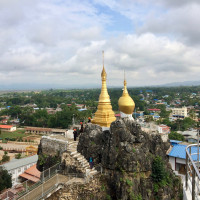
Reflections on the newly-declared Pawklo Indigenous Stewardship Territory A Commentary by Hsar Doe Doh Moo*
Topics
Regions
Protection of the environment has long been integral to Karen livelihoods and society. In this commentary, Hsar Doe Doh Moo heralds the opening of the Pawklo Indigenous Stewardship Territory as the latest conservation project in lands under the administration of the Karen National Union in southeast Myanmar. Amidst conflict, the importance of the PIST and other indigenous parks does not relate only to the local environment. As he describes, they are models of autonomous administration which is community-based, collective and democratic, ensuring their preservation for future generations. As such, they provide vital examples of good governance and environmental conservation to other parts of Myanmar and around the world.

Photo credit KESAN
In pursuit of collective self-determination
In the midst of the ongoing airstrikes and bombardments by the repressive regime in Burma/Myanmar which are happening nationwide, on 22 April this year K’nyaw/Karen communities in the autonomous territory of Kawthoolei1 reached another historic milestone by collectively declaring a new conservation territory. In the process of developing this project and in preparation for its launch, the Pawklo river basin communities and their governing body decided to call this specially-protected area the ‘Pawklo Indigenous Stewardship Territory’ (PIST).
The name reflects the two-way relationship at the heart of this new territory: namely, the importance of the Pawklo river to the peoples inhabiting the territory and, at the same time, the importance of the inhabitants in caring for the Pawklo river and basin area. Originating from the sacred K’Ser Doh mountain, the Pawklo river is essential in supporting local livelihoods, safeguarding cultural identity and sustaining ecosystem cycles. In defence of these goals, K’nyaw/Karen communities have historically managed and protected the waterways and surrounding forests through ‘community-based traditions rooted in collective responsibility and long-term care’.
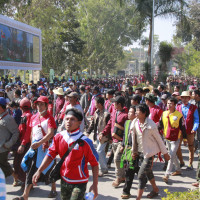
To honour the crucial role of the planetary ecosystems in supporting and sustaining different forms of life on earth, it was decided that the official launch of the PIST should coincide with International Earth Day on 22 April. The three-day ceremonial event then followed until 24 April at a makeshift venue situated on the banks of Pawklo river.
Located in K’Ser Doh Township, Mergui-Tavoy District, Pawklo is the third indigenous-conserved territory in the administrative area of Kawthoolei under the governance of the Karen National Union (KNU). Its creation follows the establishment of the Salween Peace Park (SPP) in Mutraw District in 2018 and the Thawthi Taw-Oo Indigenous Park (TTIP) in Taw Oo District in 2024.
Despite the intensity of armed conflict and the political instability, around a thousand participants joined the launch from local communities and organisations to show their support. Unfortunately, however, representatives of the SPP and TTIP, who were eager to travel long distances to demonstrate their solidarity, became delayed on the way due to the increasing security risks, and they were ultimately unable to reach their destination. Nonetheless, with safety a key priority, security protocols that were employed throughout the three days served to ensure everyone’s safety and the successful completion of this auspicious event.
In his opening remarks, P’doh Saw Ehna, secretary of the KNU Mergui-Tavoy District, stated that ‘this gathering signifies our solidarity and commitment toward national causes in advancing the right of self-determination.’ Reflecting this objective, the gathering connected participants from different communities and fostered inter-generational bonds through cultural dances, traditional poetry, songs, histories and cultural artifacts. Remarkably, one of the women participants brought traditional clothes that are estimated to be around 320 years old.
Against this backdrop, the launch of the PIST marks another symbolic advance for the Karen people, defying state repression and the authoritarian rule of the military regime in Nay Pyi Taw. Through this initiative, Pawklo indigenous Karen communities are determined to show that autonomous governance practices are achievable which are community-based and grounded in the principles of democracy, collective-decision making and mutual understanding. In doing so, they reaffirmed their commitment to shape their collective future not only for their own well-being and that of future generations but also in continued protection of the natural world that their ancestors maintained in meaningful balance and harmony since earliest times.
The coordinator of the PIST’s Cultural Working Group explained just how critical the initiation of the project has become:
‘Of course, we are happy that we can declare our territory. I even thought that it was impossible given the political situation. But after several meetings with the communities, we decided to move forward. Our objective was to care for one another and unite in preserving our traditions and culture that are slowly fading away, as well as our forests and wildlife because we Karen people and the forest cannot be separated.’
In establishing this specially-conserved territory, local communities honour their ancestors by exercising their collective power and rights to resist against inter-generational injustice, land dispossession and cultural threats that they have endured through different eras of history. To amplify these goals, the PIST issued a founding statement:
‘This declaration affirms our inherent right to self-determination, our responsibility to care for our ancestral lands and waters, and our shared commitment to peace, justice, cultural survival, and environmental integrity. PIST is a living Indigenous territory governed by the Indigenous people who have protected it for generations.’
In physical terms, the Pawklo Indigenous Stewardship Territory spans over 356,000 acres (over 1,400 km²). It is home to 24 indigenous Karen communities whose main livelihoods include Ku rotational farming, agroforestry, orchards, livestock-rearing and betelnut plantations. With the political support of the KNU, this latest ‘territory of life’, following the SSP and TTIP, demonstrates that Karen communities are able to govern themselves through exercising everyday democracy and can be effective stewards protecting their ancestral lands and environment. As a result of their collective efforts for locally-led environmental conservation and stewardship, 11 community forests and 15 fish conservation areas have been established in the PIST to date.
To explain the local evolution and context, a local Karen elder stated at the launch:
‘We initiated the PIST after the [2015] Nationwide Ceasefire Agreement was signed. Some of the 97 members of the PIST Steering Committee have already passed away. Now that our goal of declaring this territory to the world has been achieved…both the communities and our leaders support it. We hope that in the future this territory will strengthen our livelihoods and promote sustainable development, so that our nature and the indigenous peoples here can live and thrive peacefully. [It’s my earnest hope and wish that] more indigenous territories like PIST will be established across Kawthoolei.’
In his speech, Saw Paul Sein Twa, chairperson of the Salween Peace Park Governing Committee, further emphasized the integral links between building indigenous conserved territories and the struggle for self-determination. Of special resonance, he highlighted the importance of:
- collective resistance against injustice and external influences
- having strategic visions and plans
- strengthening autonomous governance (self-strengthening)
- engaging and/or empowering indigenous women and youth in leadership roles
- revitalizing and integrating indigenous knowledge systems and practice into the existing environmental governance systems and practices.
The long-term vision of mutual recognition and support
The KNU Mergui-Tavoy District has a long-term vision of territorial connectivity rooted in an integrated/holistic landscape approach. The PIST project does not exist in isolation. Rather, the goal is to establish a broader K’Ser Doh Conservation Area (KCA), with the Pawklo Indigenous Stewardship Territory serving as a key building block, where meaningful relationships can be fostered between indigenous communities, traditional livelihoods, cultural identity and the environment.
Spanning over 1.3 million acres (over 5,000 km²), the KCA is a vast territorial landscape composed of 42 villages covering the Pawklo territory, Htee Mo Pwar and Paluak areas, K’ser Doh and Ler Nu Htee wildlife sanctuaries, and the Baw Chaw Law wildlife corridor. Named after the sacred mountain, it is also vital for biodiversity conservation, local livelihoods and cultural preservation. According to an official of the Forestry Department of the KNU Mergui-Tavoy District at the opening ceremony, 73 fish species and 35 land-based species have been researched and/or identified so far and, amongst the terrestrial species, five of them are currently categorized as critically endangered.
Aside from learning about the positive trajectory of the KCA, the participants at the launch had a chance to hear about how the PIST came into being as part of the KNU’s commitment to environmental conservation. As an official of the PIST Steering Committee explained, a key element were community-led efforts in the establishment of the new territory, with an 88 per cent pass rate among the local public in a referendum to approve the PIST charter.
On this basis, local communities at the three-day event appeared overjoyed following the certificate signing ceremony and declaration by the KNU administration of the new conservation territory. As speakers noted, KNU and indigenous-conserved territories are two sides of the same coin with different roles to achieve the same self-determination rights. Said P’doh Saw Ehna, secretary of the KNU Mergui-Tavoy District, ‘forests, wildlife and local communities are inseparable and this interconnectedness is foundational to achieve Kawthoolei aspirations.’
As an environmental model, speakers also noted that the PIST project is innovative in marrying traditional practices and present-day needs. Among Karen communities, the indigenous stewardship of nature is spiritually and culturally embedded in their belief systems, taboos, ways of life, livelihoods, and expressions in poetry and folktales. At the same time, sustaining these knowledge systems and praxis contribute to the effective implementation of KNU policies on environmental conservation. Consequently, it is intended that the PIST will strengthen mutual recognition, cooperation and support between indigenous communities and the KNU.
In line with these goals, one of the male Karen leaders commented that the PIST can play an important role in helping achieve the ten-year strategy of the Kawthoolei Climate Action Plan in addressing climate change. By working closely with local communities, it is also hoped that the KNU and PIST can provide a model role in environmental governance and leadership at the global level. But many challenges remain. In a message of solidary and mutual recognition, Saw Ywar Pweh Moo, joint secretary of the Salween Peace Park said:
‘I want to say that these indigenous-conserved territories will support the Karen people’s rights to self-determination in Kawthoolei. In these territories, we have the full right to manage, govern and care for our natural environment. These territories will benefit everyone. As we have just begun, we may face many challenges and attacks. Please do not give up. Stand firm and move forward according to your plans to achieve your goals. As indigenous people, we will always support each other and do as much as we can to govern and manage our territories, land, forests and plants, and to preserve our traditional practices.’

photo credit KESAN
Grassroots initiatives, global impacts
Indigenous Karen-conserved territories, such as the SPP, TTIP and newly-established PIST, are internationally referred to as ‘Indigenous and Local Communities Conserved Areas and Territories’ (ICCAs). To support this objective, ICCA is the global movement of indigenous peoples to defend and promote their ancestral lands and ‘territories of life’ through community-led conservation and the territorial rights of indigenous peoples to govern, manage and steward their ancestral lands and natural resources. Such ground-breaking projects as the PIST therefore have international consequences.
This linkage was explained by a male representative of a community-based organisation. In sharing with the audience about the engagement of ICCAs with the international community, he underscored the positive contributions of indigenous-conserved territories and their effective environmental stewardship to biodiversity conservation, climate change mitigation, and eco-centric and human right-based approaches to conservation.
This subject attracted further attention during the meeting. When asked about international recognition of the PIST, the chair of Salween Peace Park explained that there is an official platform through the ICCA registry. He was then pleased to say that, after years of consultation, gaining consent from local communities and preparing the required documents, the SPP was formally added to UN Environment Programme’s Global ICCA Registry on 1 December 2025.
It is to be hoped that this is an important sign of recognition and protection. The aspiration is that, by registering on this platform, indigenous peoples and local communities will be able to leverage their political power by exercising their international right of ‘Free, Prior and Informed Consent’ (FPIC) to promote advocacy and funding opportunities while stopping development aggression and putting political pressures on their governments through international networks and diplomatic channels.
The path forward
Following the achievement of this historic milestone, the indigenous communities in Pawklo, along with their counterparts in the SPP and TTIP, are seeking liberating solutions to break free from the existing dominant and repressive systems of authoritarianism, colonialism and capitalism. These historic burdens continue to dispossess us from our ancestral lands, plunder our resources, contaminate our rivers, destroy our livelihoods and suppress our cultures through territorialization, militarization and development aggression.
This need for change was emphasized by a KNU official present at the PIST launch who insisted that ‘the grabbing of our ancestral lands and natural resources [by external actors] must be stopped indefinitely.’ Through these words, the intention was to send a strong political message to reclaim our territorial rights and sovereignty through autonomous governance free from repressive military rule in Burma/Myanmar.
It is also intended that the PIST will have beneficial impact on local scale, serving as a peace-building space to resolve internal tensions and reconcile political differences amongst local peoples and communities. In support of this goal, one of the priorities of the PIST Steering Committee’s plan is the establishment of a General Assembly, based upon the building of ‘ground-up’, inclusive and community-led systems of governance through collective-decision making. This will be put into effect after elections held across 24 villages in which local communities will exercise their democratic rights in electing representatives to the General Assembly.
We are now looking forward with hope and positivity to the future. Among the Karen people it is believed that this form of grassroots democracy will help shape their collective future and the world that they want to live in. The goal is that it is grounded in local cultures, solidarity, land and resource protection, ways of life and co-existence with nature. As such, it is an achievable and long-needed alternative to the regime’s version of governance which is based on sham elections and the continued entrenchment of a military and crony elite through violent means. In this way, Karen communities will keep fighting for their social and political rights in a just, peaceful, equitable and sustainable world, strengthened by their grassroots and knowledge-based resilience through the development of the PIST, SPP, TTIP and other community-based initiatives in the progressive land of Kawthoolei.
*Hsar Doe Doh Moo is a dedicated environmental educator and researcher whose passion is to empower indigenous K'nyaw/Karen youth to revive, preserve and carry on indigenous eco-cultural knowledge and traditional values.
Credits
More like this
-
From War to Peace in Kayah (Karenni) State A Land at the Crossroads in MyanmarPublication date:
-
The Promise and The Statue A Commentary by Dee DePublication date:
-
The Inspiring Model of Community Conserved Territories in Myanmar Launch of the Thawthi Taw-Oo Indigenous ParkPublication date:
-
Chronology on the Statue Case in Loikaw, Kayah State A Commentary by UKSY/ LAIN*Publication date:
-
Earning Credentials: A Karenni perspective on the future of Burma/Myanmar A Myanmar Commentary by Khun BeduPublication date: