Sign the petition: Help end investor-state dispute settlement (ISDS)
Topics
Regions
The Handel Anders! coalition is calling on governments to put an end to Investor-State Dispute Settlement (ISDS), a mechanism that allows foreign investors to sue states over measures that may affect their investments.
The coalition has launched a petition urging governments to withdraw from existing ISDS agreements and reject new ones.
TNI supports efforts to end ISDS and encourages readers to learn more about the issue and sign the petition.
Campaign by


Why does this matter?
Fossil fuel giants, mining corporations and others are using secretive tribunals to sue governments for billions over decisions that go against them:
- Between 2022 en 2025 Shell en ExxonMobil filed multiple arbitration claims against the Netherlands over the closing of the gasfield in Groningen. They claim billions of euros of ‘lost profits', while they contest their financial liability for decades of earthquake damage
- Omani energy company Petrogas has been suing the Netherlands since 2025 because of the Dutch government's introduction of a temporary solidarity contribution in 2022 on windfall profits in the oil and gas sector - a measure designed to ensure that energy companies pay their fair share to support public budgets and society during a period of exceptional profits and social hardship
- In 2021 German energy company RWE filed a 1.4 billion euro claim against the Netherlands over the government's decision to phase out coal power plants
- Mining giant Rio Tinto threatened to sue the Serbian government and was able to force through a devastating lithium mine despite public protest
These tribunals give powerful corporations leverage against decisions made to help ordinary people during the cost of living crisis, protect homes, tackle the climate crisis and safeguard the natural environment. Governments have already recognised that a big ISDS treaty, the Energy Charter Treaty, is incompatible with the Paris Climate Agreement. However ISDS is also included in a web of smaller treaties.
Netherlands a key player in the international ISDS-system
The Nederlands plays a key role in the international ISDS system. The Nederlands, and the then Dutch company Shell, started the ISDS system in the 1960s. The Netherlands still is a key player: it has over 70 bilateral investment treaties with ISDS clauses and 10% of ISDS cases worldwide are based on Dutch treaties (only the U.S. has more). This is because of the large number of 'mailbox' companies in the Netherlands. Companies can use legal constructions to file an ISDS claim against a state when that state has a bilateral or multilateral agreement with the Netherlands and the company has a (mailbox) entity in the Netherlands. This way, the Netherlands is an international hub for ISDS claims.
The numbers
• Total compensation claimed by international companies based on ISDS in Dutch treaties: €100 billion
• Compensation awarded to international companies based on ISDS in Dutch treaties: €17.6 billion
• Number of Dutch Bilateral Investment treaties with ISDS: 70
• The Netherlands is responsible for 10% of ISDS claims worldwide
What can we do?
We need to get rid of this anti-democratic system once and for all. The good news is that we’ve done it before. Fossil fuel companies have been using ISDS in the Energy Charter Treaty to block climate action. After thousands of us took action, many of our governments woke up to the risk and have been getting out of that treaty – we won!Now we need to join together and tell our governments to close the loophole provided by the web of small treaties and get rid of ISDS completely. This year the First Conference on Transitioning Away from Fossil Fuels was held, and many governments, especially those of countries in the Global South, said that ISDS is a barrier to climate action. But pushback from a few countries in the global north, including the Netherlands, meant that agreement was not reached on this. However, it is a major step forward that governments are discussing this and it is an opportunity we must seize for governments to work together to end ISDS.
No false solutions!
The EU and some European governments have at times tried to make small changes to the way that ISDS works and claim that this will solve the problem. It won’t, because those tweaks leave the core of the system (allowing corporations to sue governments outside of national legal systems) unchanged. Therefore we refer to ‘all forms of ISDS’ to be clear that we also mean these other versions – which are called things like ICS (Investment Court System), MIC (Multilateral Investment Court) or a ‘standing mechanism’.
Credits
Authors
More like this
-
ISDS in numbers Impacts of investment arbitration against Latin America and the CaribbeanPublication date:

-
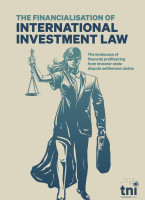
The Financialisation of International Investment Law The landscape of financial profiteering from investor-state dispute settlement claimsPublication date: