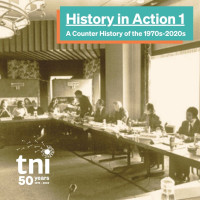
Peter was Chairman of the Board of the Institute for Policy Studies (IPS) when they decided to launch an international arm—what would become the Transnational Institute. In an interview in 2024, Peter said: "I felt strongly that the United States should not be telling the rest of the world what should be done—we were internationalists—and that we had a lot to learn from other countries. And that was the basis for inventing TNI."
After its founding, Peter became a valued TNI Fellow and advisor. He consistently put his skills and knowledge at the service of the greater public good. He was instrumental in bringing together legal experts, government officials, and civil society advocates internationally to continue the fight for nuclear abolition, as well as key projects like the Middle Powers Initiative and the Hague Appeal for Peace.
"I met Peter and Cora when TNI was being created and always visited them in New York when I went there (also I published two articles by him in openDemocracy)," said Anthony Barnett, one of TNI's founding fellows. "He was a wonderfully clear minded opponent of nuclear weapons and a strong, trustworthy and practical supporter of TNI and also IPS in Washington, with a dry sense of humour. He gave a memorable presentation to a TNI Fellows meeting of developments in Vietnam when he returned as one of the first visitors to Hanoi after it was fully liberated in 1975 and when it was still being embargoed. Brave and clear-sighted we were very fortunate to have his support."
Peter played a very significant role in the World Court Project, which led to the historic ruling by the International Court of Justice on the illegality of nuclear weapons. Peter's work remains a source of inspiration for campaigners advocating for the abolition of nuclear weapons.
Achin Vanaik, a TNI associate for more than three decades remembered Peter: "Praful [Bidwai] and I, having joined TNI in the late 1980s, soon realized how central Peter and Cora were to the existence and continuity of TNI and to its work across many areas especially with regard to Africa's liberation and post-colonial development. Of particular importance to both of us as anti-nuclear activists was their commitment to nuclear restraint and disarmament worldwide."
He lectured and wrote widely on human rights in the United States and beyond. He was counsel to Joyce Horman in her case against General Pinochet and others, based on the torture and assassination of her husband, U.S. citizen Charles Horman, in the Santiago stadium in 1973.
Peter was a pioneer in efforts to hold transnational corporations accountable for their crimes. He brought the Alien Tort Claims Act to prominence in the U.S. as counsel in the Filartiga case.
Peter passed away at the age of 99 on November 3, 2025, just one month before his 100th birthday. All of us at TNI extend our sympathy to his children, Judy, Tamara, and Danny, and his wife, Cora.
Rest in peace, Peter, and thank you for your immense contributions.
You can read a tribute to Peter Weiss by the Institute for Policy Studies here.