Why is Women’s Access to Land So Complex in Myanmar? A Commentary by TNI
Regions
Women face many obstacles in equality, work, ownership and access to land in Myanmar, rights that are essential for their everyday livelihoods. This TNI commentary examines why, in a country in conflict, these challenges have become systemic and complex. Customary law and policies pursued by ethnic organisations provide some answers. But there is still much further to go. Land reforms should not informed by legal principles alone but by the experiences of rural working women and those who are often ‘invisible’, including IDPs and migrants, in the field.

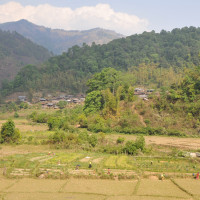
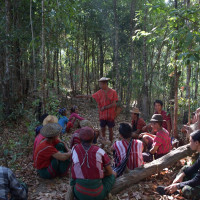
Photo credit: Lahkyen Roi / လခဲန်ရွယ်
Case study one: On paper, Daw Myint’s husband is the sole head of the household, and his name is the only one written on their official Form 7 land registration document. In reality, Daw Myint acts as the de-facto co-head of the farm, managing agricultural bank loans, hiring daily wage workers, and working in the fields from planting to harvest cycle. Yet, when the family calculates the season's agricultural expenses, Daw Myint’s labour is omitted from the ledger and treated as "free" and invisible, excluding her from both the documented costs and the direct profits of her own work. Since her husband passed away, she has been facing significant administrative hurdles to change Form 7 to her name which is tied to several entitlements.
Case study two: Living in the militarized terrain of Hopong township, Nang Seng witnessed the heart-breaking confiscation of her ancestral lands by armed forces, who then ordered her home to be torn down and forced her family to pay for the newly-allotted house plots in faraway areas. With her brothers fleeing the region to evade forced conscription, she and her sister are left entirely alone with her elderly parents to cultivate a small plot of farmland that they could still access, while navigating a landscape with landmines and carrying the responsibility of caring for her elderly, traumatized parents.
Case study three: Following her divorce, Mi Sorn discovered that Mon customary equality is overridden under statutory law because their rubber plantation was registered solely under her husband's name as the "head of household". After a gruelling court process that drained her savings in legal fees and “under-the-table” payments, the judge ordered the land split into three parts, yet her ex-husband stubbornly refused to hand over her share. Now carrying the social stigma of a divorced woman, she is forced into a tiny, rented plot, where she grows vegetables and some cash crops to sell at the market to take care of her children without a proper financial safety net.
These three stories illustrate how gender norms, armed conflict, military rule, and socio-economic conditions make it difficult for women to access and use land, let alone truly benefit from land access. In some cases, it is not even clear what “access” means or what “land” entails. Why is women’s access to land in Myanmar such a challenging issue? And what can be done to increase their access and benefits related to land? The answers are not simple, but not beyond reach. This commentary aims to explore some of these complexities and imagine more grounded paths toward land-based social justice.
1. Formal land policies ignore real-life complexity
In Myanmar, protecting women’s rights takes more than just writing equality into laws, official policies or international treaties. When it comes to owning land, women face hidden social and political barriers that keep these legal promises from changing their real, everyday lives. In fact, aid and development projects – including from international organisations – can unintentionally make things worse for women. Many poverty-reduction programmes try to help by dividing up community land and handing out official property deeds to guarantee “tenure security”, using the national land laws enacted in 2012 by the then Thein Sein Government. These laws have been widely criticised for mainly benefitting large companies and not small-holder farmers, especially in ethnic minority regions, and do not take into account the right to land of ethnic communities and women.
As a result, because these programmes frequently ignore deeply-rooted patriarchal norms and unequal power relations, the resulting land titles almost always end up solely in the husband's or a male relative's name. Instead of empowering women, these projects end up locking them out of their own land, turning their hard work into invisible labour that is not recognised socially and materially. In the words of a woman farmer from Mon State: “It is necessary to be able to work and live with emotional security. When there is no land ownership right, opportunities are lost and our livelihoods are also affected.”
This focuses attention on the importance of Form 7. While holding a Form 7 (or having one’s name attached to it) does not entirely guarantee complete land tenure security or full enjoyment of land entitlements, it provides holders with a crucial sense of security and acts as a bridge to state subsidies or financial loans. The text box below explains this dilemma and complexity.
Myanmar's Formal Land Framework
The 2012 Land Laws and their 2018 amendments: The Farmland Law and the Vacant, Fallow and Virgin (VFV) Lands Management Law formalized private property rights but heavily favoured commercial interests, effectively criminalizing the traditional shifting cultivation and customary tenure systems common in many ethnic nationality areas. Under these frameworks, communities are forced to apply for 30-year concessions just to use lands reclassified as "VFV”. Following the strict 2018 amendments, those who fail to register within the statutory six-month deadline face eviction, heavy fines and up to two years of imprisonment. Consequently, both laws have "neglected the customary land tenure of ethnic nationalities as well as the important cultural and historical values of land.” (Land in Our Hands (LIOH), 2017, p.1).
Form 7: This is the Land Use Certificate (LUC) issued under the 2012 Farmland Law. While it allows the holder to legally cultivate, sell, pawn or lease land, civil society networks like Land In Our Hands have consistently pointed out its flaws. Form 7 does not protect against land grabbing and largely locks out women whose names are rarely printed on the document. In fact, LIOH’s nationwide research revealed that 42.5 percent of respondents who suffered land confiscation actually held official government land documents at the time. The study further highlighted that in nearly half of all documented cases, land grabbing directly involved the military – either operating independently or colluding with government ministries, local authorities and business elites (Land in Our Hands, 2015).
The 2016 National Land Use Policy (NLUP): This progressive document, developed through public consultation, recognised customary tenure systems, gender equality, women’s land rights, and the right to land of IDPs and refugees, although not to the full extent advocated by civil society organisations. While the policy was intended to serve as the foundation for a unified national land law, its implementation and formal legalization were frozen by the 2021 military coup and successive political crises.
References:
- Land in Our Hands. (2015). “Destroying People’s lives: The impact of land grabbing on communities in Myanmar” [Research Report].
- Land In Our Hands. (2017, July 19) “LIOH statement on the 2012 Farmland law amendments”.
According to the 2017 Myanmar Poverty and Living Conditions Survey, only 14.2 percent of agricultural women hold official land documents – often tracked statistically as “secure” land rights – compared to 32.1 percent of men. A major barrier preventing women from securing these formal land documents is navigating the complex bureaucratic and administrative requirements necessary for official land recognition. Furthermore, many rural women remain entirely unaware of these rights. Many women in different nationality areas do not speak fluent Burmese, the primary language of administration in Myanmar.
This language barrier is then compounded by lower literacy rates among women and girls, who are frequently pressured to leave school early due to economic hardship. In a patriarchal society where a girl’s education is often deemed less important or a poor investment compared to her male siblings, families systematically prioritize boys' schooling when household resources are limited. For these women, paperwork and administrative hurdles – intertwined with broader socio-political challenges – remain formidable barriers to formal land recognition.
At the same time, women are systematically labelled as "dependents", even though they invest their labour equally alongside their husbands on the farms and serve as the primary caregivers in the household. A woman from Magway captures this reality perfectly:
“Women are fully involved in all processes of agricultural work – the beginning, the middle and the end. Although the man is called the head of the household, the woman has to keep the business running. We are also involved in the decision-making around hiring and managing daily wage workers. Even if both men and women go down to work in the fields together, once they reach home, the woman’s work does not end. She still has to do the domestic chores.”
Notably, then, local authorities generally refuse to change the status of women from the “dependent” to the “household head” even after the husband has died or lived separately after divorce. This has left the women with even more administrative challenges and socio-economic insecurities.
Crucially, women cannot be viewed as isolated individuals. They are intertwined with other people. They have dependents and families, and their access to land are mediated by these social relationships. And even those women who may be “on their own” might not be living in the same ways. Some are unmarried daughters with no right to inheritance, some are widowed, some are trafficked, some are at risk of being sold off in arranged marriages – and the list goes on. Ultimately, a woman’s right to access, use and benefit from land is never a simple equation – it is entirely dependent on her ethnicity, geographical location, social standing and age. Moreover a woman’s tie to land expands beyond what a land title or plot of farmland can offer. It is multi-dimensional and an interconnected web of relationships.
The situation above reflects problems related to the right to land for women living in areas controlled by the central government, which is currently under military dominance again. In contrast, different dynamics are at play in territories governed by ethnic armed organisations (EAOs), several of which have adopted land policies that respect, promote and protect the right to land for ethnic nationality communities, internally displaced persons (IDPs), refugees and women. Such movements have long since controlled large territories with significant populations and set up their own civilian administrations.
The reality, however, on the ground remains fluid. Even within progressive EAO legal frameworks, local traditional authorities and village elders often default to customary patriarchal practices. An unmarried daughter or a widowed refugee in an EAO-controlled area may find that while her de jure (legal) rights are protected by ethnic governance policies, her de facto (real-world) access to land is still heavily-shaped by the social standing of her male relatives and local traditions.
2. Land is a system of flourishing, not just a commodity
In Myanmar and elsewhere, land is not simply a commodity. It is not just a piece of property to be titled, bought or sold. For many rural and ethnic communities, land is an entire system of survival –a vital source of food, firewood, medicine, grazing, shelter and community belonging. It holds memory, identity and care, serving as an essential anchor for tradition, culture and religion. When land is reduced to mere "farmland" or a "house plot" – conceptually attached to a single certificate and a solitary plot – everything outside that narrow economic framework disappears.
This holistic relationship is clearly articulated in a statement issued by civil society organisations (CSOs) from Shan State:
“All the land in ethnic regions must belong to the people of these lands as it is their life-blood and their way of life… Customary tenure systems include management of community forest, wildlife sanctuary, protected forest, sacred land, cemetery land, shifting cultivation areas, pastoral land, common land and village reserve land including other land and water sources and watershed areas within the village boundary.”
In rural villages, land use is inherently fluid and collective. Families grow crops in one area, gather herbs in another, and fish or graze animals elsewhere. Individual and collective access and uses of land and natural resources smoothly coexist and change over time. For many women, this flexible, overlapping access to land is key. Gathering vegetables, fetching water, collecting firewood or seeking medicinal herbs all depend on a fluid type of land access that cannot be captured by a property title.
Women – such as Daw Myint, Nang Seng and Mi Sorn in the case examples above – are at the forefront of care work, managing the vast array of activities that ensure the flourishing of lives, families and communities. This includes food provisioning, cleaning, childcare, schooling, nursing the sick, and providing emotional support. Because these responsibilities require women to routinely rely on communal lands and natural resources, they maintain intricate, structural links to common lands – often more directly than men. Hence, care work is not separate from the land; it is made possible by it.
Crucially, this relationship of care goes both ways: just as the land sustains women, women actively nurture the land. There are many forms of land-based care. Through the preservation of indigenous seeds, and the application of agroecological farming practices, rural women serve as primary guardians of local biodiversity and soil health. An interesting example can be found in the Lahu highlands in eastern Shan State. In this area, women carry much of the responsibility in the farms and in preparing food for everyday household consumption and communal festivals. This can reinforce traditional gender roles and limit their time for other self-fulfilling activities. But these customs reflect a strong ethic of sharing and solidarity.
In these ways, land, food and care are part of a collective system of support that women help sustain. Many examples can be given. In some areas, opium is grown as a cash crop to buy food and essential household items, but part of the harvest is kept for home remedies, to cure illnesses such as diarrhoea, coughs and pain. A woman selling produce from the land in the market might use her earnings to buy rice, oil and salt, which she then uses to prepare food for her children. A midwife walks across fallow fields to reach a neighbour in labour – a reminder that even when land does not yield crops or commodities, it remains parts of the routes through which vital livelihoods (such as midwifery) move. A man working in Thailand sends money home to his wife, who farms land registered in his name and cares for their children. She, in turn, treats his remittances as a reserve, buying food when crops fail, covering medical costs, repairing the house after damage by storms or flooding, or preparing for the next planting season. This, too, can involve various costs, such as purchasing seeds, fertiliser, hiring labour, and more.
In the country today, such practices are all deeply-embedded forms of land-based care, tied intimately to mobility, ecology and collective well-being. While land use can certainly generate monetary income, treating land merely as a commodity ignores its profound cultural and social value. This is especially true when considering women’s specific and diverse roles, which are different from men’s. Because these roles are so deeply woven into everyday survival and community identity, women’s access to land is a highly complex – and at times contentious – issue in Myanmar. At the same time, environmental destruction due to logging, mining, urban expansion and intensive commercial agriculture is increasingly threatening this delicate system of survival. Echoing a reflection from a focus group discussion of a group of rural women from different areas in Myanmar:
“The natural environment is degrading, and climate disruptions like unseasonal rain are occurring. Soil erosion, landslides and loss of topsoil are happening, so even though land is there, it can no longer be cultivated. Because droughts and water scarcity occur, water wells and water pumps have to be used, leading to low profits and loss of principal capital.”

Photo credit TNI
3. Customary safety nets in times of crisis
Myanmar’s rural communities are highly diverse when it comes to languages, livelihoods, spirituality and customs. Land is at the centre of each community’s customary life, which defines the meaning and purposes of land for humans and non-humans alike. The issue of land inheritance for women and men, for example, differs from one community to another. As described in a report by the Ethnic Community Development Forum:
“In Kachin and Zomi cultures, men attain the main farmlands while, in Karen society, female inheritance is prioritized. Inheritance of lands in Shan, Mon and Kayah villages generally do not prioritize any particular gender.”
Regardless of these diverse inheritance patterns, many customary systems provide a crucial layer of protection against state bureaucracy and the structural shortfalls of formal legal systems. Importantly, they can serve as indispensable safety nets for women whose land rights are unrecognised or unattainable under formal state law. A widowed woman, for instance, may work on land inherited from her in-laws without an official title. Following the 2018 Vacant, Fallow and Virgin (VFV) law amendment, her land is confiscated and handed to a private investor. Despite protections promised in Myanmar’s 2015 National Land Use Policy and recognition of customary land tenure, the VFV law overrides them. Under formal law, she has little recourse. But through her community, she might still access land via customary allocation, particularly if widows are recognised and supported in local traditions. In addition, women play vital roles in running and maintaining customary systems. According to the Karen Environmental and Social Action Network:
“Women EHRDs [environmental human rights defenders] in Myanmar are often the primary holders of traditional ecological knowledge, especially within Indigenous communities like the Karen, Chin, Kachin and Shan. They serve as keepers of local wisdom and culture, ensuring that ecological practices and sustainability are passed down through generations. Community leaders, mothers and teachers also understand the intrinsic connection between the environment and human well-being.”
However, customary tenure systems are sometimes criticised as backward and patriarchal. Some critics argue that customary land systems undermine women’s access to land. “Access to land” is often narrowly defined as individual land access for economic production that brings in monetary income. But, as Land in Our Hands has written, “in indigenous customary land management systems, land and people are inseparable and the territory is the lifeblood of the villagers and their collective identity as a people.” As such, land is more than just a resource to be demarcated and owned by individuals.
It is true that some customary practices may limit women’s liberty or movement. Some restrict access to sacred sites. Others allow only men to hold important positions of power. And, as alluded to above, women may be barred from inheriting land or other resources. Restrictions or obligations related to marriage may exist as well. The underlying patriarchal dynamics that drive them, however, are not unique to rural areas – nor are they unique to Myanmar. These dynamics very much depend on local contexts and communities. Some are stricter, others more flexible. But customary practices are not static, and they can change over time. As do people, borders and landscapes. The Land Policy of the Karen National Union (KNU) explicitly acknowledges this capacity for potential reform:
“Where constitutional or legal reforms strengthen the rights of women and place them in conflict with custom, all parties must clearly and actively strive to cooperate to accommodate such changes in the Kaw (Karen customary tenure) systems.” (article 3.3.7)
Recognising that customary systems possess both progressive provisions and a capacity for internal reform, contemporary ethnic administrations are actively upgrading them to protect both women and the land. Some ethnic land policies, such as frameworks among Karen, Karenni and Mon groups, now integrate these customary systems into formal recognition. In addition to explicitly protecting customary systems and women’s rights to land, these ethnic land policies regulate processes that might threaten (or have threatened) the sustainability of customary systems. Examples include:
- Land size floor and ceiling, as well as prevention of land monopoly (Mon Region Land Policy: articles 1.1.14 and 1.1.15)
- Limitation on large scale monoculture and contract farming (Mon Region Land Policy: article 3.12.13 and 3.12.14)
- Restriction on uses of communal land for development or investment (KNU Land Policy: article 3.5.7)
- Obligation of compensation by armed groups or companies in case of land confiscation (Mon Region Land Policy: article 4.13.6).
4. Moving forward
This commentary has outlined three main reasons why women’s access to land is a challenging and contested issue in Myanmar. The aim here has not been to provide neat solutions. It is to open up this problem and make visible the realities that are sometimes overlooked or ignored. This leads to more questions than answers. There are three central reflections that are important in addressing the right to land for women.
First, land laws and policies are not neutral. They are shaped by histories of power, exclusion and survival. Any attempt to address land inequality must reckon with these forces. As beautifully stated in the KNU Land Policy (article 2.1.4): a key land policy principle should “be historically grounded in order for the often ‘invisible’ social injustices of the past to be seen and effectively remedied.” One provision (article 3.8.5) within the Mon Region Land Policy illustrates how such a principle could be applied: “Landless people, especially landless women, shall be prioritized in the allocation of farmland by due process when land use change is required from reserved land to agricultural land.”
Land-related reforms must be informed not only by legal principles, but by the concrete, lived experiences of those who are often invisible, such as rural working women, IDPs, migrants or those living in customary systems. This means being sensitive and responsive to any barrier they may face – even something as seemingly insignificant as paperwork at administrative bodies. Additionally, respect should be given to decision-making and governance mechanisms that may not necessarily fit within national legal frameworks but are rooted in local customs. These grassroots arrangements, too, are valid forms of land policy.
Second, there are more questions to address than only: How do we give women access to land? What kind of land? For what purpose? In which conditions? What else is needed to make land truly accessible and meaningful?
In this regard, the definition of “access” needs to be broadened. It is not only about one’s rights, but more about one’s ability to benefit from things (in this case land), and the surrounding power dynamics that influence that ability. Measuring one’s “access” to land is thus an empirical, not normative, endeavour. As such, it recognises that one’s rights do not always translate into access in real life and, conversely, one’s access on the ground does not always derive from legally-enshrined rights.
Furthermore, access to land is not only about formal ownership, as illustrated by the way communal resources enable women and others to care for their communities. It is about people’s autonomy in determining their relationship with the land – including how they access, use and maintain it. This may include shared access and responsibility to care for water bodies, forests and seeds. But this should also cover political processes where diverse people – including women – can participate in decision-making of various kinds. In some ethnic land policies, these include quotas for women in land management committees and capacity-building opportunities (such as in the Mon Region Land Policy), which crucially go hand in hand with other provisions to ensure the equitable flow of benefits of land and natural resources for marginalised women.
Finally, discussing women and land is already difficult due to rigid gender norms and the complexity of land issues themselves. But that does not mean these are impossible. The conversation can become richer when we connect it to the broader web of relationships and identities women hold. Many are not navigating land alone, but in relation to husbands, children, in-laws and friends etc. Others have different sexual orientations or other experiences that shape how they access, use or lose land. After all, a woman’s womanhood is only one part of her humanity.
Thus, land policy should not see “women” – or “men” or any other genders for that matter – as a homogenous group. It must reflect the diverse and relational ways people live and, as such, it must adapt to its time. This may look different for every community. It can range from facilitating joint land use between spouses or families, recognising women’s essential care work, acknowledging non-traditional households, to accommodating people on the move.
These are not entirely new ideas nor do they pretend to be final answers. But they suggest that the first step is to grapple with the complexity of the situation. Only from there, one can point towards policy-making processes that are truly just and inclusive.
Credits
More like this
-
The Meaning of Land in Myanmar A PrimerPublication date:
-
‘There is no vacant land’ A primer on defending Myanmar’s customary tenure systemsPublication date:
-
The 5Rs in Myanmar Five principles for a future federal democratic system where rural working people can flourishPublication date:
-
Position Paper on the Rights to Customary Land and Practice Systems in Myanmar Essentials to consider for a Federal Democratic countryPublication date:
-
From The Authoritative Land Management System To The Federal Land Governance System A Commentary by Si Thu (Land in Our Hands)Publication date: