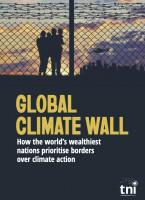
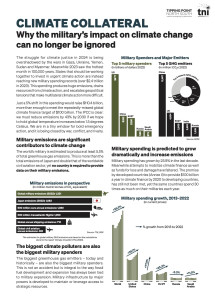
Climate Collateral Why the military’s impact on climate change can no longer be ignored
The struggle for climate justice is increasingly overshadowed by a global arms race even though global temperatures are reaching record highs. States that should be working together to invest in urgent climate action are instead spending record sums on the military (over $2.7 trillion in 2024). This spending produces huge emissions, drains resources from climate action, and escalates geopolitical tensions that make multilateral climate action more difficult. (Briefing first created in 2023, updated for third time in November 2025)
Download PDF
Just a 5% shift in this spending would raise $135 billion, more than enough to meet the repeatedly-missed global climate finance target of $100 billion. The IPCC is clear: we must reduce emissions by 43% by 2030 if we hope to hold global temperature increases below 1.5 degrees Celsius. We are in a tiny window for bold emergency action, and it is being closed by war, conflict, and geopolitical rivalry.
Military emissions are significant contributors to climate change
The world’s military is estimated to produce around 5.5% of total greenhouse gas emissions. This is more than the total emissions of Japan and double that of the worldwide civil aviation sector, yet no country is required to provide data on their military emissions.

The biggest climate polluters are also the biggest military spenders
The biggest greenhouse gas emitters – today and historically – are also the biggest military spenders. This is not an accident but is integral to the way fossil fuel development and expansion has always been tied to military expansion. Military infrastructure by major powers is developed to maintain or leverage access to strategic resources.

Military spending is predicted to grow dramatically and increase emissions
Military spending has grown by 37% in the last decade. Meanwhile attempts to mobilize climate finance as well as funds for loss and damage have faltered. The promise by developed countries (Annex II) to provide $100 billion a year in climate finance by 2020 to developing countries, has still not been met, yet the same countries spend 50 times as much on their militaries each year.

Market analysts expect an annual growth rate of global military spending of between 4.2% and 6.9% up to 2030. In 2025, NATO ratcheted up this growth to new heights by committing all its members to the goal of spending 5% of GDP on the military. Meeting this goal would double military expenditure to a total of US$19 trillion between 2025 and 2030 and would lead to an additional estimated 840 million tonnes of emissions (compared to if military expenditures were maintained at 2% of GDP).

Military spending is diverting money from climate finance
Climate change is the most serious threat facing all of us. Yet military action is prioritised over climate action in state spending, diverting political attention. Every dollar spent on military expansion is a dollar not spent on a rapid and just green transition. Policymakers also consistently seek to exempt the military – and the accompanying arms trade – from any binding climate and environmental regulations.

Investing even a portion of this military spending in climate action could substantially reduce emissions.

Winners and losers of the global arms race
The principal winners of military spending are the arms companies whose profits and stocks have soared, far outperforming the average growth of many other industrial sectors.

The richest countries (Annex II) export to all 40 of the world’s most climate vulnerable countries. Rather than providing money to cope with the impacts of climate change, the richest countries are providing weapons that will fuel conflicts in regions such as the Sahel and increase vulnerability of those on the frontlines of the climate crisis.

Credits
In collaboration with
- Tipping Point North South
- Stop Wapenhandel
Download PDF
More like this
-
Climate Collateral How military spending accelerates climate breakdownPublication date:
-
Climate Crossfire How NATO’s 2% military spending targets contribute to climate breakdownPublication date:
-
Primer on climate security The dangers of militarising the climate crisisPublication date:
-
Global Climate Wall How the world’s wealthiest nations prioritise borders over climate actionPublication date: