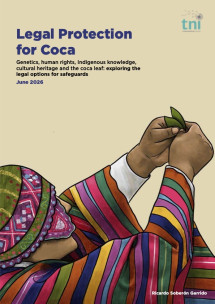
Legal Protection for Coca Genetics, human rights, Indigenous knowledge, cultural heritage and the coca leaf: exploring the legal options for safeguards
Topics
Regions
While international drug treaties maintain the state of prohibition, legal regulation of the coca plant in the Andean-Amazonian region continues to develop, and can be strengthened and broadened. The aim of this new report is to explore viable ways to safeguard genetic resources, cultural heritage and Indigenous knowledge of the coca leaf, as well as to protect legal markets for coca from risks of misappropriation, biopiracy and corporate capture.
Download PDF
Authors
Introduction
Failed attempts to modify the level of control of the coca leaf under the global drug control regime leaves trade restrictions on the plant intact. While international drug treaties maintain this state of prohibition, legal regulation of the plant in the Andean-Amazonian region continues to develop, and can be strengthened and broadened.
Beyond its cultural significance, the plant has become a political symbol of resistance against prohibitionist narratives and foreign intervention. The defence of coca, more than a question of protecting traditional practices, is also a political and epistemic affirmation, challenging the imposition of foreign regulatory frameworks on local realities. Cultural heritage preservation can thus be seen as both a legal tool and a political strategy to reposition coca on the world stage.
From this perspective, coca ceases to be understood solely as a plant or raw material under international control. Rather, it is part of a complex cultural system that encompasses agricultural, ritual and medicinal practices as well as forms of community organisation and diverse worldviews a collective and living knowledge system. This view enables the activation of legal mechanisms to legitimise such practices at the national and international levels.
There are four distinct and separate legal frameworks, though these are not always optimally interconnected. They can be regarded individually or collectively by countries where coca remains a cultural reference point for their citizens. The specific features and advantages of each regime can be promoted, strengthened and validated at both the domestic and external levels. This document analyses in detail the legal complexities of the four regimes and illustrates how the various mechanisms interact at the international, regional and national levels, and provides examples of existing practices. The aim is to explore viable ways to safeguard genetic resources, cultural heritage and Indigenous knowledge of the coca leaf, as well as to protect legal markets for coca from risks of misappropriation, biopiracy and corporate capture.
Credits
Editors
Pien Metaal and Martin Jelsma (TNI) provided commentary. The report draws on discussions at the round table, “Legal Protection of Plants: The Case of Coca”, held in Cusco on 28 and 29 November, 2025, organised by the Transnational Institute, with the participation of specialists, activists and community representatives from the Andean Amazon region, the United States and Europe. The event and publication form part of an international campaign in defence of the coca leaf, supported by Open Society Foundations, Riverstyx Foundation and Dr. Bronner’s.
Download PDF
More like this
-
WHO Critical Review of Coca Leaf A Comprehensive OverviewPublication date:
-
Coca Chronicles: Coca review denouement Issue #7: The UN drug scheduling system in disputePublication date:

-
Erythroxylum Coca. Los Confundidos A DocumentaryPublication date:
-
Coca leaf: Myths and Reality A beginner's guide to CocaPublication date: