
In Memoriam: Susan George (1934–2026)
With gratitude for her life and legacy, we remember Susan George, former President and Honorary President of the Transnational Institute (TNI), who passed away on 14 February 2026 at the age of 91.
Susan was an extraordinary political economist, writer and activist whose work shaped the global justice movement for more than four decades. Her intellectual rigour, moral clarity and unwavering commitment to equality and democracy inspired colleagues, partners and friends across the world.
She was closely connected to TNI for many years, contributing to its intellectual life and supporting its mission to link critical research with social movements.

A Life of Commitment
Born in 1934, Susan dedicated her life to challenging injustice and exposing the structural causes of inequality. Her landmark books, including How the Other Half Dies and A Fate Worse Than Debt, reshaped public understanding of global hunger and sovereign debt.
She believed that research must serve people. Throughout her life, she worked to ensure that analysis was not detached from action, but instead strengthened movements striving for democratic and economic transformation.
Her influence extended far beyond institutions: she was a mentor, collaborator and friend to many.
Related

Videos of Susan George speaking
This curated playlist brings together Susan speaking at various events over the years. In these recordings, you can hear not only her incisive critique of global systems, but also her humor, warmth, and tireless belief that change is possible.
Her speeches remain profoundly relevant. They remind us that:
- Global injustice is not inevitable.
- Democracy requires vigilance and participation.
- Economic systems must serve people, not the other way around.
- Courageous analysis can fuel transformative action.
Messages and Tributes
We have been deeply moved by the many messages received from friends, partners, colleagues and comrades across the world.
Below we share a selection of tributes. We will continue to update this page as further messages arrive.
Attac France
Our friend and comrade Susan George has left us
We express our sorrow at her passing. She actively supported our entire association, of which she was a founding member in 1998 and remained honorary president.
From national and international bodies to local committees, she embodied and nurtured with her expertise the action-oriented popular education that has been the strength of our association. This was the spirit of her many books and countless lectures.
We also express our gratitude to an inspiring figure of anti-globalization and the weaver of a vast network. Politicized by her opposition to the Vietnam War and France’s welcome to American draft dodgers, her internationalist spirit never wavered. During those years of war and repression, she worked to bring an American think tank, the Institute for Policy Studies, to Europe, where it became the TNI, Transnational Institute, based in Amsterdam, of which she was president and honorary president.
After being commissioned to write a report for the FAO in 1974, she published her first book in 1976, which earned her international acclaim : How the Other Half Dies (Laffont, 1978). This marked the beginning of her fight against the multinationals that are starving the planet, against the perverse colonialism of the “debt” of the countries of the South and the role of international institutions in its creation.
In 2000, she published Le rapport Lugano (Fayard), a provocative work of “factual fiction” set in Lugano, Switzerland, featuring a group of experts gathered to save capitalism. It remains relevant today. Sensitive to ecological disruption, she was a member of the Board of Directors of Greenpeace International and Greenpeace France from 1989 and participated in the launch in France of an organization known in the United Kingdom, Extinction Rebellion.
Faced with neoliberalism, embodied by the dogma of the globalized market and free trade, and the excesses of finance, she was involved in all our struggles, from the blockade of the WTO in Seattle in 1999 the World Social Forums initiated in Porto Alegre in 2001, to the concrete organization, with local Attac committees, of national campaigns against free trade agreements (notably the GATS, General Agreement on Trade in Services), tax havens, and campaigns against GMOs and Monsanto.
We remember her determination, her availability, her elegance, and her humor, which was often devastating to her opponents. In these dark times, we hear her message : "Of course, I can feel discouraged at times. But I don’t think I’ve wasted my time. I believe that the effects of an action, and even more so of a series of actions, can occur at any time and often when you least expect it" (Je chemine avec Susan George, Seuil, 2020).
Corporate Europe Observatory
We at CEO are deeply saddened to learn that our staunch ally, source of inspiration, helpful comrade, and very dear friend Susan George, has died.
A sharp writer and author, Susan wrote passionately about social justice and democracy, from the publication of her first book How the Other Half Dies in 1976. She wrote book after book, all of which inspired thousands of people to act.
She was always so much more than a writer; she was an activist who helped create movements. She will be remembered as a key figure in the fight against the IMF and the World Bank in the 80s and 90s, and for her work for debt cancellation for the Global South. She was important to the Transnational Institute, and she will be remembered as one of the founders of the alter-globalisation movement, including for her role in establishing the ATTAC movement.
To us at CEO, she was not a distant star; she was a friend among us. Susan sat on our organisation’s board from the outset, and remained there for two decades, accompanying us through countless struggles and campaigns. Whether the subject was the WTO and global trade, lack of democracy in the EU, the euro crisis, or corporate power in all its shapes and forms, she was always sharp, perceptive, inspiring and helpful. A lot of our work has her fingerprints.
Some of the things she said about us made us blush. Such as this: “These researchers do what I have recommended ever since my first book: ‘study the rich and powerful, not the poor and powerless. The poor already know what is wrong with their lives and if you really want to help them, you should help them to understand the forces that keep them where they are.’” Needless to say, perhaps, that is a good description of her own work.
She was an invaluable voice. We are so grateful to Susan, for what she did for our shared causes, and who she was when she was with us in Brussels or elsewhere. We miss her.
Eric Toussaint (CADTM)
Much has already been written in praise of Susan George, who died on 14 February 2026 at the age of 91. I will therefore limit myself to reviewing a few aspects of her work in relation to the themes and practices on which we converged.
Susan George was one of the authors who played a very important role in raising awareness in the global North about the issue of debt owed by countries in the global South. She devoted two powerful books to this subject, which had a significant impact in Europe, North America and industrialised countries in general: A Fate Worse Than Debt published in 1988, and The Debt Boomerang: How Third World Debt Harms Us All published in 1992. To these we can add Faith and Credit: The World Bank’s Secular Empire (with Fabrizio Sabelli, Westview Press), 1994 which takes a critical look at the history of the World Bank and the IMF.
Prior to that, from the 1970s onwards, she devoted her literary output to shedding light on the issue of world hunger, successfully reaching a wide audience in the North who were trying to understand the causes of the problems experienced by the peoples of the South. Her seminal work on this subject is How the Other Half Dies: The Real Reasons for World Hunger(Penguin, 1976).
Susan George always linked her investigative work to activism with a view to bringing about social change in favour of the oppressed.
As soon as the Committee for the Cancellation of Third World Debt (CADTM) was founded in Belgium in 1990, she responded positively to our invitations. She participated in several major conferences organised by CADTM alongside Belgian Marxist economist Ernest Mandel, French writer Gilles Perrault, Vandana Shiva (India), Rosario Ibarra (Mexico), Nawal el Saadawi(Egypt), Bishop Jacques Gaillot, Albert Jacquard, Walden Bello and others. All of them were engaged in the same struggle for the cancellation of illegitimate and odious debts imposed on the peoples of the South. These conferences were generally attended by 600 to 1,200 people.
Intense collaboration continued in the second half of the 1990s around alternative activities to the Davos Economic Forum, opposing the annual meetings of the G7, the annual assemblies of the World Bank and the IMF (notably in Madrid in 1994 for the 50th anniversary of the Bretton Woods institutions) and the WTO summits.
In 1998-1999, Susan George was deeply involved in the early days of the ATTAC association, and CADTM participated actively, notably by helping to create ATTAC Belgium. Susan George and CADTM were present at numerous international meetings, which reached their peak between 2001 and 2006 with the creation of the World Social Forum, which met for the first time in January 2001 in Porto Alegre, Brazil, and the European Social Forum in 2002 in Florence.
Throughout the 2000s and 2010s, the collaboration between CADTM and Susan George was intense. At the fifth world assembly of the CADTM international network held in Tunis, she sent a warm message of support, which we reproduce here:
"On 26/04/2016 at 17:02, Susan George wrote:
For many years, CADTM has been an indispensable resource for anyone who wants to know the truth about debt. When I was working on Third World debt in the 1980s and 1990s, CADTM accompanied me every step of the way.
Today, unfortunately, it remains an indispensable resource. Why unfortunately? Because more and more countries have fallen into the debt trap. They are all subject to the same devastating policies of “structural adjustment”, as it was called in the past, and “austerity”, as it is called today.
These countries are all prey to international capital and subject to the dictates of institutions such as the International Monetary Fund. Europe is no exception, and in European countries, particularly Greece, debt is an instrument of colonisation and oppression, just as it was – and often remains – for the countries of the South. As a result, more and more of us need the research and action of CADTM.
The figures could certainly be found elsewhere. But the great virtue of CADTM is that it always places them in the political context of 21st-century globalisation and acts on the basis of its encyclopaedic knowledge of the subject to help the victims find a way out
In its early days, CADTM was essentially a ‘one-man show’, then a few comrades joined Éric Toussaint and today it is an international network holding its World Assembly in Tunis.
So many fields explored! So much ground covered! I am certain that your work will be fruitful and that we will always find you in the struggles that insatiable neoliberalism imposes on us. Allow me to pay special tribute to Éric and Fathi Chamki and to wish everyone a successful World Assembly and long life to CADTM — at least until it has finally won the fight against the debt that enslaves.
Susan George, Honorary President of Attac France, President of the Transnational Institute [TNI] (Source: 13383)
Susan George had great qualities as an author: she succeeded in making issues such as hunger, debt, the commodification of the world, and the neoliberal offensive understandable to a wide audience. She adopted a fluid, accessible writing style that was always well-researched without ever being ‘boring’. In most of her books and lectures, she also tried to show that citizens were taking action to change the world and that everyone could join the fight for emancipation. Jean Ziegler did the same in his books, and we converged in this approach. It is not enough to analyse, describe and denounce injustices; we must call for action to end them.
As a lecturer, Susan George always spoke in a calm manner, never raising her voice. Susan George did not harangue, she explained.
Susan George was not a revolutionary. She was in favour of profound change, but preferred the path of moderate, step-by-step reforms. In line with this, she participated in the creation of the Roosevelt Collective in March 2012 and, in 2013, joined the new political party Nouvelle Donne alongside Pierre Larrouturou.
In 2020, in the midst of the pandemic, we co-signed an international appeal for a Covid tax, which stated that “it is urgent to put wealth distribution on the agenda, i.e. the idea that high incomes and large properties should be taxed in the interest of the community.”
In the last years of her life, she became more radical and in 2022 supported La France Insoumise, the Popular Union Parliament and Jean-Luc Mélenchon’s candidacy for the French presidency (see her short 2-minute 44-second video message).Some personal memories. I first came to know Susan George through her books, in particular A Fate Worse Than Debt, published in 1988. This convinced me to invite her to the major conferences organised by CADTM in Brussels. From then on, we were in close contact and often shared a platform in different parts of the world. We had the opportunity to exchange views fairly regularly during the 1990s until around 2010.
I remember that on 20 December 2001, when the revolt that had broken out in Argentina against neoliberal policies was being brutally suppressed (39 dead), I received a phone call from her. She said to me: ‘Éric, we must do something together urgently because the Argentine people have risen up against the debt, against the IMF and its policies.’ And of course, we joined forces in support of the Argentine people.
I also remember a conversation between her and me in 2003-2004, when she learned that I had decided to write a doctoral thesis on the political issues surrounding the intervention of the World Bank and the IMF in Third World countries. She told me about the torment she had experienced in writing her own doctoral thesis.
In 2008, we met again at the Cannes Film Festival to present a documentary film that had been selected by Critics’ Week. In this film, entitled ‘The End of Poverty?’, filmmaker Philippe Diaz drew on the testimonies of people such as Susan George, Amartya Sen, Joseph Stiglitz and myself to make his documentary, which asked the question: ‘With so much wealth in the world, how can there be so much poverty?’ . Susan George and I presented the film at Cannes and took part in a street demonstration to spread its message. This gave us another opportunity to take stock of the international situation and the actions we supported.
Susan George was a very calm, almost reserved person. She wasn’t the type to slap her friends on the back, but in private she never missed an opportunity to have a laugh. In her lectures, she usually showed her sense of humour, and she was always very attentive to questions from the audience, trying to answer them by demonstrating that it was possible to try to change things. We really need people like Susan George.
Eric Toussaint
Isabel Ortiz
Director | Global Social Justice
I am deeply saddened by the passing of Susan George — a loss that feels both personal and collective for all of us who believe in social justice. I first encountered her through A Fate Worse than Debt, while writing my master’s thesis on Latin America’s external debt. That book was an eye opener: it fundamentally shaped how we understand the structural nature of debt, power, and inequality. From that moment on, her work became a constant intellectual companion. Susan (who was not an economist) had the rare ability to make complex global economic realities morally and politically clear without ever simplifying their depth.
Across more than four decades, she stood among the most lucid and fearless critics of neoliberalism. In How the Other Half Dies, she exposed the political economy behind global hunger, demonstrating that famine and malnutrition were not inevitable tragedies but the result of policy choices. The Debt Boomerang revealed how the debt crisis imposed on the Global South would ultimately reverberate back into Northern economies and societies. With The Lugano Reports, written as an ironic and provocative thought experiment, as if a secret committee of elites had commissioned experts to save capitalism from its own contradictions, she dissected the internal logic of neoliberal globalization with unsettling precision, while Another World Is Possible If… offered a grounded and democratic vision of alternatives. I was then in Manila, so far from everything, and this was the first time that I wrote to her.
At a time when the World Bank and regional development banks were studying the poor — to pretend that something was done for them — she would wave this aside: “Ah, nonsense, you must study the rich and the powerful.” The world, she told me, was awash with money, carefully hidden, organized, and defended. That lesson stayed with me forever. Across her work, she relentlessly exposed how powerful vested interests shaped and manipulated economic rules to their own benefit, at immense social cost to ordinary people.
After the global financial crisis, she argued relentlessly that austerity policies forced societies to pay for crises created by banks — socializing losses while privatizing profits — producing deep cuts to social services, rising poverty, and widening inequality, ultimately advancing a conservative agenda aimed at dismantling the welfare state. She spoke with courage about how Greek, Spanish, and Portuguese citizens were turned into “laboratory rats” of an austerity experiment whose social consequences we are seeing today. She insisted that economic policy was never neutral, and that democracy itself was at stake when technocratic decisions overrode social rights.
Her institutional legacy is immense. A founding figure of ATTAC — the Association for the Taxation of Financial Transactions — and of the Transnational Institute in Amsterdam, where she built an intellectual home for independent and cutting-edge research to challenge social injustice and present democratic public alternatives to neoliberal globalization.
Susan was, paradoxically, a shy and deeply modest person. Her manners and appearance were almost conservative, yet she was a writer and speaker of enormous force and passion: she felt a responsibility to speak truth to power.
Even when extraordinarily busy, she continued to support those working on progressive causes, always generous with her time. On a personal level, Susan’s support meant a great deal to me. She praised and encouraged my work on austerity on multiple occasions, offering solidarity at difficult moments. I mourn her deeply.
A giant has fallen — but her sharp writings, her intellectual bravery, and her refusal to accept injustice will continue to inspire us.
Mario Pianta
Susan George and her “important and just” struggles
On February 14, 2026, at the age of 91, Susan George passed away. For decades, she was a leading intellectual figure of global justice movements, author of key books critical of neoliberalism, and honorary president of the Transnational Institute and Attac France. An American naturalized French citizen, Susan George began her activism against the French war in Algeria and the American war in Vietnam. In 1973, together with the Institute for Policy Studies of Washington, D.C., a think tank of the American left, she founded the Transnational Institute, based in Amsterdam, a meeting place for movements that continues to engage in cross-border campaigns. In 1974, she participated in the UN Conference on Hunger in Rome and two years later published her first book: How the Other Half Dies (1976). This started her work on the mechanisms of power at the root of global injustices in economics and politics. She went on denouncing Third World debt (A Fate Worse than Debt, 1988 and The Debt Boomerang, 1992), the World Bank (Faith and Credit, 1994), the rise of the World Trade Organization (Remettre l’OMC à sa place, 2001).
Always at the center of international initiatives, she participated in expert commissions and movement networks. Susan George played an important role in the years of the World Social Forum in Porto Alegre and during the G8 in Genoa in 2001. She was a tireless organizer, a speaker at countless events, a frequent writer for Le Monde Diplomatique and the Italian daily Il Manifesto. Susan George — always elegant and graceful — easily combined activism and reflection; she was equally at ease in messy movement meetings as in formal debates with political opponents. Alongside criticisms, she offered proposals; for the global justice movements, she outlined alternative paths in Another World Is Possible If… (2003) and Whose Crisis, Whose Future? (2010).
As the Davos Economic Forum became the meeting place for global capitalism, Susan George wrote — mixing satire and dystopia — The Lugano Report (1999), followed by How To Win The Class War (2012), describing how the global elite planned to preserve capitalism in the 21st century and — as the French title suggests — ‘this time, do away with democracy’. She offered a disturbing and visionary insight into the transformations of power and the ways the rich and powerful operate.
Her commitment on the European front was also important, with intense activism and the book We the Peoples of Europe (2008). In the midst of protests against austerity and the Greek debt crisis, in June 2012 she was at the European Parliament in Brussels at the meeting “Another Way for Europe”. The session “A Democratic Europe” saw Susan George alongside Rossana Rossanda — a major figure of the Italian Left — offering insights from their political experiences and an agenda for recovering progressive politics to hundreds of representatives of European movements, unions, and campaigns.
In 2020, Je chemine avec Susan George (Seuil) was published in France, about her political and personal trajectory: "I am now an 86-year-old lady. I feel I have had the uncommon opportunity to do exactly what I wanted to do in life. I could engage in the struggles that seemed important and just to me." And she taught countless others how to recognize, understand, and participate in these struggles.
Achin Vanaik
Here in Delhi on the evening of the 19th, my wife Pamela suddenly learnt from a Facebook post the deeply saddening news that Susan had just passed away. What made this so ironic was that at that very moment I was immersed in a 2026 book by Ann Pettifor, The Global Casino, that was explicitly dedicated to Susan George. It cited the author's deep indebtedness to Susan's two books in particular, namely Casino Capitalism (1986) and Mad Money (1998). Yes indeed, Susan's books will continue to inspire many who never had the luck or privilege to meet and know her in person.
I first became associated with TNI and Susan in the late 1980s but like so many others on the Indian left had already devoured her How the Other Half Dies. From then on, my admiration would continue to deepen but now coexisting with the development of a warm collective sense of fellowship with Susan and others when we could all joke, laugh, share stories and experiences, as well as argue fraternally over the best ways to address contemporary challenges. Susan helped steer TNI's concerns and activities in important new directions. Earlier than most, she recognised the growing urgency of taking up the ecological dimension in all its ramifications and the necessity of the Fellowship to begin familiarising itself with the writings and presentations of experts like Robert Goodland, Herman Daly, Larry Lohmann among others.
Many have remarked about Susan's insistence that to better help the poor, deprived and oppressed we have to study what the rich and powerful say, think and do. By doing so we are better able to speak truth to the powerless even more than speaking truth to power, since for the most part the powerful already know the truth but don't care! We of the TNI family were lucky to have Susan as mentor, ally and friend. Praful and I joined as Fellows together and before Praful's tragic demise in 2015, we would often refer to her as the guiding personification of TNI's enduring internationalism. May that spirit remain!
In salutation and with love,
Achin
Tom Kucharz
I wanted to write a longer note in memory of and to express my gratitude to Susan George, who passed away on the 14th, for her role in the cycle of protests against neoliberal globalization.
I think we will remember her fondly as a comrade and a key figure with whom we were fortunate enough to share numerous battles in the movement for global justice: the fight against the International Monetary Fund (IMF) and the World Bank; the cancellation of the debt of the Global South; the Multilateral Agreement on Investment; the World Trade Organization (WTO) and the General Agreement on Trade in Services (GATS)—which commodified and deepened the privatization of public services worldwide—; tax havens; GMOs; the Bolkestein Directive; the European Constitution; financialization; and the Transatlantic Trade and Investment Partnership (TTIP).
Thank you for every book, for every conversation, for every march we shared. Her legacy is indelible: her example lives on in the networks she built—TNI, Attac, Corporate Europe Observatory, and so many other organizations—and I hope that young people will take her work as a starting point for developing new strategies.
I hope I have done her justice. I have left many things unsaid. My apologies in advance.
Jayati Ghosh
Susan George has left us. One of the best political economists of our time, she came out with such classic books as How the Other Half Dies, which exposed how global capitalism creates hunger, and A Fate Worse than Debt, which is a modern classic. A good friend and colleague, she was someone so many of us looked up to and sought to emulate. I nominated her for the Right Livelihood Award (aka the Alternative Nobel Prize) in 2006. She not only deserved that prize but also the Nobel Prize for Economics, instead of many of the irrelevant neoclassical space cadets that regularly receive it. Susan, may you rest in peace. You will not be forgotten.
John Cavanagh
Susan was hired by IPS in 1973 to help set the groundwork for the establishment of our overseas branch, the Transnational Institute (it was part of IPS for its first quarter century). She went on to direct TNI. Her first book, How the Other Half Dies, came from one of the first grants to TNI. Part of the same grant went to Frances Moore Lappé and Joe Collins for the book Food First. Those two books became bestsellers and helped change the way the world thought about corporate power and poverty and development.
In the 1990s, we at IPS collaborated with Susan on her book The Debt Boomerang in a beautiful global team, exchanging insights and data and analysis on how the Third World debt crisis hurt workers and farmers and the environment in both South and North, and spurred migration from the South to the North. She had a gift for translating complex realities into beautiful prose.
She once told me that she thought up her best book titles in the shower. The rest of us benefited so much from those higher water bills.
A toast to Susan!
Tchenna Maso
At Via Campesina, we often say that when our political and activist leaders leave us, they become seeds, because their ideas and actions inspire generations to come. Dear Susan, thank you so much for sharing so generously. You have inspired me greatly with your actions and have always been a leader in the fight against transnational corporations.
Susan George, presente! Presente! Presente!
Anthony Barnett
For me, as a TNI Fellow back in the 70s and early 80s, Susan had a special presence. She was there, elegant, self-possessed, precise and deeply radical among scruffy theorists of revolution! She was ahead of all of us in understanding global inequality, the role of finance and climate change and, as John Cavanagh says, her writing "changed the way the world thought about poverty and development". An American who migrated to Paris, she radiated a contemptuous awareness of the irredeemable, cold-hearted wickedness of extractive finance and the so-called 'Washington Consensus'. Vindicated but never sorry for herself, she held the flag for global justice against the storm of neoliberalism and never lowered it.
David Sogge
Among her diverse roles for the Transnational Institute, her chairing of Board meetings stand out for me. She did so with humour, acuteness and pithy reminders of, among other things, what TNI should be about (“TNI should be true to its mission: studying the rich and powerful…” while rejecting politics that amount to mere slogans, or that help visit violence on civilian communities, and much more.) In writings such as How the Other Half Dies, The Lugano Report, and that superb research-essay of 1997, ‘How to Win the War of Ideas: Lessons from the Gramscian Right’, she re-framed the issues and left an inspired legacy that's sure to endure.
Raphael Hoetmer
As a young student, I could listen to Susan at the European Social Forum in Florence. Not exaggerated to say, that talk was a true eye-opening moment and inspiration for me, which influenced my professional, political and personal choices after. Thank you so much, for inspiring and enlightening me and so many others.
Que tu viaje sea leve, y que espíritu seguirá en la lucha con nosotres!
Francesco Martone
Rest in power dearest Susan. You have been a great comrade and mentor. I have known you since the times when you were Chair of the International Board of Greenpeace International, when I had just read your books on debt. It must have been early 90s or so. And I was collaborating with Campagna Nord-Sud, a key actor on the Third World debt at that time. Then our roads crossed so many times. Always on the right side of history. You gave me the inspiration to contribute to the creation of the Campagna per la Riforma della Banca Mondiale, now re:common. I recall very well that day when you presented your book on the World Bank at the Rome Capitolium and you asked the audience whether anyone knew what the Italian ED in the WB Board was voting. Then shared the jury of the Permanent Peoples' Tribunal session on European TNCs in Latin America, in Madrid. And we crossed roads again at the Transnational Institute. With a lot of friendly tenderness and admiration we used to hug each other. You will be missed.
Dorothy Guerrero
Rest in power Susan George!
I met Susan when I was 25 at a TNI Fellows Meeting in Amsterdam in 1994. I was on a one-month visit in The Netherlands then organised by El Taller, a global initiative to train young activists from various countries. I was awed by her brilliance and inspired by her commitment to social justice.
I will forever be grateful that she always made herself available to speak at events I organised for the Institute for Popular Democracy, World Social Forum, Focus on the Global South, Asia Europe People's Meeting, ATTAC, Global Justice Now, etc. It was a privilege to have worked with her. She was very supportive when I built Focus' China Programme from scratch in 2005 and said it was a good time for nuanced analysis and effort to link with the then nascent Chinese independent NGOs.
She was always encouraging, made time to know what I was up to whenever I met her at TNI events and enjoyed dancing on Solidarity Nights. That last dance was in an ATTAC European Summer University in Toulouse. She will be greatly missed.
Meena Raman
Deputy Executive Director, Third World Network
Vice President, Consumers Association of Penang
President, Sahabat Alam Malaysia [Friends of the Earth Malaysia]
I remember Susan whose book – How the Other Half Dies – moved me. She was invited to a conference organised by the Consumers Association of Penang (which is the mother organisation that led to the formation of Friends of the Earth Malaysia and the Third World Network) sometime in the early 1980s. I was a young student studying law then and attended the conference too and was happy to meet this great mind.
The leaders of CAP then were S.M. Idris and Martin Khor, who wanted Susan to come and share her views, along with other progressive voices, exposing the deep structural and unjust systems and rallying to fight the oppression.
She has contributed much for social justice and her legacy will live on through her writings and publications, which will continue to inspire many more to the cause for a better world, especially in these very trying times.
Rest in Peace Susan.
Remembering you,
Meena Raman
Imad Sabi
Chair of TNI Board
I feel deeply saddened by Susan’s loss, although there is some comfort in knowing that she passed away surrounded by her family, having lived an enviably rich, prolific, and fiercely principled life. I first met Susan – if memory serves me right – when she came together with Fiona Dove, the TNI Director, to visit Oxfam Novib, where I was working as a grantmaker and was TNI’s Programme Officer. Susan had an immediate presence and gravitas. Tall, handsome, and speaking in a dignified, thoughtful manner, she was striking and impressive. As a grantmaker, I tried to follow the advice she gave in one of her books: that progressive funders should not only support projects but see their mission as nurturing ideas that make an alternative, better world possible.
I met Susan again afterwards at the European Social Forum when it was held in Florence. I don’t recall the topic, but whatever she said, she said it very clearly, very compellingly, in that very profound manner of hers. It was impossible not to admire the human being Susan was. Impossible not to deeply respect her intellect and the passion she conveyed in her speech and writing.
I am proud to be associated with Susan through TNI, which celebrated fifty years of its existence recently. Together with my other colleagues on the TNI Board, we consider our service to be a homage to everything Susan represented and to her dreams of a world where there are no two halves: one who lives enjoying the abundance of the earth far, far beyond their needs, and the other half who dies, chasing after food, peace and dignity, exploited and victimized, its resistance policed and suppressed. Another world is possible, Susan said that; she lived and fought for that… we should continue walking on her path.
David Fig
Susan was a light. An inspiration to the many of us who shared her concerns with humanity and the world we live in. She was always on point, with sharp and clear analysis, without being the least arrogant or inaccessible. Her reputation was built on committed scholarship and on speaking out to share her understanding of complex realities. In doing so she transcended her origins, one example of which was choosing to live in France rather than her native USA. I am so grateful to have had meaningful contact with her both when she attended fellows' meetings in Amsterdam as president of TNI and on her visits to South Africa, where she was celebrated and appreciated. Long live her progressive spirit and her work, which will always remain as a legacy and a provocation to all of us who loved her to follow her engaged and exemplary life.
Sol Trumbo Vila
A leader among those resisting injustice.
She made profound intellectual and organisational contributions to several generations of social movements. Among her many books, I remember how The Lugano Report: On Preserving Capitalism in the Twenty-First Century left a deep mark on me. It is political education at another level.
I treasure my first years at TNI, when I had the privilege of working with her and Brid Brennan against the Troika (the European Central Bank, the European Commission, and the International Monetary Fund). This photo is from that time.
The respect she commanded across progressive movements was remarkable. She was one of the sharpest voices explaining what was happening at any given moment — exposing the powers we were up against, and illuminating both what divided us and the urgency of setting aside differences to work together.
At the TNI offices, her words greet every visitor:
"Study the rich and powerful, not the poor and powerless... Let the poor study themselves. They already know what is wrong with their lives and if you truly want to help them, the best you can do is give them a clearer idea of how their oppressors are working now and can be expected to work in the future."
We will keep doing the work you envisioned, Susan.
Barry Gills
Susan was enlightening and inspiring. Her scholarship was exceptional, as was her scholar-activism. I am deeply indebted to her and regard myself as truly fortunate to have known her over several decades. May she be at peace.
Robin Broad
Thank you all for your very moving tributes to Susan George. Reading them and reliving them with you has meant a lot to me, as I’m sure it has to others. And I thank Walden for beginning this thread.
It has taken me a bit of time to regroup and recollect after hearing of her death nearly two weeks ago. And, in the interim, many of you have written poignantly of her work and her being. I will try not to duplicate. (Nor will I comment on recent current events, important as they are.)
Instead, a few memories and Susan-related facts or tales that others have not yet covered:
Susan received the International Studies’ Association’s very first Outstanding Activist Scholar award (then called Outstanding Public Intellectual) in 2007. I cannot remember if Barry Gills or myself or both of us nominated her, but she was a very clear choice. I wish we had a copy of the remarks she gave at the ISA Annual Convention on the panel that honored her. She was very moved to be honored by academics. She was of course both brilliant and sharp in her remarks in terms of what was needed from activist scholars or scholar activists. (Here’s the list of recipients which includes Walden, Richard Falk and others you likely know: <https://www.isanet.org/Programs/Awards/IPE-Outstanding-Activist-Scholar>)
I cannot remember when I first met Susan, but I think it was around 1983 when I was finishing my PhD (under Richard Falk, who has already written a tribute to her). What I do remember is that I was in somewhat of a quandary about what I should do in terms of a career. I vividly remember a dinner with Susan around that time. She was dressed properly in tweed something-or-other and carried a very proper handbag. As we were nearing the end, I asked her precisely that: what should I do with my life if I want to be both an activist and a scholar/researcher? Susan stood up very erectly, picked up her purse, smiled at me and said: “Robin, life is long.” And then she walked out of the room. It took me years to figure out what she meant. But, indeed, as Susan’s life showed, life is long enough that one can do lots of things; one does not have to choose just one path. But one does have to choose the correct trajectory.
As others of you well know, Susan was very much there for those of us in her orbit who needed her. Another vignette, this one from 2006. I had authored an article in RIPE called “Research, Knowledge and the Art of ‘Paradigm Maintenance’” – using with permission Robert Wade’s term -- of case studies of how neo-liberal “paradigm maintenance” worked in the World Bank’s research department. After the article’s publication, one of RIPE’s advisory board members who was close to the World Bank world, wrote the editors and all board members asking that my article be retracted given, this person argued, its shoddy research and what clearly must have been a poor review process. So too did two men from the World Bank send a letter of complaint, like wise asking for retraction. It was very unclear how this was going to play out – until Susan, who was also on that RIPE board, jumped in (without my asking) and circulated one of her pointed communications: “Could it be that the letter of complaint [from the World Bank] helps to prove rather than disprove Broad’s case – it struck me as a classic case of manning the barricades in the interest of paradigm defense.” And with that, the World Bank complainers retreated, seemingly fearful of the academic give-and-take that would happen if they agreed to write a rebuttal (which the RIPE editors had offered in the wake of Susan’s communication) but to which I, in turn, would have a chance to respond. Susan took delight in how easily she won that battle.
In my mind’s eye, I see Susan raising her glass of wine… and, with her perfect poise, tipping it in the direction of all of you who have shared memories with the rest of us or have such memories dancing in your heads. And let her live on through those memories and through our work as well as through her works.
In solidarity, Robin
Charlie Clutterbuck
I remember interviewing Susan for New Scientist and a special edition of Science for People by the Agricapital group of BSSRS (British Society for Social Responsibility in Science). Our work is now available in the Welcome Foundation Collection (Euston Road), and here is Susan's interview online. https://wellcomecollection.org/works/awvngd6v/items?canvas=58
Philip McMichael
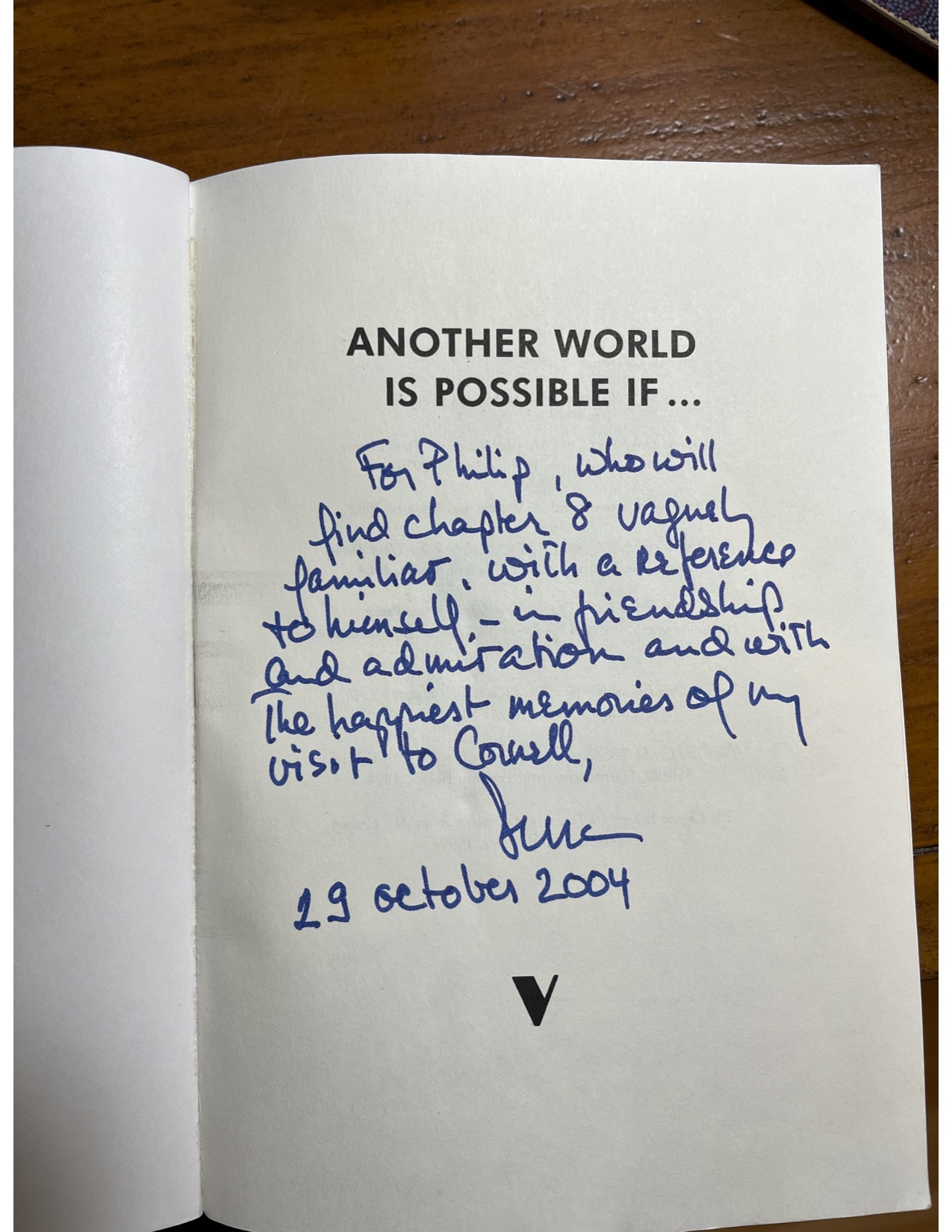
Peadar King
Helena Norberg-Hodge
"I knew Susan very well. We first met in the early 1980s, when we briefly found ourselves on different sides of the emerging anti-globalization debate. True to her intellectual integrity, Susan did not remain there for long. She soon joined the resistance and became actively involved with ATTAC in France. Over the years, we met up regularly at meetings in the US and all over Europe.
Brilliant, witty and always supremely elegant, Susan was also a formidable and much-loved ally to all who strive for equality, justice and ecological wellbeing." — Helena Norberg-Hodge
Satoko Kishimoto
I was deeply saddened to hear of the passing of Susan George.
Susan was an intellectual pillar of the Transnational Institute and a remarkable voice in the global struggle for justice and democracy. Her work exposed the structures of power, inequality and corporate domination with extraordinary clarity. At the same time, she never lost sight of the possibility of a more just and democratic world. Her writing combined sharp analysis with moral courage, and helped many of us better understand the forces shaping our societies.
For me, Susan was not only a renowned scholar and activist, but also a deeply supportive presence. During all the years I worked at TNI, from 2003 to 2022, she consistently encouraged my work and believed in what we were trying to do. Her trust meant more to me than I can fully express. In difficult moments, her words and her quiet confidence gave me strength.
My years at TNI shaped the ethical foundation of my life and work. The knowledge, experience and solidarity I found there convinced me that I had a responsibility to contribute to democracy and justice in my own society. That conviction ultimately led me to enter local politics in Japan. Today, as mayor of Suginami in Tokyo, I continue to draw on what I learned from that community — and from people like Susan.
Susan taught us that the task is not to study the powerless, but to study the powerful, and to expose the structures that sustain injustice. She lived that principle with intellectual rigor, courage and integrity.
I feel deeply grateful to have been part of the community she helped build at TNI. Her ideas, her generosity, and her unwavering commitment to justice will continue to inspire many of us.
Her spirit will remain with us as we continue the work — in different places, in different ways — for democracy and justice.
With deep respect and gratitude,
Satoko Kishimoto
Manuel Perez-Rocha
Remembering Susan George, a shining light of “alter-globalization”
The late Susan George was a pillar in unraveling the obscure mechanisms of economic domination through so-called “free trade.”
Susan George passed away in Paris on February 14 at the age of 91. Born in the U.S. and naturalized as a French citizen, Susan was one of the most important figures in denouncing capitalism over the last 50 years. She stood out for her elegance and refined voice.
But above all, she was known for her dedication to just causes and her authority in explaining the structures of inequality. Throughout her career, she wrote 17 groundbreaking books that have been translated into several languages, such as The Debt Trap, The Lugano Report, A Fate Worse than Debt, and We the Peoples of Europe, to name a few.
All of her work is of utmost importance to Latin America. She criticizes the Bretton Woods System and the Washington Consensus. She was a central figure at every forum she attended, such as the World Social Forums and European Social forums. She is credited with coining the phrase “another world is possible” and published a book with that title, but adding the condition “if” as a call to action. The phrase has been associated with the Zapatista slogan “one world where many worlds fit,” and both are seen as a direct confrontation to Margaret Thatcher’s “there is no alternative.”
She was honorary president of the Transnational Institute in Amsterdam and ATTAC France, and a key founder of both organizations. As TNI states in its obituary, “Susan always defended an objective, honest look at the magnitude of the progressive task. As formidable as it might look, Susan believed that the system has cracks, and ‘we just have to get out there with our pickaxes and work along the fault lines.’”
TNI quotes Susan:
“Either we achieve together a new level of human emancipation, and do so in a way that preserves the earth, or we shall leave behind us the worst future for our children that capitalism and nature can deal them. No one knows in which direction the balance will tip, nor does anyone know which actions, which writings, which alliances may achieve the critical mass that leads us one way or another, backwards or forwards. I am acutely conscious of the precariousness of our moment, and my much-loved grandchildren give me added resolve to address it.”
As the French chapter of ATTAC, the global organization against foreign debt and other injustices, remembered Susan as “an inspiring figure of anti-globalization and the weaver of a vast network. Politicized by her opposition to the Vietnam War and France’s welcome to American draft dodgers, her internationalist spirit never wavered. During those years of war and repression, she worked to bring an American think tank, the Institute for Policy Studies, to Europe, where it became the TNI, Transnational Institute, based in Amsterdam.”
John Cavanagh, who headed IPS in Washington for more than 20 years, says of Susan, “we have lost a true treasure of a colleague, ally, and leader.” He credits her book How the Other Half Dies for helping to “change the world’s view of poverty and development.” Susan “had a gift for translating complex realities into beautiful prose,” John said.
I was fortunate enough to meet Susan in Paris in 1998, in a humble café in a working-class neighborhood near the Gare de L’Est. I was on a tour of several European cities in search of partnerships for our work ahead of the negotiations for a Free Trade Agreement between Mexico and the European Union (MXEUFTA).
Our goal at the Mexican Action Network on Free Trade was to influence the outcome of the negotiations to achieve an agreement that was different from NAFTA — one based on human rights, in contrast to the liberalization of trade and the privileging of foreign investment.
I gave her a copy of our first report, “Citizens of Mexico before the European Union,” which was based on a forum with dozens of organizations and experts at the Convento del Carmen in Mexico City (I would also like to highlight the participation of the recently deceased Maestro John Saxe-Fernández). She seemed amazed, as she was at the center of the campaign against the Multilateral Agreement on Investment (MAI), which sought to impose a global investment protection treaty — one designed and commanded by the OECD, the so-called club of rich countries, into which former Mexican president Carlos Salinas de Gortari had enrolled us.
The MAI largely failed due to France’s rejection — and Susan’s leadership in mobilizing thousands of workers and organizations. An investment chapter could not be included in the MXEUFTA because in 2000 the issue was still not within the EU’s competence but that of its member countries separately.
But since the 2007 Lisbon Treaty, the EU has gained this power — and now the governments of both Mexico and the EU are seeking to impose an investment chapter that includes, for example, the possibility of suing countries in supranational courts (through ISDS).
Susan warned in a publication by IPS, TNI, the Rosa Luxembourg Foundation, and the Institute for Agriculture and Trade Policy that “when companies talk about ‘barriers’ to trade, we call those same measures ‘safeguards’ for people’s health, well-being, and the environment. Companies want absolutely no restrictions on access to natural resources, as several arbitration cases have made clear. All they have to do is set foot in a country and we have to say goodbye to the natural resources of poor countries, including basic necessities such as land, water, and forests.”
Susan George was never against the European integration project, but she was against its agreements with third countries that she said “are not about trade, but about power: they are not about tariffs, but about corporate control of regulations… they are negotiated in secret… and are almost impossible to reverse,” she warned. That is the truth about the “modernization” of the MXEUFTA that is about to be signed any day soon.
Susan George was a pillar in unraveling the obscure mechanisms of capitalist domination through so-called “free trade” and in the global struggle for justice and democracy.
This commentary was first published in Spanish by La Jornada.