
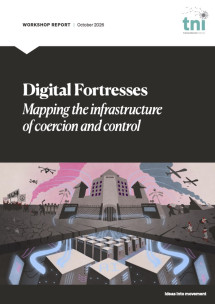
Digital Fortresses Mapping the infrastructure of coercion and control
Digital technologies are expanding the reach of state violence, surveillance and repression, connecting borders, policing and militarisation through an increasingly interconnected infrastructure of control.
In March 2026, TNI and TITIPI brought together 30 activists, researchers and organisers in Amsterdam to map this infrastructure, identify connections across different struggles, and strengthen collective resistance.
Download PDF
Authors
Authors


Introduction
We live in times of growing coercion and control, where activism, resistance, and even existence are under threat in the face of state violence and repression. The infrastructure for this is increasingly digital. Migrants are swept up and imprisoned in border-patrol dragnets in US cities or in desert towns in Mali and their personal details recorded in transnational biometric databases. Fishing boats off the coast of Venezuela or wedding parties in Yemen are eliminated at the touch of a drone operator in Arizona. Activists holding up signs saying ‘I oppose genocide. I support Palestine Action’, and even for comments made on a Zoom call, are being charged with terrorism. This genocide continues to unfold in Occupied Palestine in which the names of journalists, teachers, health workers and even children are entered into databases, and an algorithm determines them to be a legitimate target for elimination.
Digitalisation has dramatically increased both the coercive scope of state agencies as well as its potential impact. This is facilitated by a physical and mobile infrastructure of data centres, databases, cables, mobile and home devices that penetrate every realm of our lives. It is an infrastructure that interconnects previously distinct areas of state power, reliant on a small coterie of private corporate actors, and embedded in physical landscapes and institutions that might well outlast those who dare to challenge it.
To examine this digital infrastructure, the Transnational Institute (TNI) and The Institute for Technology in the Public Interest (TITIPI) convened a diverse international group of 30 activists, researchers, and organisers working at the intersections of technology, militarisation, borders, and social justice. The workshop was in response to the recognition that many movements work reactively, responding to specific moments or advocacy opportunities, and thus sought to create space for broader conceptual connections across different arenas of resistance.
The workshop took place over two days in Amsterdam in March 2026, with support from Funders Initiative for Civil Society (FICS), in the historic Ru Paré building – a space rich with symbolic significance. Named after Henrica Maria (‘Ru’) Paré, a prominent artist who organised resistance networks during Nazi occupation and saved Jewish children, the venue continues to work with marginalised communities in Amsterdam and embodied the workshop’s spirit of resistance and solidarity.
Credits
Authors
In collaboration with
DESIGN: Evan Clayburg
ILLUSTRATION: Michelle Tylicki
Download PDF
More like this
- The Institute for Technology in the Public Interest (TITiPI)
- Transnational Institute
