Rethinking Palestine beyond exceptionalism Afterword
Temas
Solidarity is not a sentiment — it is infrastructure. Rafeef Ziadah maps the economic corridors, energy deals, and security doctrines that sustain settler colonialism, and asks what it takes to build movements that endure beyond moments of outrage.
Longread de


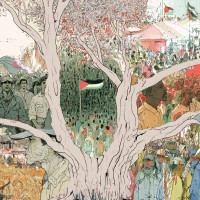
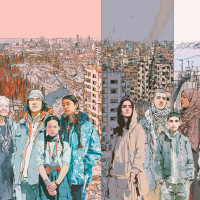
Illustration by Fourate Chahal El Rekaby
Writing in this moment is difficult. Not because there is nothing to say, but because there is too much that resists language. We are asked, somehow, to think clearly from within catastrophe, to write from within an unfolding genocide, while the present feels both unbearable and unfinished. The demand to produce coherence, to draw conclusions, sits uneasily alongside the knowledge that what we are living through is still in motion.
And yet it is precisely from within this tension that this collection emerges. Not as a record of what has already happened, nor as a detached analysis, but as an intervention – a refusal to isolate Palestine, to render it exceptional, to treat it as a singular site of suffering detached from the world that produces it. Instead, across the articles in this collection, Palestine appears as part of a wider field of struggle.

Illustration by Fourate Chahal El Rekaby
Reclaiming Palestine as relation
What this collection offers is not a single argument, but a political orientation. It situates Palestinian liberation within broader struggles against imperialism and ecological devastation, refusing to fragment the violence of genocide into manageable humanitarian concerns. In doing so, it reclaims a horizon that has been systematically eroded, one in which Palestine is not an object of solidarity, but part of a wider, unfinished movement for liberation.
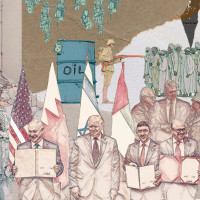
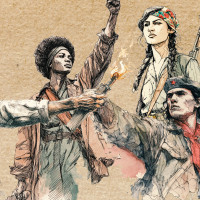
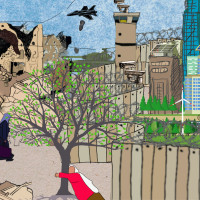
Across the collection, Palestine is read in relation to both the Gulf states and American power, situated within the shifting architecture of US imperialism in Southwest Asia and North Africa (SWANA). It is also situated within longer histories of Third World solidarity, where the Palestinian struggle is not an isolated cause but one that has moved alongside, and has shaped and been shaped by, other anti-colonial movements. Crucially, it is also analysed through the lens of climate justice, highlighting how fantasies of sustainability and green capitalism continue to coexist with the realities of dispossession and genocide.
The collection also moves outwards, tracing connections that are not merely symbolic but material. From Sudan to Egypt, from the African continent to West Asia, the articles reveal how Palestine cannot be understood in isolation from the regional context. The failures of revolution in one place reverberate in another; the suppression of popular movements in Sudan or Egypt is not separate from the ongoing dispossession of Palestinians, but part of the same configuration of power. To fail Sudan, as one article explains, is also to fail Palestine, not as a moral claim, but as a political reality.
This movement continues across geographies. From Vietnam and Algeria to China and India, from Latin America to Indigenous struggles across the Americas, Palestine appears in these articles not as a distant cause but as a point of connection within a global landscape of resistance. These are not parallels drawn for rhetorical effect, but relations that have been lived and built over decades. The articles remind us that solidarity is not an abstract sentiment, but a historical practice, one that emerges from shared conditions, even as those conditions are unevenly distributed.

Illustration by Fourate Chahal El Rekaby
Against exceptionalism
The isolation of Palestine has long been a political project, to render it a permanent crisis, a space of humanitarian concern rather than political struggle, a site to be managed rather than transformed. In this framing, Palestine becomes either a symbol or a laboratory, exceptional in its suffering, but disconnected from the systems that produce that suffering.
This collection disrupts that framing. It insists that Palestine is neither an anomaly nor a self-contained space, but is part of wider structures that extend across borders. To understand Palestine, then, is not only to examine its immediate conditions, it is also to trace the economic, military and ecological networks that sustain them. Refusing exceptionalism does not mean erasing difference. It means holding together specificity and connection, and analysing how imperialism, capitalism and settler colonialism operate across contexts in different forms.
In returning to these connections, many of the articles also return to the past. With startling clarity they recover histories of solidarity, revolutionary alignment, and political imagination that once moved across borders and that can feel distant from the fragmentation of the present. But this return is not, and should not be, an exercise in nostalgia. The past offers no simple blueprint. It cannot be mined for consoling images of unity or victory, while leaving aside the contradictions, defeats and limits that shaped it. We return to these histories because they remind us that the present was not inevitable, that other political horizons were once imaginable and fought for, and that solidarities had to be built, sustained and defended under conditions no less difficult than our own. To learn from them seriously requires moving beyond visible moments of success to examine the ongoing, often unrecognised, organising practices that made those moments possible.
If there is a danger in looking backwards, it is the temptation to romanticise, to extract fragments of hope without reckoning with the complexities that shaped them. To resist this, we must approach the past not as a repository of inspiration alone, but as a field of struggle in its own right, marked by contradictions and unfinished trajectories. The question is not how to replicate what came before, but how to learn from it without reducing it.

Illustration by Fourate Chahal El Rekaby
Normalisation as infrastructure
What follows is not only a different reading of the past, but a different way of approaching the present. If Palestine is not exceptional, it must be understood within the economic, political and infrastructural processes through which SWANA is being reorganised economically, politically and infrastructurally.
If this collection powerfully insists on Palestine’s place within the wider anti-imperialist struggle, it also pushes us to ask how, concretely, the region is being remade around Palestine. Not only through war, siege and genocide, but also through ongoing projects of normalisation that seek to fold Israel ever more deeply into the political economy of the region while further fragmenting Palestinians.
Normalisation here should not be understood narrowly, as a matter of diplomatic agreements alone. It is not exhausted by summits or the public handshakes of state representatives. It is a much deeper process: the construction of regional arrangements in which Israel becomes an indispensable military, logistical, technological and energy node, while Palestine is reduced to a security problem, a humanitarian file, or an afterthought to wider commercial integration. What is being normalised is not only Israel’s presence, but also the infrastructures of its permanence.
These dynamics are visible in several recent developments across SWANA: the consolidation of Gulf–Israeli ties; the integration of surveillance, arms and security technologies; so-called green development schemes that present themselves as sustainable futures while entrenching colonial dispossession; and new transport and trade corridors, including projects like the India–Middle East Economic Corridor (IMEC), which imagine seamless regional circulation while passing over the shattered geographies and political claims of Palestinians. These projects are often framed in the language of connectivity, innovation and prosperity. But connectivity for whom, on what terms, and built over whose erasure?
This broader scramble for access – to trade routes, data, energy, land, ports, subsea cables, logistical corridors, and regional influence – is central to understanding the present. Imperialism is not simply war, it works also through supply chains, financial circuits, cloud architecture, extractive energy projects, weapons transfers, and the digital terrain through which populations are monitored, governed and rendered profitable.
This has direct implications for how we understand the changing political economy of Palestine itself. Gaza and the West Bank are not simply two territories under occupation in the abstract; they have been differently but intimately reshaped through siege, enclosure, aid dependency, labour control, donor governance, and, very importantly, security coordination between the Palestinian Authority and Israel. Gaza has been subjected to repeated military destruction, alongside a long siege that has made life itself conditional, while also turning reconstruction, humanitarian management, and crisis into a durable mode of rule. The West Bank, meanwhile, has been carved up through settlements, checkpoints, bypass roads, permits, debt and aid. This fragmentation has been consolidated through the 1993 Oslo Accords, signed between Israel and the Palestine Liberation Organization (PLO), which reorganised Palestinian governance under occupation. The result is a fragmented space in which limited forms of economic life are permitted. Oslo did not suspend colonisation; it reorganised it.1
This reorganisation has reshaped not only the material conditions of Palestinian life, but also the terms through which Palestine itself is understood. Too much analysis still treats Palestine as if it were reducible to Gaza and the West Bank alone, or, worse, as if the question begins in 1967. In the process, Palestinians holding Israeli citizenship are folded into the background, appearing only intermittently, despite their central place in the struggle against settler colonialism, dispossession and racial rule. Their condition reveals something essential: that the issue is not simply occupation in the narrow territorial sense, but the wider structure of a settler-colonial regime that governs different Palestinian populations through differentiated forms of control.
The same is true, perhaps even more sharply, for Palestinian refugees, who remain the majority of the Palestinian people and yet are persistently marginalised in public discourse. They are too often treated as a residual issue, postponed to a final status that never arrives, rather than recognised as central. Any regional order that seeks to integrate Israel while setting aside the right of return and the political claims of refugees is not resolving the question of Palestine: it is attempting to close it by force. And any account of normalisation that does not confront this will remain partial.
This is why it is not enough to oppose normalisation as an idea. We have to understand the material arrangements through which it advances: the ports and corridors, the energy deals, the digital infrastructures, the aid regimes, the security doctrines, the class interests, and the regional alliances that together remake the terrain of struggle. What many of the articles in this collection show, each from a different angle, is that Palestine cannot be understood apart from these wider systems. The analysis of Gulf capital and American power, the critique of eco-apartheid and greenwashing, the attention to militarism, regional revolution and transnational solidarity – these are not separate conversations, they are glimpses of a larger totality.
To insist on that totality is to say that solidarity must become more materially literate, more attentive to political economy, more capable of tracing how power moves through infrastructure as much as ideology. And it is to recognise that if Palestine has been systematically isolated, that isolation has never been merely rhetorical. It has been built into the region’s roads, wires, checkpoints, markets, ports, and data systems; into the agreements that make some movement frictionless and others impossible. To challenge that order demands that we learn to see the machinery more clearly, and organise accordingly.

Illustration by Fourate Chahal El Rekaby
From mobilisation to organisation
This brings us back to the present moment, and to the forms of solidarity that have emerged within it. We are witnessing, in many parts of the world, an unprecedented scale of mobilisation, perhaps the largest since the Vietnam War. Millions have taken to the streets, refusing silence, refusing complicity, insisting that what is happening in Palestine cannot be normalised.
But scale alone does not produce transformation. The question that confronts us is what remains when the moment of mobilisation passes. If our politics is tied only to moments of visibility – peaks of outrage or cycles of attention – it risks dissipating as quickly as it emerges. As those who organise in labour movements insist, the challenge is not only to mobilise, but to organise: to transform participation into commitment, to build structures that can sustain struggle beyond moments of crisis.
This requires a shift in how we understand solidarity. Not as a series of actions, protests, campaigns and statements, but as a process of political formation. To think about how people move from protest to organising. In short, to ask ourselves what kinds of ‘infrastructures of dissent’ we are building, and whether they are capable of enduring.2
The scale of the present mobilisation offers possibilities, but it does not guarantee outcomes. To realise those possibilities requires attending to the slower, less visible work of organising, building relationships, developing analysis, and creating spaces where political commitment can deepen over time. It requires resisting the pull of immediacy, the constant demand to respond quickly with constant small actions, in favour of constructing something that can last. This collection is part of that work, helping to situate struggle and to deepen analysis.
This collection does not provide a blueprint. It does not resolve the tensions it raises. But it does something that is perhaps more important: it reopens questions that have been foreclosed, reconnects histories that have been fragmented, and gestures towards forms of politics that exceed the limits of the present.
To read it is to recognise oneself within the systems it maps, and within the struggles it traces. What follows from that recognition is not given. It must be made, collectively, in the uneven and ongoing work of building something that can endure.
Towards Palestinian Liberation
View the collection-
El contexto de Palestina Israel, los Estados del Golfo y el poder de los Estados Unidos en Oriente MedioFecha de publicación:
-
Palestina en un mundo de lucha El papel de los palestinos en la solidaridad del Tercer MundoFecha de publicación:
-
Fantasías de sostenibilidad/realidades genocidas Palestina contra un mundo de apartheid ecológicoFecha de publicación:
-
Out-Organise the Enemy! Eqbal Ahmad and the liberation of PalestineFecha de publicación:

-
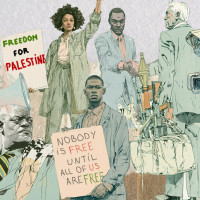
Actitudes y solidaridad de África con Palestina De la década de 1940 al genocidio de Israel en GazaFecha de publicación:
-
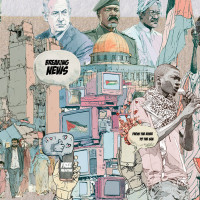
Al fallarle a la revolución sudanesa, le fallamos a Palestina Lecciones de los vínculos entre Sudán y Palestina en materia de política, medios de comunicación y organizaciónFecha de publicación:
-
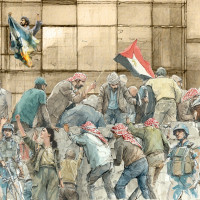
«La condición para la libertad es que las masas egipcias salgan a las calles» La importancia de Egipto en la lucha por la liberación palestinaFecha de publicación:
-
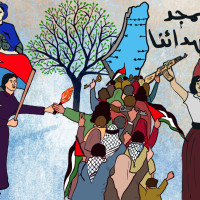
Vietnam, Argelia y Palestina Pasar la antorcha de la lucha anticolonialFecha de publicación:
-
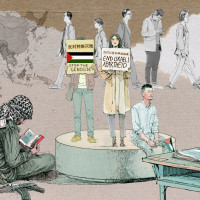
Del antiimperialismo internacional a los guerreros diente de león La solidaridad de China con Palestina de 1950 a 2024Fecha de publicación:
-
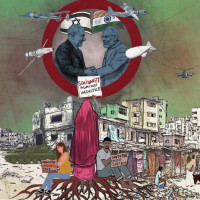
India, Israel y Palestina Las nuevas ecuaciones exigen nuevas solidaridadesFecha de publicación:
-
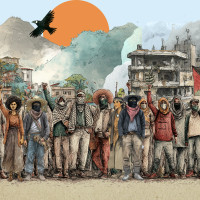
Yalla, Yalla, Abya Yala América Latina al encuentro de Palestina en tiempos de genocidioFecha de publicación:
-
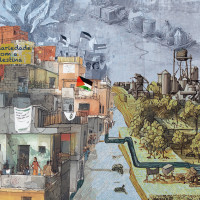
De las favelas y el Brasil rural a Gaza Cómo el militarismo y el greenwashing determinan las relaciones, la resistencia y la solidaridad con Palestina en BrasilFecha de publicación:
-
From Turtle Island to Palestine Resisting settler colonialism and genocideFecha de publicación:
-
Fecha de publicación: