ICARRD+20 and the emerging global coalition behind the 4Rs Land Redistribution, Recognition, Restitution and Regulation
Topics
ICARRD+20 in Cartagena brought governments, scholars, and social movements together to revisit the unfinished agenda of agrarian reform. Amid deepening land inequality and ecological crisis, debates converged around the 4Rs: Recognition, Redistribution, Restitution, and Regulation, as pillars for democratizing land and advancing systemic transformation.
Longread by


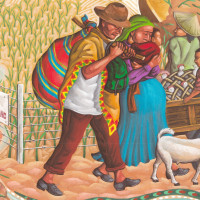
Illustration by Federico 'Boy' Dominguez
ICARRD+20, its context and object
The inter-governmental International Conference for Agrarian Reform and Rural Development (ICARRD+20) was convened by the Colombian government on 24-28 February 2026. More than 4,000 representatives of governments, social movements and NGOs, international development institutions, and academia from all over the word participated in the conference in Cartagena, Colombia. It was formally opened by Colombian president Gustavo Petro and chaired by Martha Carvajalino, the charismatic minister of agriculture of Colombia. The idea of an ICARRD+20 was originally conceived by social movements, particularly the International Planning Committee (IPC) for Food Sovereignty (or IPC, a global alliance of social movements including La Via Campesina) years ago. They were the ones that persistently pushed and advocated for organizing the inter-governmental platform.
On the eve of the official ICARRD+20 event, more than 200 representatives of social movements of Indigenous Peoples, and other rural communities: including peasants, pastoralists, fishers and landless farmworkers from the Global South and North also convened in Cartagena on 22-23 February. This was organized by IPC.
In addition, on 20-22 February 2026, 410 scholars from 321 universities and research institutions from 55 countries around the world held their own pre-ICARRD+20 academic conference at the University of Cartagena under the theme: ‘Land, Life and Society’. More than 100 scholarly papers were presented and discussed. The agenda of the conference was to bring together evidence-based arguments in support of exploring new ways of asking questions about an old, persistent challenge: democratizing land politics, globally. It aimed to consolidate the contributions from the international academy to public conversations about the ways forward, and on how scholars can support more effectively the struggles by social movements.
ICARRD+20 is not as big and as well-known as the other regular intergovernmental platforms such as the climate change focused UNFCC Conference of the Parties (COP), or the Convention on Biodiversity (CBD). The origin of it was the World Conference on Agrarian Reform and Rural Development (WCARRD) convened by FAO in Rome in 1979. In 2006, the first ICARRD was convened by the Brazilian government under Lula’s presidency in Porto Alegre in 2006.
ICARRD is an intergovernmental conference like no other because it touches on an extremely politically contentious topic: the possible dismantling of large private landed properties and their redistribution to peasants, rural working people, and the Indigenous. Agrarian reform was the term conventionally used to describe the effort at dismantling land monopoly. That 56 national governments participated in ICARRD+20 and 28 of them ratified the Cartagena Declaration is extraordinary, especially because very few countries, not more than a dozen, have existing redistributive land policies.
Colonialism and imperialism and their land legacies
Centuries of colonialism and imperialism have left us with so many ruins – not only in the colonized societies, but among the working class, peasants and the Indigenous Peoples in the colonizing and imperialist countries. The pattern of land use, web of access, and mosaic of property relations and institutions that are ecologically destructive, exploitative and oppressive are among these legacies.
For the past 500 years, the logic of capital has propagated the absurd idea of endless and limitless economic growth, or profit-making. In turn it requires constant and ever-expanding land frontier-making. Commodification of land, life and nature through market relations and extra-economic coercion has resulted in cycles of dispossession and expulsion based on class and interlocking axes of social differences: race and ethnicity, genders, generation, caste, religion and nationality, as well as in ecological plunder.
Political struggles to democratize land access, through agrarian reform, resulted in numerous important victories worldwide where peasants, Indigenous Peoples, pastoralists and fishers got land. But during the past five decades of neoliberal capitalism, many of these earlier gains were canceled out through market relations or land grabbing.
Thus, today the most immediate and compelling context for and object of ICARRD+20 was the fact that after a full century of land reformism, land titling and land tenure formalization programs worldwide, contemporary land control of the 1.5 billion cultivated agricultural land demonstrates extreme inequality: 1% of all farms cover 70% of all agricultural land, and the bottom 40% of all farms cover only 3% of all farmland. If we broaden the baseline of what we account, then such monopoly in land control may be and is likely to be deeper and wider as market-based solution to climate change, such as carbon sequestration projects require up to 1.2 billion hectares of conservation areas that are more likely to benefit big corporations rather than Indigenous Peoples and ordinary rural working people. For the United Nations FAO to state more or less the same global situation in its Global Land Observatory (GLO) Report launched in Cartagena is politically significant. What to do with the reported existing land monopolies is another story.
Rejecting the two dominant approaches to land policies
The pattern of ecologically destructive land use, undemocratic web of land access and mosaic of property relations were direct outcomes of colonialism, imperialism and capitalist market relations. Yet, during the past five decades of neoliberalism, mainstream institutions like the World Bank wanted us to believe that the only way to address these problems is through market mechanisms: willing seller-willing buyer in land market, market-based climate action and so on. It is in this context that the academic conference, the social movements summit, and the many speakers at the official ICARRD+20 conference have exposed and opposed the two mainstream approaches to land.
The first approach is ‘land tenure security’. The idea is to promote and provide security of tenure to those who have access to land often through formal land titles, whether individual or collective. For example, individual formal land title to a peasant household, or a formal collective land title to an Indigenous territory. The formal registration and title can be used in formal market transactions: in forging a contract with a mining company, or as a collateral for loans. There is nothing inherently good or bad with this process. The problem comes in when formalization of land tenure is pursued without the policy of redistribution or restitution, and without regulation on how much land an individual or corporation can accumulate. When this happens, land tenure security is essentially ratifying what exists, and in most societies today, what exists is extreme land-based inequality. In this context, the practice of land tenure security is simply formalizing inequality.
The second, complementary approach is petty reformism. The main idea is to give lands to peasants, Indigenous Peoples, pastoralists, fishers and farmworkers. But it comes in the form of small parcels and tiny territories, and often of marginal quality. At best, it covers very limited space and proceeds in the manner of 1+2+3+4+5. In contrast and at the same time, big capitalists also get lands, but for a much wider scope and in a much faster pace: 1x2x3x4x5. The modest gains of ordinary rural working people and Indigenous Peoples are not due to the loss of big capitalists, but due to the endless land frontier-making which is often done through cycles of dispossession and ecological plunder. This is in contrast to the essence of the 20th century land reforms in which the gains of landless peasants were achieved through the losses of big landlords. Ultimately, this dominant approach can only result in sporadic and tiny gains for rural working people and Indigenous Peoples without really changing the unjust status quo.
These two dominant approaches were discussed and rejected at the academic conference and social movement summit, as well as in many interventions in the official ICARRD+20 conference.
Rejecting the official Declaration, celebrating the ICARRD+20 process
Social movements rejected the ICARRD+20 official Declaration, but at the same time underscore the positive relevance and importance of the ICARRD+20 process and platform. The reason why the social movements rejected the official ICARRD+20 Declaration was largely due to the language used in the final text that relates to Indigenous Peoples, namely, “Indigenous Peoples and Local Communities”. In its statement, the IPC explained they rejected the Declaration because of “the conflation of Indigenous Peoples with the vague concept of ‘local communities’”. Moreover, “Indigenous Peoples organizations articulating through the IPC under the International Indian Treaty Council (IITC), emphasized that the three UN mechanisms on the rights of Indigenous Peoples have clearly distinguished the unique characteristics, origins, and legal status of Indigenous Peoples’ rights, and warned that grouping them with undefined communities undermines those protections.” Yet, the IPC and its member social movements and allies have repeatedly emphasized the strategic importance of the ICARRD+20 for bringing back the issue of democratizing land at the center stage of global public debates. They support the call for regularizing this platform, including convening ICARRD once every three years.
What is to be done? The 4Rs and a global united front for systemic change
Struggles to democratize land control have been notoriously sectoral: a plot of farmland for peasants, a block of grazing range for the pastoralist, a territory for Indigenous Peoples, a patch of landing area for fishers. At best, we see some strong, but very sectoral, struggles. The worst, more common story has been that the forces inside and outside the State in many societies use these sectoral issues to divide and rule working people and Indigenous Peoples and their social movements. Governments distribute lands to peasants, but it turned out that these are territories of Indigenous Peoples. Governments recognize and formalize land claims of occupants, but it turned out these are lands historically claimed by Internally Displaced Peoples (IDPs). There are endless combinations of putting different Rs against one another.
What ICARRD+20 in Cartagena has accomplished best, in our view, was to push and inspire different social movements of peasants, Indigenous Peoples, fishers, pastoralists, farmworkers – across genders, generation, race and ethnicity, caste and nationality – to forge a global united front, and decisively resolve not to be party to the reproduction of the reactionary divide and rule strategy of those opposed to deep social reforms. La Via Campesina’s framework in going to ICARRD+20, as well as IPC’s guidelines, are both centered around what they call the inseparable and mutually reinforcing principles of land Recognition, Redistribution, Restitution and Regulation – or the 4Rs.
For those who have still access to land but that such is constantly threatened or ignored, key is land Recognition – whether this is for the land control by Indigenous Peoples, rural working people and peasants in customary tenure settings, women or young people’s land access. For the landless due to the dull compulsion of market relations, earlier land grabs, or simply being born to landless families, key is land Redistribution of big land monopolies. For the victims of involuntary displacements, the urgent policy is Restitution, together with reparation for the comprehensive loss. And the three will not work without Regulation to how much individuals and corporations can accumulate in terms of land hectarage. If there is no ceiling to how much land can be accumulated by individuals and corporations, big capitalists will monopolize land control and render land policies promoting land access for ordinary rural working people and Indigenous Peoples as empty promises. Like La Via Campesina, the IPC also has also highlighted the 4Rs in its framework. For its part, TNI has been working on the concept of the 4Rs (or 5Rs) much earlier – in its work on the concept of agrarian climate justice, and in its Myanmar program. Land is taken loosely as a default for nature more broadly. Thus, the fisher movements present in Cartagena were pushing for the 4Rs in the context of marine spaces (oceans, seas, rivers, lakes) for fishers and fish workers, as pastoralist movements pushed for the 4Rs in the context of grazing territories.
Related

For the social movements at ICARRD+20, especially IPC and La Via Campesina, agrarian reform of the twenty-first century has to be based on the mutually reinforcing 4Rs. This was the same 4Rs-centered conclusion reached at the academic conference in Cartagena that was attended by 410 scholars from 321 universities and research institutions from different parts of the world. See the academic conference Cartagena Declaration here.
Representatives of social movements and scholars, as well as key ministers at ICARRD+20, also emphasized the point that even if we manage to do the extremely difficult-but-not-impossible task of democratizing land regimes through the 4Rs, if we do not transform in systemic ways the ecological and economic contexts within which land use, land access and mosaic of property relations are embedded in, positive impact on societies are far-fetched.
Just transitions are crucial, and in turn, require agroecological ecological transitions. But agroecological transition is only possible if we democratize existing land regimes through the inseparable principles of land Recognition, Redistribution, Restitution and Regulation, and in a truly global terrain as it is not only an issue in the Global South. The global united front struggle for democratizing land through the 4Rs is a necessary core element in the broader working class struggles within and against capitalism and imperialism.
Without autonomous social movements, struggles to democratize land regimes will not go anywhere. But with social movements alone and on their own, struggles will not go very far because the forces against deep social reforms, inside and outside the state and inter-governmental institutions, are so strong and influential. Social movements need allies. One of the outcomes of ICARRD+20 is the broadening of global alliance behind the 4Rs: across social movements and their NGO allies, progressive governments or pockets of reform-oriented officials in national governments and international development institutions, church institutions, as well as scholars, especially scholar-activists. The conferences in Cartagena also emphasized the need to go beyond sectoral struggles, and beyond being ‘merely agrarian’, pointing to the strategic importance of building alliances with other rural and urban sections of the working class: industrial workers, (migrant) farmworkers, food system and health workers, among others. This was also emphasized during the 3rd Nyeleni food sovereighty global assembly in September 2025 in Sri Lanka. These are not easy tasks, but these are good reasons to be hopeful in the present and future political struggles to democratize land regimes and push for agroecological transition and food sovereignty.
Credits
Authors
Jun Borras is a TNI associate, and a Professor of Agrarian Studies at the International Institute of Social Studies (ISS) of Erasmus University Rotterdam (EUR), and is part of the distinguished Erasmus Professors program for positive societal impact. He is a co-editor with J. C. Franco of The Oxford Handbook of Land Politics (2025).
Jennifer C. Franco is a TNI researcher in the Agrarian and Environmental Justice Program and in the Myanmar-In-Focus Program. She is a co-author with J. Borras of the Essential Concepts of Land Politics (2025) and Scholar-Activism and Land Struggles (2023).
Notes:
For related discussion on the 4Rs or 5Rs in the context of Colombia, refer to:
Arango Vásquez, L. (2025). Indigenous peoples, commons and the challenge of sustaining life amid capitalist land grabs. Journal of Peasant Studies, 52(6), 1107-1134.
Rojas Herrera, I. (2025). Limits and possibilities of contemporary land struggles by Indigenous Peoples, Black Communities and Campesinxs in the Colombian Amazon. Journal of Peasant Studies, 52(4), 667-696.
For earlier discussions on the 4Rs or 5Rs, the following titles from TNI and TNI researchers are suggested:
TNI (2021). The 5Rs in Myanmar: Five principles for a future federal democratic system where rural working people can flourish. Transnational Institute (TNI).
Paula Satizábal, Yukari Sekine, Carolina Hernández, Catalina García, Carmen Mannarino, Wilmien Wicomb, Carsten Pedersen and Jackie Sunde (2026). From customary tenure to capital: connecting ocean, water and fisher peoples’ territorial struggles to global production networks, land politics and agrarian debates. A paper presented at the International Academic conference, ‘Land, Life and Soci3tey’, prior to ICARRD+20, 20-22 February 2026, Cartagena, Colombia.
Borras, S. M., & Franco, J. C. (2018). The challenge of locating land-based climate change mitigation and adaptation politics within a social justice perspective: towards an idea of agrarian climate justice. Third World Quarterly, 39(7), 1308-1325.
Borras Jr, S. M., & Franco, J. C. (2025). Essential concepts of land politics: An A–Z guide. London: Earthscan
More like this
-
ICARRD+20 must move beyond technocratic fixes to implement real, integral agrarian reform Global Social Movements in CartagenaPublication date:
-
Reforming pattern of land use, web of land access and mosaic of property institutions Issues for reflection in the context of COP30 and ICARRD+20Publication date:
-
Publication date:
-
The politics of land Introducing an important new collectionPublication date:
-
Publication date: