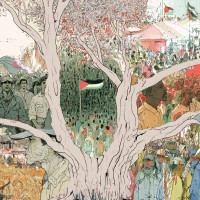
What connects Vietnam, Algeria, and Palestine? This introduction traces a century of anti-colonial struggle and solidarity — from the Nakba to the genocide in Gaza — to recentre Palestine as a defining struggle of the global South.
Longread by


Illustration by Fourate Chahal El Rekaby
“If I must die,
you must live
to tell my story
…
If I must die
let it bring hope
let it be a tale”
– Refaat Alareer (1979–2023)
“We know the entire history and future of Palestine because we have lived it. We endure the settler colonial project that calls itself the United States. We survived the elimination and removal of our ancestors. We are in our fifth century of resistance. We know that Palestine’s future is a certain future because we are still here!”
– The Red Nation’s message to the Free Palestine National March on Washington, November 20231
We would like to start this collection with a note of hope and of optimism (‘optimism of the will’ in Gramsci’s phrase), even as we recognise that this is in constant tension with feelings of powerlessness and pessimism of the intellect.2 To nurture this hope and optimism, what we would like to do in the following pages is to convey the complexity of liberation struggles, and the need to view them from a longue durée perspective, as protracted fights against systems of domination, oppression and exploitation. In these struggles there is always the potential for victory, but victories are not easy and are never guaranteed. Things can become much worse before they start to change for the better. Faced with this reality, our intellectual and militant choice is to join the struggle and to continue fighting for a better world, through our ideas, our words and our actions.
Why the emphasis on a longue durée? Because viewing phenomena only as single events occurring at a given time and in a given place may generate a skewed picture and a distorted assessment. Instead, we should view all events and dynamics (however horrible they are) as an accumulation of experiences, lessons and contradictions that can culminate in overthrowing systems of oppression – when the right conditions align at the national, regional and international levels.
The long struggle for Palestinian liberation is no exception to these observations. We are not saying anything new here, but we find it extremely important to reiterate and emphasise this point in the face of the genocide in Gaza. At a time when the deadly and dehumanising forces of empire and capital are bent on destroying hope and killing the idea of resistance, we cannot afford to fall into the webs of defeatism. We must find hope by drawing linkages across history and geographies. Doing so can show us not only that a better world is possible, but also that parts of it are already present, in the histories and daily practices of struggle, solidarity and care that continue to be lived, remembered and enacted. It is these histories and practices that we must bring to the surface and to foster.
In doing so, it is important to understand that those elements that make up this better world to which we aspire, from national liberation movements to the contemporary Palestine solidarity movement, have always begun – and are able to persist – not solely based on their opposition to an enemy that enacts colonial violence, but also because they embody love and care for one’s people and for each other in the face of injustice, dispossession and atrocities. Continuing to build the better world we want to live in can come about solely through the concerted and collective efforts of us all, not only by continuing to practise solidarity and care, but also by building better systems that are grounded in these principles.
One part of these collective efforts – which is where this collection comes in – is analysing, diagnosing, and (re)framing; as well as challenging and debunking myths, lies and misconceptions. This includes revealing ignored or lost histories of resistance and solidarity, and bringing to the fore the unshakeable will of downtrodden and oppressed people everywhere who have fought to overturn the status quo and vanquish seemingly invincible enemies.
What can we say or write about what has been happening in Gaza, Palestine and the broader North African and West Asian (NAWA)3 region in the last two-plus years? Omar Jabary Salamanca, Punam Khosla and Natasha Aruri have posed this very question:
How does one write in the midst of an ongoing genocide? When the contours of Palestine are being redrawn in blood, and when unconscionable images of starving, injured, and dead children, women, and men have become our daily breakfast? How do we register the indignities, dehumanisation, and sadism being unleashed on the Palestinian people? Where does one begin to chronicle the cumulative calculus of 164 days of genocide compounded by the invisibilised cruelties of a long century of Zionist settler colonialism and imperial capture?
The genocide, brutal occupation, ethnic cleansing, mass starvation, and untold destruction taking place in Palestine today perfectly lay bare the violent and ugly underpinnings of the global capitalist-imperialist system and condense its deadly and devastating contradictions. They show that system’s tendency to deploy large-scale and unimaginably cruel violence. What is taking place today in Gaza is not only a genocide. Witnessing the accumulated destruction, death, trauma, terror and erasure unleashed over the last two years on Palestinians, it is not clear that we yet have an adequate lexicon to describe the present colonial situation in Palestine. Words like occupation, settler colonialism, apartheid and even genocide and ecocide feel insufficient in isolation. We need a new vocabulary to help us describe and grasp these phenomena. Some have proposed the term holocide – the annihilation of an entire social and ecological fabric of life.
In the face of all of this, our feelings of frustration, anger, sadness, pessimism and hopelessness are at times assuaged by glimmers of hope and moments of inspiration, alongside a sense of humility, when we witness Palestinians’ sumud (steadfastness)4 and ongoing resistance. Despite the calamity and the pervasive, omnipresent and unrelenting catastrophe they face, Palestinians continue to resist and cling to their land. In the context of the Israeli and American plan to ethnically cleanse Gaza, Mahmoud Bahjat from North Gaza told a reporter: “Even if it costs us our souls, we will not leave Gaza”. Jamalat Wadi likewise declared: “If there is only one drop of blood left in our children, we won't go out of Gaza. We won’t give up on it!” When we hear these words of Mahmoud and Jamalat (and many others like them), showing their iron-clad determination and solid resolve, it drives home that we too must resist falling into despair. As Palestinian spoken word artist and academic Rafeef Ziadah has poignantly said: “We Palestinians wake up every morning to teach the rest of the world life.”
Thus, while this introduction – and this collection as a whole – does indeed recount death and destruction (in order to make sense of what is taking place), it also tells stories of resolve, steadfastness, courage, sacrifice, love and solidarity. This includes the amazing global outpouring of solidarity with Palestine now taking place, which makes clear that Gaza has awakened the world and that Palestine has become the quintessential and defining struggle of our time.
As part of that struggle, this collection seeks to document and analyse reality in order to change it. We recognise that words on their own are never enough and that theory without practice and revolutionary forces remains lacking. The contributions in this collection are therefore an effort to enrich our liberatory ecologies and revolutionary praxis, with the aim of radically transforming the world in which we live – not just for the sake of Palestinians, but for all of us, and for the generations to come.
With this aim in mind, in the following pages, we first (“Key contours of the Palestinian struggle”) set out some of the key developments in the Palestinian struggle, from the Zionist colonisation of Palestine at the start of the 20th century, via the era of Third World internationalism in the 1960s and 1970s, and up to the current moment of the normalisation of Israeli expansionism and genocide, and popular global resistance to it. The aim here is not to offer an exhaustive chronology but rather to both provide the reader with what we think is the essential context for situating the authors’ contributions, and to place Palestine’s liberation struggle within a longue durée perspective that highlights that struggle’s centrality in the fight for a liberated world. Then (“Why this collection now? What we aim to achieve”) we explain why we are presenting this collection now, and the principles and ambitions that lie at its heart – particularly the effort to rebuild global networks of anti-colonial solidarity. Thereafter (“Summary of the articles”), we summarise the articles, before (“Conclusion”) concluding with some remarks about the need to draw inspiration from earlier periods of internationalist struggle in order to complete decolonisation, overcome the imperialist-capitalist system, and restore our denied humanity.

Illustration by Fourate Chahal El Rekaby
Key contours of the Palestinian struggle
On the colonial origins of Zionism: from the Nakba to the June 1967 war
We cannot understand the genocide in Gaza without understanding the colonial origins of Zionism. The genocide is the outcome of Zionist settler colonialism, which is premised on the eradication of the Palestinian people in order to create a Western outpost serving colonial and imperial interests in the NAWA region.5
The Nakba (catastrophe) of 1948, in which around 750,000 Palestinians were displaced and more than 500 Palestinian towns and villages were destroyed, is the defining moment of Palestinian history. It was amid the ethnic cleansing and mass violent displacement and dispossession of the Palestinian people during the Nakba that the Zionist State of Israel was established.6
However, Zionist colonisation actually began 60 years earlier. It was in the period 1882–1897 that haphazard colonisation of Palestine first began to be supported by wealthy Jewish financiers as a mixed philanthropic-colonial venture.7 Palestine was sold as “an empty homeland waiting to be redeemed by the exiled Jews”8 – in other words, as a ‘land without a people for a people without a land’. This was the context in which the First Zionist World Congress was held in Basel in 1897 under the leadership of Theodor Herzl. This produced the Basel Programme, which stated that the aim of Zionism was “to create for the Jewish people a home in Palestine”. Over the next few years, institutions were established to organise and facilitate the Zionist colonisation of Palestine, including the Jewish Colonial Trust (1898)9 – now Israel’s Bank Leumi – and the Jewish National Fund (1901).10
Herzl was clear about the White-supremacist and colonial nature of the Zionist endeavour. He wrote in his pamphlet The Jewish State: “We should there [Palestine] form a portion of a rampart of Europe against Asia, an outpost of civilization as opposed to barbarism”.11 In his diary he wrote: “If it is God’s will that we return to our historic fatherland, we should like to do so as representatives of Western civilization & bring cleanliness, order & the well-distilled customs of the Occident to this plague-ridden, blighted corner of the Orient”.12 In 1902, writing to Cecil Rhodes, Herzl confirmed that Zionism was “something colonial”.13
Zionist colonial and racist aspirations mirrored and were aligned with similar aspirations that existed across Europe at this time, including in Britain, which was seeking to expand its influence over the NAWA region.14 As explained in 1918 by British Foreign Secretary Arthur Balfour (whose famous ‘declaration’ set out the British government’s aim of aiding Zionist colonisation), Britain sought control of Palestine to guard the gateways of British India. It was this strategic ambition that French-Hungarian Zionist leader Max Nordau sought to play upon when he declared at a Zionist meeting in London in 1919: “We shall have to be the guards of the Suez Canal. We shall have to be the sentinels of your way to India via the Near East”. A similar sentiment was expressed by Winston Churchill in 1921: “Palestine is all the more important to us … in view of the ever-increasing significance of the Suez Canal”.
These were some of the strategic calculations that lay behind British sponsorship of the Zionist project to settle and colonise Palestine, which it did under the post-war British Mandate for Palestine (1920–1948). This sponsorship involved facilitating land purchases by Zionists, dispossessing Palestinian farmers, and establishing separate Jewish-only economies and colonies. Most importantly, it involved crushing Palestinian resistance to Zionist colonisation.
Early Palestinian resistance had predominantly taken the form of legal appeals to the British, organising against the sale of land to Zionists, and appealing to international actors to support Palestinian national independence. When it became clear this was not working, the Great Arab Revolt was launched (1936–1939). This involved strikes, demonstrations and guerilla actions against both the British and Zionist settlers. Armed struggle within the Revolt was inspired by the Syrian-born revolutionary Shaykh Izzeddin al-Qassam’s efforts to launch an armed struggle against the British in the early 1930s (in which he perished). The British responded to the Great Arab Revolt with violence and repression, killing over 5,000 Palestinians, wounding 15,000, exiling and executing the Palestinian leadership, and organising joint British-Zionist death squads, involving groups such as the Haganah, to attack Palestinian villages. British imperial violence was thus essential in incapacitating Palestinian resistance to Zionist colonisation.
As this brief summary has shown, the cementing of Zionist colonisation in Palestine largely depended on the support of Britain. It was that support that ultimately secured the Zionist colonial project and the establishment of Israel. This pattern of imperial patronage of Zionism continued after Israel was established: both Britain and France were key supporters of the new country, including in their tripartite invasion of Egypt in 1956, following Nasser’s announcement of his intention to nationalise the Suez Canal. However, things took a decisive turn with the June 1967 war, in which Israel delivered a crushing defeat to the forces of Arab nationalism. The United States immediately saw that Israel would be useful as a US imperial outpost in the strategically vital NAWA region, and quickly became its primary supplier of arms and financial aid.15

Illustration by Fourate Chahal El Rekaby
Palestine and Third World internationalism
The 1967 defeat (Naksa in Arabic) dealt a severe blow to Nasserism and to pan-Arab nationalist dreams, and produced despondency across the NAWA region. It was against this gloomy backdrop that Palestinian armed resistance, embodied by the Palestine Liberation Organisation (PLO), burst onto the scene with an energising force, through its victory against Israeli forces in the Battle of Karameh (Jordan) in 1968. This success restored hope to the Palestinians after the traumatic events of the Nakba, and to the wider region in its fight against Israel and US imperialism.
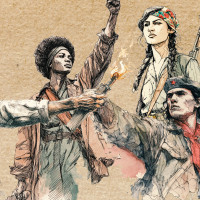
It was in this way that Palestinian revolutionaries – through the PLO and its constituent factions, including Fatah and the Popular Front for the Liberation of Palestine (PFLP) – actively cast themselves into the world. Learning from and taking up the torch of revolutionary and liberation struggles in Vietnam, Cuba, Algeria and China, Palestinians formed a part of, and made a significant contribution to, what became known as the era of Third World internationalism, which lasted from the 1950s to the late 1980s.
In 1960, which became known as the Year of Africa, 16 newly free African countries joined the UN,16 signalling a shift in the international system. In this period, national liberation movements across Africa, Asia and Latin America that had fought against colonialism and imperialism took their legitimate place in the international system, bringing with them their anti-colonial and anti-imperialist fervour. Since the UN General Assembly was based on the system of one nation one vote, it became a space where newly independent and socialist states could leverage their weight against the forces of European and US colonialism and imperialism, expanding the notion of self-determination beyond the national level to the international sphere. The UN thus represented a space of hope for newly decolonised states. Ghanaian revolutionary Kwame Nkrumah underlined this perspective: “I look upon the United Nations as the only organization that holds out any hope for the future of mankind”.
The era of decolonisation saw the birth of a distinct political project: achieving national liberation while also moving towards a more egalitarian world order.17 This was represented by the vision of a New International Economic Order (NIEO),18 which sought political and economic sovereignty and greater cooperation rooted in Third World politics.
The Palestinian struggle became the centre of this new spirit of anti-colonialism and Third World internationalism, as several articles in this collection highlight. It is no coincidence that it was in 1974 (the same year in which the NIEO was endorsed by the UN General Assembly) that the UN recognised the PLO as the sole legitimate representative of the Palestinian people and granted it observer status. A year later, UN Resolution 3379 declared Zionism a form of racism and racial discrimination.19 The resolution symbolised the solidarity between the Palestinians and South Africans (and between Arabs and Africans more broadly) in their joint struggle against (in the resolution’s wording) the “unholy alliance” between “the racist regime in occupied Palestine and the regimes in Zimbabwe and South Africa [that] have a common imperialist origin”.
For Israel, the US and other countries supportive of Zionism, Resolution 3379 was a symbol of the Third World take-over of the UN. While today the radical potential of the UN and other institutions has no doubt been lost (alongside any hope that these institutions could offer), what we want to highlight in this history is the transnational solidarity between oppressed and colonised peoples that was a driving force in changing the world in this period. It is to a renewal of this solidarity that we wish to contribute through this collection, by re-situating Palestine within global anti-colonial history and recentring it as “a paragon of today’s struggles for true decolonisation” and the push towards a more egalitarian world order.20 Recounting this history, and connecting it to present actions of resistance and solidarity, provides a longue durée view of the trajectories of these struggles, and underlines the ties that bind us together against the forces of colonialism and imperialism.

Illustration by Fourate Chahal El Rekaby
The ongoing Nakba: colonial genocide in Gaza, Zionist expansion, and regional war
While the era in which we are now living is qualitatively different to the period of Third World internationalism, the fate of Palestine today remains linked to the fate of the NAWA region and the world. As in previous eras marked by massive colonial and imperialist violence, from Algeria to Vietnam, today we are again witnessing how far colonialists and imperialists will go to preserve and expand their domination.
Israel has murdered (at least) a recorded 72,000 Palestinians in the Gaza Strip (some estimates surpass 280,000)21 and has destroyed or damaged 81 per cent of all infrastructure, including its 36 hospitals, at least 92 per cent of its residential buildings, and 97 per cent of its schools. As part of the targeted destruction of the health sector, Israel has killed at least 1,722 health workers. For more than two years, Israel has blockaded aid to manufacture famine. Through these deliberate actions, it has prevented the possibilities for reproducing life in Gaza: ensuring the injured are unable to heal, babies and children are unable to grow, mothers cannot feed their children, the elderly cannot be cared for, and people starve. To prevent the world seeing what is happening, Israel has murdered at least 234 Palestinian journalists and media workers. Most, if not all, Gazans have seen family members killed or wounded. For at least 902 families, no one from any generation survives: no living members remain on the Gazan civil registry. Israeli leaders declared at the outset that “Gaza won’t return to what it was before. We will eliminate everything.” This has come to pass: the destruction of entire neighbourhoods, and even cities (like Rafah), means that the places that more than 2 million Palestinians called home are now unrecognisable or have ceased to exist.
For many, the attack on Al-Ahli hospital on 17 October 2023, which killed nearly 500 Palestinians in a single air raid, was a clarifying turning point. As images of the destruction surfaced, Israel’s propaganda machine claimed it was caused by a misfired weapon from a Palestinian militant group – a claim international media parroted without investigation. Palestinian doctor Dr Ghassan Abu-Sittah and colleagues held a press conference outside of nearby Al-Shifa hospital surrounded by the bodies of those killed in the strike. He later explained that it was on that day that he realised Israel intended to commit genocide in Gaza. The attack on Al-Ahli hospital was a test to see if the world would act to stop the carnage. The international response, which lined up behind Israel to blame Palestinians for their own deaths, made clear that there was no crime Israel could commit that would draw direct condemnation. Massive colonial violence, and ultimately genocide, was normalised.
Israel’s genocide in Gaza is but one part of the colonial expansionist project of Zionism, which is now accelerating its longstanding ambition of removing Palestinians from their lands, either through extermination or forced displacement. In the West Bank and Jerusalem, Israeli settler, police and military violence against Palestinian communities is intensifying, forcing Palestinians out to pave the way for yet more Israeli settlements. At the same time, 1948 Palestinians (Palestinians who remained on their lands after the 1948 Nakba) are facing increased surveillance, state violence, and homicides. Across historic Palestine,22 Palestinians are being imprisoned by Israel and subjected to torture in an attempt to pacify the population and instil fear. This includes children. The strategy is clear: Israel aims to put as much pressure as possible on Palestinian communities and families, either directly or indirectly, to force them to leave.
Even as it pushes forward its plans to exterminate and expel Palestinians from their homeland, Israel is seizing the moment to redraw the map of the entire region, expanding its territorial control in pursuit of a messianic vision of ‘Greater Israel’.
In Lebanon, this has involved the 2024 pager attack that killed 42 and wounded 4,000, the assassination of Hezbollah leader Sayed Hassan Nasrallah in the same year, and the destruction of entire villages in the south of the country, alongside bringing down multiple tower blocks in Beirut, killing thousands (mostly civilians). Even before the renewed invasion that is ongoing at the time of writing, construction of military infrastructure inside Lebanese territory indicated Israel’s intention to establish a permanent occupation of parts of the country. A similar intention is evident in Syria, despite its new rulers’ alignment with US plans for the region. There, following the swift fall of the Assad regime in 2024, Israel took the opportunity to bomb military infrastructure, weapons factories and warehouses, destroying Syria’s air force and navy in 24 hours. It has expanded its occupation of the Syrian Jawlan (Golan Heights), including establishing new outposts on Jabal Shaykh (Mount Hermon) and other areas of the buffer zone. The tone has been set: a sovereign Syria that is not under the boots of Israel and the US won’t be allowed to emerge.
Israeli military aggression has not been restricted to its immediate neighbours. Seeking to end the Houthi blockade of the Red Sea (a reaction to the genocide in Gaza), it bombed Yemen multiple times, including killing the Houthi prime minister and most of his cabinet in Sanaa (to near silence from international media). Israel has also violated Iraqi airspace, attacked the Global Sumud Flotilla in Tunisian, Maltese and international waters, and even bombed Qatar (in an attempt to assassinate Hamas negotiators).
But the clearest evidence of Israel’s expansionism and ambition to dominate the entire region is its war on Iran. The 12-day war of June 2025, in which the US participated only in the bombing of Iranian nuclear sites, was inconclusive, leading many commentators to argue that it was only a matter of time before Israel resumed attacks on the country – likely with greater US assistance. On 28 February 2026, their predictions were proved correct. That day saw the assassination of Iran’s Supreme Leader, Ayatollah Ali Khamenei, and numerous government and military figures, alongside the killing of over 160 schoolgirls in the US bombing of a school in Minab. The aim is nothing less than total Israeli dominance of the NAWA region. Iran’s response to the US–Israeli aggression has been to target US military bases, alongside transport, water and energy infrastructure in the region, particularly in the United Arab Emirates (UAE), Bahrain, Kuwait, Qatar and Saudi Arabia. This has brought to the fore the role of Gulf monarchies in facilitating US imperialism and Zionist expansion in the region, and has shaken the global capitalist economy. Oil and gas flows, alongside other important trade and shipping circuits, have been disrupted as Iran has closed the Strait of Hormuz.
It is worth pausing here on the role of the UAE within US–Israeli plans for domination of the NAWA region. Since the 2020 Abraham Accords – the US-brokered normalisation agreements between Israel, the UAE, Bahrain, Sudan and Morocco – the UAE has rapidly scaled up its military and energy cooperation with Israel. In addition to playing a key role in pushing Sudan to normalise with Israel, since April 2023, the UAE (with the help of Israeli technology and intelligence) has provided military and political support to the Rapid Support Forces (RSF) in their war with the Sudanese Armed Forces (SAF). The UAE’s complicity in both the genocide in Gaza and the brutal war in Sudan has resulted in a convergence of the Sudan and Palestine solidarity movements, as signalled by the Boycott, Divestment and Sanctions (BDS) Movement officially announcing the UAE as a boycott target.
While it is unclear how the regional war now raging will end, Israeli and US plans for Gaza point to their vision for the region as a whole: it is a vision in which US and Western imperialism, Gulf complicity, and Indian cooperation come together to crush Palestinian – and regional – independence and self-determination. In May 2024, Israeli Prime Minister Benjamin Netanyahu’s office released the ‘Gaza 2035’ plan, which envisaged Gaza being razed, rebuilt and linked to the arteries of imperial capital. This morphed into the touted ‘Gaza Riviera’ plan promoted by US President Donald Trump and his son-in-law Jared Kushner. The plan is linked to the India-Middle East Corridor (IMEC) project, a US–European and Gulf states initiative that envisages major railways and ports connecting Asia, the Gulf and Europe, with Israel seen as the main connecting hub. In this envisaged future, Palestinians will be ethnically cleansed or trapped in tiny enclaves, while Israel is further integrated into the region. A step forward in realising this dystopian vision was taken in November 2025, when the UN Security Council shamefully voted in favour of Trump’s ‘Gaza peace plan’, which envisages placing Gaza under the control of Trump’s ‘Board of Peace’ – an outright denial of Palestinian sovereignty and self-determination in their own land.
As Israel continues to break so-called international norms and laws in the ongoing pursuit of settler colonial expansion and regional control, the Western world appears willing to tear down the liberal institutional order that it constructed in the post-World War era to permit it to do so. The relative lack of international condemnation of Israel’s ongoing genocide in Gaza, settler expansion, extraterritorial assassinations, and attacks on surrounding countries can be explained by the function Israel’s settler colonial regime serves as an advanced outpost of Western imperialism in the region. Former US President Joe Biden stated this clearly in 1986, arguing: “Were there not an Israel, the United States of America would have to invent an Israel to protect her interest in the region”.
The traumatic events of the last two-plus years, now extending to regional war, make clearer than ever the centrality of the Palestinian struggle within regional – and indeed global – developments. Palestine is woven into the history, contemporary, and future of the NAWA region, the Global South and the world, through its relationship to imperialism and resistance to it. This centrality means the struggle for Palestinian liberation plays a pivotal role in the struggle against imperial designs, and in rebuilding a global progressive and anti-colonial political project.

Illustration by Fourate Chahal El Rekaby
The resurgence of a global movement in solidarity with Palestine
In response to the expansion of Zionist violence, and above all Israel’s genocide, we have seen the resurgence of a truly global movement in solidarity with Palestine. A key component of this movement is South–South solidarity, in the form of Southern countries’ commitment to the Palestinian cause and efforts to isolate Israel. These developments have echoes of the era of Third World solidarity described earlier.
South Africa’s case against Israel at the International Court of Justice (ICJ) for breaching the Genocide Convention is one such effort. As a nation whose struggle against Apartheid developed alongside and together with the Palestinian struggle for liberation, South Africa’s ICJ case highlights the use of international law to expose and exacerbate the contradictions of the liberal world, which not only allows genocide but participates in it. This is an historic development: African men and women (with their allies) are confronting White supremacy and colonialism. At hearings in the Hague in 2024, representatives of the nation that suffered from, and combated, Apartheid stood up for basic human decency, justice and solidarity. In their actions, the heirs of Mandela are honouring his memory and underlining the truth of his words: “we know too well that our freedom is incomplete without the freedom of the Palestinians”.23 As UN Special Rapporteur Francesca Albanese has stated: “watching them wage this fight will remain one of the defining images of our time. [it] will make history whatever happens”.
Many other Global South countries are supporting South Africa’s case, from the Americas (Colombia and Cuba) to Southeast Asia (Malaysia and Indonesia). In contrast, Western powers (the US, the UK, Canada and Germany) have backed Israel. Particularly notable in this connection was the rebuke Germany’s support for Israel received from Namibia, its former colony, which referenced Germany’s failure to learn from its murderous history of committing two genocides in the 20th century (the genocide of the Herero and Nama in Namibia and the Holocaust in Europe).
Several Global South countries have also cut diplomatic ties with Israel (Brazil, Bolivia, Nicaragua and others), severed trade with it (Colombia and Turkey) or banned the use of their ports to transfer goods (particularly military goods) to it (Malaysia, Spain and Namibia). Often, it is people’s pressure from below that has pushed such action by states. Such was the case with Colombia’s ban on exporting coal to Israel and Brazil’s cancelling of its planned purchase of Israeli military equipment.
However, there are limitations to state-led solidarity, even where it has popular support behind it. A stark example is the fact that South Africa – despite arguing before the ICJ that Israel is committing genocide – continues to export coal to Israel, which powers that genocide. Other examples include Jordan and Egypt, which continue to facilitate the integration of water and energy infrastructure with Israel to the latter’s benefit, at the expense of their own people (Egypt is also a part of Israel’s largest gas deal to date); Turkey, which hosts part of a pipeline from Azerbaijan through which 28 per cent of Israel’s oil during the genocide has flowed; China, with its muted response to the genocide and continued trade with and investment in Israel; and Indonesia, with its participation in Trump’s Board of Peace. Nevertheless, even with these limitations and contradictions, we are glimpsing the beginnings of a move towards a multipolar world, in which the South asserts itself politically and economically. We are not (yet) in a new Bandung phase, but with our collective force we can work together to accelerate the decline of the US-led empire.
Most obvious of all has been the solidarity with Palestine shown by people all over the world. From Korea to Mexico, from the Inuit on Turtle Island (Canada) to Kenyans in Nairobi, millions have taken to the streets and engaged in actions for Palestine, in a show of solidarity unseen in any other moment in history. Trade unions have issued statements in support of Palestine, blocked shipments to Israel, and played a key role in mobilising workers across the world. Indigenous peoples across the Americas have highlighted their joint struggle with Palestinians against settler colonialism and genocide. Grassroots and organised BDS campaigns have also successfully resulted in local governments boycotting and divesting from Israel, and have impacted complicit corporations, such as McDonald’s, Carrefour, Chevron, Puma, Intel and others.
A vivid demonstration of the qualitative nature of people’s solidarity was the Global Sumud Flotilla and the Sumud Convoy. In the former, hundreds of activists, doctors, journalists and high-profile individuals, from more than 40 countries, put their bodies on the line as they sailed to Gaza to break the siege and deliver lifesaving aid. Particularly moving was the historic participation of North Africans in the Convoy: nearly 2,000 Tunisians, Algerians, Libyans, Mauritanians and Moroccans set off by land from Tunis, before being forced to halt in Sirte, a coastal city in Libya under the control of armed forces with links to Sisi’s Egypt and the UAE. Those participating knew it was likely they would be stopped before they reached Gaza, and that they could face physical harm, yet they joined nonetheless. Their actions represent the spirit of global solidarity, and also shed a light on the complicity of nations facilitating Israel’s genocide and blocking essential aid from reaching a starving population.
It is clear that, even as Palestinians face the greatest threat to their very existence on their land since the Nakba, grassroots solidarity with the struggle for Palestinian liberation has never been so widespread and so intense – present across every continent of our planet. It is as part of this wave of global solidarity with Palestine’s anti-colonial resistance that we present this collection.

Illustration by Fourate Chahal El Rekaby
Why this collection? What we aim to achieve
“O soldiers, a compass that does not point to Jerusalem is suspicious
Smash it on the heads of its owners
Trust your hearts
For the heart flutters no matter how strong the winds of evil may blow.”
– Muthaffar al-Nawab
Edward Said once wrote that “Palestine is the cruellest, most difficult cause to uphold, not because it is unjust, but because it is just and yet dangerous to speak about”. Despite the dangers in these times of genocide (extending from censorship and silencing to violent repression of protests, imprisonment of activists, and the loss of one’s job and livelihood), we cannot afford to be silent and silenced: we must speak about Palestine as honestly and concretely as possible. This collection aims to do this.
After 7 October 2023 and the start of the genocide in Gaza, it became clear to us that these events would change the trajectory of the Palestinian struggle, the wider NAWA region, and potentially the world. Knowing this, we felt that no matter how difficult this task is during the ongoing genocidal horror and US–Israeli aggression in the region, it is crucial to continue thinking, analysing and writing. Thinking together in times of catastrophe was the guiding compass of this project. By better understanding, and building on, histories and daily practices of struggle, solidarity and care, including drawing connections across geographies of struggle and illuminating the current juncture, we hope to forge one path (among many) towards liberation – for Palestine and the world.
It is with this aim that we invited scholars and activists to reflect on the Palestinian liberation struggle and its reverberations around the world, from Africa to Asia to the Americas. In this collection, they offer us enlightening analyses and insightful reflections. Importantly, their contributions are grounded in movements – and often in their own personal histories of struggle. This is a key feature of these contributions: they engage with and embrace praxis; they are written from and for movements. In short, the authors write to document and analyse reality in order to change it. We strongly believe that these powerful interventions set an important tone and will help shape the ongoing debates and discussions on Palestinian liberation.
It was crucial to all involved in this collection that we frame Palestine as an anti-imperialist, anti-colonial, feminist, anti-racist, and environmental/climate justice struggle. As the articles explain in detail, we view the Palestinian struggle as a struggle against Western imperialism and fossil capitalism, as a climate justice issue in the midst of collapsing ecological systems worldwide, and as a structurally pivotal node in the global struggle against colonialism, imperialism and racism.
Throughout the articles, settler colonialism appears again and again as a conceptual framework. This is only natural in light of the history of Zionism, but it is also a necessary corrective to the erasure of this framework from mainstream media, and policy and scholarly spaces. Relatedly, the collection firmly situates Palestine liberation and the attacks of 7 October 2023 within the lineages of anti-colonial revolt and resistance worldwide. As several authors make clear, discussions about political strategies and tactics, from armed struggle to nonviolent resistance, are not novel, and have a history of praxis.
A key distinctive characteristic of this collection is the centring of diaspora and Global South voices. All of the authors are people of colour, and they are largely from the Global South. They are Palestinians, Arabs, Africans, Latin Americans, Asians and Indigenous people. In a world dominated by White supremacy and racial hierarchies, we believe it is imperative to centre and elevate voices that are marginalised and sidelined by mainstream media and Eurocentric scholarship.
True to this emphasis on a global perspective, the articles offer an overview of the solidarity with Palestine from key countries with regional significance: Brazil (Latin America), China (Southeast Asia), India (Asia) and Egypt (NAWA). They also focus on the interaction between the Palestinian struggle and other contemporary struggles within the transnational left, including solidarity with Sudan, Indigenous struggles, the struggle for African and Latin American independence and solidarity, as well as climate justice.24
Ultimately, through bringing together these global perspectives, the collection aims to show how the history of the Palestinian struggle is one part of the history of the Global South. It is a struggle that is rooted in a vision of a world free from imperialism, colonialism and capitalism – a vision that recalls the era of Third World internationalism and anti-colonial solidarity. At this critical juncture of world history, we must rebuild the links and networks of that era. We must learn from both past and contemporary struggles against global imperialism. This is what this collection can help us to do. In short, our aim is for this collection to be a resource for those who share this vision and who continue to struggle for a liberated Palestine in a liberated world.
Summary of the articles
The articles are divided into four sections:
Section I, “Palestinian liberation: an anti-imperial, eco-just and transnational struggle”, sets the context and advances an understanding of the struggle for Palestinian liberation today as an anti-imperial and transnational struggle in the era of socio-ecological collapse.
In “Framing Palestine: Israel, the Gulf states, and American power in the Middle East”, Adam Hanieh situates Palestine in the context of the NAWA region’s central place in our fossil fuel-centred world. He shows how Israel, as a settler colony, is crucial to the maintenance of Western imperial interests – notably the US – in the region, and how the oil-rich Gulf Arab monarchies, principally Saudi Arabia, increasingly play a similar role. As Hanieh explains, the fast-evolving relationships between the Gulf, Israel and the US are essential to understanding the current moment, especially given the relative weakening of American global power.
In “Palestine in a world of struggle: the role of Palestinians in Third World solidarity”, Wael Omar addresses a deeply important question: ‘Why Palestine and not other struggles?’ Why has Palestine become such a central focus of solidarity worldwide? In answering this question, Omar shows how the Palestinian struggle was at the heart of internationalist, Third Worldist, anti-colonial, and anti-imperialist movements, particularly from the 1960s to the 1980s. He emphasises the crucial role Palestinians themselves played in shaping these global solidarities, which laid the groundwork for the revival of solidarity with Palestine today.
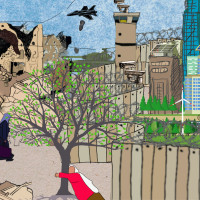
In “Sustainability fantasies / genocidal realities: Palestine against an eco-apartheid world”, Asmaa Ashraf and Vijay Kolinjivadi explain why the combined ecocide and genocide in Gaza is an expression of eco-apartheid – a violent racialising phenomenon that advances the colonial frontier of land occupation and resource plunder to funnel wealth to a privileged few. Ashraf and Kolinjivadi highlight the key facets of eco-apartheid, in which people are dehumanised and deliberately cast out to face the wrath of climate change and social precarity, while the elite deflect responsibility and shield themselves through so-called ‘sustainability’-branded living.
In “Out-organise the enemy! Eqbal Ahmad and the liberation of Palestine”, Arun Kundnani looks at the Pakistani scholar-activist’s legacy and his commitment to the Palestinian struggle. He focuses on Ahmad’s ideas about revolutionary violence, showing that Ahmad saw armed struggle as only one tool for achieving Palestinian liberation, alongside other strategies. He advised Palestinians and their supporters to outmanoeuvre and “ambush the enemy politically, administratively, and diplomatically, not merely militarily”. Kundnani shows how Ahmad’s advice is relevant today, when it is becoming clear that Israel is losing the ideological battle in the West.
Section II, “From Palestine to Africa and the Arab world”, turns to the intersections between Palestine, Africa, and the Arab region, fleshing out the connections between the liberation struggles of their peoples while identifying the challenges that exist – and how to overcome them.
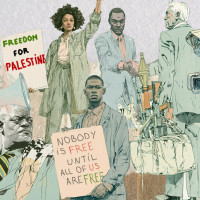
In “African attitudes to, and solidarity with, Palestine from the 1940s to Israel’s genocide in Gaza”, Kribsoo Diallo assesses divergent African reactions to the genocide in Gaza, which have included widespread popular support for Palestine, alongside some states’ unconditional support for Israel. He places these reactions within the historical context, tracing the shifting African relations with Palestine over time. Diallo shows how the historical principles of African unity, rooted in revolutionary liberation movements and South–South solidarity (including with Palestinians), have given way in recent decades to Israeli penetration of Africa, challenging a unified stance in support of Palestine.
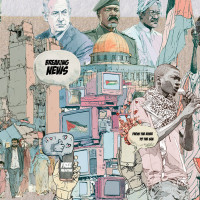
In “Failing Palestine by failing the Sudanese revolution: lessons from the intersections of Sudan and Palestine in politics, media and organising”, the late Muzan Alneel examines the intersecting struggles of the two countries as they each face genocidal violence. In particular, she shines a light on the competition for public and global attention in light of the simultaneous wars, examining how these dynamics pose challenges to organisers supporting both Sudan and Palestine across the world. In doing so, Alneel draws out important lessons for how we can engage in effective political action and work towards sustainable transnational liberation.
In “‘The condition for freedom is for the Egyptian masses to take to the streets’: Egypt’s centrality in the struggle for Palestine”, Nihal El Aasar traces Egypt’s trajectory from confrontation with Israel under Nasser to normalisation under the 1978 Camp David Accords. She argues that the continued presence of Israel in the NAWA region is a primary cause of its weak development, and that Arab normalisation has led directly to the genocide in Gaza. El Aasar underlines that there is no future for the region, let alone economic prosperity, social justice and individual rights, without the liberation of Palestine, and that achieving this must be a collective Arab task, with Egypt at its heart.
Section III, “From Palestine to Asia”, starts by exploring the African/NAWA–Asian ties of anti-colonial solidarity that have linked Algeria, Vietnam and Palestine, before diving into the shifting positions of two Asian powers (India and China) on the Palestinian liberation struggle over the years.
In “Vietnam, Algeria, Palestine: passing on the torch of the anti-colonial struggle”, Hamza Hamouchene reflects on the Algerian and Vietnamese anti-colonial struggles, drawing connections and parallels between the two, and between them and the ongoing Palestinian liberation struggle. In doing so, he highlights the importance of transnational solidarities, while also debunking attempts to portray a false equivalence between the violence of colonisers and the violence of those fighting to free themselves from colonialism. Ultimately, Hamouchene argues that the Palestinian liberation struggle needs to be (re)situated within the long trajectory of anti-colonial/anti-imperialist/anti-apartheid struggles, and of decolonisation.
In “From global anti-imperialism to the dandelion fighters: China’s solidarity with Palestine from 1950 to 2025”, Zhang Sheng reviews the evolution of China’s stance on the Palestinian struggle over time. He shows how the Maoist era saw strong Chinese support for Palestinian liberation. Zhang explains that while this support was downgraded from the 1980s onwards, with China increasingly deepening its relations with Israel, the genocide in Gaza has led many young Chinese to re-discover the pro-Palestinian legacy of the Mao era. Zhang argues that, as these young Chinese move into influential positions in government and society, we could see a strengthening of China’s support for Palestine in the future.
In “India, Israel, Palestine: new equations demand new solidarities”, Achin Vanaik traces the shifts in India’s position on Israel and Palestine. In his nuanced account he shows that, despite its anti-imperialist solidarity with the Palestinian liberation struggle, newly postcolonial India contained from the outset the seeds of future recognition of settler colonial Israel. Over time, these seeds germinated under the influence of realpolitik considerations (including the desire to counter Pakistan), particularly after India’s economic liberalisation. Vanaik details how this trend has accelerated with the advance of neoliberal Hindutva under Modi, leading to deep ideological overlaps and economic and military ties between Israel and India – ties Vanaik argues must be resisted for the sake of both Indians and Palestinians.
Section IV, “From Palestine to the Americas”, first looks at Latin American solidarity and how the Palestinian struggle is interlinked with struggles against dispossession, extractivism, and state and police violence in the region, particularly in Brazil; it then turns to Turtle Island (North America) and draws parallels between the genocide of Indigenous peoples and the Zionist genocide in Palestine.
In “Yalla, yalla, Abya Yala: reaching out to Palestine from Latin America in times of genocide”, María Landi offers a rich account of Abya Yala’s (Latin America’s) complex relationship with the Palestinian cause, from early state support for the establishment of Israel to increasing support for Palestine by governments, under the pressure of grassroots pro-Palestine organising. Landi devotes particular attention to how people in Abya Yala and elsewhere can move from symbolic and discursive solidarity to effective action, including through initiatives like organising visits to Palestine and translating Palestinian voices so they can be read in Abya Yala.
In “From the favelas and rural Brazil to Gaza: how militarism and greenwashing shape solidarity with Palestine and resistance in Brazil”, Andressa Oliveira Soares provides a detailed account of the relations between Brazil and Israel, encompassing military cooperation, agribusiness deals, and diplomatic postures. She zooms in on how solidarity movements in Brazil – many rooted in the favelas and rural landless movements – have implemented successful campaigns linking Israel’s militarism to Brazil’s own state violence and environmental plunder. Oliveira shows that these campaigns have led to shifts at the government level, and she argues that they must be deepened and extended to ensure Brazil becomes a leading voice confronting Israel on the continent and within the Global South.
Last but not least is the powerful contribution by Ellen Gabriel, Kanien’kehá:ka: “From Turtle Island to Palestine: resisting settler colonialism and genocide”, in which she draws on the experience of the Kanien’kehá:ka (Mohawk) and other Indigenous peoples to highlight the parallels in how violence is normalised by settler states like Canada and Israel. While acknowledging the colonisers’ overwhelming control over resources and laws, which they use to oppress the colonised, Gabriel underlines how Indigenous peoples on Turtle Island have nevertheless resisted colonialism and genocide over centuries, drawing strength from their relationship with their lands – just as the Palestinians are now doing.
Conclusion: against imperialist barbarism and for revolutionary and internationalist resistance
“Yes, we will not die, but…
We will uproot death from our land
Yes we will not die, yes we will live
Even if the shackle ate from our bones
And even if the whips of tyrants tear us apart
Even if they set fire to our bodies
Yes, we will not die, but we will
Eradicate death from our land.”
“To be hopeful in bad times is not just foolishly romantic. It is based on the fact that human history is a history not only of cruelty, but also of compassion, sacrifice, courage, kindness. What we choose to emphasize in this complex history will determine our lives. If we see only the worst, it destroys our capacity to do something.”
– Howard Zinn25
“You can cut all the flowers, but you cannot keep Spring from coming.”
– Pablo Neruda
As we write, toxic acid rain is falling on Tehran and toxic air is filling the lungs of the city’s population of 10 million people, after Israel – with US assistance – bombed Iranian oil storage facilities. The Israeli–American aggression against Iran is already a regional war, and it threatens to bring about a global economic crash. Coming after more than two years of genocide in Gaza, this new war underlines that we are at a decisive moment in both Palestinian and global anti-colonial histories, characterised by an upsurge in colonial imperialist violence and also by the total collapse of the liberal façade of international law and human rights.
This collapse was signalled by the lamenting words of Canadian Prime Minister Mark Carney at Davos in January 2026:
We knew that the story about the rules-based order was partially false ... We knew that international law applied with varying rigour depending on the identity of the accused and the victim. This fiction was useful … This bargain no longer works. Let me be direct. We are in the midst of a rupture, not a transition.
The falsity of the “rules-based order” – Western hypocrisy and double standards – was no secret for those who wanted to see. For more than two years, Western leaders, including Carney, have actively supported a genocide in Gaza, arming it, funding it and providing cover for it, while simultaneously claiming the importance of defending Ukrainian human rights and sovereignty. They had no qualms about Gaza being erased from the surface of the earth; they cheered when Lebanese, Iranians, Yemenis and Syrians were relentlessly bombed; and they didn’t shed a tear when the US kidnapped the Venezuelan President, Nicolás Maduro, in a blatantly criminal act. Rather, what prompted Carney’s widely praised speech was the fact that Donald Trump began to talk about applying the same standard of ‘might makes right’ to Western allies, such as Canada and Denmark.26 After showing that the law is optional depending on the identity of the aggressor and the victim, it seems Carney and other Western leaders are finally waking up to the realisation that the “rules-based order” is a fiction. This fiction has been shattered in front of their eyes as they have watched the imperialist-in-chief Trump punish them with stifling tariffs and bully them through humiliating harangues and injunctions.
This whole episode recalls Aimé Césaire’s observation that “what [the Europeans] cannot forgive Hitler [for is] … the fact that he applied to Europe colonialist procedures which until then had been reserved exclusively for the Arabs of Algeria, the coolies of India, and the blacks of Africa.”27 Césaire explained that before Europeans became victims of Nazism, “they [had been] its accomplices … [they] shut their eyes to it, legitimized it, because, until then, it had been applied only to non-European peoples”.
It is the dehumanisation of “non-European peoples” that allowed Europeans to act like the Nazis had, towards those peoples, and which has enabled every imperial and colonial crime in history, from the genocide of Turtle Island to the genocide in Gaza. Lina Mounzer, writing in October 2024, explained that the most painful realisation for Arabs in the last two years is that they have “discovered the extent of [their] dehumanization to such a degree that it’s impossible to function in the world in the same way”.
It is becoming crystal clear not only to Palestinians and Arabs but also to the oppressed majority worldwide that they can no longer function in the world as it is currently constituted, dominated as it is by a system that dehumanises people, that enshrines super-exploitation, that subjugates nature and humanity, that generates massive inequality and untold poverty, that reproduces endless war and militarisation, and that causes ecological destruction and climate chaos.
If we cannot function in this world, we are left with only one option: to change it. This is why we see revolts and rebellions against capitalism, colonialism / imperialism, patriarchy, and White supremacy taking place on all continents and in all regions. These include Arab, African, Asian and Latin American uprisings, the Black Lives Matter movement, GenZ revolts, the resistance of Indigenous communities, the global labour movement, movements for climate justice, food sovereignty, migrants’ rights and peace, as well as the pro-Palestine student encampments, and – of course – Palestinian, Lebanese and Iranian resistance.
Yet these rebellions often remain episodic and largely geographically confined. For the resistance they embody to succeed against the powerful forces arrayed against them, they need to go beyond the local and to reach the global: they need to create enduring alliances. Such an aim is not only possible but necessary: transnational solidarities and alliances are crucial in the global struggle for the emancipation of the wretched of the earth.
It is here that we need to take inspiration from the past – specifically, the period of decolonisation struggles, Bandung, Third-Worldism, the Tricontinental, and similar internationalist experiences. We must immerse ourselves in the histories of these revolutionary and progressive projects. Some of these histories have been ignored, while others have been silenced to hide from view an inspiring era of revolutionary connections across continents. We must familiarise ourselves with them, draw lessons from them, and use what we have learned to create convergences across the struggles taking place today.
For example, we need to remember how independent Algeria – with its audacious foreign policy in the 1960s and 1970s – became a symbol of revolution and a model for liberation struggles across the globe. It was this that led Amílcar Cabral, Guinea-Bissau’s revolutionary leader, to announce at the first Pan-African Festival (in Algiers in 1969): “the Muslims make the pilgrimage to Mecca, the Christians to the Vatican and the national liberation movements to Algiers!” Similarly, we should remember how Vietnam’s fight against US imperialism in the 1960s was a rallying cause for progressive movements, and influenced the global social revolt that led to the protests of 1968.
Above all, we must embrace our revolutionary internationalist heritage, from the Arab world to Africa, and from Asia to Latin America. This heritage is recorded in the deeds and words of great revolutionaries like George Habash, Leila Khaled, Mahdi Amel, Frantz Fanon, Djamila Bouhired, Amílcar Cabral, Fidel Castro, Celia Sanchez, Thomas Sankara, Dora María Téllez, Walter Rodney, Ghassan Kanafani, Kathleen Neal Cleaver, Samir Amin, Miriam Makeba, Che Guevara, Angela Davis, Teodora Inácia Gomes, Ho Chi Minh, Assata Shakur and Mao Zedong – to mention just a few.
We need to revive the ambitious projects of these figures, who sought emancipation from the imperialist-capitalist system. Building on this revolutionary heritage, being inspired by its insurgent hope, and applying its internationalist perspective to the current context is of utmost importance to Palestine, and to other emancipatory struggles all over the world. As Frantz Fanon once wrote: “Each generation must, out of relative obscurity, discover its mission, fulfil it, or betray it."28
In this vein, it now falls to our generation to continue the tasks of decolonisation and delinking from the imperialist-capitalist system, in order to restore our denied humanity. Through resistance to colonial and capitalist logics of appropriation and extraction, new imaginaries and counter-hegemonic alternatives will be born. Let us not surrender. To paraphrase a famous saying that is familiar to many Muslims: let us work for radical change as if it will take an eternity to realise but prepare the ground for it as if it is going to happen tomorrow.
As revolutionaries sang at the Pan-African Festival in 1969: “Down with imperialism, down with colonialism!” “Colonialism, we must fight until we win! Imperialism, we must fight until we win!”29
To which we can add: ‘From the river to the sea, Palestine will be free!’
Towards Palestinian Liberation
View the collection-
Publication date:
-
Introduction: The long and arduous road to a liberated Palestine Reclaiming anti-colonial resistance and solidarityPublication date:
-
Framing Palestine Israel, the Gulf states, and American power in the Middle EastPublication date:
-
Palestine in a world of struggle The role of Palestinians in Third World solidarityPublication date:
-
Sustainability fantasies/genocidal realities Palestine against an eco-apartheid worldPublication date:
-
Out-Organise the Enemy! Eqbal Ahmad and the liberation of PalestinePublication date:

-
African attitudes to, and solidarity with, Palestine From the 1940s to Israel’s Genocide in GazaPublication date:
-
Failing Palestine by failing the Sudanese Revolution Lessons from the intersections of Sudan and Palestine in politics, media and organisingPublication date:
-
“The condition for freedom is for the Egyptian masses to take to the streets” Egypt’s centrality in the struggle for PalestinePublication date:
-
Vietnam, Algeria, Palestine Passing on the torch of the anti-colonial strugglePublication date:
-
From Global Anti-Imperialism to the Dandelion Fighters China’s Solidarity with Palestine from 1950 to 2024Publication date:
-
India, Israel, Palestine New equations demand new solidaritiesPublication date:
-
Yalla, Yalla, Abya Yala Reaching out to Palestine from Latin America in times of genocidePublication date:
-
From the Favelas and Rural Brazil to Gaza How militarism and greenwashing shape solidarity with Palestine and resistance in BrazilPublication date:
-
From Turtle Island to Palestine Resisting settler colonialism and genocidePublication date:
-
Publication date: