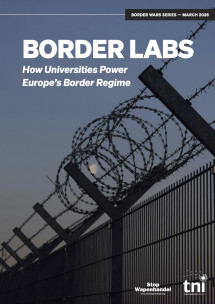
Border Labs How Universities Power Europe’s Border Regime
Regions
This report exposes how universities are embedded in the EU’s border regime, driving the militarisation, surveillance, and externalisation of migration control. It reveals a growing border-industrial-academic complex and challenges academia’s role in legitimising and advancing policies that systematically harm and exclude people on the move.
Download PDF
Authors
Authors

Key points
Since 2016, TNI’s Border Wars series has exposed the EU’s efforts to securitise, militarise and externalise its borders, focusing especially on the role of the military and security industry. This report examines the role universities play in this endeavour. Its findings show that the scale and depth of university involvement in the EU border regime has led to the emergence of what can be termed a border-industrial-academic complex.
The report finds that:
- Universities play an indispensable, if often obscured, role in the development, perpetuation and expansion of ‘Fortress Europe’. They provide research, analysis, data, and new technologies, as well as an illusion of scientific legitimacy to policies and practices that are ethically questionable and routinely violate fundamental rights. Sometimes universities take this as far as willingly involving themselves in legally dubious research and fieldwork, as shown by some of the more controversial case studies covered in the report.
- From 2002 to May 2025, over 200 universities, higher-education institutions, and academies participated in 110 EU Framework Programme projects related to border security and control, receiving a total of over €100 million in EU funding. Most were part of consortia that often included arms and IT companies as well as EU member state border authorities. Arms corporations Leonardo and Thales and the Fraunhofer research organisation appear most frequently as partners of universities in these consortia.
- The three largest university beneficiaries of this funding are Laurea-Ammattikorkeaukoulu (Finland), University of Reading (UK) and Katholieke Universiteit Leuven (Belgium). All three have participated in particularly controversial projects.
- Universities play a significant role in research projects which are rooted in the humanities and social sciences. These include projects about forecasting migration, scenario-planning, and analysing the drivers of migration and decision-making processes of people on the move. These projects explicitly aim to generate insights that support the development of largely repressive border and migration policies.
- In “technical” Framework Programme border security and control projects, universities participate in most consortia, which arms companies often lead. These projects span a wide range of border-control technologies. The report documents universities working on biometrics, surveillance, AI, lie detection, drones and other unmanned systems, and tools designed to automate decision-making in sensitive situations.
- Apart from the Framework Program funding the EU uses several other instruments to fund university (research) work in the field of border security and control. The report details funding for controversial ‘awareness-raising’ projects designed to deter people from migrating, as well as for border externalisation efforts. Maastricht University (Netherlands) plays a significant role in EU-funded training of border guards from non-EU-countries.
- Universities also seek to commercialise the results of (EU-funded) research, including through spin-off companies. The report highlights cases in which such spin-offs have marketed controversial border-control technologies such as supposed AI “lie detectors” and heartbeat detectors, which were sold to the EU Border and Coast Guard Agency Frontex and the UK Border Force.
- Frontex, a central node in the EU’s securitised border regime, is often intended as a direct end user of university-led research and development and a bridge to the industry. In December 2022, Frontex launched its own Research Grants Programme for border security technology, funding small-scale projects largely led by universities.
- Frontex also cooperates with universities on training and education, including on a Joint Master’s programme in Strategic Border Management, and a wider network of Partnership Academies that host meetings and training activities. In the field of border externalisation Frontex also trains border guards from non-EU-countries. This includes a longstanding cooperation with the Naif Arab University for Security Sciences (NAUSS), linked to the Saudi royal family, one of the world’s most repressive regimes.
- The EU increasingly seeks to ‘bridge the gap’ between academic research, policymaking and real-life applications. In doing so, it seeks to ensure that the research it funds connects to its political priorities and to that end facilitates interactions with end-users in industry and government, for example through Frontex workshops. The Community for European Research and Innovation for Security (CERIS) plays a central role in this process by aligning research agendas with official security narratives. This approach narrows research questions from the outset, shapes which findings and recommendations are taken up, and inevitably makes future funding dependent on how well projects meet the end-user demands.
- At universities there appears to be limited acknowledgement that findings from EU-funded research are likely to be used to reinforce current EU border and migration policies, shaped by a strong security and deterrence narrative. Past experience suggests that the hope, expressed by some researchers, that factual evidence and analysis will steer policymakers towards a more humane course is misplaced. Advance ethical assessments tend to avoid these issues by focusing narrowly on ethics within the research process itself. As a result, a broader question typically remains unaddressed: whether it is ethical at all to work for, or with, governments and agencies that use this research to develop and implement repressive, rights-violating border and migration policies.
- This dynamic is also reflected in the ethics checks for Framework Programmes projects. These checks are mostly based on self-assessment by the consortia partners and often treated as a box-ticking exercise, sidestepping questions about real-world harms the research results – and the policies and practices they support – may cause. Universities and other organisations involved in such research, however well-intentioned, are ultimately complicit in the harmful outcomes of a process that falls short of its stated ethical standards.
- Since Russia’s full-scale invasion of Ukraine in February 2022 the EU has accelerated efforts to expand its military role and capacities both within NATO and alongside it, and to support the military and security industry. A “whole-of-society” militarisation trend is drawing universities into closer cooperation with military and security forces and with industry. As higher education becomes more militarised and securitised, there is less scope and funding for research that does not serve military, border-security, or dual-use purposes, which narrows research agendas and sidelines dissent.
Introduction
As seats of learning, the principal functions of universities revolve around teaching and research. Their members include faculty, researchers and students, be they graduate or undergraduate, as well as administrative and other critical support staff, such as librarians. With very few exceptions – at least in Europe – they are public bodies that depend mainly on public funds, supplemented in some cases with endowments.
For many decades, however, research across the social sciences as well as in technical areas such as engineering has depended on a blend of institutional (public) and external funding, whether from philanthropic organisations such as the Bill & Melinda Gates Foundation, donor agencies such as the Foreign, Commonwealth and Development Office (FCDO) in the UK, or Trócaire in Ireland, as well as industry, both private and public. Indeed, many university departments as well as think tanks expect research fellows to attract sufficient external funding to offset their salaries. All such bodies that receive a blend of public and private funding have differing sets of broad ethical requirements, such as not accepting funding from the arms industry or tobacco companies, in addition to specific obligations regarding research involving human subjects. In general, all research undertaken at a university, provided it is not subject to industrial confidentiality, is made publicly available either in university repositories or on their website, as well as in articles published in peer-reviewed journals and other publications.
In recent years, universities have been challenged to decolonise their curricula and teaching, and to acknowledge the benefits they received from colonialism and enslavement, and of their physical symbols – such as the movement to remove the statue of Cecil Rhodes gracing the façade of Oriel College, Oxford. Others have targeted the ties between universities and the fossil fuel industry, often connecting the climate crisis with broader questions of international justice.
Most recently, campus encampments have been set up – in the style of the Occupy Wall Street encampments in 2011 – to protest against universities’ involvement, however tangential, in the genocide and total physical destruction of homes, schools and hospitals in Gaza, the assassination of aid workers by the very same Israel Defense Forces (IDF) who had authorised them to deliver food, water and other essentials to people living under siege and continual displacement, and Israel’s encroachment on Palestinian territory on the West Bank. This follows on years of action concerning universities’ ties to Israel through investment portfolios and related issues.
The many campaigns and actions regarding the relations between universities and Israel’s genocidal attack on Gaza have raised new questions about what kind of research and with or for whom universities want to be involved in. They focus not just on the subject and design of a specific research project, but also on a critical assessment of partners and clients as such and on what research outcomes can possibly be used for in terms of policies and practices.
This report looks specifically at research funded by the European Union (EU) and related entities. Many universities, mainly in the EU and the United Kingdom (UK) play an important, but in some cases somewhat hidden, role at least at the level of narrative in strengthening and expanding border security and control, which informs repressive migration policies in theory and, ultimately, practice. Some of the information presented in this report has been both uncovered and criticised by university members, whether academics, researchers or student bodies.
The first chapters examine EU-funded research and other work, as well as connections with the military and security industry, with specific attention to universities’ own policies regarding ethics in such cases. The next chapters take on universities’ ties with EU border guard agency Frontex (the European Border and Coast Guard Agency) and the commercialisation of research via the establishment of start-ups at universities. In general, this commercial angle cannot be underestimated: in a situation where in many countries, due to shortages in government spending, universities and academic researchers are forced to look for external funding sources, available money and those who provide it, also play a significant part in determining what is on research agendas, and what not.
Finally, it deserves to be mentioned that there are other types of cooperation and ties between universities and border authorities and/or the military and security industry which fall (largely) outside the scope of this report, such as sponsoring, internships, participation in career events and investments in companies via university endowments (which in many countries are highly non-transparent). Universities can also act as border agents themselves, for example by imposing strict rules and controls on foreign students.
Credits
Authors
Editors
- Niamh Ní Bhriain
- Deborah Eade
- Josephine Solanki
In collaboration with
FOREWORD BY: Michele Lancione
ACKNOWLEDGMENTS: Mirjam Twigt, Solid Sustainability Research, Norma Fötsch
Download PDF
More like this
-
Exporting Borders Frontex and the Expansion of Fortress Europe in West AfricaPublication date:
-
Financing border wars The border industry, its financiers and human rightsPublication date:
-
Expanding the fortress The policies, the profiteers and the people shaped by EU's border externalisation programmePublication date:
-
Border Wars The arms dealers profiting from Europe's refugee tragedyPublication date:

-
Border Wars II An update on the arms industry profiting from Europe's refugee tragedyPublication date: