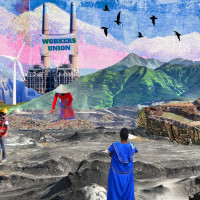
Industrial Politics from Below Reclaiming Industrialization as a Liberation Agenda in Indonesia and Beyond
Contemporary industrialization in the Global South, including Indonesia’s mineral downstreaming and green transition, reproduces dependency and green extractivism amid ecological crisis and inequality. This article proposes industrial politics from below as a counter-hegemonic framework that redefines industry as the collective capacity to produce and reproduce life rather than a narrow growth-centered accumulation paradigm. Drawing on political economy, dependency theory, and feminist critiques of industrialization, and informed by grassroots discussions at the Batang Dialogue 2025, it argues that agrarian reform, community–worker control, and democratic state transformation are essential to reclaim industrialization as a decolonial and life-centered project.
Longread by
-
Benny Agung P

-
Olisias Gultom


Illustration by Agah Nugraha Muharam
Introduction
In the context of an escalating global crisis, which includes climate degradation, biodiversity loss, socio-economic inequality, the resurgence of authoritarianism, and growing geopolitical tensions,1 the limitations of the modern industrial development model have increasingly been revealed. For decades, industrialization has been regarded as a symbol of progress; yet in practice, it has often relied on the exploitation of natural resources, ecological destruction, and the perpetuation of global inequalities between the North and the South.2
In recent years, the discourse on industrial policy has gained renewed prominence across many countries, following decades of neoliberal orthodoxy and its failure to deliver inclusive prosperity, social stability, or ecological sustainability. Many countries in the Global South, including Indonesia, have begun to reconsider the role of the state in industrial development in response to structural dependency and vulnerability within the global economy. However, the resurgence of state-led industrial policy has often reinforced authoritarian tendencies and reproduced growth-oriented patterns that neglect social and ecological justice.
As several recent global studies note, industrial policy has been implemented unevenly across the global economy. Both the capacity to pursue transformative industrial policy and the ways in which such policy is implemented remain deeply shaped by the global financial and monetary hierarchy, integration into global supply chains, and geopolitical positioning. The pace at which advanced and less-developed countries adopt industrial policy differs significantly, with advanced economies being better positioned to capitalize on the current period of turbulent change.
Global economic shifts, such as supply chain disruptions, the United States–China rivalry, and the push toward “green industries,” have not fundamentally transformed the prevailing paradigm. Rather than marking a break, the green economy largely reproduces existing logics of capital accumulation, commodification, and financialization, including of nature itself. As a result, practices of green colonialism and transition mineral extractivism have further constrained countries in the Global South, where the extraction of strategic minerals intensifies environmental destruction and labour exploitation (Hamouchene & Sandwell, 2023). This has fuelled the rise of resource nationalism in most mineral-rich developing countries in the Global South, driven by the state agendas of national elites seeking to extract greater value and exert more ownership over their natural resources (Warburton, 2018). In Southeast Asia, discourses on industrial policy and industrial politics3 are increasingly intertwined with struggles against extractivism, digital inequality, and the shrinking of democratic space.
In this context, many activists and researchers have felt the need to shift the perspective from mainstream industrial policy—which focuses on economic growth and market oriented—toward industrial politics from below: an effort to reimagine the politics of production and reproduction in a more just, democratic, and ecological way. This approach positions communities, workers, and affected groups as key actors in shaping development pathways, rather than mere objects of state or market policies.
Inspired by this spirit, the Beyond Development Global Working Group (BDGWG)4, together with Indonesian activists drawn from a broad spectrum of popular organisations—including KPR, KASBI, AMAN, SMI, and SEMPRO5—the group organised the Global Meeting on New Industrial Politics in Batang, Central Java, on 7–11 September 2025. The meeting served as a space for collective reflection and cross-sectoral as well as transcontinental exchange, while also providing a platform to formulate strategies and reimagine the direction of industrialization in a decolonial, socially just, and life-sustaining manner, rather than one subordinated to the logic of endless growth and capital accumulation.
The Batang Dialogue should not be understood merely as a meeting or a source of citations, but as a form of collective political knowledge production. It brought together workers, peasants, Indigenous, students, feminists, environmental activists, and researchers from diverse national and regional contexts—including participants from Latin America, Africa, Europe, North America, East Asia, and Southeast Asia—in a horizontal process of dialogue and analysis. Rather than producing expert-led recommendations, the Batang Dialogue generated knowledge through collective reflection, situated experiences, and inter-movement exchange across continents, thereby grounding its analytical insights in transnational perspectives from the Global South and beyond, and embodying the very principles of industrial politics from below that this article seeks to theorize. Building on the discussions and collective reflections from the meeting, this article seeks to explore emerging directions of industrialization in Indonesia and other countries of the Global South. The insights generated in Batang serve as the primary basis for reinterpreting contemporary theories and practices of industrialization in both Indonesia and the Global South.
This article argues that to respond to the multifaceted crises of our time—ecological breakdown, widening inequality, democratic erosion, intensifying geopolitical competition and militarism, the rise of neo-fascism, and the deepening structural dependency6 of the Global South within unequal global trade, financial, and technological hierarchies—industrialization must be reclaimed as a liberation project rather than a vehicle of extractivist growth. Industrial politics from below refers to the collective power of workers, peasants, Indigenous peoples, women, and ecological movements to reshape how, for whom, and under what conditions production is organised. It seeks to redefine industry not as a domain of capital-intensive modernization but as the social capacity to produce and reproduce life. By shifting the locus of industrial transformation from the state–corporate nexus to popular collective agency, this article contends that industrialization can become a pathway toward life-sustaining autonomy, democratic control, ecological justice, and the restoration of people’s sovereignty.
Related

The Historical Context of Industrialization in the Global South and Reflections on Indonesia
The trajectory of industrialization in the Global South cannot be separated from the historical legacies of colonialism, dependency, and the profoundly unjust international division of labour constituted within the capitalist world-system. From Africa to Asia and Latin America, what took shape under colonial and imperial rule was not autonomous industrialization, but rather externally imposed and structurally subordinate forms of production, including extractive enclaves and limited, labour-intensive industrial activities, integrated into global commodity chains in ways that reinforced peripheral positions. Within the framework of world-systems theory (Wallerstein, 1974), such subordinate and dependent forms of industrialization functioned to reproduce the hierarchical division of labour that positioned former colonies primarily as suppliers of raw materials, low-value manufactures, and cheap labour for core economies.
The pattern of dependency is particularly evident in Africa. As noted by Ibrahima Thiam, a climate justice activist from Senegal, the colonial legacy has shaped an uneven and fragmented foundation for industrialization. After independence, African countries inherited export-oriented factories designed to serve metropolitan markets rather than the needs of their own people. Postcolonial industrialization efforts thus remained overshadowed by the influence of the Bretton Woods institutions and modernization theory, both of which promoted development without altering land ownership structures or relations of production (Batang Dialogue, 2025). Samir Amin (1976) describes this condition as peripheral accumulation—an economic growth process detached from the domestic social base, reliant on raw material exports, and subordinated to external capital and technology.
A similar entrapment in the logic of dependency is visible in India, which has experienced two contrasting phases of postcolonial industrialization. In the first phase, under Nehru’s leadership from the 1950s, the government prioritized the development of heavy industries and public sector enterprises (Industrial Policy Resolution, 1956; Kesar & Bhattacharya, 2020). Agrarian reforms introduced during the 1950s and 1960s, however, remained limited in scope and unevenly implemented, leaving feudal structures largely intact and constraining the potential of industrialization to benefit small farmers and workers in the informal sector (Kesar, 2023; Bhattacharya & Kesar, 2020). The second phase, beginning with the economic liberalization of the 1990s, intensified India’s integration into global markets, expanded privatization, and opened sectors to foreign investment, yet these reforms did not fully overcome structural dualism or transform the position of peripheral actors within the industrial system (Kesar, 2023). As highlighted by Dinesh Abrol (Batang Dialogue, 2025), India’s experience demonstrates that both nationalist industrialization and neoliberalism have marginalized rural communities, widened inequality, and generated new forms of structural violence.
Meanwhile, in Latin America, the strategy of import-substitution industrialization (ISI) implemented between the 1940s and 1970s was initially promoted as a path toward industrial self-sufficiency through tariff protection and state intervention. However, as contemporary political economists have argued, ISI policies often failed to create true autonomy because they remained structurally dependent on the technology and capital goods of the Global North (Chang, 2002; Cypher, 2021). Alan Carmona, from Mexico, emphasized that ISI essentially “built a national industry without challenging the colonial logic of the world economy.” It created a new national industrial class reliant on imported technology and urban middle-class consumption, while agrarian sectors and Indigenous communities continued to be marginalized (Batang Dialogue, 2025).
The failure of ISI, followed by the wave of neoliberal reforms in the 1980s, later paved the way for the emergence of progressive governments in the early 2000s that sought to offer an alternative path. Yet, as Daniel Chavez from Uruguay noted, these projects “did not truly break away from the paradigm of extractivism, but rather replaced it with a more nationalistic face.” The state strengthened control over strategic sectors such as oil, gas, and mining, but the underlying logic of accumulation remained the same—an economy based on the export of raw commodities and continued dependence on global markets (Batang Dialogue, 2025). Miriam Lang from Ecuador/Germany further observed that the phenomenon of neo-extractivism under progressive governments in Bolivia, Venezuela, and Ecuador revealed a paradox: “The state employed a rhetoric of redistribution and social development, yet continued to treat nature and local communities as sacrifice zones.”
Thus, industrialization in Latin America over the past century cannot be understood as a linear or homogeneous process. While colonialism, developmentalism, and neoliberalism represent distinct historical regimes with different institutional forms and state strategies, they nonetheless share structural continuities in terms of accumulation patterns and the region’s subordinate position in the global capitalist economy (Batang Dialogue, 2025).
In today’s multipolar world, Latin America’s dependency has not disappeared but rather shifted into new forms of interdependence. Investment and loans from China have increasingly supplemented—and in some sectors partially displaced—the traditional economic dominance of the United States, particularly in trade, infrastructure financing, and extractive industries. Since the early 2000s, China has become one of the principal trading partners for several Latin American economies, while Chinese policy banks have emerged as significant sources of development finance, especially during periods of restricted access to Western capital markets (Jenkins 2012, Gallagher 2016, and Myers Ray 2024). However, despite this reconfiguration of external economic relations, the region’s export-orientated commodity structure remains largely unchanged, reinforcing patterns of primary commodity dependence and limited industrial upgrading (Svampa 2019; CEPAL 2022).
As articulated in one of the Batang panel discussions, “industry in this region is rarely understood as popular productive sovereignty, but rather as a geopolitical instrument among states.” In our analysis, industrial politics from below in Latin America emphasizes the importance of building community economies, strengthening local productive bases, and rearticulating the relationship between humans and nature beyond the logic of extraction and limitless growth. Crucially, this perspective does not bypass the state; rather, it conceptualizes the state as a contradictory and contested terrain—simultaneously constrained by global capital and geopolitical pressures, yet potentially reshaped through popular organisation and bottom-up industrial strategies (Gramsci, 1971).
A similar reflection arises from Indonesia’s experience, which reveals a pattern of colonial continuity with its own distinctive political character. Since the enactment of the Agrarische Wet in 18707, the Dutch East Indies developed into a labouratory of colonial capitalism centered on export-oriented plantation and mining sectors. Geertz (1963) documented how the expansion of large-scale industries, such as sugar, triggered an “agricultural involution” that marginalized local economies. This phenomenon is further emphasized by Breman (1989), who analyzed the plantation system as a form of extreme capitalism relying on strict control over labourers to maximize global market profits. According to Booth (1998), these dynamics reinforced a dualistic economic structure in which foreign capital functioned as the primary driver.
This structural legacy did not entirely disappear after independence; Anderson (1983) argues that the Indonesian state inherited colonial bureaucratic apparatuses that retained extractive logics, resulting in persistent economic dualism and continued dependency on foreign capital into the contemporary period. As noted by Iwan Nurdin, an agrarian reform specialist and peasant rights campaigner, in the Batang Dialogue, “Indonesia continued to pursue a growth model based on the exploitation of natural resources for export, while national industrialization efforts failed due to the absence of agrarian reform—the very foundation of economic self-reliance—unlike East Asian countries such as South Korea and Taiwan, which succeeded in building their industrial base.”
Industrialization under Sukarno’s leadership8 can be understood as a systematic attempt to break colonial dependency through strategies of nationalization and the development of basic industries such as steel, fertilizer, and cement (Thee, 2012). However, this project faced significant structural constraints, particularly with the emergence of a class of “bureaucratic capitalists” lacking the technical and financial capacity to sustain long-term industrial growth (Robison, 1986). The continuity of this national industrialization project ultimately collapsed under geopolitical pressures and the tragedy of 19659, which functioned as a moment of violent restructuring of the Indonesian state (Roosa 2006/2008). This process formed part of a broader global pattern known as the “Jakarta Method” (Bevins 2020/2022), in which the systematic destruction of leftist movements became an international blueprint for reintegrating postcolonial economies into the orbit of Western capitalism. As a consequence, the agenda of genuine agrarian reform10 was abandoned and replaced by a regime of state territorial sovereignty that prioritized large-scale corporate concessions over peasant land rights, allowing the dualistic economic structure inherited from colonialism to persist into the present (Li 2014).
The New Order period (1966–1998), consolidated under President Suharto following the 1965 violence, marked a shift toward a form of state capitalism intertwined with military authoritarianism and international capital. Supported by global financial institutions, the regime promoted export-oriented industrialization and the deregulation of foreign investment. The result was rapid yet fragile economic growth, underpinned by deepening social inequality and widespread ecological degradation. Peripheral capitalism in Indonesia did not emerge from a popular productive base, but rather from a subordinated integration into the global economy, with the state acting as a facilitator for the expansion of international capital (Habibi, 2016).
Following the 1998 crisis and the onset of the Reformasi era, Indonesia’s industrialization became increasingly integrated into global value chains (GVCs), particularly in extractive sectors and low-wage manufacturing. This integration constitutes a contemporary form of imperialism in which multinational corporations in the Global North control production in the Global South through contractual mechanisms and control over market access, without direct ownership or territorial domination (Suwandi, 2019). This form of control is underpinned by global labour arbitrage, whereby surplus value generated by cheap labour and resource extraction in countries like Indonesia is produced in the Global South but appropriated and realized in the capitalist core (Smith, 2016). At the national level in Indonesia, local firms often serve merely as “intermediaries between local labour and multinational corporations,” remaining in a subordinate position within global value structures. The peripheral national capitalist class in Indonesia has never been truly autonomous; it depends on foreign capital flows and functions primarily as a conduit linking global capital with the domestic reserve of cheap labour (Habibi, 2016).
This dynamic reflects what Samir Amin described as the law of globalized value, in which labour across the North and South is structurally integrated into a single but hierarchically organised global system of production and exchange. Although labour-power has one global value, it is “recompensed at very different rates,” generating imperialist rent—a structural mechanism through which surplus value is extracted from peripheral economies and transferred to the capitalist core (Amin, 1978/2010; Lauesen, 2024).
Today, under the banner of mineral downstreaming (hilirisasi)11 and the green energy transition, a new form of economic imperialism has emerged: green extractivism—the expansion of transitional mineral industries such as nickel, copper, and bauxite, still dominated by foreign capital, particularly from China. This pattern underscores the persistence of colonial economic dualism, where industrial production remains detached from agrarian bases and popular needs, reaffirming that “green capitalism” is merely a new face of old exploitative relations within the global commodity chain. Moreover, a state-led resource nationalism model in Indonesia’s mineral downstream industry has resulted in the hijacking of the Indonesian Constitution by the oligarch, thereby perpetuating the country's subordination to global capitalism. The practice of resource nationalism, as emphasised by Bresser-Pereira (2018), will only lead to a developmental state promoted by the bourgeois political elite, which forms a national class between capitalists and techno-bureaucrats in maintaining a liberal economic policy regime.
From Africa to Indonesia, these experiences reveal a consistent pattern: top-down industrialization—whether in the form of colonialism, developmentalism, or neoliberalism—has failed to generate economic sovereignty and social justice. On the contrary, it has perpetuated inequality and deepened ecological crises. In response to this historical failure, the concept of industrial politics from below has emerged as a counter-hegemonic paradigm. This framework is rooted in grassroots movements and collective intellectual inquiries that seek to reconfigure development—returning control over ownership and production to the people, and integrating social and ecological justice within a decolonial framework. Specifically, this approach emphasizes that industrial policy is not merely a technocratic tool, but a democratic process driven by “from below” actors, such as labour unions, agrarian communities, and local cooperatives (Batang Dialogue, 2025).
Taken together, these initiatives clarify that industrial politics from below is not merely a technical alternative but a normative and political project. They provoke us to rethink who should control productive infrastructures, advance concrete institutional models that redistribute authority toward communities, and produce material outcomes—reduced exploitation, strengthened food sovereignty, and territorially grounded energy autonomy—that gesture toward a different horizon of development.
Industrial Politics from Below
Industrial politics from below begins with a conceptual rupture: it challenges us to rethink what ‘industry’ means. In response to the persistent patterns of dependency and exploitation, the idea of industrial politics from below is advanced in an effort to reclaim the direction and meaning of industrialization from the hands of the authoritarian state and capital. As discussed in the Batang Dialogue 2025, this notion does not merely propose an alternative model of industry; it calls for a radical reimagining of the politics of production itself. Following Gramsci (1971) and Poulantzas (1978/2000), this reimagining views the state not as a monolithic opponent, but as a contested terrain of struggle and an ‘integral’ space of power. The goal, therefore, is to shift the balance of forces within this terrain—empowering workers, peasants, Indigenous communities, women, and environmental movements to conduct a ‘war of position’ against hegemonic capital. In this sense, these popular classes become the key subjects who reclaim the state’s apparatus to determine how, for whom, and for what purpose production should be organised, transforming the state into a vehicle for social and ecological justice.
Within this framework, industrial politics from below seeks to— as articulated in the Batang Dialogue— ‘reorder the material basis of life.’ Industrialization is not merely about constructing factories but about building society’s collective capacity to produce and reproduce life in just and sustainable ways. This means that the economy cannot be separated from ecology, nor production from care. Technology and industry are not to be rejected but must be reclaimed under social control and social-ecological integrity— Industrialisation for breaking the chains of dependency within an emancipatory project.
This reconceptualization resonates strongly with feminist political economy, which has long argued that the capacity to ‘produce and reproduce life’ rests on gendered infrastructures of care, social reproduction, and community knowledge that remain invisible within dominant industrial paradigms (Bhattacharya, 2017; Federici, 2012). Feminist scholars and movements remind us that industrialization has historically depended on women’s unpaid or undervalued labour—spanning care work, ecological stewardship, food provisioning, and knowledge transmission—yet these forms of labour are excluded from what is conventionally recognised as ‘industry’ (Mies, 1986; Fraser, 2016).
Bringing a feminist lens to industrial politics from below therefore makes explicit that transforming industry requires transforming the gendered organisation of life-making itself. In this sense, redefining industry in life-centered terms shifts the center of gravity from growth and accumulation to care, social provisioning, and ecological regeneration. It challenges modern industrial imagination that treats production as detached from land, gendered and precarious labour, and community relations, and instead foregrounds forms of production rooted in reciprocity, autonomy, and democratic control.
The fundamental distinction for us between mainstream industrial policy and our conception of industrial politics lies in their logic and subject: the former is a domain of the state—technocratic, hierarchical, and growth-oriented—while the latter is a field of political contestation, where the dispossessed challenge, negotiate, and redefine the direction of the economy according to collective needs. In this sense, industrial politics from below is not a new policy but a process of economic democratization—a rejection of industrialization as a purely top-down project dominated by ruling classes and led by capital.
This critique is increasingly relevant because modern industrialization projects continue to reproduce old colonial relations in new forms. While initiatives such as mineral downstreaming are formally intended to move Southern economies beyond the role of raw material suppliers, in practice they are often captured by local and national elites, serving as a pretext for profit-making within global markets without addressing the welfare or participation of affected communities. In Indonesia, mineral downstreaming and “value-added” processing programs have frequently been implemented in ways that benefit oligarchic interests, while leaving environmental degradation, land dispossession, and inequitable distribution of benefits largely unaddressed. Special Economic Zones, mineral downstreaming initiatives, and so-called “green transitions” thus often deepen patterns of dependency even as they appear to challenge them. Building industrial politics from below therefore also means decolonizing industry: rejecting passive and subordinate roles in global value chains and reaffirming the people’s right to control resources and the means of production to satisfy their own priorities first.
However, rejecting exploitative forms of industry does not mean rejecting industry itself. Without a strong material base, people’s economies will remain structurally subordinated. Industry—in a broad sense, not limited to factories or manufacturing—is still necessary—not for growth per se, but to establish material self-reliance: the capacity of communities to produce essential goods such as food, energy, and tools without dependence on global markets. In this view, industry becomes a means of liberation and self-reliance rather than domination and dependence. It is therefore crucial for social movements to link the struggles of workers, peasants, and Indigenous peoples within a shared framework of industrial politics from below.
In a broader horizon, the Batang Dialogue 2025 articulated industrial politics from below as a form of realistic utopianism—a political imagination that places human life at its center. Industry must be rooted in local wisdom, community and workers ownership, equitable distribution, and ecological integrity. This approach not only strengthens communal control over resources but also envisions a new international order grounded in solidarity rather than imperialist domination. The Batang Dialogue 2025 called for a strategic shift: replacing neoliberal industrial policies with democratic ones; redirecting orientation from profit accumulation toward people-centered economies; centering production around care and satisfying basic needs rather than excessive and unnecessary extraction or militarism; strengthening South–South cooperation based on solidarity (and not on unequal exchange); and dismantling life-destructive industries such as the military-industrial complex and luxurious sectors for the rich. All of these converge toward a transformative vision: transcending modern industrial imagination and rebuilding city–village relations on the basis of mutual support, social and ecological justice, and reparative historical consciousness against colonial and extractive violence.
Thus, industrial politics from below is not merely an economic concept but a political project to restore life. Industrialization carries meaning only insofar as it frees humanity from subordination and oppression—not when it extends the domination of capital and empire. This marks a fundamental shift: from growth to sustainability, from competition to solidarity, and from exploitation to care. In a world increasingly beset by climate crisis, inequality, and authoritarianism, reclaiming industrialization means building a just future for both humanity and the planet.

Illustration by Agah Nugraha Muharam
Pathways Toward Industry from Below: The Indonesian Context
Across various regions of Indonesia, emerging practices of industrial politics from below are beginning to reveal the possibility of a form of industrialization that is life-centered and materially rooted in community and workers control. These initiatives do not merely function as isolated alternative livelihood strategies; rather, they articulate a normative critique of the dominant industrial regime while simultaneously proposing different forms of economic institutionalization. Industrial politics from below thus emerges not simply as an act of refusal, but as a counter-hegemonic and inclusive project of political–economic development.
Materially, industrial politics from below refers to the ways communities build autonomous productive capacities—such as acquiring and operating rice mills, reclaiming land, managing decentralized energy systems, and reorganising labour cooperatively. Crucially, these processes do not bypass the state. Instead, the state is treated as a contested but necessary terrain for coordination, scaling, and institutionalization at national and regional levels. Industrial politics from below therefore seeks not the withdrawal of the state, but its transformation from below, aligning state capacities with community-rooted, workers-controlled production and democratic popular oversight.
A concrete example can be found in the cooperative rice-milling unit (LANUSA), established through a farmer–worker alliance between the Konsorsium Pembaruan Agraria (KPA) and the Kongres Aliansi Serikat Buruh Indonesia (KASBI). By reclaiming control over land and basic food-processing infrastructure, managing it through cooperative mechanisms, and distributing rice directly to farming households and urban workers, this initiative disrupts long-standing dependence on distribution chains dominated by middlemen and capitalist landlords. Such intervention not only shortens supply chains and reduces capital exploitation, but also redefines food as a collective right. In this context, the milling cooperative functions as a political claim that materializes a solidarity-based political economy of food, grounded in class alliances and local sovereignty over essential infrastructure.
While currently in a pilot phase, LANUSA’s operations already span multiple regions in Indonesia: paddy is sourced from smallholder farmers in West Java and Central Java, milled locally, and distributed to workers in the Jakarta metropolitan area and surrounding regions. A 2021 assessment by KPA indicates high monthly rice demand, with potential supply among cooperative members estimated at 80 tons per month. At present, LANUSA mills 30 tons from 50 tons of harvested paddy—grown on roughly 12 hectares of smallholder land—though its maximum capacity could reach 350 tons per month. These figures suggest that, with expanded coordination and harvests, the cooperative model has significant potential for scaling and broader impact.
Similarly, Indigenous Community-Owned Enterprises (Badan Usaha Milik Masyarakat Adat, BUMMA) promoted by Aliansi Masyarakat Adat Nusantara (AMAN), institutionalize communal control over productive resources and link them directly to Indigenous governance and collective rights. To date, AMAN has fostered 46 BUMMA and over 300 Indigenous Economic Groups in agriculture, livestock, and fisheries, including initiatives led by youth and women. By integrating community-led infrastructure—such as micro-hydro systems and solar panels—BUMMA demonstrates that industrial capacity can be built from within, supporting decentralized renewable energy and cooperative production while promoting ecological reciprocity and the rehabilitation of Indigenous territories.
Taken together, these practices affirm that industrial politics from below does not appear as a linear or technocratic package of policy reforms. Rather, it evolves across multiple terrains of struggle involving peasant unions, labour movements, Indigenous organisations, women’s collectives, youth networks, and environmental groups. Each arena becomes a space for contesting asymmetrical power relations, reclaiming resources, and gradually building autonomous productive capacities.
For this reason, realizing industrial politics from below in Indonesia constitutes a political project that demands structural transformation rather than a mere shift in discourse. At a dialogue of Indonesian activists held in Bogor12 West Java, one of the country’s major industrial and agrarian regions (1–3 July 2025), it was affirmed that community-controlled industry must be grounded in the restoration of popular sovereignty over land, labour, and natural resources. Crucially, this project does not treat the state as an external or neutral actor to be bypassed. Instead, it recognises the highly centralized, often authoritarian, and frequently comprador-oriented character of the Indonesian state as a key site of struggle.
Industrial politics from below therefore combines autonomous popular initiatives with a longer-term political agenda aimed at contesting and transforming state power itself—through organised mass movements, class alliances, and strategic interventions in policy and institutional arenas. Without such a strategy of engagement and contestation, industrialization carried out in the name of the people risks reproducing structural inequality, labour exploitation, external dependency, environmental destruction, and the exclusion of local communities.
It is within this framework that the concept of community-rooted, worker’s control acquires its political and constitutional relevance. The democratization of economic development and the direction of Indonesia’s industrialization require a substantive reassertion of popular sovereignty over natural resources as mandated by Article 33 (3) of the 1945 Constitution. State control over natural resources cannot be understood merely as administrative centralization; rather, it must be realized through democratic, community-based mechanisms of popular and workers’ control.
The hijacking of the constitution by the oligarchic elite must be reclaimed and the constitution's mandate must be restored as part of the political action. Accordingly, industrial politics from below does not stand outside the framework of the state, but rather seeks to fill and radicalize the constitutional mandate of Article 33 of the 1945 Constitution. Community-Worker control functions as a bridge between state authority and people’s sovereignty, ensuring that the utilization of natural resources is genuinely directed toward shared prosperity. The constitution of Indonesia, which is anti-colonial in nature, continues to serve as a significant instrument for the realisation of popular control over key aspects of access, ownership, models of production and extraction, distribution, and consumption of natural resources.
On the basis of this principle, community-workers control can serve as a foundation for the planning and formulation of national economic and industrial development regulations, including: (1) the designation of strategic sectors and development priorities aimed at the greatest prosperity of the people; (2) the regulation of the role of state-owned enterprises in managing strategic and priority sectors; (3) limitations on extractive activities in the management and utilization of natural resources; (4) the determination of substantive indicators of popular prosperity in strategic economic and industrial development; and (5) the formulation of democratic mechanisms of public oversight (Kertas Posisi Indonesia, 202513
In material terms, the principle of community-workers control finds its most fundamental expression in control over land. For this reason, genuine agrarian reform constitutes an absolute prerequisite. Land is the material basis of all forms of production—agriculture, energy, and people-centered industry alike. Without land redistribution and the recognition of Indigenous territorial rights, industrial sovereignty cannot be realized. Substantive agrarian reform does not stop at land certification, but requires a fundamental restructuring of ownership and control over resources so that productivity and value creation can emerge at the community level. The recognition of Indigenous peoples’ right to self-determination is crucial to ensuring that the direction of industrial development is shaped by local governance, cultural respect, and meaningful participation, rather than by linear and externally imposed models of progress (Kertas Posisi Indonesia, 2025).
Political and institutional foundations must also be strengthened. The state has an obligation to ensure that industrial, investment, and infrastructure policies are formulated through substantive public participation. The principle of Free, Prior, and Informed Consent (FPIC) must be broadly applied, including in energy policy and mineral downstreaming. Labour protection, freedom of association, and a universal social security system constitute basic conditions for ensuring that industrialization proceeds in a democratic and inclusive manner, in line with Article 33 of the 1945 Constitution, which mandates that control over natural resources be exercised for the greatest prosperity of the people (Kertas Posisi Indonesia, 2025).
Community-based technological and economic capacities must be strengthened alongside industrial politics from below. This presupposes that communities can independently produce tools of work, energy, and basic necessities. Achieving this requires transforming education beyond neoliberal training of “industrial labour,” providing diversified technical knowledge tailored to local and national needs. Expanding access to universities and advanced technical training for community members, together with support for local innovation centers—such as workshops, technology cooperatives, and village labouratories—can enable sectors like community-owned micro-hydro and solar energy systems (as promoted by AMAN) and cooperative agro-processing facilities, ensuring that technical expertise serves collective empowerment rather than individual market mobility.
A reorientation of the industrial sector is also imperative amid ecological and food crises. Industrial development must shift away from extractivist logics toward life-sustaining sectors: food, clean energy, health, education, and water governance. Mineral downstreaming programs must be critically evaluated to ensure that they do not deepen global dependency or reinforce capital dominance, but are instead directed through democratic planning that limits extraction and prioritizes popular needs (Kertas Posisi Indonesia, 2025).
All of these agendas can only advance if supported by the development of a solidarity-based economy and popular finance, and by a political effort to challenge the subordinate insertion of peripheral economies into the global capitalist system—an insertion that reproduces dependency and constrains the possibilities of industrial politics from below through imperial power relations. This resonates in this sense resonates with Samir Amin’s notion of delinking—not as economic autarky, but as a strategic reorientation of development priorities away from global accumulation imperatives and toward popular needs.
Industrial politics from below cannot rely on neoliberal financial mechanisms. Cooperatives, productive village funds, and social credit institutions must be strengthened, with industrial project evaluations placing social and ecological value above narrow return-on-investment metrics. The protection of local labour—including opposition to precarious contract work, outsourcing, and exploitative internships—forms an integral part of this agenda, alongside educational reform aimed at building popular technological capacity.
Finally, cross-sectoral and interregional alliances must be consolidated as a unified socio-political force. In the global context, South–South cooperation opens space for the exchange of knowledge, popular technologies, and political strategies to confront new forms of dependency under regimes of green extractivism. Economic decolonization can only be meaningful if it is built upon solidarity and economic democracy rather than market competition and unequal exchange (Kertas Posisi Indonesia, 2025).
Taken together, these measures mark a fundamental shift: from industrialization as an instrument of growth to industrialization as a project of life. In Indonesia and elsewhere, this entails restoring the economy to its social roots—land, community, and solidarity. Industrial politics from below opens up the possibility of economic democratization and the reconstitution of relations between humans, nature, and labour on the basis of justice and sustainability.
Conclusion
To reclaim industrialization is to rewrite the direction of civilization itself: from exploitation to care, from capital accumulation to the continuity of life. A feminist reading makes this shift even clearer: the continuity of life is sustained through forms of labour, knowledge, and relations that have historically been feminized and devalued. Industrialization can only become a project of liberation when it centers these life-making practices—care, social reproduction, ecological stewardship—and recognises the women, Indigenous communities, and caregivers who have long upheld them as political subjects rather than marginal figures in development. Industrial politics from below offers a new way of imagining progress—not in terms of economic growth, but by how far industry serves the well-being of the people and ecological justice.
In the Indonesian context, this vision is urgent amid projects such as mineral downstreaming, food estates14, and the so-called green transition15, which often reproduce extractivist and neocolonial logics. Without genuine agrarian reform, industrial democratization, and community control over resources, development will only deepen inequality.
The experience of the Batang meeting demonstrates that another path is always possible: an industrialization rooted in the people, aligned with sustainability, and fostering cross-border solidarity. If industrialization once symbolized domination, it can now become a tool of liberation—so long as it is grounded in democracy, social justice, and ecological care.
Credits
Authors
-
Benny Agung P
-
Olisias Gultom
Benny Agung P is an independent researcher based in Jakarta. He is an active member of the People’s Struggle Unity (Kesatuan Perjuangan Rakyat, KPR), a political confederation of workers, students, and rural communities.
Olisias Gultom is a senior researcher based in Indonesia and the Executive Director of Sahita Institute (Hints), a civil society organization that conducts research to support community organizing and grassroots networks.
Rachmi Hertanti is a lawyer and has a background in International Trade Law from the Master's School of Law at The University of Indonesia. She has been involved in several just trade policy advocacy and campaigns since 2011 with a focus on Intellectual Property Rights on seeds and medicines, Investment treaties and corporate lawsuits, and digital trade, including trade-related impacts on energy and raw materials.
References:
Alami, Ilias, Tom Chodor, and J. Taggart. “Industrial Policy and Imperial Realignment.” Phenomenal World, June 14, 2025. https://www.phenomenalworld.org/analysis/industrial-policy-and-imperial-realignment/.
Amin, Samir. Unequal Development: An Essay on the Social Formations of Peripheral Capitalism. New York: Monthly Review Press, 1976.
Amin, Samir. The Law of Worldwide Value. Translated by Brian Pearce and Shane Mage. New York: Monthly Review Press, 2010. Originally published 1978.
Anderson, Benedict. “Old State, New Society: Indonesia’s New Order in Comparative Historical Perspective.” Journal of Asian Studies 42, no. 3 (1983): 477–496.
Arrighi, Giovanni. The Long Twentieth Century. London: Verso, 1994.
Bevins, Vincent. Metode Jakarta: Amerika Serikat, Pembantaian 1965, dan Dunia Global Kita Sekarang. Translated by P. T. Chatami. Tangerang Selatan: Marjin Kiri, 2022. Originally published 2020.
Bhattacharya, Saumik, and S. Kesar. “Precarity and Development: Production and Labour Processes in the Informal Economy in India.” Social Change 52, no. 3 (2020): 1–22. https://doi.org/10.1177/0486613419884150.
Bhattacharya, Tithi, ed. Social Reproduction Theory: Remapping Class, Recentering Oppression. London: Pluto Press, 2017.
Booth, Anne. The Indonesian Economy in the Nineteenth and Twentieth Centuries: A History of Missed Opportunities. London: Macmillan, 1998.
Breman, Jan. Taming the Coolie Beast: Plantation Society and the Colonial Order in Southeast Asia. Delhi: Oxford University Press, 1989.
Bresser-Pereira, Luiz Carlos. “Economic Nationalism and Developmentalism.” Fiscaoeconomia 2 (2018): 1–27. https://doi.org/10.25295/fsecon.2018.s1.001.
CEPAL (ECLAC). International Trade Outlook for Latin America and the Caribbean. Santiago: United Nations Economic Commission for Latin America and the Caribbean, 2022.
Chang, Ha-Joon. Kicking Away the Ladder: Development Strategy in Historical Perspective. London: Anthem Press, 2002.
Cypher, James M. The Process of Economic Development. 5th ed. London and New York: Routledge, 2021.
Economist Intelligence Unit. Democracy Index 2024: Trend of Global Democratic Decline and Strengthening Authoritarianism Continues through 2024. London: EIU, 2024. https://www.prnewswire.com/news-releases/eius-2024-democracy-index-trend-of-global-democratic-decline-and-strengthening-authoritarianism-continues-through-2024-302384989.html.
Federici, Silvia. Revolution at Point Zero: Housework, Reproduction, and Feminist Struggle. Oakland: PM Press, 2012.
Frank, Andre Gunder. Capitalism and Underdevelopment in Latin America. New York: Monthly Review Press, 1967.
Freedom House. Freedom in the World 2025: Uphill Battle to Safeguard Rights. Washington, DC: Freedom House, 2025. https://freedomhouse.org/report/freedom-world/2025/uphill-battle-to-safeguard-rights.
Gallagher, Kevin P. The China Triangle: Latin America’s China Boom and the Fate of the Washington Consensus. Oxford: Oxford University Press, 2016.
Geertz, Clifford. Agricultural Involution: The Processes of Ecological Change in Indonesia. Berkeley: University of California Press, 1963.
Beyond Development Global Working Group (BDGWG). Global Meeting on New Industrial Politics: Alternative Economies and the Politics of Transition from Below (Batang Dialogue), Batang, Indonesia, 7–11 September 2025.
Gramsci, Antonio. Selections from the Prison Notebooks. Edited and translated by Quintin Hoare and Geoffrey Nowell Smith. New York: International Publishers, 1971.
Habibi, Muchtar. Surplus Pekerja di Kapitalisme Pinggiran: Relasi Kelas, Akumulasi, dan Proletar Informal di Indonesia sejak 1980-an. Jakarta: Marjin Kiri, 2016.
Hamouchene, Hamza, and Katie Sandwell, eds. Dismantling Green Colonialism: Energy and Climate Justice in the Arab Region. London: Pluto Press, 2023.
“How Not to Do Industrial Policy.” Financial Times, June 18, 2024.
Industrial Policy Resolution of 1956. Government of India, 1956.
Jenkins, Rhys. “Latin America and China: A New Dependency?” Third World Quarterly 33, no. 7 (2012): 1337–1358.
Kertas Posisi Indonesia. Industrialisasi dari Bawah. Position paper. Bogor, Indonesia, July 1–3, 2025. https://hints.id/2025/12/industrialisasi-dari-bawah/.
Kesar, Surbhi. “Economic Transition, Dualism and Informality in India.” Review of Development Economics 27, no. 4 (2023). https://doi.org/10.1111/rode.13040.
Kesar, Surbhi, and Saumik Bhattacharya. “Dualism and Structural Transformation.” European Journal of Development Research 32, no. 3 (2020): 560–586. https://doi.org/10.1057/s41287-019-00228-0.
Kompas.id. “RMU LANUSA: Dari Petani untuk Buruh demi Memangkas Rantai Panjang Pasokan Beras.” October 17, 2025. https://www.kompas.id/artikel/rmu-lanusa-dari-petani-untuk-buruh-demi-memangkas-rantai-panjang-pasokan-beras.
Lauesen, Torkil. The Long Transition Towards Socialism and the End of Capitalism. London: Iskra Books, 2024.
Li, Tania Murray. Land’s End: Capitalist Relations on an Indigenous Frontier. Durham, NC: Duke University Press, 2014.
Mies, Maria. Patriarchy and Accumulation on a World Scale. London: Zed Books, 1986.
Mouterde, Perrine. “Faced with Nature’s Decline, the ‘IPCC of Biodiversity’ Calls for Far-Reaching Systemic Transformations.” Le Monde, December 19, 2024.
Myers, Margaret, and Rebecca Ray. Feeling the Stones: Chinese Development Finance in Latin America and the Caribbean, 2023. China–LAC Report. Boston: Boston University Global Development Policy Center, 2024.
Oxfam in Asia. “Colonialism Hijacks Energy Transition.” Press release, September 24, 2025.
Poulantzas, Nicos. State, Power, Socialism. Translated by Patrick Camiller. London: Verso, 2000. Originally published 1978.
Robison, Richard. Indonesia: The Rise of Capital. Sydney: Allen & Unwin, 1986.
Roosa, John. Dalih Pembunuhan Massal: Gerakan 30 September dan Kudeta Suharto. Translated by Hersri Setiawan. Jakarta: Institut Sejarah Sosial Indonesia and Hasta Mitra, 2008. Originally published 2006.
Smith, John. Imperialism in the Twenty-First Century. New York: Monthly Review Press, 2016.
Stiglitz, Joseph E. “How Neoliberalism Failed, and What a Better Society Could Look Like.” Roosevelt Institute, August 2024.
Suwandi, Intan. Value Chains: The New Economic Imperialism. New York: Monthly Review Press, 2019.
Svampa, Maristella. Neo-Extractivism in Latin America. Cambridge: Cambridge University Press, 2019.
Thee, Kian Wie. Indonesia’s Economy Since Independence. Singapore: Institute of Southeast Asian Studies, 2012.
Transnational Institute. “Back to the Future.” December 30, 2025. https://www.tni.org/en/article/back-to-the-future.
United Nations Environment Programme. Global Resources Outlook 2024. Nairobi: UNEP, 2024. https://wedocs.unep.org/20.500.11822/44901.
Wallerstein, Immanuel. The Modern World-System I. Berkeley: University of California Press, 2011. Originally published 1974.
Warburton, Eve. “Nationalism, Developmentalism and Politics in Indonesia’s Mining Sector.” In Indonesia in the New World: Globalisation, Nationalism and Sovereignty. Singapore: ISEAS–Yusof Ishak Institute, 2018.
World Economic Forum. Global Risks Report 2025: A World of Growing Divisions. Geneva: World Economic Forum, 2025. https://www.weforum.org/publications/global-risks-report-2025/in-full/global-risks-2025-a-world-of-growing-divisions-c943fe3ba0/.
More like this
-
Between a mineral and a hard place Indonesia's export ban on raw mineralsPublication date:

-
Back to the Future Nyerere's Vision of Industrial Development and its Lessons for the Contemporary Global SouthPublication date:
-
Green Industrial Policy in Asia Pacific and the Global Supply Chain A Dynamic Exchange of Ideas for a Sustainable FuturePublication date:
-
Green Industrial Policy Digging Deeper: Conversations on Mining and Just TransitionsPublication date:
-
Digging Deeper Conversations on Mining and Just TransitionsPublication date: