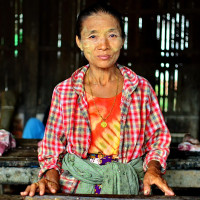
"Land is Our Life" The Struggling Lives of Pa-O Farmers amid Land Confiscation, Climate Change and Rural Collapse
Regions
A commentary by the Pa-O Youth Organisation and Transnational Institute
Amidst conflict, Pa-O farmers have long faced multiple challenges as they struggle for cultural survival and daily existence in southwest Shan State, including land confiscations, military conscription and climate change. Many young people leave for Thailand to seek new lives. In this commentary, the Pa-O Youth Organisation interviews local farmers to analyse the deepening hardships and systemic nature of repression. Land rights protection, the restitution of seized lands and an end to conscription and other coercive practices by the military regime and its proxies are clearly essential.

Photo credit: TNI
"This land is our life. If we can't farm, it won't be easy for us to keep living."
This is the heart-breaking truth spoken by a Pa-O woman farmer in Hsihseng township in southern Shan State. For rural communities in regions inhabited by the Pa-O ethnic group, "land" is not a raw material for making a living. Rather, it is the "lifeline" that sustains their livelihoods, their children's education, their social relations, and the traditions and customs passed down by their ancestors.
This commentary spotlights the struggles for survival and genuine aspirations of Pa-O farmers in Hopong and Hsihseng townships in the Pa-O Self-Administered Zone. Farmers in these territories have had to contend with a “four-way” pressure since the early 1990s: land confiscations, soaring agricultural costs, multiple taxes and conscription pressures from various governing bodies, and socio-economic impacts and climate change.
In the early 1990s, the Myanmar Army, the local People's Militia Force (originally a ceasefire group known as the Pa-O National Organisation [PNO]), and associated administrative organisations began confiscating farmland and village land belonging to local communities in Hsihseng and Hopong townships. Most of the land was confiscated during 1991-92 for a military base, urban expansion and other strategic reasons. Most of the villagers did not hold official land ownership documents. In rights and in history, the land was a traditional ancestral heritage under customary tenure systems regulated by village committees.
Through these actions, more than 18,000 acres of land previously under customary control was seized in total under various pretexts and justifications – an enormous area about the size of Beijing International Airport and Bangkok International Airport combined. For the local villagers, this sparked an enduring cascade of material and social losses so great that it has totally reshaped their lives and continues until the present day.
This commentary is based on recent interviews with 12 farmers and agricultural workers in Hopong and Hsihseng townships, as well as some in nearby Taunggyi, the capital of Shan State.
Land confiscation: a cascade of losses and injustices
Initially, when their lands were first confiscated, a 67-year-old Pa-O male farmer from Hsihseng town observed that “it wasn’t as noticeable because we were allowed to farm.” This was despite losing two-thirds of his land when the Myanmar military confiscated 10 acres from him. Like other farmers, he never received any compensation for the confiscated lands. But later on he said that the situation changed in 2010 when "they allowed us to work on the land, but we had to pay tenant fees back to them.” Farmers began paying 2,000, 3,000, 5,000 or even 10,000 Kyats per acre to the military or to the Pa-O National Army (PNA) militia, the military wing of the PNO, just to be able to cultivate their own land.
Later, under the quasi-civilian government of President Thein Sein, a miniscule 625 of the total 18,000 acres of confiscated lands – just 3.5 per cent – were officially returned. But even then, very little of this land made it back to the original farmers. This is because the “returned” 625 acres of land were transferred to a single individual – Khun San Lwin, a prominent member of the PNO/PNA and currently chairman of the Pa-O Self-Administered Zone, designated under the 2008 constitution. In this way, only a tiny portion of the total confiscated land was ultimately returned (via Khun San Lwin) to the original farmers.
In consequence, the vast majority of the more than 18,000 acres confiscated during the 1990s are yet to be restored to their rightful owners. In the meantime, the lands previously confiscated by the Myanmar Army are currently controlled by the PNO/A. The story, however, does not end there. As a 67-year-old Pa-O male farmer from Hsihseng township said:
“In some areas, they fenced off the lands but provided a gate. We had to cover the cost of building the gate, and we could pass through it. Now, they have closed that gate again, and they don't allow us to work there anymore. The lands of about 50 to 60 people are involved. There are 250 households in total. In terms of acres, the confiscated land amounts to around 600 or 700 acres. Consequently, people have become unemployed. Among those who lost everything, some have gone abroad to look for work. In previous years, people would already be preparing the land at this time of year."
Against this backdrop, a common complaint among farmers is that they "have land but do not dare to cultivate it." Instead, they find themselves in the precarious situation where they no longer have access to the land or the income that it once afforded but, in the meantime, they have lost even more money because they still have to pay rent. Farmers feel truly helpless.
Making matters worse, this year farming families began facing demands to pay exorbitant amounts of money to get their plots back, combined with forced evictions from their homes, with a deadline of May 27 to complete the process. Equally insidious, the labyrinth of extortion extends to the allocation of lands when making claims, with local farmers threatened that, if they want replacement land, households with over five acres must pay for a compensation plot which is significantly smaller in size. In addition, although it was promised that those whose homes and farmlands were confiscated would receive at least small plots as compensation, they are now reportedly required to pay for them instead.
The same farmer quoted above explained the details about these unjust rules and substitutions:
"Regarding the land confiscation, the PNO has not provided any help, and the current situation is an ongoing conflict with them. There is no compensation paid for the confiscated lands. The total confiscated land amounts to 625 acres, including both residential and agricultural land. I heard that the authorities will provide a 40 x 50 foot replacement plot for confiscated residential plots, but we have to pay 2 million Kyats [about 400 euros]. Local farmers can neither afford to pay nor accept this. Those who have houses there were told to move out by May 27 at the latest. There are about 200 households affected."
A 50-year-old Pa-O woman farmer from Hsihseng township expressed how vital and precious the land is to her:
"This land is our life. If we can't farm it to survive, it won't be easy for us to keep living. We rely solely on this land for our children's education, social affairs and healthcare. We value it more than our own lives."
Rising Agricultural Costs and Input Challenges
Even before the 2021 coup and the latest developments regarding access to their land, villagers had been encountering additional stress related to their use of land in their home townships. For various reasons, this situation has worsened since the coup.
The farmers primarily cultivate maize (locally known as ‘CP’ corn – after Charoen Pokphand, a large Thai agro-business company), rice (including upland rice), peanuts, sesame, pigeon peas, and cheroot leaves (‘thanatphet’) and garlic. But their agricultural system has also transitioned over recent decades from traditional methods using manual labour and natural fertilizers to a system that relies heavily on costly machinery and excessive chemical inputs.
Currently, there is an imbalance between the income which farmers earn and their expenses due to the high prices of machinery, fuel and fertilizers which, in turn, are compounded by the manipulation of trade within the crop market. These rising costs have trapped many farmers in a cycle of debt. Notably, recent military conflicts in the Middle East have reduced the availability of fuel in Myanmar. Furthering the crisis, the prices of petrol and diesel have skyrocketed due to the system of restrictive rationing on the domestic market. Consequently, tractor rental fees have recently risen from the previous 60,000 Kyats per hour to as much as 150,000 Kyats [about 30 euros] per hour.
A 65-year-old Pa-O male farmer from Hopong township shared his farming experience:
"I have been farming since I was about 8 or 9 years old. Our ancestors also farmed for generations. In the past, there was no chemical fertilizer. We mixed cow dung and prepared it ourselves. First, we scraped the soil, then burned the weeds, mixed it with cow dung, and covered it back with soil. For my nine acres of land, I had to apply eight bags of fertilizer this year. Last year, I used seven bags. The year before that, I used only six bags. Every year, we have to increase the amount of fertilizer otherwise the crops don't grow well. It has been about 15 years since we started using chemical fertilizers. Brokers introduced them to us. In the past, tractor rental fees were only about 60,000 or 70,000 Kyats per hour. This year, the price is around 150,000 Kyats per hour. I think it's because of the rising fuel prices. First, we clear the weeds manually. When the rain comes, we hire a small machine. The small machine costs 25,000 Kyats per hour."
A 58-year-old Pa-O woman farmer, also from Hopong township, described her experience:
"This year, the ploughing season is already here. But because fuel prices have become too expensive, we haven't been able to plough yet. Fertilizer prices have also gone up. For example, a bag of 'Lhae Yin' (Bullock Cart brand fertilizer) used to cost 92,000 Kyats, but now we have to pay 106,000 Kyats."
Adding to the challenges, more chemical fertilizer must be applied every year because of soil degradation, with fertilizer prices rising season after season. A Pa-O male farmer from Hsihseng township explained the challenges in the transition from natural to chemical fertilizers:
"In the past, there was no such thing as chemical fertilizer. During the cooperative era [in the 20th century], they used to introduce fertilizers by giving them out for free to increase rice yields. Back then, a bag cost only around 9 or 10 Kyats. Now, there are no grazing lands left because the population has grown. The land doesn't expand, only the population does. Since grazing lands and cattle are gone, machinery has taken over. People started using fertilizers. We can get fertilizer on credit. If we need money for cultivation, we can take loans with interest from brokers."
Once ready for market, the prices of the crops produced by farmers, especially maize and peanuts, do not depend on the farmers themselves; instead, they rely entirely on the rates set by local wholesale centres. For example, despite the high production costs, CP maize fetches only around 900 to 1,100 Kyats per viss (1.6 kilogram), which does not cover cultivation expenses and results in a loss. A 65-year-old Pa-O farmer from Hsihseng township described the manipulation of the local crop market and the losses faced by farmers due to such price instability:
"In our area, we mostly buy crops for consumption. The crops we grow vary. When it's time for farmers to sell, they suppress the prices. For instance, we get only 1,000 Kyats per viss of CP maize. It also depends on the quality and size. Major fertilizer shops have multiplied. We can't afford not to use fertilizer either.”
The current conditions of transport and marketing also work against farmers. He continued:
“The rising transportation costs hurt farmers. When we buy items back for our own consumption, the prices are high. But when we sell our harvest, we only get the price set by the wholesale centres. The price of the products we sell is not decided by the farmer; it depends entirely on the wholesale centres.”
Financing is another challenge. Farmers who lack capital for cultivation have to borrow money, seeds or fertilizer in advance from local brokers at a monthly interest rate of 3 per cent ("3 Kyat interest"). When the harvest season arrives, they are then forced to sell their crops back to these same brokers at suppressed prices. As a result, profits end up in the hands of the brokers, while farmers remain trapped in a long-standing cycle of debt.
As a 45-year-old Pa-O woman farmer from Hsihseng township explained:
"When we have no capital to cultivate, operating with loans helps at first. However, if the harvest yields don't match up when it's time to pay it back, people can't repay."
Similarly, a farmer from Hopong township said:
"If we cannot afford the inputs, we have to borrow from crop trading brokers at an interest rate of about 3 per cent. For me, planting 9 bags of maize seeds costs around 7 million Kyats. When I sold the harvest, I had to pay around 2 million Kyats just in interest."
As these experiences exemplify, the heavy reliance of farmers on the commercial-industrial agricultural system over recent years has stripped them of economic autonomy. Because they do not own the seeds, the vital inputs or the market prices, they are forced to operate entirely at the mercy and direction of external brokers and corporations as well as military authorities who act as coercive forces in these territories.

Photo credit: TNI
Multiple Taxes, Armed Organisations and the Burden of the Conscription System
Following the 2021 coup by the State Administration Council (SAC), human security deteriorated further for local farmers, and the extortion of money and the forced recruitment by the SAC and the PNO of manpower from local residents become ever more oppressive. In townships studied in this commentary, people are variously forced to pay the SAC and PNO fees on a monthly, quarterly or bi-annual basis for such charges as military conscription, proxy recruitment, rations and gate taxes.
Collection methods, though, may vary: an average of 120,000 Kyats, for example, per year paid quarterly to the PNO and 25,000 Kyats per month to the SAC, and so on for the various charges. In some villages, residents are also forced to pay between 30,000 and 40,000 Kyats directly. These taxes are compulsory, and even those who cannot afford them must find a way to pay by whatever means necessary, a burden that has severely impacted on the basic livelihoods of many families.
Adding to the pressures, residents who own cars or motorcycles in some areas face extra taxes for these possessions. If they fail to pay, the local people face pressure and threats of arrest. In some villages, they must also contribute rice and supply packed meals in addition to financial fees. Also expensive, transporting agricultural supplies incurs gate fees ranging from 500 Kyats per bag to 15,000–20,000 Kyats per vehicle, making the flow of goods even more difficult for local farmers.
A woman farmer from Hsihseng township explained the pressures they face:
"Each household has to contribute 3,000 Kyats a month to the village fund. For the military conscription fee, we have to pay 15,000 Kyats a month, collected once every four months. Starting this month, we also have to contribute 10,000 Kyats every two months for the PNA militia's rice. In this way, we have to provide personnel for military service, and we also have to contribute money from our community fund.”
A 30-year-old youth leader added:
“Compared to the towns, taxes in the villages are extremely high. Because of this, most people don't want to live in the villages anymore. The local People's Militia [PNA] cannot be relied upon. They are only interested in the food expenses and personnel they need. They provide no support for what the village actually needs. In our area, villages have to provide one person to the Myanmar Army. The villages have to pool money to pay his salary, which is 650,000 Kyats per month, collected once every four months. We also have to pay money to the PNA which is collected every three months."
A 58-year-old Pa-O woman farmer from Hopong township also spoke about the taxes:
"I only do farming as my main livelihood. I grow maize, rice and pigeon peas. There is no extra income. There are other social expenses. On top of that, I have to pay 120,000 Kyats a year to the PNO, and 25,000 Kyats a month to the SAC. I don't even know where all our income goes."
A 45-year-old male agricultural worker from Hsihseng township shared his experience:
"Farmers face many difficulties when transporting agricultural supplies, fertilizers and seed baskets. We have to pay money when passing through checkpoints. Depending on the gate, we have to pay various amounts, such as 500 Kyats per bag or 15,000 to 20,000 Kyats for a small car. Large trucks carry 300 to 600 bags. Meanwhile, maize doesn't fetch a good price: we only get 900 to 1,000 Kyats per viss. The losses are heavy. The money we have to pay for conscription and other taxes amounts to about 100,000 Kyats a month. Some farmers have even had to sell off their lands because they can no longer afford it."
In summary, local residents are bearing the heavy brunt of taxes and burdens of the conscription system which are imposed by various armed organisations, notably the Myanmar military and PNO/A, in the Pa-O region.
Socio-Economic Impacts and the Migrant Worker Issue
Political crises, armed conflict and land dispossession directly impact the family life and education of rural communities. Following the 2021 coup, parents encountered severe economic hardships. Due to the fighting, the burning down of homes, internal displacement and the lack of security, parents in some areas have been unable to send or keep their children at school.
As a result of these circumstances, some children have become stuck in lower grades, creating a stark age-level mismatch and leading to a decline in educational standards. For this reason, parents express the fear that, if their traditional farmlands – the only asset and source of income they can rely upon – are confiscated, they will completely lose any means to continue supporting their children’s education in the future.
A 45-year-old male agricultural worker from Hsihseng township explained:
"Before 2021, people could afford to buy small tractors. They held donation ceremonies and festivals. Children's education was going smoothly. After 2021, people could no longer afford it, so there were dropouts. There are also cases where parents can't send them to school due to the clashes nearby. As a result, some children are already 13 or 14 years old but are still in Grade-1."
In this worsening landscape, the pressures on young people and their families are intense.
Driven by a lack of arable land due to confiscations, the desire to escape military conscription, and the fact that agricultural work is merely seasonal and daily wages cannot secure a livelihood, the majority of Pa-O youth migrate abroad – especially to Thailand – via undocumented routes to find work. With the remittances sent back by these youths abroad, families have been able to build new houses, hold Buddhist novice initiation ceremonies, and support the parents and children left behind.
These sacrifices, however, do not resolve the underlying challenges facing local people. In many areas, villages are now left with only the elderly and young children. This, in turn, means that, as the capable youth workforce diminishes, communities face negative fall-out, including difficulties hiring labourers for farm work, a lack of people to preserve traditional customs, and experiences where other actors enter and farm their lands because the rightful owners are unable to return home.
A 60-year-old Pa-O male farmer explained his own experience:
"During the cultivation season, we have to hire labourers. The daily wage is 20,000 Kyats for men and 15,000 Kyats for women. Working hours are from 8:00 AM to 4:00 PM, with lunch and rest breaks in between. Hiring labourers, though, is difficult. Young people in their prime find no suitable jobs here, and many have gone abroad to work because of military conscription."
A 30-year-old youth leader from a village in Hsihseng township added more on the continuing exodus:
"Most young people go to work in Thailand, mostly through undocumented routes. They can go if they have about 2 million Kyats. Most leave because their livelihood is unsustainable and also due to the mandatory conscription. One group has to provide one person for military service every four months. No one wants to go. Therefore, we have to collect money to hire a proxy to go instead. It costs about 100,000 to 140,000 Kyats per household for a four-month period."
A 45-year-old independent farmer shared his observations:
"I own two acres of land. I take turns planting a variety of crops and flowers. I grow tomatoes, strawberries, globe amaranth flowers, long beans, chilli, maize and rice. When planting rice, I have to hire workers. But since I plant a mix, weeding is constantly required. I hire one full-time worker regularly. I pay a daily rate of 15,000 Kyats, which amounts to 450,000 Kyats a month. This money is not a lot for them. However, on my end, I can only afford this much; I cannot pay any more than this. The crops do not fetch a fair value. Prices are high only in the retail market along the road."
Climate Change
In addition to repression, human and economic hardships, farmers are simultaneously suffering from natural disasters. In recent years, the rains have become unpredictable, with delayed monsoons, while flooding and excessive rainfall destroyed maize and rice fields between 2023 and 2025.
This year, due to the combination of land conflict and climate change, most farmers are cautiously waiting, not daring to move forward with planting even though they have already prepared their land. When crops are destroyed by the weather, farmers face severe livelihood struggles. They are forced to deplete their savings from previous years to make ends meet or borrow money from brokers again with interest, trapping them in a "robbing Peter to pay Paul" (digging one hole to fill another) cycle where they make no profit from their cultivation. Confronted with the natural threat of climate change alongside the pressures of politics, land confiscation and conscription costs, farmers can no longer cultivate with peace of mind, leaving the agricultural economy on the verge of total collapse.
Agriculture nevertheless remains the ultimate anchor for these farmers, as shared by a 65-year-old Pa-O male farmer from Hopong township who has been working the land since he was 8 years old:
"The income earned from farming is spent on living expenses, education, donations and repaying debts. There are years when it isn't enough. When it's not enough, we have to borrow from the brokers again. As for this year's cultivation, I have ploughed the land. But whether we can actually plant or not, I don't know yet. The rain is late this year. And with the land problems, I don't dare to plant yet. The rains have been unpredictable for over 10 years now."
Another 60-year-old Pa-O male farmer similarly stated:
"The weather brings either too much or too little rain – it varies from year to year. In some places, it has been two years now since we planted but things didn't go well and we got nothing to eat. Still, we rely on the income from farming to make donations, and we spend it on everything from basic living expenses to education. Furthermore, land is incredibly important to us. I think it is important not just for farmers, but for the entire country. For farmers, things will not be okay without land. I can't even describe the feeling of what it would be like to have no land left. It is truly beyond words."
In these terms, he expressed just how deeply vital land is to local communities and farmers but also how dangerous the present crisis has become.
Conclusion
For the farmers in the Pa-O region, "land is their life." However, due to multiple compounding pressures, the agricultural economy is currently on the verge of collapse. Unjust land confiscations, high input costs, climate impacts, extortionate taxes and conscription costs – all are having devastating effect. These are the primary drivers forcing youths to migrate abroad, which not only depletes human resources but also causes traditional customs to fade and destroys the fabric of rural society. At the same time, the data indicates that these issues are pushing local residents who have sought to remain in their farms into lives as daily wage labourers and, very often, leaving them completely landless.
Echoing the sentiments of many, one farmer remarked: "I just want to be able to farm properly and peacefully like before." As these words remind, the fundamental aspiration of these farmers is straightforward: to secure the right to cultivate their lands peacefully, free from intimidation and fear. Clearly, the protection of land rights, the restitution of confiscated lands and an end to unjust taxes, military conscription and other coercive practices are integral to conflict resolution and political reforms in the country today.
It is be hoped that, one day, agriculture and farming in the Pa-O region will become a model of progressive and sustainable change.
Credits
More like this
-
Land, Forests and the Struggle for Survival A Three-Decade Journey in Ye Chaung Phya (Bee Ree)Publication date:
-
Reflections on the newly-declared Pawklo Indigenous Stewardship Territory A Commentary by Hsar Doe Doh Moo*Publication date:
-
Why is Women’s Access to Land So Complex in Myanmar? A Commentary by TNIPublication date:
-
People, Food and Land Lessons from the Lahu highlandsPublication date:
-
A comprehensive guide to TNI’s Myanmar publications The complete archivePublication date: