Migrant farmworkers & farmers, intersectional & internationalist alliances
Topics
Regions
In today’s global food system, migrant farmworkers remain central yet exploited. This longread confronts global capitalism, migrant labour regimes, and land–labour politics, highlighting the urgent need for alliances between migrants, peasants, farmers, and food sovereignty movements worldwide.
Longread by


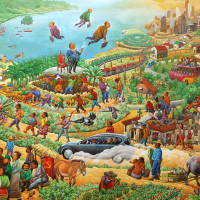
Painting by Filipino activist painter Boy Dominguez
Migrant farmworkers and global capitalism
“The exploitation of [migrant] farm labor… which is one of the ugliest chapters in the history of [the] industry, is as old as the system of landownership of which it is a part. Time has merely tightened the system of ownership and control and furthered the degradation of farm labor. As far as the vast army of workers who operate these great tracts are concerned, their plight is nearly as wretched as it was thirty years ago… [I]t would be difficult to find a parallel for this strange army in tatters… Sources of cheap labor … have been generously tapped to recruit its ever-expanding ranks. As one contingent of recruits after the other has been exhausted, or has mutinied, others have been assembled to take their places. Although the army has been made up of different races, as conditions have changed and new circumstances arisen, it has always functioned as an army. It is an army that marches from crop to crop. Its equipment is negligible, a few pots and pans, and its quarters unenviable… No one has ever been able to fathom the mystery of how this army supports itself or how it has continued to survive.”
These powerful lines about life and work, labour and land, of production and the incessant renewal of life and of a social group can very well be describing present-day Eastern European migrant farmworkers in the Dutch agriculture that comprise the majority of almost a million migrant workers in the Netherlands; or Mexican strawberry pickers in California; or Nicaraguan workers in Costa Rican pineapple plantations; or Rohingyas expelled from Myanmar working in Malaysian oil palm plantations; or Sudanese migrants working in capitalist farms in Ethiopia.
But the quoted description was about migrant farmworkers in California. The source of the quote was the classic book, Factories in the Field: The story of migratory farm labor in California by the scholar-activist writer, Carey McWilliams, published in 1935. He was describing the rise of Californian agriculture and the key role played in it by migrant farmworkers from China, Japan, Philippines, India, Mexico, and Europe. The setting was the second half of the 19th century to the first quarter of the 20th century.
The reason why his text reads like a description of contemporary global condition is because the general situation for migrant farmworkers that he observed in California a century ago has not only remained largely unchanged, but has been globalized. It reminds us too that despite numerous changes in the regulatory rules about migrant farmworkers, largely about selective illegalization and invisibilization of migrant labour, the logic that underpins the rise and reproduction of migrant workers has remained the same, namely, the logic of capital. The idea of endless economic growth and limitless profit-making require a constant supply of migrant labour that can be taken in when needed, and expelled when no longer required.
Regardless of the emerging migration corridor and changing pattern of regulations, whether under a liberal political atmosphere or in the shadow of a rising anti-migrant far-right, the logic that reproduces this social class, and the fundamental character of it, have remained the same. To take another verbatim quote from McWilliams: “But, in substance, it is the same army that has followed the crops since 1870.” McWilliams said this in 1935, in California. We could still say the same in 2026, anywhere in the world.
Peasant struggles within and against capitalism without the significant participation of migrant farmworkers will be inherently weak. Participants at the 3rd Nyeleni world assembly on food sovereignty has identified the alliance between migrant workers on the one hand, and peasants, Indigenous Peoples, pastoralists and fishers as fundamental in the struggle to transform the capitalist global food system.
But migrants, farmworkers and farmers linking arms in a unitary movement, or in a coalition of social movements, is easier imagined than carried out in real life. There are many contradictions, starting with competing interests: migrant workers want higher wages and better living conditions that in turn increase production cost; farmers who hire farmworkers want to keep production cost low.
What are the structural, institutional and political conditions that block, or enable, working class solidarity among migrants, farmers and farmworkers? What are the challenges for sectoral social movements of farmers, pastoralists, fishers or Indigenous, as well as for workers’ unions in terms of connecting movements to go beyond being ‘merely agrarian’, or for that matter, beyond being ‘merely labour’? in order to forge and sustain truly anti-systemic social movements?
A groundbreaking set of empirical studies
The questions above are some of the challenges addressed by the authors of 15 articles in the Special Issue of Agriculture and Human Values: “Migrants, Farmers and Farmworkers and the Politics of Land and Labour” guest edited by us, together with Tsegaye Moreda, Martha Jane Robbins, Wang Chunyu, Yunan Xu and Ye Jingzhong. Most of the papers are Open Access.
Migrant farmworkers in the world’s agricultural and food sector comprise a very significant percentage of the total workforce, but they are also the least organized in social movement terms. They shape agrarian transformations and partly influence the fate of the world’s smallholder farms – in their home communities and in their migrant work sites – but rarely figure out in the agendas of farmers’ public actions and in the analysis of the fate of smallholder farmers. These challenges can be understood better when seen from the perspective of interlocking politics of land and labour, as well as production and social reproduction concerning the interconnected geographically distant households and communities of migrant farmworkers and of farmers and farmworkers.
The world-renowned agriculture and food sector of the Netherlands is highly dependent on temporary migrant workers. In European Union, one-fourth of the total work force in agriculture and food sector is comprised of temporary migrants, both coming from inside the EU and outside. This is likely to be an under-estimation. This is more or less a similar pattern in North America and Japan. To varying degrees, with different structural conditions and institutional arrangements, we find this phenomenon is not limited to upper income countries. This is in fact found in lower- and middle-income countries, such as Costa Rica, Thailand, South Africa, Ethiopia, and Colombia. The sector of migrant farmworkers in southern China is also significant. Migrant work enables and sustains the livelihoods of migrant families back home, even when the wage levels and working conditions are often quite precarious. This is not new. Poorly paid migrant wage work in agriculture and food sector, mining, construction, among others, has always been part of the evolution of global capitalism. They are enticed by companies and governments when needed, then discarded when necessary. Brilliant classic studies such as Factories in the Field by Carey McWilliams, and contemporary ones such as Fresh Fruits, Broken Bodies by Seth Holmes, as well as advocacy reports such as the 2024 Oxfam report, tell us about the human sufferings as well as political agency of the working class under capitalism.
There are a number of issues that we feel are under-studied academically and/or under-debated politically that have been explored in the Special Issue. The contributions to the Special Issue have covered these issues, and in this blog, we selected only a handful insights.
A chain of hollowed-out rural villages
A farmer in the central Myanmar works their family farm from May to October. In November, he, his wife and eldest son travel to the southern province of Yunnan in China to cut sugarcane from November to April. They leave their younger children behind with their relatives, while they brought the youngest, a toddler, with them to China. While they are away, they hire landless farmworkers in their village to work their farm and take care of their goats. In Yunnan, they work in several sugarcane farms owned by farming households whose adult members are working as migrant farmworkers in several cutflower greenhouses in the capital city of Kunming as well as tea plantations in nearby counties. Most of the farmer households in the sugarcane area nearby the border with Myanmar have their adult members migrated to other places to find well-paying migrant wage work. But they hold on to their small farmland back home, and continue to operate them long distance by hiring migrant farmworkers from Myanmar. These are not random cases. The Myanmar-Yunnan is corridor is dominated by such stories as examined by Wang et al. and Xu et al.
This chain of hollowed-out rural villages has led to the emergence of what Elizabeth Fitting in her contribution calls “transnational agricultural care chains” in the context of Canada and Jamaica. Simply put, the land-labour productive and social reproductive activities in the multiple geographic sites of migrants, farmers and farmworkers are tightly interconnected.
We see this chain in many migration corridors: Vietnam-Guangxi, Central America-USA, Middle East and North Africa-Turkey, Morocco-Italy, Sudan-Ethiopia, Venezuela-Colombia, Nicaragua-Costa Rica, and Zimbabwe-South Africa, Philippines-Malaysia to name a few. We also see this within a country, such as Ethiopia, Colombia and Myanmar – usually the poorer regions of a country becoming the supplier of poorly paid migrant farmworkers elsewhere in the country. Many are stories about migrants seeking better paying jobs elsewhere. But others have become migrant farmworkers because of their violent expulsions from their homeland, or because of involuntary displacement caused by militarism, or because they were running away from military conscription as in the case of Myanmar.

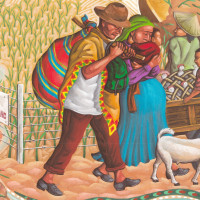
Painting by Filipino activist painter Boy Dominguez
Small and medium-size farmers are among those who hire migrant farmworkers
In classical agrarian studies, only rich farmers and big capitalists in agriculture and food sector hire in labour. In conventional theory, a defining feature of middle or family farmer is that it does not hire in labour to any significant extent, while a defining character of poor peasant and small farmer is to hire out their household labour to augment their farm income.
Included in the 21st century dynamics of migrant farmworkers/farmers is that as farmers in the centers of global capitalism age and retire, the reality of what Ben White calls as the ‘generation problem’ bites: who is going to continue farming? Migrant farmworkers are increasingly becoming migrant farmers, as the study by Laura-Anne Minkoff-Zern in the context of the United States show. The challenge of the social reproduction of farmers as a social category is an urgent and difficult one, as studies of various situations in many parts of the world, including Japan and China, show. The hiring in/hiring out dimension in production is a key element in the ability of farmers to reproduce themselves.
What the contributions are showing is that contemporary pattern of hiring in/hiring out labour tends to veer away from the classical assumptions. In many of the cases studied in this Special Issue, medium-size farmers, and even small farmers, rely on available migrant farmworkers in order to maintain their farm operation. While it is not surprising that small farmers hire out their labour, we see increasing trends where medium-size farms diversify sources of income in order to sustain their farm operation, including hiring out their own labour. This has implications for our understanding of class formation and class politics, and in our understanding of the fate of the peasantry. Are small and medium farmers in many parts of the world able to survive as a social category because of the availability of migrant farmworkers that they could hire? If so, this calls for the revision of how we understand the conventional wisdom about agrarian transformation and rural politics more generally.
The politics of land are increasingly shaped by migrant labour regimes
The politics of land – who gets which land, how much, how, through what institutional mechanism, and for what purposes – have generally been studied within the structural, institutional and political parameters of a nation-state. This is usually how we study land concentration, monopoly and accumulation, and institutional instruments to reform or sustain particular land regimes. Landlord/peasant/central-state relations are central.
But in the various contributions to the Special Issue what has emerged to be an important variable is that how existing democratic distribution of land to small and medium farmers are sustained, or how land grabbers able to consolidate their large-scale investments, how landless peasants or small and medium farmers in the home countries of migrants are able to accumulate land are increasingly being shaped by emerging migrant labour regimes in the multiple sites of production and social reproduction in the chain of hollowed-out communities. This renders conventional studies about productivity and livelihoods, as well as social differentiation that are tightly based on farm plot performance still relevant but incomplete. The ability of many land reform beneficiaries, or Indigenous Peoples’ communities who got their territories, to maintain control of the reformed lands can only be understood when examined in relation to migrant wage work that these peasants and Indigenous Peoples engaged in.
Land and labour for production and social reproduction
Studies on land, at least in the field of Critical Agrarian Studies, and debates about public action around land tend to be centered on production, e.g. farm land/land redistribution. This is fundamental. But it does not fully capture the real life meaning of land for working people and Indigenous Peoples. The diverse and multiple access to land by rural working people and Indigenous Peoples are for both production and social reproduction for the incessant renewal of life. Land and social life are intertwined. Thus, land is farmland, land is for food garden, playground for children, to have access to a riverbank to fetch water for irrigation and everyday household use, access to community forest to forage things of use value and exchange value, and so on. The pattern of land use and the web of access to land ultimately mean that the institutions of property relations form a mosaic: private with alienable rights, private with usufruct rights, state, community, open access, commons.
Human labour, in turn, is always in the unitary sphere of production and social reproduction. Seeing land and labour this way, and looking back to the chain of hollowed-out communities of migrants, farmers and farmworkers we can begin to understand better that land is important not just for production, but also for social reproduction. Further, we see that migrants, farmers and farmworkers are necessarily tied to more than one geographic site of land/labour and production/social reproduction. This political economy of land/labour and production/social reproduction is quite challenging in terms of unit of analysis or public action that is usually focused on one geographic site, although in reality these are multi-sited.
Interconnected conditions, less connected struggles
Looking at the Canadian case in her paper, Martha Jane Robbins asks straightforward but politically difficult questions: “Can migrant farmworkers be part of local food systems and still call those systems ‘local’? To what extent do local food systems challenge the internal logics of the corporate food regime, especially when relying on transnational labour? Solidarity efforts will have to grapple with these larger systemic questions. Is it possible to change the agricultural labour system to one based on justice for workers and sustainability for family farmers?”
Perhaps one of the biggest obstacles to social movement-building among migrant farmworkers is the difficult political conditions of organizing class-based solidarity movement among migrant farmworkers themselves. Many of them are undocumented, or if they are undocumented, they are temporary and mobile shuttled from farm to farm, or are on short-term temporary contracts. For the vast number of undocumented migrants, operating incognito and below the radar is their guarantee to be able to sustain their work. The last thing that they would think of doing is to get formally organized into unions because it means getting visibilized. For the documented migrants, the challenges of having contracts that are short-term and temporary, and requiring constant mobility, it becomes operationally difficult to sustain organizing and agitation work.
Equally challenging is how to build alliances between agrarian social movements of peasants, Indigenous Peoples, pastoralists and fishers on the one hand, and migrant farmworkers on the other hand. Not only that the materials conditions for migrants to organize themselves are not conducive to building social movements, there are fundamental contradictions in the class interests between farmers and farmworkers, alongside tensions based on identity politics. History has shown that these differences had been overcome in many instances, but these challenges remain complex and difficult.
But without broad alliances between farmers’ and farmworkers social movements, struggles for agrarian justice in the context of social justice more generally will be weak.
Forging intersectional and internationalist coalitions of social movements
The uneven development of capitalism globally and across societies resulted in the variegated class formations and relations, as well as class consciousness. The other axes of social differences, namely, race, ethnicity, nationality, caste, gender and generation that interlock with class make the construction of class consciousness among all exploited and oppressed social classes and groups inherently uneven and challenging. This is especially because the conditions of life and work for migrant farmworkers are defined by all types of violence. It is for this reason that migrant farmworkers’ movements and alliances between peasant and Indigenous movements and farmworkers have to be intersectional in its fundamental character. Without class element in movement building, struggles will not go anywhere; but with class purism, struggles will not go very far either as identity politics play an important role in the making of political consciousness.
Migrant farmworkers have to organize themselves. Farmers’ movements cannot do it for farmworkers. One cannot blame farmers’ movements if migrant farmworkers have weak social movements of their own. But farmers’ movements can help in multiple ways.
The struggles of peasants, small farmers, Indigenous Peoples and migrant workers are intertwined intersectionally. These are collectively a struggle of the working class that are defined by potential class solidarity and actual contradictions. This is even more important because however strong a peasant movement is if it is not able to connect to political struggles of the working class more broadly and society more generally, it remains just that: merely agrarian – and its impact will be limited. Forging alliance between farmers and migrant farmworkers is a giant step, and a strategic one, towards intersectional struggles for systemic transformation.
The multisitedness of migrant farmworkers productive and social reproductive activities, and their entanglement with farmers in the various sites across national borders make the resolution of the social problems of one social class or group in site dependent on the resolution of the problems of another social group across national borders. Farmers in Myanmar working as farmworkers in Yunnan province in China, farmers in one region of Myanmar working as farmworkers for farmers in another region who engaged in migrant wage work in China, farmers in Yunnan working as peasant-workers in Shanghai. Their life and work trajectories are intertwined, and the resolution of their social issues are dependent on each other. The logic of capital under a generalized commodification of life and labour compels the working class to build truly internationalist social movements and alliances.
The theme of the recently concluded 3rd Nyeleni world assembly held in September 2025 in Sri Lanka is ‘food sovereignty and systemic transformation’. One of the strategic calls is to forge enduring alliance between food sovereignty movement and workers’ trade unions. Building migrant farmworkers and farmers alliance is foundational in this context. The 3rd Nyeleni world assembly’s framework on alliances with migrant farmworkers reflects Nyeleni’s grasp of the urgency and necessity of forging intersectional and internationalist social movements and alliances. And this is truly inspiring.
Invitation to a continuing conversation
We invite fellow researchers and movement activists to read the contributions to this Special Issue, and engage in a continuing conversation about how to interpret this part of the rural-urban realities in our world in order to change it into something better: more just, fairer and kinder.
Credits
Authors
Acknowledgements
This study on migrant farmworkers and farmers, land and labour has received funding from the European Research Council Advanced Grant project, RRUSHES-5, Erasmus Professors programme for positive societal impact through DKPI, and the Transnational Institute (TNI), especially through its Myanmar-In-Focus as well as Agrarian and Environmental Justice Programs.
Jun Borras is a professor of agrarian studies at the International Institute of Social Studies (ISS) of Erasmus University Rotterdam (EUR), and is part of the Erasmus Professors Programme for positive societal change at EUR. He is an associate of the Transnational Institute (TNI). His latest publications include The Oxford Handbook of Land Politics (2025) and Scholar-Activism and Land Struggles.
Jennifer C. Franco is a researcher at the Transnational Institute (TNI) and works specifically with the Myanmar Programme and the Agrarian and Environmental Justice (AEJ) Programme at TNI. Her latest publications include the book Essential Concepts of Land Politics (2025).
More like this
-
ICARRD+20 and the emerging global coalition behind the 4Rs Land Redistribution, Recognition, Restitution and RegulationPublication date:

-
Reforming pattern of land use, web of land access and mosaic of property institutions Issues for reflection in the context of COP30 and ICARRD+20Publication date:
-
The politics of land Introducing an important new collectionPublication date:
-
Publication date:
-
Publication date: