
Sustainability fantasies/genocidal realities Palestine against an eco-apartheid world
Regions
Gaza endures unprecedented devastation, with relentless bombings since October 2023 reducing its landscape to over 40 million tonnes of rubble. This destruction has led to thousands of civilian casualties, while hospitals, essential services, and the environment suffer extreme contamination. This essay examines Gaza’s plight as part of a broader eco-apartheid system, perpetuating colonial violence to safeguard Western interests and profits.

Illustration by Fourate Chahal El Rekaby
“…our death is sustenance for the world we live in, necessary to maintain things as they are. Our blood is the price of the colony’s sense of “security.” (11)
“Palestine is a microcosm of the world: wretched, raging, fraught, and fragmented. On fire. Stubborn. Ineligible. Dignified. The lens we lend the Palestinian reveals how we see each other, how we see everything else.” (30)
-Mohammed El-Kurd, Perfect Victims (2025)
Gaza has recently experienced the largest slaughter of men, women and children in decades and a destruction rate that has produced well over 40 million tonnes of rubble that will take over a decade to clear. The near 100,000 tonnes of bombs dropped on the Gaza Strip since1 October 2023 surpasses the World War II bombings of London, Dresden and Hamburg combined. Gaza is also the site of one of the largest engineered mass starvations this century. For over two years, a day did not pass in which a child was not dismembered by the US-backed Israeli army. Gaza has seen its hospitals, universities, markets and essential services blown to pieces, and its waterways, air and soils polluted to highly toxic levels by chemical residues from carpet-bombing. The destructive force with which the Gaza Strip has been – and continues to be despite a “ceasefire”– bombarded is equivalent to several times that of the nuclear bomb that the United States dropped on Hiroshima. And yet the tens of thousands of Palestinian children who have died due to mutilation and incineration, and from infection resulting from amputation, count for absolutely nothing in the eyes of the West, in stark contrast to how it reacts when an Israeli is held hostage, or an ultra-wealthy American is trapped in an undersea submersible on a pleasure trip to view the Titanic. Over these two years it has been breathtakingly clear that Palestinian lives do not matter to imperial powers and their interests.
The complete dismissal of entire populations as sub-human, or not equivalent to European or Euro-American bodies, is a stark reminder that the horrors of the transatlantic slave trade and colonial genocide of Indigenous populations by Western empires have never left us. It is also a frightening reflection of the priorities of the world’s rulers as we watch the planet’s life-support systems erode due to ecological collapse. The ruling class’s desire to preserve a liberal democratic society that is free from ecological breakdown extends only to a future reserved for themselves – an ever-decreasing minority of multi-millionaires and billionaires. Meanwhile, what we have witnessed in Gaza is a sign of what is to come in an era of growing ecological breakdown brought on by a capitalist world order that is no longer fit for purpose – if it ever was. As Colombian President Gustavo Petro declared at the COP28 climate conference in Dubai in December 2023: “Gaza is the mirror of our immediate future”.
The word genocide is woefully insufficient to describe the deliberately engineered annihilation of people and of the ecological relations that sustain their life. What we have witnessed in Palestine is the monstrous intent to do away with an entire people and a whole environment in order to consolidate US-led imperial interests in the face of anti-colonial resistance, just so that private equity can capitalise on oil and gas projects and “waterfront property”1 on Gaza’s shore. With a rising mobilisation of demonic far-right factions and a general shift towards authoritarian capitalism around the world, the future might very well see more such instances of the annihilation of the social and ecological fabric of places, in a last-ditch effort to continue to extract profit and to remove ‘surplus populations’ – but with less of a liberal and progressive pretence regarding morals, human rights, and ‘win win’ solutions. These acts of annihilation will instead be framed as situations in which “civilised” victors conquer barbarian “bad guys” (in the words of Tim Walz, the Democrats’ candidate for vice-president in the 2024 presidential elections) – dehumanising populations inconvenient to the ruling class, whose sacrifice will be deemed necessary in order to maintain a dying and utterly catastrophic world order.
In this article, we explain why the combined ecocide and genocide in Gaza is an expression of eco-apartheid – a violent racialising phenomenon that advances the colonial frontier of land occupation and resource plunder to funnel wealth to a privileged few at the expense of the vast majority of people. Within the racial imperialist order of eco-apartheid, the destruction of the ‘wretched of the earth’, of brown, Black and Indigenous people, and the erasure of their environments, cultures and knowledges, is seen as completely banal, a system that functions as it is supposed to. It is for this reason that genocide and ecocide should be considered two sides of the same coin. Both are defined by an attempted annihilation of an entire people and the living environments of which they are active participants inshaping. Climate change is the outcome of centuries of colonial occupation and exploitation of racialised people and their lands as ‘resources’. What distinguishes genocide from ecocide is the pace of the murdering and decimation of life – fast in some places, slower in others.
The process of funnelling wealth to a handful of people involves the creation of both geopolitical and geophysical ‘sacrifice zones’ of varying severity. These sacrifice zones can occur both in the Global South and in the heartlands of the empire. For instance, while working class Americans in parts of North Carolina received no more than $750 in relief funds after the destruction caused by Hurricane Helene, which was super-charged by climate change, the US government has given over $22.7 billion in aid to Israel to bomb Gaza and Lebanon (equal to over $2,300 per Israeli citizen) since 7 October 2023.
While the consequences of the ecocide-genocide nexus are deadly for humanity, we argue in this article that eco-apartheid is necessary in order to maintain the capitalist imperialist system for decades to come, and to secure a White supremacist settler future. In this future, the niceties of a liberal rules-based order will be done away with and reserved to a few in ever tightly controlled gated communities: the myths of multilateralism, multiculturalism, international law and human rights will no longer be expedient for the ruling class in the face of overwhelming economic and ecological contradictions. As Nesrine Malik has written, the unfathomable assault on Gaza continues to proceed with finger wagging at best, even as most Western governments roll out the red carpet (and weapons sales) to a tyrannical genocidal state that they think represents their interests, indicating that our world is still one where might is right. The ‘look the other way’ attitude of Western powers who have actively supported and encouraged the genocide of Gazans, and the orchestrated silencing of voices in opposition to it, foreshadow the coming normalisation and collective gaslighting of unimaginable violence as climate catastrophe continues unfolding in lockstep with growing inequality as the ruling class continue to enrich themselves and build fortress walls
In the following sections we highlight some facets of the worldwide regime of eco-apartheid, in which increasing numbers of people are dehumanised and deliberately cast out to face the wrath of climate change and social precarity, including through violent military occupation. At the same time, we show how the elite double down in deflecting their complicity, shielding themselves through so-called ‘sustainability’-branded living. We note here that in preparing this article we talked with anti-imperialist land defenders and community organisers who offered advice on building the power needed to organise and fight in an historical moment in which dependence on existing institutions is glaringly futile.
Palestine in the world ecology
The Zionist project is but one modern iteration of the West’s savage settler colonial history. Starting from the British Balfour declaration and the violent repression of the 1936–1939 Great Arab Revolt, to France’s heavy arms supply in the mid-20th century, and now the United States’ unceasing military aid, Israel has always been viewed as the central bulwark for imperialist domination in the Middle East and North Africa region. . It is considered an outpost of Europe’s ‘civilising mission’ (mission civilisatrice) among the ‘backwards’ Arabs and their arid landscapes, and the antidote to expressions of Arab self-determination and progressive Arab movements.
Like the British empire before it, which legitimised and facilitated the Zionist project, the US empire (which has become that project’s principal backer) is not interested in democracy, human rights or fighting anti-Semitism. These, like marketable ‘sustainability’, are merely convenient narratives that serve to leverage social concerns for the purposes of re-branding the US empire’s military and economic projects – in Palestine and elsewhere. The intent of these projects is to subdue territories and people and to push them into circuits of accumulation around labour, land and new forms of debt. This drive to create wealth only sees Gaza for its natural gas, its luxury real-estate value, and through aesthetic standards of “progress” – including ecology as a kind of beautification or cover-up for the utter violence left in the wake. Eco-modernism thrives off imperial violence and settler colonial fantasies of barren land, masquerading as efficiency improvements to stimulate more wealth accumulation. As a consequence, worldwide, already wealthy people maintain and enhance their water- and energy-intensive lifestyles through eco-modernist automation that is branded as climate-resilient. In essence, eco-modernist lifestyles are nothing but the top 10 per cent making a killing (literally and metaphorically) on their investments.
The colonial quest for resources also gives the White supremacist coloniser exalted status, especially when it is Arabs, Muslims and lower-income brown or Black people who suffer at the whim of Western interests, whether in Haiti, Lebanon, the Democratic Republic of the Congo, Cuba, Venezuela, Iran, Sudan, or domestically against immigrants and Indigenous People within the United States or other Western countries.
It is important to note here that Israel is the most important outpost of the US empire, not because of inter-religious conflicts or the influence of the ‘pro-Zionist lobby’ in North America and Western Europe,2 but because of West Asia’s central position in the capitalist world system. After the 1967 war with Nasser’s Egypt, in which Israel proved itself a dependable partner of US imperialism, the US assumed the position of the primary sponsor of the Zionist regime, supplying arms and financial support to the settler state. The US’s interests in the region focus on the fossil fuel oil economy and in particular on guaranteeing the stable supply of oil within the US hegemonic global order. This involves a vicious positive feedback cycle in which petrodollars beget more petrodollars, by way of military campaigns, resource exploitation, wars and ecocide. In this configuration, only Israel, with its strategically situated settler population, vulnerable borders, militarised society and repressive forces can be wholly relied upon by the US to help entrench the US-based order in the region.
At the same time, the extreme-right Zionist entity is also entirely dependent on the US for survival: financially, militarily and politically. In fact, Israel’s survival is key to the survival of the global capitalist order, which is based on US imperialism and Western European hegemony. A threat to Israel is therefore a threat to US imperial domination. It is only through this dialectic perspective that we can understand both the unconditional support afforded to Israel’s genocide in Gaza and the absolute normalisation of genocide in Western society. This viewpoint also explains the scale of the tyranny and holocaust perpetrated by Israel in response to Palestinian acts of resistance: a holocaust that is rationalised and rebranded as ‘routine’ or as constituting a series of ‘limited ground operations’.
Palestinian resistance is the stone lodged in the throat of US imperialism. Well before October 2023, US President Joe Biden’s Middle East strategy had been very clear: normalising ties between Israel and Saudi Arabia, opening new formal investment markets in the region, and further stabilising imperial relations. With a Saudi–Israeli normalisation deal on the cusp of being announced as winter 2023 approached, the question of Palestinian national sovereignty was brought back into sharp relief through popular resistance on 7 October. And so we must remember that the US-backed Israeli obliteration of Gaza is not simply a way to open up new real estate markets or to seize land for capital. Palestine, Lebanon and Yemen have been punished for their role in thwarting uneven capital accumulation and value drain from West Asia. Through the genocide in Gaza, the Palestinian resistance has articulated the clearest expression of anti-colonial dissent, of a national liberation movement that refuses to have its humanity cancelled and its populations erased and sacrificed for the imperial core.
Our intent in demonstrating the link between genocide and ecocide is to stress that the scale of Israel’s annihilation of Gaza, where the social, ecological and political fabrics are torn apart by megatons of military arsenal that leave limbs scattered and the soil laden with toxins, will become increasingly commonplace as crises of global capital accumulation intensify under the stresses of an altered climate, degraded ecosystems, , social and economic inequality, and geopolitical manoeuvres that reshape old alliances to reap the benefits while scoring new profits. The bulldozers that continue to devastate Gaza’s ecology even during the grotesquely misnamed ‘ceasefire’ are no different from the bulldozers that rip apart primary rainforests for agri-business expansion, precipitating the sixth mass extinction. The artificial intelligence (AI) technologies deployed by companies like Palantir and that refine weapons used to murder civilians in Gaza’s hospitals and schools are the very same that target the immigrants in ICE deportation raids in US cities, requiring new energy sources like coal, oil and gas, renewable, and even nuclear power that promise expanding resource imperialism and colonialism in places like Venezuela and Greenland The appetite for energy of Big Tech overlords like OpenAI, Amazon, Microsoft, Alphabet, and Meta, among others, not only cancels out environmental gains from renewable energy use, but also reinforces ecologically devastating extractive practices and toxic waste dumps on communities of people considered unworthy and sub-human elsewhere. All of this makes clear that what we are witnessing is a vicious cycle of genocidal and ecocidal violence.
In his speech at the COP28 summit in Dubai, Colombian President Gustavo Petro stated:
The unleash[ing] of genocide and barbarism on the Palestinian people is what awaits the exodus of the peoples of the South unleashed by the climate crisis.
We can add that those who dissent in the Global North will be gaslit and violently repressed, while those who organise to resist in the Global South will be met with violent external interference and barbarism.
Yet, Western interests have lobbed the most depraved acts imaginable on the people they accuse of requiring “peace” and civilization. By references to lofty ideals and moral standards,
the history of modern Western civilisation has been one of savage colonisation, dispossession, enslavement and genocide. This brutality characterised the Euro-American colonisation of the ‘New World’ from the period during which European settlers killed over 55 million Indigenous people in North, Central and South America over a 100-year span to the ‘civilising period’ of the 19th and 20th centuries. During this time, Western interests espousing the Euro-American supremacy carried out the most brutal and savage mutilation and extermination campaigns across the world under the banner of modernity and development – including within its own borders. Brutality has also characterised the 20th century and early 21st century, an era marked by the wars waged by US imperialism, involving the brutalisation of populations in Vietnam, Angola, Iraq and Afghanistan, and US support for tyrannical proxy leaders in places like Chile, Argentina and Indonesia – just to name a few. These genocides and massacres over the last several centuries are not footnotes or case studies: entire life-worlds were exterminated to ensure the survival of the colonial order. In short, these mass crimes are fundamental to understanding the ecological crises we are experiencing today. They show us that, though all civilisations throughout history have had their wars and conflicts, only the White supremacist Euro-American empire, with its racialising technologies, has so sharply perfected a social and ecological infrastructure premised upon genocide and ecocide. While the massacres in Gaza (and also in Lebanon, particularly in 2024) have shaken the sleeping conscience of the masses, they are an unsurprising and highly consistent reflection of the West’s moral character as demonstrated over the past 500 years.

Illustration by Fourate Chahal El Rekaby
For the ruling class, climate change just means more bodies to sacrifice
What then is new in our current conjuncture? What characterises the renewed era of US imperialism that we have now entered? The answer is the abandonment of even the most modest pretences to a rules-based international order: a situation in which the rules apply to everyone except the colonial powers that have inflicted 500 years of violence on the planet and its people, and whose modus operandi of fragmenting humanity to extract labour and resources is based on the idea of White supremacy. Historian Enzo Traverso argues that this state of exception for the colonising powers is an implicit admission of immorality: it implies the selective transgression of laws, in which all civil liberties and freedoms, as well as basic rules of law and order, can be dismantled in the name of safeguarding the future of the empire as it counteracts its own decline.
The implications of this selective exercising of immorality are absolutely terrifying in an era in which the earth’s life-support systems are at risk of crumbling due to ecological collapse. And therein lies the key to understanding eco-apartheid, as we witness the horrors unfold in Gaza. Long gone is the era of Western claims to humanity, sustainability and human rights (if they were ever valid): instead we see an acknowledgement that those rights only belong to a few, and that the ‘other’ must be sacrificed to save this dying order as well as anyone who stands in the way.
Colombian President Gustavo Petro and others who have drawn parallels between the ongoing genocide in Gaza and an unfolding global system of ‘eco-apartheid’ are not making a simplistic comparison. The summers of 2024 and 2025, during which Israel’s genocide continued without pause, saw unprecedented global heat records, crossing the 50°C mark in large parts of the Global South, including Egypt and Mexico. Floods and fires ravaged vast portions of the world, including in the heart of the empire in the US, disproportionately harming those racialised people, as well as the White working class, whose lifetimes of labour have been exploited with little in the way of compensation or safety nets. These disasters revealed that a world in which large numbers of people are displaced by climate change is not a distant hypothetical but is our “immediate future” (in the words of Gustavo Petro) if fossil fuel production continues unabated, as per the wishes of the Saudi energy minister, who has promised that “every molecule of hydrocarbon will come out” or the worldview of U.S. president Donald Trump, who claims that it is not international law, but his “own morality” that can stop him from seizing Venezuela’s oil reserves and thus turbocharge climate change.
Meanwhile, the scale of the exodus of people as a result of extreme heat, droughts and famine in recent years has led some scientists to raise a clarion call about social and ecological breakdown. (Xu et al., 2020) However, these climate-displaced people are already being met with anti-immigration laws and deportation orders by an emboldened right-wing shift across the world, from Turkey to India, and from the Philippines to Canada, the United States, the United Kingdom and the European Union. These laws are materially enacted via militarised borders that are designed to kill migrants and refugees, or let them drown and starve – and then to scapegoat them for all the ills of capitalism. As many have done with the livestreamed genocide in Gaza, Western liberals preaching morality will continue to turn a blind eye to those whose cheap labour was once required in the imperial core, only to be traumatically and sometimes violently deported on a whim.
The violence of this immediate future is well underway. Importantly, this violence is increasingly being legitimised by discourses that frame climate change as a matter of national security. Thus, even as Western nations continue to exceed their fair share of the carbon budget, they simultaneously continue to fortify their borders against migrants and climate refugees. On this point, it is worth noting that if the global carbon budget were to be divided equally among the global population, the United States (considering its historically high per capita emissions) would have exceeded its fair share by a factor of 4 to 10. (Fanning and Hickel, 2023) While the deliberately underdeveloped nations of the Global South are unlikely to even reach 100 per cent of their national carbon budgets, it is nevertheless upon their bodies that the most barbaric impacts of climate change and scarcity-imposed ecological policies will be felt.
It is important to underline here that no population, rich or poor, chooses refugeehood over sovereignty and autonomy over their lands, their culture, and their way of knowing the world. The pressure to leave one’s home due to war, forced dispossession during agricultural land grabs or mining projects, or other climate-induced crises is a condition forced upon those viewed by the colonial powers as ‘surplus populations’ of the world. They are trapped within sacrifice zones and super-exploited as a reserve army of labour (if they are lucky). But when colonised nations form a front of anti-colonial resistance, when they attempt to delink their economies from the imperialist world system, when they express their right to resist the exploitation of their labour and natural resources, the West “is ready to respond with death” as Gustavo Petro has stated. We see this in Palestine, across Abya Yala,3 in Lebanon, in Iran, and throughout the African continent, where legitimate struggles for self-determination are demonised and undermined, and in some cases, weaponised to depose rulers whose interests do not serve the West. In the case of Palestine, resistance has been met with more than two years of carpet-bombing.
A nail in the coffin of Western “morality”
In January 2024, the International Court of Justice (ICJ) issued a provisional ruling ordering Israel to take measures to “prevent acts of genocide” after a robust case had been put forward by South Africa arguing that Israel was in breach of the Genocide Convention. Two years later, the ruling has become a symbol of the subordination of all institutions of multilateral governance to the interests and will of the United States, and it has demonstrated their abject failure as instruments of global democracy. The United Nations’ position and efforts amidst the genocide have been woefully insufficient at best. Fifty-eight days after the indiscriminate slaughter of Palestinians in Gaza began, Antonio Guterres, the Secretary General of the UN, invoked Article 99 – a tool that has not been used since 1989 – to call a meeting of the Security Council “to avert a humanitarian catastrophe in Gaza”. Notably, Guterres continued to frame the situation as a humanitarian catastrophe, rather than a deliberate genocide by a Western-backed occupying force against a native population. Since October 2023, the United States has vetoed six ceasefire resolutions at the UN security council.
The first two of these resolutions actually fell short of calling for a full ceasefire and simply called for pauses in the fighting to deliver humanitarian aid. The ability of a single state, due to its military and economic hegemony, to veto ceasefire resolutions that aim to – at least symbolically – condemn an ongoing genocide demonstrates clearly the utter impotence of the UN, and by extension shows the categorical failure of multilateralism in a world system defined by US-led imperialism.
Even starker is the way in which UN General Assembly Resolution No. 3103 of 1973, regarding people’s right to resist occupation and oppression, is ignored and denied. After 76 years of occupation, ethnic cleansing, and dehumanising and sustained conditions of violent apartheid, Palestinians are expected to be docile and subservient in the face of their oppressors. Similar to the expectation that those living in deprived ghettos and subjected to religious or racialised pogroms, or those forced onto slave ships or reservations, plantations or concentration camps, should never aspire to overcome the shackles of their oppression, Palestinians are expected to surrender to the ‘mission civilisatrice’ and accept their fate as “human animal” barbarians. In May 2024, the Prosecutor for the International Criminal Court filed applications for arrest warrants for both Hamas leaders and Israeli war criminals Benjamin Netanyahu and Yoav Gallant. The equivalence inherent in comparing Israeli colonial violence with Palestinian resistance against decades of ethnic cleansing, apartheid, repeated bombings, land grabs, water restrictions, and murders with total impunity invokes a false sense that the law is neutral. It completely masks the scale of continuous death and terror that the Zionist state has imposed on generations of Palestinians since – and even before – 1948. And yet, even this attempt at false neutrality, with all its unspeakable flaws, has failed to lead to the arrest of the Israeli war criminals let alone any accountability for their crimes .
The brutal slaughter of 100,000 people (and very likely many more) in the course of two years, in what is the most televised and recorded genocide in human history, is simply seen as the cost of doing business as regards maintaining the terrorising regime of US and Western European-sponsored apartheid, ecological devastation, and genocide, represented by the state of Israel. The combined normalisation of genocide and the criminalisation of protestors in universities and institutions around the world demanding divestment from the genocidal war machine renders null and void any redeeming effect of Western societies’ action on other moral and social causes – whether relating to human rights, justice, feminism, sustainability, or equality. In other words, it is impossible to make claims regarding supporting diversity, equity or inclusion when you are developing AI technology that enables snipers to more accurately target the bodies of children and when you are shipping weapons to murder 100 Palestinians a day. The false conflation of criticism of a state’s policy with criticism of a people or a religion, amplified by the instrumentalisation of the historic pain and trauma of Jewish people as a result of the Western European Holocaust to permit genocide in Palestine, is a grotesque tactic of manipulation. It justifies the utterly demonic pretence that murdering Palestinian people by the tens of thousands is somehow self-defence and germane to a sense of “civilizing” moral purpose to pave the way for “peace” resembling luxury real estate. Meanwhile, the White supremacists and far-right fascists in Europe and North America who regale in perpetuating acts of anti-Semitism are having a field day, having found their perfect ambassador, in the Zionist project, which shields them from accusations while deflecting the blame onto Palestinians and Palestinian supporters.
The acceptance – and encouragement and support – of the present genocide in Gaza crucially and painfully showcases how the untold pain and suffering from bombing schools, hospitals, murdering children en masse, among other depravities, are viewed as badges of honour for Team America. The implications are significant. If the depravity we are seeing in Gaza is accepted – and even glorified, including by those who claim to be ‘progressive’ – it is very unlikely that the much longer and slower violence experienced by the global majority as a result of ecological collapse and climate change will invoke any kind of sympathy from the ruling class.
Oil and gas companies, Big Tech companies, weapons manufacturers, and real estate speculators all stand to make windfall profits from new claims and sales in and around the Gaza Strip. It is precisely these interests that form part of the backbone of a global economy that is trashing the planet to sell the spoils to the highest bidder. In this context, the refusal of Western countries to accept the ICJ’s ruling on genocide in Gaza demonstrates that nothing will stand in the way of profit and domination – certainly not human rights, ecological breakdown and climate catastrophe.
Gaza has therefore driven home the eternal truth that international law and Western morality can never be called upon to relieve our crises –political, socio-economic or ecological. The UN Framework Convention on Climate Change (UNFCCC), its Conferences of the Parties (COPs), and agreements advanced by the major global economies, have long been framed as the sole legitimate avenues for addressing climate change at a global level. But the era of Western claims to democracy, multilateralism and international collaboration is over: their complete failure to halt the slaughter of the Palestinian people, and to make crucial links between genocide and ecocide, have terminated it. The world is bearing witness to the myth of an international rules-based order going down in flames, eradicated by Israel’s destruction of Gaza and in the face of the Palestinian people’s insistence on their own humanity.

Illustration by Fourate Chahal El Rekaby
The settler future of eco-apartheid
The annihilation of the population of the Gaza Strip as the banal backdrop to business-as-usual productivity and vacation plans for North Americans, Western Europeans, those in Gulf countries, and others who profit from the Euro-American imperial order offers a taste of what is to come in a situation of global ecological breakdown. We already saw this deeply blasé attitude during the Covid-19 pandemic lockdowns, when millions of poor and racialised people were deliberately put in harm’s way both internally in Western countries and in the Global South to provide the essential services for White and White-adjacent middle classes and elites in order to maintain their comfortable lifestyles and to provide them with their dream vacations in the post-pandemic period. Simultaneously with the genocide in Gaza, the planet is increasingly reeling from the impacts of the ever-accelerating global orchestration of resource extraction and labour exploitation, aligned to lightning-speed computer clicks and linked to machine learning that increasingly dictates global supply chains. The Global Circularity Report 2024 highlights that between 2016 and 2021 alone, the global economy consumed 582 billion tonnes of materials, roughly 75 per cent of all the materials it had consumed over the entirety of the 20th century (740 billion tonnes)! Rather than tempering this gargantuan acceleration of material and energy use to halt ecological breakdown for the benefit of humanity, the ruling classes are framing the consequences of this completely untenable growth as multiplying ‘security threats’ that need managing. These ‘threats’ include the movements of unskilled migrants and asylum seekers and geopolitical invasions by the enemies of Western imperial order. They will do anything to funnel this enormous acceleration of material consumption to themselves at all costs.
In recent years, climate scientists have increasingly made reference to the consolidation of a polycrisis – a conjuncture of economic and socio-ecological contradictions that converge and are difficult to disentangle. This polycrisis is being framed by the ruling class as a security risk, in which the various threats that disrupt the status quo, and upon which financial growth forecasts rest, mutually amplify each other. Together, threats that are often understood as being ‘external’ to economic activity, or unintended negative consequences of growth – such as the over-exploitation of soils and underground aquifers, extreme income inequality, zoonotic spillovers leading to pandemics, rising sea levels, and worsening droughts, floods and fires – are at risk of disrupting the uninterrupted operation of business as usual. Yet these consequences are never perceived as warning signs about the system itself. Instead, they are only viewed as threats to be managed by a political and economic order that has zero intention of modifying course or adequately responding to its own contradictions. These consequences include runaway climate change associated with the illusion that growth can be decoupled from environmental impact on a global scale, permanently rising costs of living, and an emboldened far right weaponizing growing social unrest and distrust to double down on oppression. The polycrisis as security risk is therefore a fabrication of what climate writer Ajay Singh Chaudhury calls “right wing climate realism” – the ultraviolent pillaging of our planet and its people must go on to save a few milliseconds of convenience for the Mar-a-Lago set on a yacht.
Yet global ecological breakdown – ranging from a sixth mass extinction to the melting of the Arctic permafrost, to the depletion of soil organic matter that is crucial for food production, to the enormous changes in ocean temperature and acidity, and of course climate change on a scale that previously took more than a million years occurring in just a half-century – all reflect the culmination of five centuries of funnelling resources and exploiting labour to benefit an elite few. This ecological fallout is what scholar Farhana Sultana has termed “climate coloniality”. (Sultana, 2022) If we can envisage 500 years of colonial conquest sucking out the vitality from exploited human bodies for labour and from the land as extractable resources that are transferred to a privileged few, leaving only barren land, bones and limbs strewn across the generated wastelands, we can also envisage climate change as an ultra-concentrated raining down in geologic time (or perhaps vomiting up) of these consequences: burning, flooding and suffocating those very lands and those people whose vitality was initially sucked up by this process.
While it might appear that the so-called ‘progressive’ elite within the ruling class is at odds with an emboldened far right on how to manage this vomitous rainfall , the two are much closer in attitudes and approach than they might at first appear to be. The ruling class defends the interests of capital and settler colonialism, regardless of whether the outcome is authoritarian fascism or feel-good and fuzzy-branded, ‘we could be at brunch’ fascism. It doesn’t care. From the perspective of sustaining the structure of the US imperialist order, centre-moderate liberals and the far right alike have systematically dismantled democratic decision-making and planning through financialisation, fuelled global militarism and war-mongering, and empowered sociopathic billionaires to run society. They differ only in the political branding or packaging they sell to the public through the circus of electoral politics. The loss of Democratic candidate Kamala Harris in the 2024 US election is the outcome of a smug and decrepit liberal order that lauds having a “lethal” military force, incarcerating Black and immigrant children, and telling people to just accept the equivalent of mindfulness sessions as they are robbed of affordable food and housing in a world of ecological collapse – all while claiming to be the morally upstanding murderer of Palestinian children. The hypocrisy has ultimately become too much to stomach.
Both centrists and the far right promise populations the ability to avoid the worst of the impacts they have created, as perpetrators and progeny of the civilisational project that has created volumes of unspeakable violence. Crucially, though, these promises are actually assured only for the elite – regardless of the party in question. To ensure that the public goes along with the idea that benefits will be for all citizens, they are told that they need to accept certain sacrifices – including the removal of civil liberties, toxic air and water pollution adjacent to data centres that symbolise “the future,” mere thoughts and prayers for climate-fuelled super hurricanes and raging fires perpetuated by the greenhouse gas emissions from investments of the wealthy, deporting immigrants to mega prisons in other countries, illegally invading countries for more oil, deploying the national guard with lethal weapons to patrol schools, controlling women’s bodies, food price gauging, and inflated real estate that makes housing unaffordable. In contrast, the very wealthy experience none of these so-called sacrifices.
For the ruling class, renewable energy is an opportunity to sustain their primary business operations. They continuously convince the public that new energy solutions are welcome because they provide a kind of niche top-up to ever-expanding oil and gas extraction, which are much more profitable and central to maintaining monopoly power. Renewables als create new marketable goods and services (i.e. false climate solutions) like climate resilience bonds, carbon offsets, and geoengineering technologies. Enormously water- and energy-intensive machine learning is given carte blanche in the name of economic efficiency, despite its existential risks to the last lifelines of democracy, human rights, life-support systems. Similarly, the public is made to accept that billions of dollars of investment in militarisation is needed to ‘counter terrorism’, while private security and more funds to the police are needed to ‘remove criminal agents’ – a category which can be extended to anyone opposed to the murder of surplus populations and who stands in the way of eco-tourism resorts, international airports, and waterfront property.
One of the most perverse responses by the ruling classes to the social and ecological harm they deliberately perpetuate is how they intertwine a ‘green’ and ‘sustainability’ discourse with the expansion of settler colonial and resource imperialism around the world. By window-dressing the genocidal erasure of populations through, for example, new solar panels, eco-tourism resorts that allow visitors to get closer to wildlife, wind turbines, and ‘climate-smart’ buildings (which are essentially surveillance infrastructures), those with the blood of empire on their hands get to present themselves as lovers and protectors of the natural world. In actual fact, their sanitised ‘ecologies’ are real aspirations – it is just that they are not meant for ordinary people. The global majority are instead forcibly removed, left to deal with increasingly ferocious hurricanes, excruciating droughts and crop failures, burned up in wildfires (just as the children of Gaza are burned to death by Israel), or made to work outside in temperatures rarely seen on this planet, among other forms of torture. In short, ordinary people are discardable, burnable, drown-able, and bomb-able – whether from climate change or White phosphorus munitions – as part of the process of erasing populations to make way for gated ‘green’ and ‘climate-smart’ real estate or for other speculative land grabs.
Sanitised ‘ecologies’ that discard unwanted people and nature are nothing new. Heavily fortified White spaces in cities across the United States were built on the backs of Black, brown and Indigenous urban labour, while systematically denying those labourers a living wage, a say in public affairs, and control of land. As Black abolitionist scholars Ashanté Reese and Symone Johnson write, the resources that could have provided public services, decent schools, food, transport and housing for these people were re-routed to inflated police budgets and prisons institutionally designed to surveil and oppress Black bodies. (Reese and Johnson, 2022) Elsewhere, as the Red Nation (a coalition of Native and non-Native activists, educators, students and community organisers) describes, whole countries – like so-called Canada – were brought into being by invading and occupying the land of Indigenous nations, who were then forced to give up their languages and knowledges through brutal residential schooling, until the racialised ‘Indian’ in them was erased and made palatable to the Euro-American coloniser – with disastrous effects. (The Red Nation, 2011) Racial and caste apartheid, in the United States, South Africa, Israel India, and elsewhere, created and continues to entrench a legalised institutional order of segregation that privilege certain people, based on racial or other ethnic and religious lines of perceived purity, over others – who were deliberately subjected to physical and psychological oppression, violation and exploitation.
Eco-apartheid leverages imaginaries like ‘sustainability’ and ‘eco-friendliness’ to buttress the future of a minority, while institutionalising a legal, political and economic structure built around the idea of ‘national security’. It does this in the face of the collapse of life-support systems on earth, with the aim of deliberately casting out unwanted people and nature, or putting them directly in harm’s way. As political ecologist Kai Heron writes, eco-apartheid makes it permissible for certain people to die “so that capitalism may live”. (Heron, 2024) It feigns innocence by taking actions that are discursively framed as ‘difficult decisions’ that need to be taken in order to secure society from threats that are of its own making.
Eco-apartheid mimics the enclosure of unwanted people through ghettos, townships, plantation plots, or reservations that reflect the legacies of colonialism, racial capitalism, and genocide of Indigenous peoples. However, what is specific about eco-apartheid is that it leverages imaginaries of ‘nature’ – like conservation, tree-planting, solar and wind energy, and electrification – as status symbols in order to funnel the remaining food, water, transport and other resources to a few, while depending on climate and ecological disasters and war to manage surplus populations. Together, this form of apartheid, which separates the ruling class who live in elite enclaves from the vast majority of the population facing increasing climate dislocations, is framed in terms of national security interests – it is said to be in ‘everyone’s best interests’.
Gaza, as a site of anti-colonial struggle that has ruptured and exposed the enduring violence of racial capitalism, brings crystal clarity on the extent to which so-called progressives in the West who espouse concepts like equity, human rights, sustainability and diversity, normalise mass slaughter when the systems that uphold their privileges are at risk. There is no limit to the kinds of violence that are possible when diplomatic language and cultural moves to innocence fail to secure strategic geopolitical interests.
Greenwashing, gaslighting, and repression
As new forms of class fragmentation separate the worthy from the unworthy, middle class people will need to obtain sufficient access to capital (both financial and social) to avoid falling into the category of disposable. The latter category includes, for example, White working class workers, and especially brown and Black migrant workers, whose main ‘value’ for capital is the cheapness of their labour. At the same time, in a world of growing inequality and ecological fallout, maintaining the status quo will require ever more fantastical illusions of ‘sustainability’. These illusions will continue to maintain ‘peace of mind’ for those living in ‘climate-resilient’ condos in luxury zones, characterised by lush greenery, retail and commerce establishments, and 24-hour private security. The gap between these fantastical dystopias of ‘sustainable’ lifestyles and the miserable lived experience of the vast majority of humanity will require absurd levels of myth-making about the planet we all live on.
One example of this absurd myth-making is the way the host of the 2024 COP29, in Azerbaijan, allowed delegations and the private sector to tour new speculative renewable energy projects in its ‘liberated’ territory in the ethnically cleansed Nagorno-Karabakh region. This spectacle is an exemplar of the ecocide-genocide nexus that is unfolding, in which ‘green’ and environmental discourse is used to cover up the elimination and destruction of undesirable people and their natural environments, which are viewed as unsuitable for capital investment in (greenwashed) oil and gas exploration. If the UN’s Sustainable Development Goals can be met by engaging in ethnic cleansing to enable attractive investments in solar panel farms and eco-tourism resorts there is something rotten at the core of what sustainability even means.
Another example of these absurd myths of sustainability is Netanyahu’s vision for Gaza laid out in a three-step plan to be achieved by year 2035. The plan aims to ‘green’ death and destruction with what Ognian Kassabov calls an “urban dystopia built on mass graves”: a futuristic free-trade zone with public relations focusing on sustainability and modern civilisation. Trump’s Gaza “Board of Peace” to employ private equity tycoons and dreamers drooling over sunsets and yachts to reconstruct Gaza is an grotesque step in this direction, a year after Trump released a heinous AI-generated video with a giant golden statue of himself in a Gazan luxury resort.
As upwards of 1 billion people face climate disaster, famine, rising storms and deadly heat waves, making vast areas of the planet unliveable, projects like those in Azerbaijan and that advocated by Netanyahu and Trump, will continue to trample the earth to dust with complete impunity. With all possibilities for aspiration and social mobility defunct, these dystopias built on mass graves will continue to be violently defended, with militarised border walls that serve to fence off the unwanted and preserve the interests of the ultra-wealthy.
The ruling class do not believe that their charade, in which they maintain and grow their power amidst ecological collapse, is going to end anytime soon. Their aim is maximising profits even as the planet burns. But in a context of declining birth rates, increased migration, and serious climatic effects that are creating chokepoints in supply chains, they remain anxious about certain wild cards: increasing labour shortages, declining labour productivity, and the closure of avenues for investing their liquid capital. They are compensating for this by rushing to grab vast areas of potential agricultural land, mineral deposits, fossil fuels, and other so-called critical resources – from Venezuela to Greenland and beyond. As soils are eroded, prime agricultural land is destroyed in fires and floods, and populations are displaced by war and climate disasters, new rounds of resource imperialism await. The ruling classes need ‘excuses’ to justify these resource imperialist incursions. Such excuses are frequently found in geopolitical narratives of security – security against those who resist the continuous incursions – and in strategic normalisation, in which ‘peace’ is defined as obedience to capital (an example is the Arab Gulf states’ relations with Israel). Thus, in an eco-apartheid future, the notions of ‘national security’ and ‘climate emergency’ will be deployed to justify a race to the bottom, in a mad dash to accumulate geopolitical power, including through the extraction of ‘green’ minerals for low-carbon technologies and artificial intelligence.
One casualty of this deployment of national security threats will be what is left of democratic spaces in society. As the unwanted (asylum seekers, Indigenous peoples, pastoralist communities, smallholder farmers, forest-dwelling communities, and working class people in their billions) are ghettoised, bussed away, shot at in the street, or simply murdered, those still left to criticise this violent spectacle will also be treated as a security risk, including by weaponizing the use of terms like “domestic terrorist” “anti-national” or “insurrectionist”. And as they continue to protest, the spaces for dissent will be sanitised through ‘inclusive dialogues’ that are blind to the power dynamics between oppressor and oppressed. The perpetrators of crimes will continue to be cast as victims, or at best ‘stakeholders’.
The second Nakba we are continuing to witness in Gaza demonstrates just how extreme gaslighting can be: journalists and human rights defenders who painstakingly document the unthinkable violence taking place are either disregarded by the ruling classes or blamed as being part of the problem, or just killed outright. At the same time, hundreds of thousands of ordinary citizens who stand up against Israel’s blatant disregard for international law and order are rebranded as anti-nationals or terrorists, and as creating ‘unsafe’ environments on campuses, while their administrations continue to invest in murdering children and tens of thousands of innocent people and hiring private security guards to wield batons and target students with tear gas. In the eco-apartheid world in the making, ‘freedom of speech’ is only reserved for those who defend the empire, not for those who voice their dissent against it.
In short, the eco-apartheid world is one that has no room for morality. It involves grotesque justifications for the dehumanisation of vast portions of humanity so that the ruling classes can proclaim they are serving the public interest by defending against national security threats they are wholly responsible for generating. Security and the creation of public ‘safe spaces’ are the excuses used to justify their horrendous crimes while they double down to ensure the world is liveable only for a privileged minority and their children.

Illustration by Fourate Chahal El Rekaby
Ecological strategy in an eco-apartheid world
The ongoing televised genocide in Gaza is intended as a subconscious lesson from the ruling classes to all oppressed people around the world, warning them that their resistance to eco-apartheid will be met with a military onslaught that has been in preparation for many years. This departure from any policy of reconciliation has immense implications that social movements have not yet comprehended. Nevertheless, one thing is clear: it should only strengthen our resolve to build both a strategic and expansive resistance. This means that while we uplift the anti-colonial fronts fighting against military and economic imperialism in the Global South, and the South–South solidarities , we must also fortify the ability of people on the ground to resist. We also have an important battle to wage in the imperial core against capitalist imperialism, via our social movements and organisations. These are already in motion but we need to strengthen and make connections between them. In the paragraphs below, we discuss some of the ideological obstacles facing our movements, and what a united ecological strategy against eco-apartheid might look like.
Amidst the genocide, as the bodies of Palestinian martyrs have piled up, the Western climate movement has continued to focus its advocacy on the impact of the Israeli aggression on the natural world: the loss of olive trees in Palestine, the carbon emissions of the Israeli military, the disruption to non-human life. Even when extending solidarity to anti-colonial struggles, the climate movement tends to consider violence against the natural world as somehow separate from violence against humanity. This is climate reductionism because it sees the crisis as the loss of natural life in itself, rather than a crisis that results from the loss of the socio-ecological fabric that sustains human and non-human life, in Palestine and elsewhere, and which amounts to both ecocide and genocide.
What should the climate movement do differently? Firstly, it must entirely abandon reductionist approaches to the ecological crisis that reduce it to the issues of carbon emissions and impacts on the natural world. Climate reductionism is often manifested in the hierarchisation of urgent struggles, with climate change at the top. Not only does this approach separate the ecological crisis from its political-historical drivers, it also suggests that the extreme weather events brought on by climate change will be felt purely as an external effect of the earth’s systems , unrelated to gendered, racialised and classed stratifications of decades and centuries of colonial pillaging and industrial economic activity. It also disregards the ways in which climate change effects will be leveraged by far-right groups to cast themselves as victims and to enact new forms of violence on already marginalised groups. (Seymour, 2024), ‘Climate justice’ organisations too often only identify themselves with a narrowing niche of struggles related to matters having to do with an externalised natural world. The false distinction between ‘nature’ and ‘people’ is a continuation of colonial and settler environmentalism, in which people and unwanted natures are subdued and subjugated for the purposes of beautification, recreation and, ultimately, economic activity. As conservationist Fiore Longo writes, in this approach ‘nature’ is viewed as separate from the vital and diverse human societies that it has produced, and which have continued to protect it since time immemorial. (Longo, 2023)
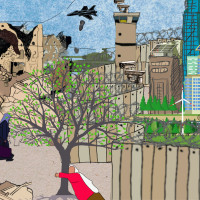
One class of climate reductionism that separates the protection or restoration of an abstract environment from people, is the growing interest in large-scale tree-planting schemes to supposedly respond to habitat loss, increase carbon sequestration, or protect soils. Tree-planting has, in some cases, fit perfectly within the intersection of the ecocidal and genocidal outcomes of eco-apartheid. The use of “trees as soldiers” to facilitate ethnic cleansing, as Rania Masri of the North Carolina Environmental Justice Network puts it when discussing Israel’s planting of trees in the West Bank, is one example. She argues that Israel plants trees to whitewash its crimes and to violently dispossess Palestinians of their generations-old plots, presenting itself as a ‘green’ saviour, even as the homogenous tree plantations it is creating become fodder for climate-induced wildfires. For instance, for decades initiatives of the Jewish National Fund (JNF) have involved planting trees atop depopulated Palestinian villages and using trees as a weapon to annex and enclose more land in the West Bank and the Naqab (Negev). This afforestation drive criminalises Palestinian residents and their diverse ecologies of carob, olive and fruit, replacing them with exotic European pines that demand significant groundwater, increase soil acidity (making it impossible to grow anything else) and immobilise and guard the territory from return by its dispossessed communities. Indeed, Avraham Duvdevani, who was JNF Chairman from 2020 to 2022, explicitly stated that the JNF’s aim with tree-planting was to “seize the open spaces near Bedouin settlements through afforestation, designed to block land takeover.” As Rania stresses: “the very ecological model of the Zionist project is one based on homogeneity, as much for the same tree as with their model of statehood and politics: one politic, one nation and we’ll erase everyone else.”
For Nadya Tannous, co-director of Honour the Earth and a leader in the Palestinian Youth Movement, the answer is “not to dismiss environmental movements”, which in many instances have been a powerful progressive force in the West and an entry point for young people angry at the violent neocolonial establishment and the impact this is having on their futures. Instead, she argues, we need to push the climate movement to adopt more anti-imperialist and internationalist currents. If we do not, we risk handing it over to ideologically liberal institutions who will use it to further strengthen their normalisation of the status quo, including through effects on the psyche and consciousness of young people.
Mainstream environmentalism’s take on progressive politics merely expands the diversity of the ecocidal and genocidal order, and increases acceptance of it, instead of doing something to change it. It distracts the population through consumption choices, diversifying the energy mix with renewables, and an obsession with promethean water and energy-intensive so-called “smart” technologies. Meanwhile, when people publicly pretend to care for, and have empathy towards, people and ecology, while at the same time doubling down on the violence of the military industrial complex, a particularly devious and deceptive form of fascism emerges, one that differs from outright fascism only in the fact that it does not openly and explicitly announce its racist, misogynist and violent rhetoric. Faced with this phenomenon it is of paramount importance that we present a strong liberatory framework that can cut through the myths of liberal environmentalism and climate reductionism.
While mainstream narratives continue to push for the isolation of climate issues and to exceptionalise the climate crisis as one of singular horror, we must emphasise the fact that the ecological dimension has often been a constitutive part of anti-colonial struggles, and that anti-imperialism must be the compass guiding our struggle. The end of the imperialist capitalist system will deliver justice, and that includes land justice and a transition towards more ecologically sustainable forms of living within planetary boundaries. On this point, Nadya Tannous of Honour the Earth gives the example of environmental leftists who condemn Morales' extractivism in Bolivia, without accounting for the country’s internal needs for development, and the protection of their national socialist project in the face of US military and economic imperialism. This means ensuring self-determination for the people to democratically decide how their “resources” will be used and in ways that are respectful and reciprocal to diverse relationships of people to their territories. Tannous stresses that “national liberation of Global South nations must be the north star” of our current movements. This does not imply defending the nation state, but rather defending liberation from colonial extraction, oppression and violence, as the first step towards building a world in which many worlds fit.
It is also the duty of social movements in the imperial core, including the Palestine movement, to understand that their own fight constitutes ecological resistance, and is one thread in the tapestry of freedom-making and liberation from ecocide and genocide. This does not involve reinventing the wheel. Ecological anti-imperialism is a rich and generative tradition that we must bring to the forefront of our movements and draw on in order to highlight the limitations and contradictions in liberal environmentalism. For example, Thomas Sankara, the revolutionary leader of Burkina Faso in the 1980s who was assassinated in a foreign-backed coup d’état, was a champion of political ecology. During his four years in power, he rolled out a feminist, socialist development programme that liberated millions from illiteracy, patriarchal customs, and medical underdevelopment. In an impassioned speech given at the First International Silva Conference on Trees and Forests in Paris in 1986, Sankara located the roots of the ecological crisis in imperialism, stating: “The struggle to defend the trees and forests is above all a struggle against imperialism. Because imperialism is the arsonist setting fire to our forests and savannas.” Unlike planting trees in order to dispossess others of their land, or to compensate for carbon releases taking place elsewhere, Sankara’s tree-planting schemes sought to protect the land from resource imperialism and racial capital, by applying embodied cultural knowledge of the territory involved.
There are other examples of liberation ecologies. One is the practices of Maroons, once-captive slaves who escaped from colonial plantations, who grew food and sustained their communities by drawing on the intimate relationships they had with the land. (Stennett, 2020) Another is guerilla warfare, which is a mainstay of many anti-colonial liberation wars, including by the Kurdish autonomous women’s army YPJ (women’s protection units) in Rojava who have pioneered a socialist people’s movement against capitalism, imperialism, and patriarchy. In guerilla warfare, the native fights on ecological terrain, using their knowledge of the territory to outsmart the settler, who is only capable of relating to the land as another objectified substrate to manage, manipulate or conquer. In Palestine, collective steadfastness involves maintaining the connection to the land, not for sentimental reasons alone but to assert one’s presence or existence (wujud) on the land, as a form of resistance in itself. (Taher, 2024) Even in the belly of the empire, the creation of social and solidarity economies that are outside the control of both the market and the state offer new environment-making possibilities. In all of these cases, the practice of asserting freedom collectively and outside of colonial and imperialist systems of oppression generates new ecological relationships that replenish and restore the conditions for life.
While acts of collective resistance can generate alternative ecologies that can liberate humanity and our non-human relations from the violence of the ‘sustainability’ solutions being sold to us, an anti-imperialist politic must also demand the rebirth of a united anti-war movement. Imperialism is nothing without militarism, as theorised by the late Arab Marxist Samir Amin, who said that imperialism walks on two legs: one economic (through a globalised neoliberal policy that is forced upon the countries of the world) and one political (including military interventions against those who resist). (Amin, 2017) Equally, the military industrial complex is one of the largest emitters, polluters, and drivers of climate change – a wasteful industry that produces no value vis-à-vis human life. Indeed, the Pentagon is the most carbon-intensive institution in the world, responsible for more annual emissions than most countries. (Crawford, 2022) As Ali Kadri emphasises, war is not an unintentional side product of capitalism; rather, the waste and destruction produced by war stimulates the capitalist economy, and, likewise, environmental degradation is the “structural waste” of capitalist imperialism. (Kadri, 2023) The US empire requires a constant state of war to reproduce itself and impose its interests on the populations of the Global South. Thus, the military industrial complex simply has no place in a future free from eco-apartheid. Understanding this is of crucial importance amidst climate and ecological breakdown because the capitalist “green” transition is also resource imperialist, prompting new wars of extraction. This is true not only in the Global South, but also in the North, where sacrifice zones for lithium and rare earth minerals extraction are created in areas where Indigenous and racialised populations live.
In parallel, we would add that one of the greatest ecological risks occurs when racialised and Indigenous people side with the oppressor to become ambassadors of the Euro-American colonising imaginary, and submit to the dominant cultural ideologies of individualism, meritocracy and a nihilistic attitude towards social transformation. Palestinian and post-colonial scholar Edward Said emphasized that the colonial mindset drives diasporic communities to permit oppression to drive them into becoming the oppressor themselves. White supremacy, which is necessary for planetary eco-apartheid to take shape, is increasingly being represented by diverse multicultural faces. Pulling the brakes on this demands an anti-imperialist anti-war movement that leverages cultural diversity to empower a shared humanity in its fight against the ecocidal and genocidal ravages of racial capitalism. At this juncture, in the face of impending catastrophe, ‘thinking ecologically’ cannot afford to involve anything less.
As the Covid pandemic showed, ecological crises will always be experienced through the very social processes that concentrate harm on poor and Indigenous peoples, who desperately require reparative justice, rather than once again being scapegoated as collateral damage. As Potawatomi scholar Kyle Powys Whyte claims, climate change only intensifies the effects of colonialism – expanding its violence to new populations across the planet. (Whyte, 2020) Unless colonial power is tackled, climate change can never be addressed. This bears repeating, and it has direct relevance to the obliteration of Gaza, which is supported by the same governments that are charged with addressing climate change, and which nimbly switch between false ‘green’ solutions and burning fossil fuels to line the pockets of venture capitalists and Big Tech firms, who bankroll arms shipments to the Zionist entity. If the constant bombardments, white phosphorus attacks, cultural erasure, and refined AI-targeted destruction of Gaza are ‘mirrors’ of an immediate future rooted in eco-apartheid, the liberation of Palestine is the north star in imagining reparative, ecological modes of living.
How so? First and foremost, the call to ‘Free Palestine’ reclaims the humanity of billions of people who are engaged in resistance, not only in Palestine, Lebanon and Yemen, but also elsewhere across the Global South, whose lives do count, as real human beings with values and dreams, imaginations, fears, joys, and flaws – equal to anyone in Western Europe, North America, Israel, Australia and the rest of the Western world. Reclaiming the humanity of this huge share of the world’s population is a bare minimum demand for a just and liveable world. The words and especially (in)actions of those who still need to be convinced of this basic truth of our shared humanity, and who continue to privilege some human lives over others, will forever be anti-ecological, no matter the nature of their climate analysis.
While the rise of solidarities across movements that put Palestine liberation at the heart and soul of their efforts is just beginning, this is a crucial first step that is absolutely necessary to prevent an eco-apartheid future. In spite of attempts to ignore the ICJ’s rulings, South Africa’s case against Israel at the court has sent shockwaves around the world. It is part of organized resistance against Israel’s genocide that has forgedglobal solidarities across working class and grassroots efforts in sometimes unexpected places, and across the North / South divide. These solidarities include dock workers in Belgium, Italy, Greece and India refusing to ship arms to Israel; consumers in Malaysia and Indonesia engaging in boycotts that have caused major financial losses for Western companies with ties to Israel; and students on university campuses around the world refusing to give an inch in their efforts to expose the hypocrisy of their institutions until their demands are met. Beyond these fronts, our challenge is connecting the struggles of brutalised workers across the world with the resistance of the Palestinian people against common systems which disregard life everywhere. Our challenge is organising workers from all domains to strike for Palestine, to prevent more shipments of arms and hard-earned tax dollars going to murder innocent people. It is this ecology of resistance that will liberate working people everywhere.
The Palestinian people and all colonised people will continue to resist the demolition of their homes, the occupation of their land, the redirection of rivers, the poisoning of soils, the killing of their non-human kin, the erasure of their cultures, and the genocide of their communities. This represents an existential truth: there is something deeply ingrained in the human spirit that refuses to be dominated perpetually. Facing the reality of our apocalyptic conditions does not mean that we have lost: rather, it gives us the vision we need to fight back. Make no mistake: resistance against imperialism and its Zionist proxy represents the strongest ecological force of our times. Building an anti-war, anti-imperialist and ecological mass movement is our duty, in order to extend the resistance of the Palestinians to all corners of the world. The coloniser believes that with enough brutalisation they can lock us into an indefinite state of repression, but history has always bent towards justice: not by chance, but as a result of the inevitable and relentless resistance of people against the forces of genocide, in pursuit of dignity for everyone on earth. The liberation of Palestine represents the linchpin of our collective survival in the face of ecological collapse; it is key to preventing an eco-apartheid future.
The opinions expressed in this article are solely those of the authors and do not necessarily reflect the views or positions of TNI.
References:
Amin, S. (2017). Contemporary imperialism. In Mapping a New World Order (pp. 181-195). Edward Elgar Publishing.
Crawford, N.C. (2022). The Pentagon, Climate Change, and War: Charting the Rise and Fall of U.S. Military Emissions. The MIT Press.
Fanning, A.L., and Hickel, J. (2023). Compensation for atmospheric appropriation. Nature Sustainability 6: 1077-1086.
Heron, K. (2024). Capitalist catastrophism and eco-apartheid. Geoforum 153: 103874.
Kadri, A. (2023). The Accumulation of Waste: A Political Economy of Systemic Destruction, Volume 3, Brill.
Longo, F. (2023). Decolonizing Conservation. In: Decolonizing Conservation: Global Voices for Indigenous Self-Determination, Land, and a World in Common. A Dawson, F. Longo, and Survival International (Eds.) Common Notions.
Reese, A.M., and Johnson, S.A. (2022). We All We Got: Urban Black Ecologies of Care and Mutual Aid. Environment and Society: Advances in Research 13: 27-42.
Seymour, R. (2024). Disaster Nationalism: The Downfall of Liberal Civilization. Verso, London.
Stennett, L. (2020). An exploration of agency within Maroon ecological praxis: Unearthing the histories of Maroon ecology in Jamaica and Brazil from 1630 to 1780. Decolonial Subversions: 99-119.
Sultana, F. (2022). The unbearable heaviness of climate coloniality. Political Geography 99: 102638.
Taher, T. (2024). Practicing wujud: A Constellation of sumud in the Fragmented Palestinian Present. Middle East Critique 33(2): 263-281.
The Red Nation (2011). The Red Deal: Indigenous Action to Save Our Earth. Common Notions.
Whyte, K.P. (2020). Chapter 4: Against crisis epistemology. In: Handbook of Critical Indigenous Studies (Eds: B. Hokowhitu, A. Moreton-Robinson, L. Tuhiwai-Smith, C. Andersen, and S. Larkin). Routledge.
Xu, C., Kohler, T.A., Lenton, T.M., Svenning, J-C., and Scheffer, M. (2020). "Future of the human climate niche." Proceedings of the National Academy of Sciences (PNAS) 117(21): 11350-11355.
Towards Palestinian Liberation
View the collection-
Publication date:

-
Introduction: The long and arduous road to a liberated Palestine Reclaiming anti-colonial resistance and solidarityPublication date:
-
Framing Palestine Israel, the Gulf states, and American power in the Middle EastPublication date:
-
Palestine in a world of struggle The role of Palestinians in Third World solidarityPublication date:

-
Sustainability fantasies/genocidal realities Palestine against an eco-apartheid worldPublication date:
-
Out-Organise the Enemy! Eqbal Ahmad and the liberation of PalestinePublication date:

-
African attitudes to, and solidarity with, Palestine From the 1940s to Israel’s Genocide in GazaPublication date:
-
Failing Palestine by failing the Sudanese Revolution Lessons from the intersections of Sudan and Palestine in politics, media and organisingPublication date:
-
“The condition for freedom is for the Egyptian masses to take to the streets” Egypt’s centrality in the struggle for PalestinePublication date:
-
Vietnam, Algeria, Palestine Passing on the torch of the anti-colonial strugglePublication date:
-
From Global Anti-Imperialism to the Dandelion Fighters China’s Solidarity with Palestine from 1950 to 2024Publication date:
-
India, Israel, Palestine New equations demand new solidaritiesPublication date:
-
Yalla, Yalla, Abya Yala Reaching out to Palestine from Latin America in times of genocidePublication date:
-
From the Favelas and Rural Brazil to Gaza How militarism and greenwashing shape solidarity with Palestine and resistance in BrazilPublication date:
-
From Turtle Island to Palestine Resisting settler colonialism and genocidePublication date:

-
Publication date:


Credits
Vijay Kolinjivadi is a professor teaching community economic development. He is also a writer and researcher of political ecology and ecological economics. He is based in Tio'tià:ke (or Montreal).
Asmaa Ashraf works in community energy, and is a writer and researcher of political ecology. She is also an organiser based in London within both the Palestine and climate movements.
Copy-edited by Ashley Inglis
More like this
-
Framing Palestine Israel, the Gulf states, and American power in the Middle EastPublication date:
-
African attitudes to, and solidarity with, Palestine From the 1940s to Israel’s Genocide in GazaPublication date:
-
Failing Palestine by failing the Sudanese Revolution Lessons from the intersections of Sudan and Palestine in politics, media and organisingPublication date: