
There’s More to Oil Why Venezuela Demands a Deeper Analysis of US Imperialism
Topics
Regions
The slogan “No Blood for Oil” has echoed through anti-war demonstrations for decades, crystallising a powerful intuition about capitalist imperialism: that great powers wage war for resource control. Trump’s seizure of Nicolás Maduro invites the familiar framing. Yet the logic unfolding in Venezuela reveals something more complicated than straightforward resource extraction. Understanding it requires moving beyond the twentieth-century narrative of crude-seeking colonialism that still dominates left analysis of global politics and economics.
Article by

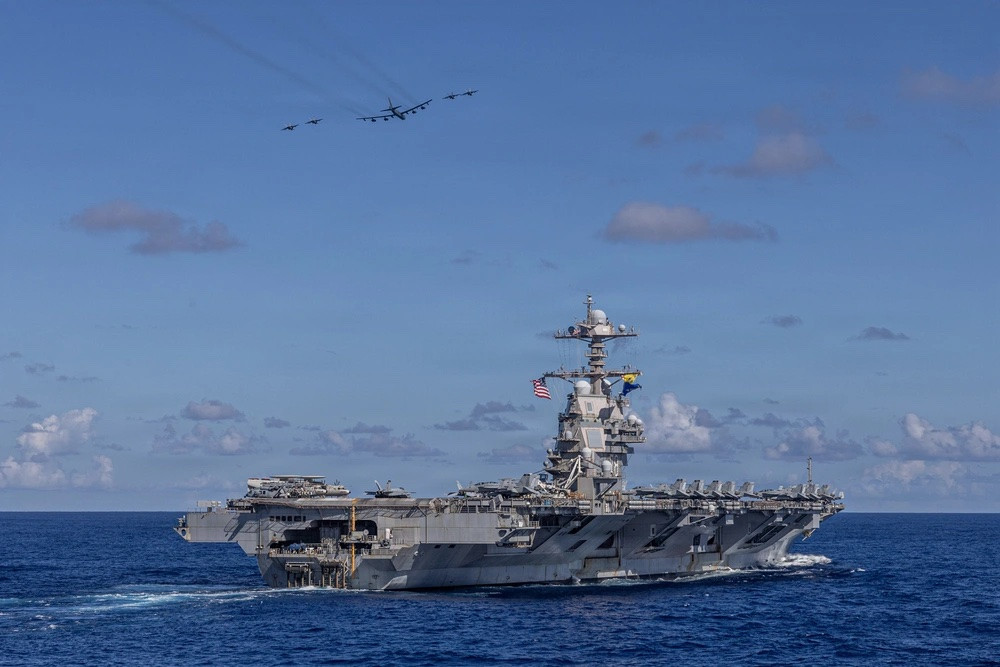
Photo: U.S. Navy / Department of Defense (public domain).
Marco Rubio stripped away the ambiguity. Speaking to NBC News, he declared: “We will not allow the oil industry in Venezuela to be controlled by opponents of the United States.” He named China, Russia, and Iran. The Western Hemisphere, he insisted, “belongs to us.” This is geopolitical containment language. Venezuela matters because it has become one of Beijing’s “all-weather strategic partners” in Latin America – a phrase Washington has come to regard as a regional challenge to its authority. China has extended roughly $106 billion in loans to Venezuela since 2000, placing it fourth among recipients of Chinese official credit globally. That financial binding and China’s growing influence in the region are what the US operation targets, not the oil itself.
The material reality of Venezuelan crude further complicates any straightforward extraction narrative. Three-quarters of the 300 billion barrel reserve consists of extra-heavy Orinoco crude: bituminous, viscous, heavily sulphurous, and prohibitively expensive to extract and refine. Global oil majors built the US Gulf Coast’s complex refineries specifically to process this grade, but at realistic long-term prices, the economics are punishing. When oil prices peaked during 2005-2014, Venezuela inflated its “proved reserves” on paper through optimistic assumptions that have since collapsed. Today, with institutional capacity eroded by underinvestment and purges, reconstruction would demand $185 billion over 16 years and complete confidence from international capital, unlikely under any managed transition.
The arbitration claims by ExxonMobil and ConocoPhillips, now presumably to be weaponised by Washington, add layers of legal and financial complexity. These cases rest on $45 billion in damages for contract restructuring around 2000, despite congressional conditions that unambiguously reserved Venezuela’s sovereign rights and rendered the corporate legal position indefensible. Trump’s invocation of “stolen American oil” resurrects private loss as state policy.
What matters is supply diversion and forcing Beijing to compete for alternative sources at disadvantageous terms. Currently, Venezuela exports roughly 600,000 barrels daily to China; US refineries consumed 2 million daily in the late 1990s. Even now, Venezuelan crude accounts for less than 4 per cent of China’s total oil consumption. Redirecting supply chains would force Beijing to source crude elsewhere at higher prices during an era when both superpowers compete for energy cheapness as the foundation of industrial competitiveness. This is Trump’s gambit: not extracting Venezuelan wealth but denying it to a strategic rival whilst simultaneously strengthening the US refineries concentrated in politically loyal states: an industry supporting 3 million jobs despite employing only 80,000 directly. The refinery sector has the highest employment multiplier of any US industry: each direct job supports forty-five others.
The old anti-imperialist critique captures something real but remains incomplete. Resource imperialism remains a persistent feature of global capitalism rather than a relic of the past, but Venezuela’s contemporary fate stems less from straightforward resource hunger than from geopolitical subordination within a fragmented multipolar system where control over resource flows matters as much as extraction itself. A hegemon no longer capable of competing through financial leverage reaches for direct military coercion instead. That this violence comes wrapped in claims about hemispheric property rights and restoring national assets shows how imperialism adapts rather than disappears. Understanding it demands analysis grasping the intersection of strategic competition, financial leverage, and institutional collapse, not simply equations of blood and barrels.
Washington sends a message: the Western Hemisphere remains its sphere, rivals will pay for any foothold, and authority matters more than economics. That the message requires bombing and kidnapping reveals its underlying fragility.
Credits
Authors
Daniel Chavez, a Uruguayan political economist, is an Ikerbasque Distinguished Professor at the University of the Basque Country (UPV-EHU). He is an associate of the Transnational Institute (TNI) in Amsterdam and Principal Investigator of the ERC Advanced Grant project S-OIL, which investigates the future of petroleum-dependent countries in the Global South.
More like this
