
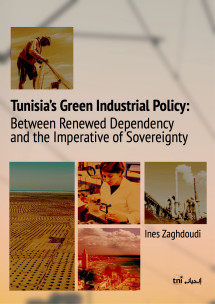
Tunisia’s Green Industrial Policy Between Renewed Dependency and the Imperative of Sovereignty
This report takes a critical look at Tunisia’s green transition. Despite its renewable potential, the current model risks reproducing extractive dynamics and external dependency, putting sovereignty, social justice, and the promise of a truly “just” transition at stake.
Download PDF
Authors
Synopsis
In an international context marked by increasing geopolitical competition, particularly over the resources needed to meet the challenges of the climate crisis, the ecological transition represents both a strategic opportunity and a potential pitfall for Tunisia. The country has been committed to the ‘green transition’ since the ratification of international agreements and the launch of national programmes such as the Tunisian Solar Plan and the National Sustainable Development Strategy. Tunisia is therefore a crucial case study for analysing the contradictions of the green transition. While the green transition is presented as an opportunity for development and resilience to climate change, structural barriers continue to block its development potential, particularly as Tunisian industry is largely based on extraction and assembly, and is only peripherally integrated into global value chains.
Faced with the rivalry of major powers vying for control of green supply chains, countries such as Tunisia are in a unique position: they are economically dependent; yet they are also rich in renewable energy potential. They are attempting to leverage this advantage to forge a path in this globalised energy transition. But they risk reproducing the same extractivist and unequal exchange patterns that have been the hallmarks of development within the hegemonic logic of globalised capitalism.
Green industrial policies can have a significant impact on this process, but the transition to green industrialisation raises many questions and concerns, particularly around the fundamental contradiction between ecological imperatives and the very logic underpinning the capitalist system. While international agreements such as the Paris Climate Agreement endorse green industrial policies, the latter are often based on a market-driven and technocratic view of the crisis, which primarily promotes private investment and the use of market instruments.
Analysis of historical dynamics in Tunisia shows an alarming inability to break away from its subordinate position in the global economy. The industrial policy of the 1960s, implemented under the banner of economic planning, failed to foster industrialisation in a way that would have enabled the country to achieve its development objectives and escape from the pattern of economic dependence established during colonisation. Moreover, the shift to economic liberalization and the emergence of an export-oriented model in the 1970s exacerbated these dynamics. The tension within Tunisia’s socio-economic fabric, between legitimate demands for social development and the doctrine of competitiveness required to meet external market objectives, has only worsened this situation.
In the 1980s, the implementation of the IMF-imposed Structural Adjustment Programme pressured Tunisia to gradually liberalise its economy and privatise some of its public enterprises. Thus, Tunisia was compelled to pursue a neocolonial scheme whereby the state structurally disengaged from the productive economy in order to create an environment favourable to (private) capital’s drive for accumulation. The liberalisation of the economy to the exigencies of the external market accelerated after Tunisia joined the World Trade Organization and the Euro-Mediterranean Partnership (often called the Barcelona Process) and signed an Association Agreement with the EU, all in 1995.
The green policy framework currently being developed reproduces the same structural faults: various national strategies have been tailored to meet the demands of the European market rather than local needs. These strategies promote the liberalisation of the energy sector and the granting of disproportionate tax breaks to international investors.
This study examines the structural dependencies established under colonialism and their ramifications on so-called green industrial policies. Far from representing a paradigm shift and a break with the past, the green transition currently appears to be a greenwashing strategy for the export-oriented, extractivist model of development that has characterised the Tunisian landscape since independence.
The export-oriented industrial policy has shaped an industrial fabric that prioritises specialising in low value-added activities at the upstream end of global value chains.Tunisian industry is therefore highly vulnerable and heavily dependent on foreign investment and European markets, mainly France, Italy, Germany and Spain.
The state’s role in the industrialisation process has been to strengthen its ties with the private sector and the market, particularly through economic partnerships such as free trade agreements with the European Union. These agreements open up Tunisian markets to foreign products while limiting the country’s ability to protect and develop its local industries. This model perpetuates economic and technological dependence, a key feature of peripheral capitalism.
The industrial sector accounts for approximately 24% of the country’s total energy demand, making it one of the most energy-intensive sectors. It therefore became the target of policies promoting energy efficiency and the use of renewable energies. This has led to changes in legislation at national and international levels, notably through the ratification of international agreements focused on reducing greenhouse gas emissions.
These legislative reforms primarily promote the gradual liberalisation of the industrial and energy sectors. New laws have been adopted to encourage private (and especially foreign) investment. Embedded within a process of market liberalisation that reflects the significant influence of international donors (the European Union, the World Bank, and the German development agency GIZ), these new laws have steered reforms toward a neoliberal model at the expense of Tunisia’s energy sovereignty.
While the legal framework has enabled modest progress in the use of renewable energies, it continues to reinforce an extractivist model in which the energy transition serves the interests of international capital over those of the Tunisian people.
Green industry appears to be one of the pillars of the industrial strategy Horizon 2035, whose objectives focus on renewable energy production, greenhouse gas mitigation and the development of a circular economy. However, these objectives are often vaguely formulated. The concrete means required for their implementation are largely absent, while exports to European markets and compliance with European standards remain at the core of the strategy.
These dynamics are particularly discernible in the green hydrogen project in Gabès. While the project is presented as an opportunity for development, in reality, it relies on debt. It is a new form of extractivism based on water and land grabbing, which does not have any significant positive impacts on the local communities it purportedly serves and reproduces the same patterns of technological dependence. This green neocolonialism illustrates how such an ecological transition is bound to perpetuate North–South relations of domination under an ecological veneer. Behind this greenwashing, Tunisia remains tied to imperialist centres as a supplier of raw materials (solar energy, green hydrogen) and as a market for their conditional investments, which both profit from these natural resources and exploit workers.
The ‘just transition’ referred to in official documents therefore seems far removed from reality. The demands of local communities are sidelined in favour of environmentally destructive capitalist accumulation. Tunisia’s ability to define its own path to development, one premised on social justice, ecological restoration and productive autonomy, will be the ultimate act of resilience in the face of climate and geopolitical crises. Urgent political action is needed to regain democratic control over decision-making in the industrial sector to prevent the green transition from becoming a new mask for dependency.
Credits
Editors
Translators
Reviewers: Hamza Ibrahim, Hamza Hamouchene and Walid Besbes
Proofreading: Meriam Mabrouk
Layout & Design: shfra.co studio
Download PDF
More like this
-
Green Industrialisation in Morocco High Aspirations, Enduring ConstraintsPublication date:
-
Back to the Future Nyerere's Vision of Industrial Development and its Lessons for the Contemporary Global SouthPublication date:
-
Industrial Politics from Below Reclaiming Industrialization as a Liberation Agenda in Indonesia and BeyondPublication date:
-
Critical Raw Minerals in Morocco An opportunity for industrialisation or a geopolitical battlefield between China and the West?Publication date:
-
Green hydrogen in Tunisia A new mechanism of plunder and exploitationPublication date: