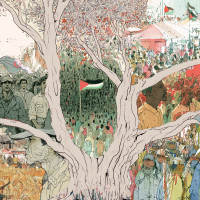
From the Favelas and Rural Brazil to Gaza How militarism and greenwashing shape solidarity with Palestine and resistance in Brazil
Topics
Brazil’s solidarity movements have long supported Palestine, but economic and military ties with Israel continue to deepen. As Brazil prepares to host COP30, grassroots campaigns are exposing links between Israeli militarism and domestic inequality, agribusiness, and state violence. This moment offers a key opportunity to strengthen Boycott, Divestment and Sanctions (BDS) efforts.

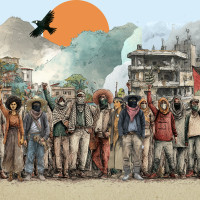
Illustration by Fourate Chahal El Rekaby
Introduction
Brazilian civil society and social movements have had solidarity with Palestine on their agenda for many decades but the last 10 years have seen a substantial increase in demands for boycott, divestment and sanctions (BDS), answering the 2005 BDS call from Palestinian civil society.
From 2003 to 2016, Brazil was governed by the left-wing Workers’ Party (Partido dos Trabalhadores (PT)). Following the impeachment of President Dilma Rousseff in 2016, Michel Temer served as president until the far-right Jair Bolsonaro took office in 2019. Under the PT government, Brazil formally recognised the State of Palestine in 2010, and it has frequently condemned Israeli military actions. Nevertheless, over the past two decades, policy on this issue has become increasingly unstable, swinging between principled affirmations of solidarity with Palestine and deepening political and economic ties with the Israeli regime. Even under PT, but especially under Bolsonaro’s government, Brazil expanded its procurement of weapons from Israel, continued exporting oil to the apartheid state, and deepened agribusiness trade with it – all of which has contributed to sustaining the infrastructure of Israeli occupation (Nakamura, 2024).
For decades, the Brazilian military–industrial complex, agribusiness, right-wing politicians and evangelical–Zionist lobby blocs have aligned to promote deeper ties between Brazil and Israel. Together, they normalise commerce with Israel under the guise of promoting technological partnerships and climate-friendly agriculture, thereby whitewashing the Israeli regime’s crimes.
This apparent contradiction between espoused solidarity with Palestine and increasing economic ties with the Israeli regime is not exclusive to Brazil. In fact, very few countries in the world have committed to cutting – or even reducing – commercial ties with Israel. This has continued to be the case even after the widespread recognition of its apartheid regime1 and the advisory opinions of the International Court of Justice (ICJ) of 2004, 2024 and 2025. In particular, the 2024 opinion was supported by the vast majority of the world’s countries (including Brazil) in a United Nations General Assembly resolution in September 2024.2
Solidarity movements in Brazil – such as those rooted in the favelas3, movements for urban housing, the rural landless, climate justice and people adversely affected by corporations, as well as student unions and trade unions – have implemented important campaigns linking Israel’s militarism to Brazil’s own state violence, environmental plunder, and agrarian extractivism. Since the beginning of the livestreamed genocide in Gaza and the rapid expansion of Israeli settlements and crimes in the West Bank the need to expose these ties of complicity, and to show how Israeli–Brazilian relations impact marginalised groups in Brazil, is more urgent than ever.
In particular, there is a need to confront ‘greenwashing’ linkages between Israeli agricultural technology (agritech) / water companies and extractivist agendas in Latin America. Such work must involve building concrete solidarity with Palestine, connecting multiple struggles, and leveraging resistance on the ground. The Peoples’ Summit is a grassroots forum for such solidarity and organising.4
This article analyses the main ties between Brazil and Israel, and how they connect to struggles in Brazil. It also analyses some of the victories achieved by pro-Palestine campaigns, and the challenges that hold back further advances, including efforts to move from words to greater action in solidarity with Palestine.
The article is structured as follows. After this introduction, the next section explores relations between Brazil and Israel, providing some historical context and setting out the countries’ military cooperation, agribusiness deals, oil trade, and diplomatic postures – especially over the past 20 years. The following section then examines how resistance and solidarity with Palestine, specifically BDS, has developed in Brazil over the last decade. The next section discusses the challenges currently faced in pro-Palestine solidarity, while the penultimate section discusses how to overcome these challenges, including priority targets and a promising path forward. The article ends with a short conclusion.
Throughout the text, the article applies the critical approach of ‘international law from below’ (Rajagopal, 2005), according to which political mobilisation is essential for the advance and enforcement of international law.

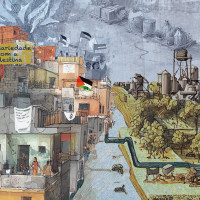
Illustration by Fourate Chahal El Rekaby
Brazil’s Military, Economic and Diplomatic Relations with Israel
Since the mid-20th century, Brazil’s relationship with Israel has combined symbolic alignment with pragmatic cooperation. In 1947, the Brazilian diplomat Oswaldo Aranha, presiding over the UN General Assembly, played a pivotal procedural and political role in advancing the Partition Plan for Palestine (UN Resolution 181). Contemporary accounts and later reconstructions credit Aranha with postponing the vote in order to consolidate a two-thirds majority in favour of the plan, and actively lobbying delegations, actions for which he was publicly honoured in Israel in subsequent decades (JTA, 2017). His prominence at the UN imprinted an early association between Brazilian diplomacy and the international legitimation of Israel’s statehood.
During the early 1960s, under Brazil’s leftist President João Goulart, bilateral ties were cordial but utilitarian, shaped less by ideological convergence than by multilateral calculations and the desire for technical cooperation. The military dictatorship (1964–1985) inaugurated a more overt security and techno-scientific alignment. Archival materials cited by investigative reports indicate cosy ties between Israel and Brazil’s junta during this period, including arms sales, the exchange of military expertise, and early nuclear cooperation. One agreement between the two countries was reportedly entered into on 10 August 1964, just four months after the coup, and further agreements followed in 1966, 1967 and 1974 (Mack, 2018). While these sources do not demonstrate any Israeli involvement in, or orchestration of, the coup itself, they indicate a rapid post-coup alignment of the two countries, based primarily around shared interests relating to security and the development of nuclear capabilities, consistent with the dictatorship’s broader pursuit of strategic technologies. The result of this alignment was a pattern in which Brazil’s regime leveraged Israeli defence and scientific ties while simultaneously deepening a larger nuclear partnership with West Germany (1975) and maintaining an opaque, parallel nuclear programme that extended beyond the end of the military dictatorship through to the early 1990s (Arms Control Association, 2006; World Nuclear Association, 2025).
In the democratic era (from 1985 onwards), Brazil has alternated between symbolic support for Palestinian rights (e.g. through recognition of the State of Palestine and in other diplomatic positions) and continued pragmatic ties with Israel in trade, security and technology. A longue durée perspective thus reveals a dual track: a foundational Brazilian role in the international legitimation of Israel’s statehood in 1947 and, decades later, post-coup cooperation that embedded Israeli expertise within Brazil’s authoritarian modernisation.
Notwithstanding this overarching picture, Brazil’s diplomatic relations with Israel have shifted notably depending on which administration was in power – although only very recently have those relations been effectively downgraded. For example, during the first decade of the 2000s, Latin America as a whole witnessed a notable reconfiguration of its foreign policy orientation towards the Israeli–Palestinian ‘issue’. This shift was largely influenced by the electoral rise of left- and centre-left governments across Latin America in what is called the ‘pink tide’, which saw a reaction against the Washington Consensus (Lucena, 2022) as well as a consolidation of South–South economic and political relations, with the emergence of BRICS and what has frequently been termed Brazil’s ‘active and assertive foreign policy’. These developments fostered attempts to assert greater autonomy vis-à-vis the United States, and encouraged the diversification of international partnerships. Within this context, engagement with the Palestinian cause became, for many Latin American governments, a strategic instrument of international positioning (Baeza, 2012).
Despite this general tendency towards expanded support for Palestinian rights, however, most Latin American states – particularly the larger economies, such as Brazil, Argentina and Mexico – continued to frame their positions in terms of balance. Expressions of solidarity with Palestine were frequently accompanied by affirmations of Israel’s right to security, revealing a dual strategy of symbolic recognition and pragmatic diplomacy (Baeza, 2012). For example, the wave of recognitions of the State of Palestine from December 2010 to March 2011, which represented a regional trend towards formal acknowledgement of Palestinian sovereignty, were frequently articulated within a discourse that emphasised ‘balance’ and the promotion of ‘peace’, rather than being accompanied by overt sanctions against, or criticism of, Israel (Baeza, 2012).
Brazil under Lula was a particularly striking example of this ‘balanced’ approach. As an emerging power with ambitions of exercising global influence, during Lula’s first and second administrations (2003–2010) Brazil sought to project diplomatic leadership in relation to the Middle East, and Lula’s government demonstrated unprecedented sensitivity to Palestinian concerns, culminating in Brazil’s recognition of the State of Palestine in December 2010. However, while Venezuela and Bolivia opted for open confrontation through the suspension of relations with Israel in 2009, Lula’s Brazil led the majority of Latin American countries in pursuing a policy that simultaneously advanced Palestinian recognition and preserved bilateral ties with Israel (Baeza, 2012).
This policy was interrupted during Jair Bolsonaro’s presidency, when Brazil aligned openly with Israel: it opened a trade office in Jerusalem in 2019, considered moving its embassy from Tel Aviv to Jerusalem (though it did not do so in the end), and joined the Israel Allies Caucus5. This posture intensified Brazil’s ideological alignment with conservative evangelicals and business elites (Huberman, 2024).
Under Lula’s third mandate, which began in 2023, Brazil returned to its former policies. During the opening of the UN General Assembly in that year, Lula talked about the importance of solving “the Palestinian issue” and the “recognition of a viable and independent Palestinian state”, but Brazil continued its diplomatic relations with Israel and resisted recognising it as an apartheid regime. However, after the beginning of the genocide in October 2023, the Lula government increased its criticism of Israeli military operations. In February 2024, at the African Union summit in Addis Ababa, Lula compared Israeli conduct in Gaza to the Nazi genocide. Israel responded by declaring Lula persona non grata, and Brazil promptly recalled its ambassador from Israel and downgraded diplomatic relations by refusing to formally accept Israel’s appointment of a new ambassador to Brasília (MercoPress, 2023). Official statements since the start of the genocide have emphasised Brazil’s continued support for Palestinian statehood and international law, and have demonstrated increased criticism of the Netanyahu government. However, they have also sought to disassociate the current Israeli government from the Israeli state itself, and Brazil has kept commercial and military ties largely intact.
Importantly, despite the genocide, the economic ties between Brazil and Israel have, with some exceptions, continued to follow the pattern established in earlier decades. From the early 2000s onwards, Brazil and Israel deepened their economic relations. In 2007, under Lula’s presidency, Brazil led Mercosur’s6 signing of a Free Trade Agreement (FTA) with Israel. The statement explaining the reasons for the decree that approved the FTA states that in 2007, commercial exchange between Brazil and Israel had reached 1 billion reais (around $200 million), a 30 per cent increase on the 2006 figure (Brasil, Congresso Nacional, 2009). The main products Brazil was exporting to Israel at the time were meat, soy and fuel additives, while the main imports were fertilisers and agrochemicals (Brasil, Congresso Nacional, 2009).
The agribusiness sector and the oil sector are the biggest beneficiaries of Brazil–Israel trade relations. Data shows that they play a critical role in sustaining Brazil’s relations with Israel, regardless of who is in charge. Perhaps not coincidentally, these two sectors are also responsible for many violations of the human and environmental rights of populations in Brazil’s countryside (Articulação para o Monitoramento dos Direitos Humanos no Brasil [AMDH], 2025). Moreover, they are also big supporters of far-right politicians in Brazil.
The alignment between the agribusiness and oil sectors, far-right Brazilian politicians, and Israel, is revealed in recent data that shows that from 2019 to 2022 (the period of Bolsonaro’s government), exports to Israel in these two sectors increased year on year, going from $371 million to $1.8 billion (MDIC, n.d.). In 2023, the amount decreased, to around $662 million,7 of which 21 per cent represented crude oil, 19 per cent beef and 18 per cent soy (Nakamura, 2024). However, even after the return of Lula, Brazil’s oil exports to Israel in 2024 made it one of the country’s biggest suppliers (Lakhani and Niranjan, 2024), responsible for 9 per cent of the crude oil Israel received in that year, not counting derivative products.
In regard to Israeli imports to Brazil, these are dominated by fertilisers and agritech, with Israel being one of Brazil’s biggest suppliers of these products (Pligher, 2023). In 2023, Brazil imported around $1.4 billion of these products, of which 45 per cent were fertilisers and 11 per cent pesticides, mainly from the Israeli companies Haifa Group and Adama (Nakamura, 2024). In addition to agrichemicals, Brazil also imports Israeli agritech, such as drones that are used to operate fertilisation and irrigation systems. This technology comes mainly from Haifa Group, Adama and Netafim.
It is important to highlight here the role these and other agritech companies play in Israeli ‘greenwashing’. This term refers to Israel’s strategic use of environmental language and rhetoric to conceal or legitimise its practices of settler colonialism, occupation and dispossession (Who Profits Research Center, 2020). In the greenwashing narrative advanced by these corporations, Israel is presented as a global leader in sustainability and innovation, while the real ecological harm and systematic human rights violations these companies and the Israeli state perpetrate against Palestinians and their environment is deliberately hidden (Who Profits Research Center, 2024). In particular, the Israeli agribusiness sector propagates the myth of Zionist colonisers in Palestine ‘making the desert bloom’, marketing its irrigation technologies and desert agriculture as global solutions to climate change and food insecurity, while erasing the historical displacement of Palestinian farmers and the ecological destruction caused by settlement expansion (Who Profits Research Center, 2020).
The aforementioned Adama and Netafim, with their significant exports to Brazil, are two of Israel’s largest agribusiness corporations and play a central role in the country’s greenwashing strategies. Netafim, widely recognised for pioneering drip irrigation technologies, markets itself as a provider of solutions to global water scarcity and climate challenges. Its branding emphasises efficiency, sustainability, and food security, projecting an image of environmental responsibility. However, the company’s operations in occupied Palestine, where it provides irrigation systems to illegal Israeli settlements in the West Bank that benefit from what has been described as ‘water apartheid’ (B’Tselem, 2023), reveal a stark contrast with this branding. By showcasing its technologies as environmentally sustainable innovations, Netafim obscures the material reality of dispossession and the reallocation of water resources away from Palestinian communities. B’Tselem reports that Israelis, including settlers, use an average of 247 litres of water per person per day, compared with 82.4 litres for Palestinians in the West Bank and 26 litres in Palestinian communities not connected to the water grid (B’Tselem, 2023).
Netafim’s global reputation as an environmental innovator thus functions as a shield against scrutiny of its complicity in settler colonial expansion (Who Profits Research Center, 2020). Adama, one of the world’s leading agrochemical producers, is similarly implicated in greenwashing dynamics. The company promotes its portfolio of crop protection products, fertilisers, and pest management systems as tools for sustainable agriculture that improve yields while minimising environmental damage. Yet Adama’s activities are closely tied to the broader agribusiness model in Israel, which relies on land appropriation, intensive monoculture, and the marginalisation of Palestinian agricultural practices (Who Profits Research Center, 2020). Moreover, the company benefits from the Israeli state’s international branding strategy, which markets Israeli agribusiness as a form of climate-smart agriculture that can be exported worldwide. This particularly affects communities in the Global South (GRAIN, 2022), where the narrative of sustainability effectively masks the ecological costs of heavy chemical use, soil degradation, and the displacement of local farming systems.
Taken together, Netafim and Adama exemplify how Israeli agribusiness corporations deploy green branding to naturalise and legitimise structures of dispossession and colonial expansion. Their global reputation as pioneers in sustainable agriculture helps integrate Israel into international development agendas, climate adaptation strategies, and food security programmes – including in spaces like the Conferences of the Parties (COPs) (GRAIN, 2022).
Another well-known example of Israeli greenwashing is the state-owned Israeli company Mekorot, which exports expertise in desalination and irrigation, while simultaneously engaging in water apartheid: the diversion of Palestinian water resources to Israeli settlements, the restriction of Palestinian access to clean water, and the use of water scarcity as a form of political control (PENGON – Palestinian Environmental NGOs Network, 2021). Although Mekorot has so far been unsuccessful in entering the Brazilian market, thanks to campaigns against it (addressed below), the company has a strong presence in other parts of Latin America and in Africa (PENGON – Palestinian Environmental NGOs Network, 2024).
It is important to draw attention here to another link between Israel’s human rights abuses and Brazilian agribusiness: Israel’s export of drones for use in that sector. While there is no evidence of military or repressive use of drones in Brazil up to now, the presence of Israeli drones in Brazilian agribusiness should raise alarm bells since agribusiness companies in Brazil are engaged in subduing small producers, peasants, traditional communities and Indigenous peoples, including through dispossession, contamination by pesticides and fertilisers, and even physical and psychological violence (Articulação para o Monitoramento dos Direitos Humanos no Brasil [AMDH], 2025). Moreover, the purchase of these dual-use products further integrates Israeli military technologies within the global green economy, thereby advancing the normalisation of the Israeli arms industry. While, as stated above, the two biggest sectors for Brazil–Israel trade are agribusiness and oil, Brazil and Israel also engage in significant trade relating to the military–industrial complex.
This takes the form of both imports from, and exports to, Israel, as well as investment by Israeli military companies in the Brazilian military sector. In regard to the former, Brazil increased its imports of Israeli arms between 2010 and 2019, receiving jets, drones, missiles, and command systems. While data on military purchases is not easy to find, official figures indicate that in 2024, Brazil spent at least $167 million on military machinery, arms and ammunition from Israel. The actual amount is probably much higher because these figures do not include purchases by states and municipalities, because many contracts are classified, and because dual-use equipment is recorded under other categories (Trading Economics, 2025). Nevertheless, even according to these official figures, military machinery, nuclear reactors, and boilers constituted the third largest category of purchases from Israel in 2024, after agrichemicals and plastics products.
It is important to note here that the amount of military–industrial imports from Israel to Brazil would have been even higher in 2024 were it not for grassroots pressure against this trade. In 2024, in the middle of the genocide and after President Lula’s recognition that genocide was indeed taking place, the Brazilian Army initiated negotiations for a deal worth $150–200 million for the purchase of 36 ATMOS self-propelled howitzers from Elbit Systems, one of the most important – if not the most important – Israeli exporters of military technology (Azulay, 2024). This was in spite of escalating political tensions in Brazil around the issue, with civil society and allies pressuring for an embargo and sanctions on Israel. Ultimately, the campaign against Israeli arms imports achieved coverage in the mainstream media and at the end of 2024, the government decided against signing the proposed Elbit contract.
The arms trade between Brazil and Israel is not a one-way street: Brazil also exports to the Israeli military sector, producing supplies for Israel’s biggest industries, while Brazilian companies also often have financial and ownership ties with Israeli arms companies. For example, AEL Sistemas, a military manufacturer located in Porto Alegre in the south of Brazil, is currently a subsidiary of Elbit Systems (AEL Sistemas, 2025). AEL produces Brazilian defence equipment using Israeli technology, with support from the federal government and other public agencies, and exports military parts to Israel (Brasil de Fato, 2023a). Moreover, Elbit became a stronger partner of Brazil’s military establishment through another joint subsidiary, Ares Aeroespacial e Defesa in Rio de Janeiro State (Ares, 2019), which from 2017 has manufactured remote-controlled weapons stations for the Brazilian Army using Elbit technology (Azulay, 2024).
Other areas of Brazilian industry also have ties to the Israeli military sector. In 2025, reporters and social movements in Brazil denounced the fact that Brazilian steel was being exported to Israeli Military Industries (IMI), an Israeli company that is connected to Elbit, to be used in manufacturing weapons (The Intercept Brasil, 2025). Solidarity groups publicised shipping documents indicating that roughly 56–60 tonnes of steel bars were scheduled to depart the Port of Santos for Haifa in early September 2025, framed as ‘dual-use’ inputs with potential downstream incorporation in Israel’s military–industrial supply chain (Chade, 2025). Those disclosures catalysed protests in Santos and Rio de Janeiro and calls for administrative intervention to halt the shipment (including actions by media and union platforms along São Paulo’s coast). Journalists highlighted that steel was among Brazil’s top 10 exports to Israel in 2024, with this trend continuing in 2025 (Sindipetro-LP, 2025).
Another relevant export from Brazil to the Israeli military sector is oil. As stated above, a 2024 investigation revealed that Brazil accounted for roughly 9 per cent of the total crude oil supplied to Israel between October 2023 and July 2024, including tankers that departed after the ICJ’s genocide ruling in February 2024 (Lakhani and Niranjan, 2024). During the Bolsonaro administration (2019–2022), oil exports to Israel had increased, peaking in 2022 at $1.07 billion (Trading Economics, 2025), but even under Lula’s presidency, oil shipments to Israel have largely continued. According to the Brazilian National Agency of Petroleum (ANP), oil exports to Israel increased by 51 per cent in 2024 compared to 2023. The main companies involved are Shell and Petrobrás (the Brazilian state oil company) (Forgerini, 2025).
For Palestinian solidarity networks and Brazilian social movements, these oil flows have become a focal point of campaigning. The biggest federations of trade unions representing oil workers, the Federação Única dos Petroleiros (FUP) and the Federação Nacional dos Petroleiros (FNP), issued statements in May 2025 calling for the suspension of oil exports to Israel in light of its military actions in Gaza. These mobilisations frame oil as a material link between Brazilian resources and the perpetuation of Israeli war crimes, arguing that the continued trade undermines Brazil’s human rights commitments and its constitutional principles of promoting peace and self-determination (FNP and FUP, 2025). This campaign has brought together the BDS movement, unions and other civil society actors. As at the time of writing (October 2025), it appears that the amount of exports of crude oil and derivative products exported to Israel has diminished significantly. Nevertheless, there are suspicions that indirect and triangled exports (ship-to-ship operations in intermediary countries before final destination) may still be happening, so demands for an official embargo, and for the Brazilian state to adhere to a principled trade policy, continue (Opera Mundi, 2025).
The suspension of the purchase of Elbit howitzers referred to above is one sign of a recent change in the government’s attitude towards Israeli arms imports. Another is the chancellor’s announcement in August 2025 that Brazil is studying the possibility of prohibiting exports of military materials to Israel. Nonetheless, the Brazilian government has so far neither reversed major military or agribusiness agreements with Israel, nor withdrawn from major frameworks like the Mercosur–Israel FTA. It is important to note, in this context, that of four bilateral agreements with Israel signed by Bolsonaro in 2021 (three of which related to cooperation on military, security and aviation), one has already entered into force and three are still awaiting approval by the Brazilian Senate. The BDS movement and its partners have called for the cancelling of these agreements by the president, something he has the power to do before a vote on their approval is taken by the Congress (Blumer, 2024).
In light of the government’s current failure to take sufficient concrete action, civil society in both Brazil and Palestine is increasing its pressure for a rupture of relations between Brazil and Israel (BADIL, 2024). The next section explores how Palestinian solidarity in Brazil connects with national struggles, and how the BDS movement has grown in the country, culminating in the huge campaign that is currently in motion, which demands action rather than just words.

Illustration by Fourate Chahal El Rekaby
Resistance and Solidarity: joint struggles
Recognition of the Palestinian struggle has always been present within social movements in Brazil, but concrete solidarity emerged due to appreciation of the historical parallels between the treatment of Palestinians by Israel – as a settler colonial state that imposes an apartheid system on Palestinians, not only de facto but also de jure – and the treatment of Black, Indigenous, and other subaltern populations in Brazil. Black movements in Brazil recognise how the tactics applied against the Palestinian people are exported for use by the military apparatus in Brazil against Black and peripheral youth and Indigenous peoples (Almapreta, 2023). Unlike Israel, Brazil is not an apartheid state by law, but it nevertheless carries a strong heritage of colonial violence. Such violence consolidates sovereign authority by eliminating or neutralising groups perceived as threatening existing regimes of accumulation, property relations, and political control. For example, the Indigenous Yanomami8 have suffered hundreds of deaths linked to illicit mining, while Black communities endure systemic state violence through militarised policing and the so-called ‘war on drugs’, as exemplified by recent killings in the Baixada Santista region (Almapreta, 2023).
The economic agenda contributes to these dynamics of oppression, in both Israel and Brazil. In Brazil, under Bolsonaro, deregulation facilitated illegal extraction on Indigenous lands, notably within the Yanomami reserve, and integrated illicitly mined gold into global markets. In Israel, the post-2008 economic crisis heightened pressures to confiscate Palestinian land as a response to the domestic cost-of-living crisis. Both cases demonstrate how settler colonial expansion and genocide serve not only political but also economic ends (Huberman, 2024).
In both contexts, although with different specificities, state violence disproportionately affects racially subaltern populations, whose resistance is perceived as a fundamental challenge to the state’s regime of accumulation, property relations, and political sovereignty. Such dynamics entail the exercise of the ‘power of elimination’, which is manifested through murder, expulsion, assimilation and confinement. These strategies are intended to consolidate colonial sovereignty over expropriated territories and to facilitate primitive accumulation. Importantly, exploitation and elimination are not mutually exclusive but rather interchangeable modalities of settler colonial power embedded within capitalist relations (Huberman, 2024).
Many civil society actors in Brazil, and especially Black and favela movements, believe the militarisation of territories in Brazil and Palestine can be read as involving connected regimes of racialised governance that operate through shared logics of exception, enclosure and surveillance, even as they unfold in non-equivalent historical and legal contexts. In Brazilian favelas and peripheries, police–military operations, datafied surveillance, and environmental policing constitute an infrastructure of control that normalises lethality and suspends rights. In occupied Palestinian areas, checkpoints, raids and borders that employ sensor technology enact a parallel architecture of constraint. What links these sites is a transnational circulation of doctrines, technologies and procurement networks (drones; intelligence, surveillance and reconnaissance (ISR) platforms; predictive policing; ‘smart city’ suites) through which vendors and security bureaucracies translate techniques that are field-tested in one setting into routine administration in another. The result is a mutually reinforcing ‘security–development’ paradigm that treats racialised populations as governable threats and treats spaces as laboratories for managerial experimentation, while obscuring the structural inequalities that lie behind narratives of efficiency, modernisation and risk management (Martins and Farias, 2024).
Mega events held recently in Brazil, especially the 2016 Rio Olympics, have consolidated the militarização do cotidiano(militarisation of everyday life) in Brazil: exceptional security regimes, fast-tracked procurement, and surveillance infrastructure were normalised and then repurposed for routine governance in favelas and urban communities. This Olympic-led security assemblage (armoured patrols, command-and-control centres, camera grids, and data-driven policing) reframed public order as a permanent state of exception, legitimising the continuous management of racialised territories as ‘risk’ zones. Such domestic application of extraordinary measures mirrors transnational circuits of security technology and doctrine, aligning Brazil’s urban governance with models refined in other contexts of occupation and enclosure and reinforcing the treatment of vulnerable spaces as laboratories for managerial experimentation (PACS, 2017).
The intensification of these structural forms of oppression has been facilitated by the ascendance of far-right administrations in both Brazil and Israel. Jair Bolsonaro in Brazil and Benjamin Netanyahu in Israel exemplify forms of ‘peripheral fascism’ that legitimate and amplify state violence, extending beyond religious fundamentalism and conservative ideological frameworks. This peripheral fascism reinforces (internal) colonialism, apartheid structures, and the deepening of primitive accumulation under neoliberal imperatives (Huberman, 2024).
It is in this context that Brazil’s Palestine solidarity movement has grown steadily since the mid-2000s, grounded in the principles of BDS, intersectional alliances, and a critique of militarism and greenwashing. The BDS movement emerged in 2005 in the form of a unified call by over 170 Palestinian civil society organisations demanding an end to occupation and colonisation, full equality for Palestinians and an end of Israel’s apartheid system, and respect for refugees’ right of return (BDS Movement, 2005). In Brazil and Latin America, BDS gained traction through the activities of unions, student and academic associations, and groups in the favelas and in the countryside that translated the global BDS platform into local campaigns, pressure on public institutions, cultural boycotts, and procurement policies, situating Palestine within broader struggles against racism, militarisation, agribusiness industry and extractivism (Misleh, 2016).
In 2006, the National University Teachers’ Union (ANDES) passed a formal motion supporting the global Palestinian civil society call for BDS (ANDES-SN, 2025). In February 2006, the Central Única dos Trabalhadores (Brazilian Unified Central of Workers) (CUT), the biggest confederation of trade unions in Latin America, issued a statement rejecting the proposed Mercosur–Israel FTA, after a BDS campaign which argued it would make Brazil complicit in Israeli apartheid (Badil, 2007).
In 2010, a BDS group was formally created in Brazil for the first time, focusing on resisting militarisation and campaigning against Elbit Systems. The group deepened alliances between Palestine solidarity and favelas-based movements and urban quilombos.9 Simultaneously, Black July events10 in Rio and São Paulo connected state violence within Brazil’s peripheries – in the form of racist policing and housing injustice – to Israel’s militarised occupation in Palestine. In 2014, the BDS movement in Brazil achieved a major victory when it stopped a proposed expansion of Elbit’s venture in Porto Alegre (Carta Capital, 2019).
The first BDS activities targeting the agriculture and environment sector took the form of the efforts (referred to earlier) to resist Mekorot’s attempts to enter the Brazilian market. In 2009, the CUT led a campaign against an agreement between Mekorot and São Paulo’s publicly owned water distributor involving workers of the state company but also small agroproducers in the region (CUT, 2009). A few years later, in 2014, the Movement of People Affected by Dams (MAB) and the Movement of Small Producers (MPA) joined efforts to prevent an agreement between Mekorot and Bahia State (Carta Capital, 2019). More recently, the Landless Rural Workers Movement (MST) leadership publicly linked land reform and anti-extractivist demands to Palestinian solidarity, seeing both as struggles against capitalist appropriation and militarism. A Tricontinental study on MST emphasises how the movement positions its solidarity as part of broader global anti-colonial resistance (Tricontinental, 2024).
Favouring coalition work, Brazilian BDS groups often collaborate with left-wing parties. For example, they collaborated with the Socialism and Liberty Party (PSOL), which passed a 2018 resolution reaffirming its support for BDS and calling for an embargo on Israeli military exports to Brazil, explicitly connecting Israeli technologies with repression domestically (PSOL, 2018).
In 2019, 14 years after the BDS movement was first established, press coverage in Brazil highlighted its cumulative impacts and visible ‘wins’, which have helped to mainstream BDS tactics – corporate disengagement, cultural cancellations, and policy debates on trade and military cooperation – while also noting cycles of backlash (legal, diplomatic and reputational) that have sought to constrain BDS advocacy (CartaCapital, 2019). These dynamics underscore BDS’s dual character as both a structured project rooted in international law and anti-racist principles and a strategic repertoire that targets institutional complicity rather than individuals, aiming to shift costs and incentives across markets, universities, cultural circuits, and public procurement (Misleh, 2016; CartaCapital, 2019).
The popular Black July protests in São Paulo and Rio referred to earlier, alongside other similar protests, have also achieved a symbolic but significant breakthrough by directly linking Israel’s weapons systems to Brazil’s own militarised policing of favelas. By reframing solidarity with Palestine as inseparable from struggles for racial justice, demilitarisation and environmental protection at home, these movements broaden their base and tie global solidarity to local demands (Martins, 2021).
Despite these advances by the BDS movement, prior to the start of the genocide in Gaza in 2023, setbacks persisted: the Mercosur–Israel FTA continued in force, guaranteeing Israel preferential trade status, while Brazil’s agribusiness and oil exports continued to undermine boycott messaging. Furthermore, government inertia and political pressure meant that broader legislative or executive action on the matter remained stalled, reflecting the limits of grassroots victories when confronted with entrenched economic and diplomatic interests.
Then came Israel’s genocide in Gaza. Between 2023 and 2025, as the genocide was livestreamed every day, the BDS movement’s visibility in Brazil increased. In this context, BDS achieved concrete victories thanks to a range of mobilisations and campaigns. As mentioned previously, in 2024, the biggest military contract with Elbit Systems to be proposed in recent years (the planned purchase of howitzers for $150–200 million) was suspended. Furthermore, a joint innovation fair at the Federal University of Ceará (UFC), which had planned to showcase partnerships with Israeli institutions in areas such as water management and food security, was cancelled in the same year (Gazeta do Povo, 2024). And in 2025, the State University of Campinas (UNICAMP), Federal Fluminense University (UFF), Federal University of Ceará (UFC) and Federal University of Rio Grande do Sul (UFRGS) all cancelled agreements with Israeli universities (Folha de São Paulo, 2025b).
These achievements have taken place against the backdrop of a shift in public opinion, as confirmed by multiple surveys. In June 2025, more than 15,000 people, including major names from the arts, music and political scenes – such as Chico Buarque, Ney Matogrosso and Francisco Rezek – signed a petition calling for concrete sanctions against Israel, including a full military embargo and an end to the FTA (Folha de São Paulo, 2025a). In August 2025, Mauro Vieira, Minister of Foreign Affairs, announced for the first time that Brazil was analysing specific economic measures against Israel, such as re-evaluating the FTA and weapons exports.

Illustration by Fourate Chahal El Rekaby
The Counter‑Offensive and Major Challenges
Despite the achievements summarised above, political resistance and structural barriers continue to constrain the advance of BDS in Brazil, and solidarity with Palestine as a whole. These include Zionist lobbying networks, governmental inertia, legal repression, and the ideological framing of Israel as a benign partner in innovation.
Two key Zionist lobbying organisations that are active in Brazil are the Israel Allies Foundation (IAF) and the Confederação Israelita do Brasil (CONIB). The IAF maintains a Brazil-focused caucus composed of parliamentarians aligned with evangelical and conservative blocs who work to counteract pro-Palestine mobilisations in the country. These legislators oppose BDS motions and promote Israeli relations in legislative forums (Israeli National News, 2023). For its part, CONIB operates as a central mediator between community institutions and state actors, defending Israeli soft power and challenging critical discourse, particularly in the media and academia.
In addition to engaging in legal threats and lawfare, pro-Israel networks like the IAF and CONIB seek to define criticism of Israel as hate speech, asserting that criticism of Israeli policy often masks antisemitic intent, a strategy that is used to delegitimise activists. Under Brazilian law, antisemitism is considered to be a form of racism and is a criminal offence; however, there is no official definition of the term. Zionist groups push for a broad interpretation of antisemitism that can be used to suppress Palestine solidarity activism. One right-wing congressman recently presented a bill that would impose the International Holocaust Remembrance Alliance (IHRA) definition of antisemitism, which is known to be used as a tool to censor criticism of the Israeli regime. However, anti-Zionist Jews, such as those from Jewish Voices for Liberation (VJL), fought the initiative and the federal government ended up leaving the IHRA, of which it had been an observer member since 2021, for good (Folha de S. Paulo, 2025b).
While, since the genocide began, Brazilian President Lula has used strong diplomatic language, including recalling Brazil’s ambassador to Israel and downgrading Israel’s diplomatic status, and while the Ministry of Foreign Affairs (Itamaraty) has announced that some measures against Israel are under review, policy shifts so far remain limited. The Mercosur–Israel FTA remains operative, and government agencies have not reversed major military or trade commitments. Meanwhile, states and municipalities continue to buy Israeli equipment. And even though the halting of the direct delivery of oil to Israel in 2025 was a major victory, a formal embargo has not been put in place and indirect shipment continues.
One reason for this limited progress is the fact that Zionist-aligned legislators (some of whom are allies of the government) and business elites continue to lobby Brazilian ministries in favour of preserving Brazil–Israel trade ties in the areas of security, agriculture and energy. One example is the Brazilian Senate’s unanimous vote in June 2025 in favour of establishing 12 April as Israel Friendship Day, in celebration of historical and economic ties between the two countries – in the middle of the genocide in Gaza (Agencia Senado, 2025). This initiative was intended to send a clear message to the presidency, including by senators from the president’s own party, after Lula’s strong statements against Israel’s actions. Meanwhile, the Ministry of Defence, which maintains coordination with Elbit-linked partners and trades with Israeli markets, has publicly defended its partnerships with Israeli companies, calling attempts to stop them “ideological interference” (O Globo, 2024).
One factor that may explain Brazilian elites’ positive orientation towards Israel is Israel’s global branding strategy (referred to above), which emphasises climate tech, agricultural innovation, and security cooperation. In pursuit of this strategy, Israel participates in many innovation fairs and events in Brazil. Taken together, this strategy allows Israel to portray itself as a partner in Brazil’s development, effectively greenwashing its occupation policies. Such narratives resonate with Brazilian elites and obscure demands for accountability.

Illustration by Fourate Chahal El Rekaby
Moving Forward: Strategies to Ensure Brazil Plays a Leading Role in Defending Palestinian Rights
Brazil occupies a pivotal position in Latin America’s foreign policy landscape. It is the largest economy in South America and was one of the top 10 economies in the world in 2025. It also plays an important role in BRICS and the movement for a multipolar international order. Brazil’s historical leadership in the Global South and its deep economic connections with Israel give it unique leverage to shift the balance towards accountability. However, this requires a deliberate break from structural complicity, in the form of military trade, agribusiness, and oil exports.
Against this background, the success of Brazil’s Palestine solidarity movement depends on making broad, intersectional alliances that bridge urban, rural, environmental, labour, and anti-racist struggles. Movements like MST, MAB, MPA, the Unified Black Movement (MNU) and favela-based collectives have shown the potential of linking land reform, housing justice, and environmental defence to Palestinian liberation (Tricontinental, 2024). Trade unions, feminist organisations, Black movements, climate justice campaigns, and student unions are also strong allies. Coordinated campaigns involving these different actors can amplify the message that Israel’s apartheid system is not an isolated and geographically distant phenomenon but is tied to the same extractivist, militarised logics that harm Brazil’s marginalised communities.
In particular, there is a need for campaigns that focus on ending defence and trade agreements with Israel. The halting of the ATMOS artillery deal with Elbit Systems in 2024 demonstrated the power of public pressure and union mobilisation and can serve as a precedent for the termination of all arms agreements with Israel.
The same approach can be applied in relation to the Mercosur–Israel FTA. Brazil should take the lead by unilaterally cancelling the agreement, even if Mercosur partners do not immediately follow suit. In parallel, unions like the FUP and FNP (in the oil sector) and the CUT should continue to leverage their economic power by refusing to facilitate oil exports to Israel and technical cooperation with Israeli-linked corporations.
Furthermore, grassroots actors must pressure the federal government to move from rhetorical condemnation to substantive action. In practical terms, the BDS movement has consistently called for imposing sanctions and accountability measures that are effective, lawful, proportionate, and designed to target the structures of oppression. It is important to note that adopting such measures is a legal duty, not a matter of discretion, as a near consensus of international legal experts today affirm. At the national level, Brazil must uphold its obligations under international law, particularly those triggered by the Genocide Convention, the Apartheid Convention, and the ICJ rulings and opinions of February and July 2024, among others. To do this, the following accountability measures are needed:
- Terminate all energy exports to apartheid Israel.
- Announce, legislate and implement a full, comprehensive military embargo on Israel, including the export and import of military material as well as dual-use material (such as drones used in agriculture), and the immediate ending of all military and security cooperation agreements with Israel.
- Cancel the FTA currently in force with Israel.
- Suspend visa-free travel for Israeli nationals and introduce verification measures to ensure individuals who enter the country have not been involved in atrocity crimes.
- Strengthen Brazil’s commitment to prosecuting individuals – regardless of their nationality (including dual Brazilian–Israeli nationals) – suspected of involvement in war crimes, genocide, crimes against humanity, and apartheid (including incitement to commit those crimes).
- Join the Hague Group and sign the Group’s declaration, to demonstrate Brazil’s commitment to collective action in defence of international law and the protection of fundamental rights.
Implementing these measures would represent not only the fulfilment of Brazil’s obligations under international law but also the fulfilment of its moral responsibility to contribute to global efforts to uphold justice, human rights and the rule of law. In particular, the involvement of Brazil’s Ministry of Foreign Affairs – which has a history of proactive diplomacy – in international legal proceedings relating to Israeli crimes would set a regional precedent that might encourage other Latin American governments to take similar action. It is important to note here that Brazil has joined South Africa’s case in the ICJ against Israel, under the Genocide Convention. This represents a victory for the pro-Palestine movement in Brazil, and it also increases the pressure on Brazil to act to prevent Israel’s genocide.
Israel’s strategies of greenwashing and security technology branding require systematic contestation through critical education campaigns. In the Brazilian context, such initiatives should prioritise the production of materials in Portuguese that critically examine the operations of Israeli corporations, such as Netafim and Adama, that profit from water apartheidin Palestine, while also highlighting how agritech narratives function to obscure and legitimise processes of settler colonial land dispossession. Furthermore, explicitly drawing connections between Israeli military technologies and Brazil’s own practices of domestic policing and surveillance of environmental activists and defenders has the potential to generate broader social resonance. By situating these dynamics within both urban and rural struggles, such campaigns can enhance public awareness, strengthen solidarities, and position Palestinian liberation within Brazil’s ongoing struggles for racial, social and environmental justice.
University-based actions, such as Israeli Apartheid Week, remain crucial, but it is also important to increase outreach into social movement spaces. To this end, visual campaigns on social media and in major urban centres should emphasise intersectional narratives of resistance.
In sum, in the coming months and years like-minded groups across Brazil must work together to push Palestine further up the national agenda, not only as an abstract theme but also in a concrete form, in terms of strengthening networks with unions, and human rights and environmental movements, and building concrete solidarity that addresses intersectional struggles. Together, this will make clear that Palestinian liberation is a sine qua non of social and climate justice in Brazil.
Conclusion
Brazil has taken important steps forward in its support for Palestine in recent years. The onus is now on the country’s government and civil society to take concrete actions to stop all complicity with the Israeli apartheid and genocidal regime.
Progress is already visible. Social movements, from MST to student unions, have secured key victories: halting contracts with Mekorot and Elbit, pushing universities to cancel Israeli fairs, and forcing public debates on oil exports and a full energy embargo. Moreover, union solidarity has linked Palestinian liberation to labour rights and environmental justice, showing how deeply these struggles intersect. This intersectionality should be further explored and expanded.
Yet the Brazilian state still remains hesitant. Despite Lula’s powerful condemnation of Israel’s genocide in Gaza and the recall of Brazil’s ambassador to Israel, the structural networks of military cooperation, oil exports and agribusiness trade remain largely intact. Zionist lobbying and economic elites obstruct meaningful action. Without sustained pressure from below, Brazil risks remaining complicit. At the same time, Palestine solidarity campaigns have not always managed to attract broad-based civil society support, and some movements still see Palestine solidarity as an abstract and in-discourse issue.
The path forward requires further intersectional organising, involving continued work with trade unions, student movements and environmental and defence-of-territory groups; persistent pressure on the government; increased regional coordination; and a public education strategy that dismantles Israeli propaganda.
Brazil has both the moral obligation and the political power to move beyond rhetorical solidarity. By fully ending complicity – military, diplomatic and economic – it can help catalyse a regional realignment and advance the global campaign to dismantle Israeli apartheid. If it seizes this opportunity, Brazil can become a leading voice confronting Israeli apartheid and militarism within the Global South and in international forums, such as BRICS, Mercosur, the Organization of American States (OAS) and even the UN. The coming years will determine whether Brazil chooses to continue as an enabler of militarism or steps fully into its historic role as a defender of human rights and international law. The future of the Palestinian struggle, and the broader struggle against global systems of oppression, will be shaped in part by this choice.
The opinions expressed in this article are solely those of the authors and do not necessarily reflect the views or positions of TNI.
Towards Palestinian Liberation
View the collection-
Publication date:
-
Introduction: The long and arduous road to a liberated Palestine Reclaiming anti-colonial resistance and solidarityPublication date:
-
Framing Palestine Israel, the Gulf states, and American power in the Middle EastPublication date:
-
Palestine in a world of struggle The role of Palestinians in Third World solidarityPublication date:
-
Sustainability fantasies/genocidal realities Palestine against an eco-apartheid worldPublication date:
-
Out-Organise the Enemy! Eqbal Ahmad and the liberation of PalestinePublication date:

-
African attitudes to, and solidarity with, Palestine From the 1940s to Israel’s Genocide in GazaPublication date:
-
Failing Palestine by failing the Sudanese Revolution Lessons from the intersections of Sudan and Palestine in politics, media and organisingPublication date:
-
“The condition for freedom is for the Egyptian masses to take to the streets” Egypt’s centrality in the struggle for PalestinePublication date:
-
Vietnam, Algeria, Palestine Passing on the torch of the anti-colonial strugglePublication date:
-
From Global Anti-Imperialism to the Dandelion Fighters China’s Solidarity with Palestine from 1950 to 2024Publication date:
-
India, Israel, Palestine New equations demand new solidaritiesPublication date:
-
Yalla, Yalla, Abya Yala Reaching out to Palestine from Latin America in times of genocidePublication date:
-
From the Favelas and Rural Brazil to Gaza How militarism and greenwashing shape solidarity with Palestine and resistance in BrazilPublication date:
-
From Turtle Island to Palestine Resisting settler colonialism and genocidePublication date:

-
Publication date: