Lives of Myanmar Migrant Workers in Yunnan, China A Myanmar Commentary by Alvina*
Conflict, displacement and poverty all continue to drive people from Myanmar into neighbouring countries. In this commentary, Alvina examines the lives of migrants in Yunnan Province, China, where many have found employment in the sugarcane industry. Here they lead lives of precarity. They have escaped a land in civil war. They send money to support their families back home. And some have been able to enter their children into local schools. In return, China’s sugarcane production has been sustained, with migrants reviving an industry in decline. But, as Alvina explains, travel and documentation are often insecure, and many worry whether they will ever return home.

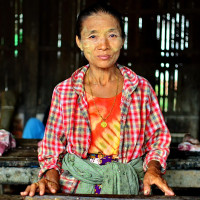
Photo credit: Jun Borras
Introduction
When we arrived, it was after lunch, so the sun was quite hot. Their house was on a small hill beside the main road. It was a small, ground-level house where about three families were living together. In that house, Zhang Wei and his family, including his wife and children, his father, his younger brother, and his aunt and her husband, all lived together. So there were an estimated 11 people.
The house was on a hill, so the wind blew and, because it was beside the main road, we could hear the sound of cars. I guessed that it must be quite cold during the cold season. He and his father were smoking cigarettes while talking to us. Even though the wind was cool, the sun's heat was scorching.
The small house is located in Lincang Municipality, one of the counties in Yunnan Province in southwest China. The economy is based on agriculture and cross-border trade with neighbouring Myanmar. It has long connections with the mountainous and isolated area over the border in Shan State. The flow of migrant workers from Myanmar into Yunnan began in the 1990s onwards in the context of a massive rural-urban migration that was happening inside China at that time.
"My wife and I have five children. The eldest daughter is 13 years old, and the youngest is five. In this house, my family, my father and my brother live together. My father's cousin and his wife also live here with us. My mother lives in Myanmar. Before the Covid-19 pandemic, my mother came here once and stayed for a while. I have four siblings. Two of them live in Myanmar. Because of the 2015 war [in the Kokang region in Myanmar], my father and my brother, my wife, and two of our children came to this side together with me," said 36 year-old Zhang Wei, telling us about his family.
Inside the house, there were many partitions, so even without his explanation, we could guess that more than one family lived in the ground-level house. Also, because of the children's clothes hanging out to dry, we could assume it was a family with many children. They didn't come here without a reason. They were displaced and forced to migrate here because of war.
Survival and Uncertainty: Difficulties for Education
In 2015 war broke out between the Myanmar Army (Tatmadaw) and the ethnic Kokang Myanmar National Democratic Alliance Army (MNDAA), which had been driven from the area in 2009 after refusing to transform into a Border Guard Force (BGF). When the MNDAA returned in 2015, the Tatmadaw launched a military offensive to block their return. Over 80,000 people were displaced. Most fled across the border to China.
What happened to them after crossing into China?
When we met Zhang Wei in 2024, they had already been living in Yunnan for nearly 10 years. He told us his story.
"When we first came here, we went to a village where my relatives on my mother's side were staying. We came with only 500 Yuan [at that time about 70 euro]. We built a place to live and stayed there for more than two years. From there, we moved to another place. My younger brother takes care of the children. My wife and I cut sugarcane.
We didn't just do that one job. We also grew corn. We did other daily farm work as well. We couldn't get other jobs, such as in construction. After three more years, my brother also came to cut sugarcane with us. The children had grown up, so they stayed at home on their own.
My wife, my brother, and I went to work in a town near the China-Myanmar Border. That's why I brought my aunt and her husband to live with us and take care of the children. My friend is a leader at work, so I can choose the job. After the sugarcane cutting season, we rent about 20 mu of land [3.3 acres] in the village where my relatives were staying and we work there. When we sell corn, we earn about 20,000 Yuan [about 2,400 euro at current rate]. All my children go to school. But they only started attending school last year."
Many thoughts flowed through my mind. They came with only 500 Yuan. Calculated at the current rate of 600 Kyats per Yuan, that is equivalent to 300,000 Myanmar Kyats. They had to use that money to build a place to live and for their immediate daily needs. I wondered what kind of place he meant: was it a place with a makeshift roof and walls? He also said that his children only started attending school last year. But his eldest daughter was 13 years old, which is later than the normal age of starting school. As he explained, "That's because the school in that village had no space for them last year. Since we are from Myanmar, we thought maybe we didn't have the right to attend.”
Jiehong, a middle-aged Chinese sugarcane farmer, shared a similar predicament about one migrant family from Myanmar who work for him in his village. "[This] Myanmar family has about five members. The children are young. The oldest is nine years old, and I don't know the youngest's age. When their parents cut sugarcane, they just play nearby. The children don't speak Myanmar; they only speak Chinese. They don't send their children to school, because the school in the village is full. The school goes up to Grade 6, and about 27-28 children are Myanmar. If they want to have an education, they have to go to a school in a nearby village."
Unlike the family Jiehong described, Zhang Wei and his children had a bit of luck. As he explained. “A Myanmar friend told me that the children could go to school in the place where we are living now. That's why we came here. My 13 year-old eldest daughter and another child are in Grade 2. The other two are in Grade 1, and the youngest is in Kindergarten. Including food, the school fee is 1,000 Yuan [about 120 euro] per semester, and another 100 Yuan to pay for books. Other Chinese students have to pay the same amount."
He then said further. "I found out about the place we are living in now from my Burmese friend. A sugarcane farmer owns this place. We had to pay 1,000 Yuan to stay in this building. It's a one-time payment. There's no guarantee how long we can stay here. I think we can stay as long as the Chinese government allows us to."
Zhang Wei then paused for a moment, relighting his cigarette. But when he continued, he confirmed my concerns and thoughts. It is uncertain for a school-age child of a migrant worker to have the full right to education in China. There are several obstacles. Some children have to take care of their younger siblings, and there are limited plots in classrooms. But they can attend if there is space in the school in the place where they are staying. If there's no space there, they have to look elsewhere for a school with an opening.
Although moving to Yunnan was the result of forced displacement due to war, once they arrived Zhang Wei and his family have been doing what they can to survive and to ensure the children's education.
I truly respect Zhang Wei. Through his eyes, I could clearly feel his joy and happiness that all his children had the chance to attend school in the new place they had moved to. Maybe the place they are living in now is just a temporary place for them. They know this. With no guarantees and few options for migrants from Myanmar, they are dependent on the good will and needs of the villagers to find a place in this society.
A Symbiotic Struggle: Myanmar Migrant Workers Filling China’s Labor Gap
Some of the people displaced by the war in Myanmar, particularly those coming from neighbouring Shan or Kachin States, had relatives in Yunnan who they could go to. Some were taken in by villages and villagers who pitied their dire situation. But there were additional reasons to take in migrants from distant places.
By the time Zhang Wei and other war refugees like him were making their way across the border into China, rural villages across China had undergone massive transformation. Beginning in the 1980s, rural villages across China began to be ‘hollowed-out’ as members of small and medium rural farming households migrated in massive numbers to urban areas in search of better incomes, while at the same time maintaining their farms. Most of those left behind are elderly, children and those with health issues. This ‘hollowing-out’ of villages resulted in rural labour shortages.
Myanmar people who fled their home villages because of the war thus became part of a new migrant labor force that was repopulating villages in China, renting farmland that had been left unattended, and providing much needed farm labour in the many sugarcane fields which are supplying raw material for the big sugar factories.
We visited a makeshift community school that is run by ethnic Lisu migrant families from Myanmar. They also fled the war in 2015. The school sits in a remote area, perched on the side of a steep hill on land rented from a villager. Originally run by volunteers from the village, it was the initiative of the village secretary who wanted to help the newly-arrived migrant families. Later, the parents took over the running of the school and hired two ethnic Lisu teachers who could teach in both Chinese and Lisu languages. The Lisu migrant families also took responsibility for the teachers' basic salary and living expenses.
It is not a school like the one in the village centre. Actually, it looks more like a refugee camp. The buildings are made from tin, wood, bamboo and tarpaulins instead of concrete. The classrooms are small and cramped. The living quarters for children and teachers are also cramped and basic. My Chinese colleague from the city, who helped organise our trip, was distressed to see the conditions.
Yet the host village had welcomed them, had supported and made space for them, and later did not resist when the migrant parents took over running the school in their own way and in their own language. We do not know what their previous experience was when they lived in Myanmar, so it is hard to make a comparison. Regarding the extent to which the migrant family has integrated into this Chinese village society, should we say if the glass is ‘half empty’ or ‘half full’? It is an interesting question, but not easy to answer.
Marriage, Mobility and Mistrust: The Status of Myanmar Women in China's Border Villages
While talking to Jiehong, I also learned other interesting things about Myanmar migrants in his village. He described the situation. "There are about 50-60 Myanmar women in the village. Some of them are married to Chinese men. Some have marriage certificates. But even without a marriage certificate, if they can prove their child is legitimate with a blood test, the child can attend school. There are also Myanmar men who marry Chinese women, but there are only a few. Myanmar women without marriage certificates are not allowed to travel to other counties. They face difficulties accessing banks, hospitals and other social matters in China. They have to rely on their husbands. Most of the women from Myanmar are ethnic Bamar, Ta'ang, and Kokang."
When, however, he said "Myanmar women" and "Myanmar men," he did not mean people of Bamar ethnicity. He meant women and men who came from Myanmar. So, we can see the importance of marriage (a marriage certificate). I wondered what percentage of women from Myanmar who come to work in China and marry Chinese men get officially married? It's clear that most of them cannot travel freely to other places.
In another village, I met Jing, a young woman from Myanmar who is married to a Chinese man. When I met her, she was 26 years old, with a 7 year-old daughter and a 4 year-old son. Jing is energetic, and she has a job. It's true that a woman with a job has self-confidence. Jing’s job is to take samples of the wastewater from the sugar factory before it is disposed of in the river. Jing can also read Chinese. Her monthly income is about 3,300 Yuan [about 400 euro].
"After I got married and had a child, I used to help pick tea on my husband's family's tea plantation. They own about 30 mu of land [about 20,000 square meters]. They didn't force me to work, but when my first child was 1 year-old, I found my current job myself. This place near the factory is where I used to play, and I met someone who was looking for a worker there. This job is only for the sugarcane cutting season,” Jing explained proudly, telling me about finding her current job herself.
Jing first went to China when she was 16. At that time she was just a child, so these places nearby were where they used to play. She continued, "When I first came here around 2015, I was 16. At that time, I stayed here for only a short while. Later, in 2016, when I was 17, I officially got married. I had a fake ID saying that I was 20 years old so that I could get married. My husband's family gave my father 36,000 Yuan [about 4,300 euro] as a dowry. In the summers, I walk alone and go back to Myanmar. My in-laws don't allow me to bring the children to Myanmar even once. They are afraid that I will run away with the children. Also, my husband has seen armed soldiers in Myanmar, so he is worried."
Jing is one of the few Myanmar girls who was able to get officially married in China. Even so, I wondered why her husband's family was worried that Jing might run away. I also questioned in my mind whether the dowry in a marriage is given as a benefit or as a sign of value? Most people say it's given as a custom. This is a part of Jing’s life.
The Seasonal Routine: Exploitation and Control in the Sugarcane Labour Migration
It seems regardless of how they arrived there or where they come from, the work of Myanmar migrants in Yunnan revolves around sugarcane. But not all of them look to settle there.
In another village, we met a group of men who only come to work for a short time during the sugarcane cutting season. They were all from Magway Region, located in the central Dry Zone of Myanmar. There were four or five of them. We had the chance to talk to them on the side of the road next to the field where they were working. From the road, we could see the place where Mai Yai and his group were working to cover the fields with special plastic, not too far from a big sugar mill.
Yunnan is one of the key large-scale sugarcane production hubs in China, primarily through a household-based system. Due to a dramatic decline in sugarcane production since the early 2010s, both the Chinese state and Chinese companies have deployed several strategies to improve the scale of production. This has included taking control of suitable land across the border in Myanmar, where there is a readily accessible pool of labour. The harvested sugarcane is then transported back to the Chinese side of the border to be processed further in sugar mills.
This arrangement has been operationalized under the opium substitution programme between the Yunnan provincial government and ethnic armed organisations along the border. For example, in 2009, a Public Announcement of Chinese Import Quotas from Opium Substitution Projects in Shan State formalized this arrangement. At the same time, Yunnan's household-based farming sector, impacted by the ‘hollowing out’ of its villages, began to depend heavily on migrant labour from Myanmar, thereby helping to sustain the sugarcane industry.
We met the Magway group in February 2024. Unlike others we had spoken with, they were not planning on staying in China. "We will go back in April," Mai Yai from their group told me. Mai Yai is about 36 years old. He is of the Ta'ang ethnic group from northern Shan State. His family still owns a tea plantation in their hometown. His wife is from Magway Region. It seems that Mai Yai followed her to her home area, Magway, after they got married.
They had all left their homes in Magway and travelled together to a city on the Myanmar side near the border in March 2023. There, while still on the Myanmar side, they worked at cutting sugarcane in the fields in the surrounding area. "We first worked there. It's only been about two months since we have been here in Yunnan. There, we cut sugarcane. The boss on the Myanmar side and the boss on the China side are the same person,” Mai Yai explained.
The original connection goes back to their home village. “Our group leader and our villagers have contact, so we came. We went by car from Magway to the border. The fare was 70,000 Kyats [about 23 euro] per person. To pass through checkpoints, we needed letters of recommendation from the ward and police station, our ID cards and Covid vaccination papers. When we left our homes, Magway was peaceful, but we don't know about the current situation. We will go back in April.”
Mai Yai compared the wages he earned cutting sugarcane on the Myanmar side with the wages they earn on the China side.
“Here, we have to cover the ground with plastic, spray insecticide and add fertilizer. The daily wage is only 100 Yuan [about 12 euro]. When we worked on the Myanmar side, we had to pay the group leader 0.5 Yuan per bundle of sugarcane. One bundle has about 20 stalks of sugarcane. We could earn up to 210-250 Yuan [25-30 euro] per day." But Mai Yai added that the group leaders get daily wages from the regular workers who can cut up to 50-70 bundles a day. This means that the group leader earns 25-35 Yuan [3-4 euro] a day just from Mai Yai alone.
While working, the migrant workers have daily contact with their family members through Viber or Facebook. They transfer money to their families through the hundi system. I continued listening to Mai Yai’s stories about their daily lives.
"We work from 7 a.m. to around 11:30 a.m. Then we take an hour-and-a-half break. We start working again at 1 p.m. and work until 5 p.m. Our boss buys food for us, and we pay him back later. There are many people who want to come here, but the border gate is still closed, right?"
He paused for a moment before continuing. "We have been coming to work like this for the past two years. But we only come during the sugarcane cutting season. When the season is over, we go back to our homes. We are used to coming to work like this. When the season comes, we contact the person who is a group leader.” Then those who want to cut sugarcane gather and prepare to go as a group, I imagined in my mind.
Those who come to work legally have to go through a series of paperwork. They have to get a border crossing permit, translate their ID card into Chinese, and get a health certificate. Finally, they get a temporary border pass (which they call a ‘red book’). These are all expenses that the workers themselves must pay for. Some bosses pay in advance, and the workers have to pay them back later.
The routineness of this life is remarkable. It has even become a normal practice for their boss to keep their red books and national ID cards, we learned. In some places, the companies that hire workers also keep the Myanmar-China border crossing permits (‘red books’) and national ID cards. They are worried that the migrant workers will not work well for the bosses. Another concern of the bosses is that the workers will run away. The bosses often keep the migrant workers' red books and ID cards as another excuse, saying that the workers came legally and they can show their documents to the police.
Some migrant workers find a job in restaurants, car washes, noodle shops and shoe factories, but most of them work as sugarcane cutters. The fact that workers have to pay a daily 10 Yuan to the group leader has also become a fixed routine for them. Listening to them explain their situation to me, I can't decide whether they consider it as exploitation or not. They come here to work hard to save money for their families. And for some of them, it's not because they don't have land to farm in their area in Myanmar. Some of them own a plot of land. But perhaps the land is not enough to make a good living or the quality of their land is not so good, or as one of them said, "We have our own land, but the weather is not good for growing plants."
I am truly worried whether they can return home safely in April as they hoped because of the difficult political situation and the fighting in Myanmar. The conditions are very grave.
Beyond Cheap Labour: Market Dynamics and Social Mobility for Myanmar Migrants in Sugarcane
It is important to note that not all migrants from Myanmar remain simple labourers. Some have gained the opportunity to become sugarcane farmers themselves on land originally intended only for Chinese farmers. This change has been driven by a shortage of available Chinese villagers to work on newly-terraced land, which led the state and sugar mills to recruit refugees and migrants from Myanmar instead. The success of this strategy is evident in villages where the presence of a larger Myanmar refugee population has allowed for the expansion of sugarcane plantations. In contrast, villages with fewer or no Myanmar refugees have seen their plantation areas shrink. This suggests that access to land projects can serve as a tool for social differentiation among Myanmar refugees, allowing a small percentage of them (less than 20% in some cases) to rise to the status of farmers, while the majority remain employed as agricultural workers.
The cost of cutting sugarcane has been rising steadily, even as the amount of land planted has varied. This is largely due to shifts in the labour market. In July 2023 the price to cut a bundle of sugarcane increased from 1.0–1.2 yuan in the 2012–2013 season to 2.5–3.0 yuan by 2022–2023. This increase is a direct result of changes in the workforce. The exodus of Chinese peasant workers has been partially balanced by an influx of migrant workers from Myanmar since the 1990s.1 However, the number of these migrant workers, which was estimated to be between 20,000 and 30,000 at one of the counties in Yunnan Province in March 2019 before the pandemic, dropped dramatically due to border closures and new border fences. Local people we spoke with in 2023 identified this labour shortage as the main cause of the sharp rise in wages, with workers reporting a wage of 3-3.5 yuan per bundle at the time.
One ton of sugarcane has about 16-20 bundles of sugarcane. A migrant worker can earn at least 120-130 Yuan [14-16 euro] per day from the cutting wage. The price of cutting depends on the size and quality of the sugarcane. It was only after talking to the farmers and migrant sugarcane cutters that I learned there are two ways of paying the wages for migrant workers when they cut sugarcane. It's easier to calculate the wages by the number of bundles for each migrant worker. When they pay the wages for the group, they usually calculate it by the ton. The farmers usually pay the wages to the group leader, and the group leader pays the wages back to each sugarcane cutter. Group leaders, however, don't just instruct one group in one place. Some lead many groups in one village, and others lead and work in other villages as well.
To support this work, employers generally arrange a place for sugarcane migrant workers to live. About 4-6 workers live together. They don't have to pay for water, but the migrant workers have to pay for the electricity bill. Most of them don't have to build a place to live. Some live in places like warehouses where they store materials. Some have to live in places built in the fields and plantations. The employers usually buy meat and fish for the migrant workers who live together like that, and the migrant workers have to pay them back later. A few employers occasionally invite them to their family’s cultural feasts, such as the mid-autumn festival or the Lunar New Year dinner.
However this does not tell the whole story. The wages for migrant workers who come from Myanmar to cut sugarcane are cheaper than those of Chinese sugarcane cutters. So should we call Myanmar workers cheap labourers?

Photo credit: TNI
Beyond the Farm: Factory Work, Labour Contractors and the New Stratification of Myanmar Migrant Workers
Migrant workers carry out various types of jobs in all the stages of this industry, not only cutting sugarcane. They also work in sugarcane cultivation, transportation and sugar production among different steps. As they do this, their lives can vary greatly from one situation to another. One migrant worker I met works in a sugar factory. He is from Rakhine State, 29 years old, and his name is Kyaw Htun.
"During the sugarcane season, from mid-December to May, we don't get a day off. When the sugar production stops, we don't get a regular salary. But we get 500 Yuan [60 euro] for food and 1,500 Yuan for other expenses. There are five people in my group. All of them are from Myanmar. They are from Pyay, Yangon and other places. When the factory is closed, I drive a car to deliver fertilizer. The wage is calculated by the ton. They have arranged a place for us to live here. The five of us live together. Before, about 10-15 people used to live together. Sometimes, if there is an emergency, the group leader will pay in advance. I get my money in cash in Yuan. I can exchange it for Myanmar Kyats at an informal money transfer service called hundi and transfer it to my Myanmar account."
Kyaw Htun also explained more about his circumstances. He initially came to China to support his family. He has been working in this sugar factory for about eight years. His job is to drive a truck loaded with sugar and unload the sugar bags in the right place. His current monthly income is about 3,500 Yuan [420 euro]. Before, he used to earn about 4,000 to 6,000 Yuan [480 to 725 euro] a month. Like others, he transfers money to his family in Myanmar. The whole world has been affected by the Covid pandemic to different extents. It can be said that Kyaw Htun was also affected. Since the pandemic, he has had many difficulties.
So Kyaw Htun is not someone who only comes to work during the sugarcane cutting season. He doesn't get a regular salary when it's not the right season. We met Kyaw Htun inside the sugar factory where he works. Their factory is very big. I think they must be very busy during normal sugar production time. So there must have been a lot of workers as well. Another interesting aspect is that the people who come to work in this kind of sugarcane and sugar industry in China are not only people who live near the China-Myanmar border. There are people like Kyaw Htun who come from Rakhine State. Also, the people who live with him are from Pyay, Yangon and other further away places.
Kyaw Htun then added why it is not easy for him to give up and go home. Other people depend on him. "I have a red book. But I couldn't get it renewed during the Covid-19 pandemic. If I want to go back to Myanmar, I can. But it's not easy to come back here. Before coming here, I worked as a construction worker in Yangon, but the income was not enough. That's why I came here. Here, I can travel freely. I haven't been able to go back to Myanmar since the pandemic. I want to save more for my parents. Before, I used to send about 2,500 Yuan [300 euro] a month to my parents. My parents are going to retire soon, so they need a place to live. Now they are living in employee housing. I have no plan to go back to Myanmar. My parents will have to give back the place they are living in soon. I want to buy a house for them. That's my dream."
Generally, it's not easy for people from a basic income group in a big city like Yangon to earn sufficient income. I understood that when he said he can travel freely, it meant he can travel around his factory even though his red book has expired. Kyaw Htun’s dream is to buy a small house for his parents. "Owning a small house" is a dream for most of us. So I wondered if his return to Myanmar will be a distant hope for him. His parents are going to retire soon and will have to give back their current home. Thus we can guess their stress and worries. I truly respect all the young people who work hard far away for their families and parents.
In understanding these labour systems, it is also interesting how Chinese employers and recruiters connect together to obtain workers from Myanmar. I met a labour contractor named Fang who used to work at a supermarket. Then he quit that job and worked at a car repair shop for about a year. From there, he worked as an electrician for a construction company that carried out explosions for tunnel excavation. When he got married, he inherited his father-in-law's labour contractor job. He has been doing this job for more than 10 years.
As Fang explained, "My wife's father used to work at a sugar factory and hired workers. Most of them were from within China. I can't say why I was chosen to be a contractor. In 2024, I hired about 120 workers. My income does not come from the workers or sugarcane cutters. It comes from a contract with the sugar factory for wastewater treatment. I hired four people for the wastewater treatment. During the sugarcane cutting season (3-3.5 months), my net income is about 20,000-30,000 Yuan [2,400-3,600 euro] a month. This is from cleaning the containers.
Unskilled seasonal workers have to do jobs like packing sugar, taking samples and cleaning containers. I signed a contract with the factory for 500,000 Yuan [60,000 euro] for all the work. The 120 workers have to work in two shifts for 12 hours a day. It's not easy to control workers who have a weak education and don't follow the rules. For example, both male and female workers have drinking problems.”
Fang then added further, "I hire workers by contacting Myanmar people from the four nearby counties in China by phone. Before the pandemic, I hired Myanmar workers who had married and lived here or came legally. Whether they are married or not is not important. After the pandemic, I mainly hired Chinese workers. Before the pandemic, since my brother's wife is Myanmar, I was able to get contact with Myanmar people through her.”
Fang clarified that the majority of the workers who come to work are from China. He didn't mention how many come from Myanmar. He also emphasized the net income from cleaning the containers without mentioning the profit from the sugar factory. He didn't mention the exact salary of a worker. From what he said, it's clear that the basic migrant workers have to do jobs like packing sugar, taking samples and cleaning containers at the factory. They have to work 12 hours a day. It also became very clear that contractors like Fang get more profit than the basic workers. I also realized that the pandemic created very different outcomes for Myanmar migrant workers. Those already in China gained more opportunities due to the severe labour shortage. In contrast, those trying to enter were faced with more limitations and fewer job prospects as a result of the border closures.
Mutually Dependent Destinies: How Conflict and Labour Needs Reshape the China-Myanmar Border
I met people who sacrifice their lives for their families among the migrant workers. I have already met a person who invests his youth for his parents. Subsequently, I also met a person who worked her whole life for her children. Her name is Xin Yi. Xin Yi is a 52 year-old woman who truly deserves recognition and praise. The first thing she told me was that she had three children, two daughters and one son. Her hometown is in a village beyond Lashio in northern Shan State. Throughout her life, she has moved and worked in various places.
Because of her family's financial situation, she only had the chance to study up to primary school. Xin Yi left her village when she was 16. She then worked as a babysitter and domestic helper for about five years. She didn't work in one house only. She would work for a year or two and then move to another house where she could be more comfortable. From there, she also opened a noodle shop.
When Xin Yi got married, she came to China with her husband and worked as a labourer after previously collecting firewood and working on sugarcane and corn farms in Myanmar. The couple then gradually transitioned from labourers to farmers by renting their own land. During the sugarcane cutting season, she also takes on contract work. The place where they live and the sugarcane fields are close by, and she even invited me to visit. Her story is truly extraordinary. Both of her daughters are now attending a university in Kunming, the Yunnan capital, while her son is in high school in a town near the China-Myanmar border. While they have worked incredibly hard, they are immensely proud when they talk about their children's education.
This family’s experience illustrates the dual reality of Myanmar migrant workers in China. While they endure a hard life as migrant labourers, the opportunities they have found in China – including paid work, education for their children and freedom from armed conflict – are often unavailable in their home country. This context helps explain why many migrants choose to stay. In return, the Chinese government and businesses, in their need for labour to support the sugar industry, have provided them at times with a pathway to social and economic reproduction, including access to education and even land.
In the end, the relationship between Myanmar and China is complex, shaped by a combination of factors: land policies and labour dynamics on both sides of the border; ethnic conflict and civil war on the Myanmar side; and, for many people, deep cultural, linguistic and family ties that cross the boundaries.
The Dual Reality of Migration: Hardship and Social Reproduction Across the China-Myanmar Border
I have been to small towns and villages in Yunnan Province. I also went to a sugar factory in a town near the China-Myanmar border. We split into two groups and had the chance to meet 44 people. We didn't just meet migrant workers. We also met farmers (big and small), the manager of the sugar factory, the village head, a labour contractor, and people from a labour contractor company. Meeting and listening to people is a part of my job.
On this one-week trip, I met a lot of people. I had the chance to listen to what they had to say. I had the chance to learn about their lives. I met migrant workers who wanted to go back home but couldn't because of the wars. I met migrant workers who are working to own a small house. I met migrant workers who are struggling for their children's education. I met migrant workers who are migrating from one place to another for their family's living.
On one occasion, Zhang Wei asked me a question as he looked at his younger brother, who was hanging up the washed clothes. "My brother has been living here with us for about five years. He wants to go back to Myanmar. But we don't know how he can go back. If you can help, can you tell us how he can go back to Myanmar?" I couldn't, however, do anything for him at that time. And I still can't do anything at the moment. Then, you might have a question of why I listened to them and why I met them. But it is also necessary for many people to know about their lives and the things they are facing. Isn’t that right?
The more I learn about people's lives, the more it hurts. So I feel like I don't want to meet people like this. And I also feel very bad because they have to give up their time to talk to us. On the other hand, we can only do something useful for them on some issues if we have personally experienced, met, seen or heard about them. Thus I have to try hard to meet all kinds of people. You can't make oil with just one sesame seed. But I believe we can help the lives of migrant workers become better in some way.
Can we do something for the education of migrant workers' children? Can we do something about the exploitation of migrant workers? Can we do something to make the living and daily lives of migrant workers better? Even if one person can't do it, we can do something with the collaboration of many people. I hope this is the case. So, I am wondering how we can get others to participate in these issues and how we can create a better future for migrant workers. And I believe that no matter how long the journey is, we have to keep moving forward little by little.
My thoughts return again to Zhang Wei and his family. I wondered how they pictured their future. Besides their past stories to cherish and miss in Myanmar, they hope for a better life for their children. They might have other hopes as well.
"Future plans? I don't want to go back to Myanmar. It's safe to live in China; there are no wars. But my brother wants to go back. My mother also wants him to return to the house in Myanmar. It's hard for him to get married here. I don't know for sure if he can bring his wife back here to live with him after he gets married".
I realized, though, as he spoke that the male-to-female ratio is very imbalanced in China for a man to get married. Migrants may not have a secure living place yet, and they are doing various jobs and migrating even though it's hard. Yet, despite all, the absence of war provides them with a sense of security. It also means that they can still have ambitions. "As for saving money for a house, it's not certain for me. That's because I have to spend money on my children's education. I want them to have a better life," Zhang Wei said calmly, looking at the cigarette butt, ending his words about his future goals. Securing their children’s future stands above all.
We are left to wonder: are migrant farmworkers from distant places who are repopulating villages on the China side of the border, in turn, leaving their own villages of origin ‘hollowed-out’? Based on Zhang Wei’s story, the answer, sadly, seems to be yes. We also have to think about the significance of this side of the story and its implications. These are experiences that tell very different narratives about lives in two countries.
*Alvina is a pen name, and she is a freelance writer. Alvina has also been working in community development since 2007 until today.
Credits
More like this
-
Fear to Enjoy The Sufferings of the Peoples of MyanmarPublication date:
-
A comprehensive guide to TNI’s Myanmar publications The complete archivePublication date: