Progress Traps and the Struggle for the Future
Topics
From MAGA to Hindutva and Ruscism, today’s neofascist movements no longer reject modernity but seek to redefine it. By appropriating the language of progress, civilisation and technological advancement, they recast repression and war as historical necessity. This essay traces the colonial and ideological roots of this transformation and argues that the struggle against authoritarianism is fundamentally a struggle over the meaning of progress itself.
Longread by


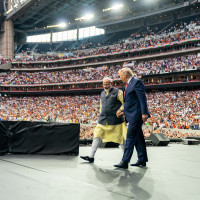
Tyler Merbler from USA, CC BY 2.0 via Wikimedia Commons
Fascism is often framed as a politics of the past. Whether the nostalgic longing for imaginary glorious times or a counter-movement to modernity, a rejection of rationality, democracy and pacifism in favour of an ‘irrational excess of mythic and political referentials’¹, authoritarian politics, hostility against perceived enemies, and the cult of masculinity and glamorisation of war and violence. Labelled as ‘regressive’ and ‘barbaric’, fascism is cast as the antithesis to progress. But this misses something important about the workings of fascist ideologies.
According to the philosopher José Ortega y Gassett, fascism ‘asserts authoritarianism and organizes rebellion’. It ‘does not believe in the restoration of any past rule’. It poses ‘the forge of a strong State, and uses means most conducive to its dissolution’. Fascists do not merely long for a nostalgic glorious past. They also present themselves as the true heirs of modernity and agents of progress. But fascism promotes its own version of progress, seeking to redefine the norms of progress itself.
In a time of multiple crises, neofascists speak of solutions: stronger borders, larger dominions or ‘spheres of influence’, faster growth, cleaner societies, and simpler truths. The contest for the meaning of progress is played out on these grounds. As neofascists describe themselves as the drivers of a purified modernity, they are gaining ample ground. To update Gramsci’s dictum, we face a reality where ’the old is dying and the new is being born, while even more morbid symptoms continue to appear.’²
State of Power 2026

From improvement and emancipation to hallowed growth and acceleration
A key tenet of modernity is belief in the progress of humanity: from the Enlightenment’s promise of perfectibility through reason and Kant’s imperative of emancipation from our ‘self-imposed immaturity’, to Hegel’s and Marx’s progressive visions of history, to Martin Luther King’s declaration that ‘the arc of the moral universe is long, but it bends toward justice’. These thinkers shared a belief in the potential of progress to bring about positive change. But this relation has never been obvious.
Others have resisted this optimistic view of history, linking progress to catastrophe. Scientific and technological advancements are weaponised leading to catastrophic consequences, and progressive political projects can turn into oppressive regimes. In their Dialectic of Enlightenment, Theodore Adorno and Max Horkheimer maintained that the very idea of progress betrayed its emancipatory promise by becoming a tool of systematic technical domination.
The instrumentalisation of progress is especially significant in the context of empire. The historian David Olusoga has argued that discourses of progress legitimised conquest, masked exploitation, and entrenched racial hierarchies in the name of ‘civilising the world’. The postcolonial scholars Anibal Quijano and Dipesh Chakravarty maintain that modernisation theory replicates this, as progressive narratives promote Eurocentrism and Western hegemony.
The historian Reinhart Koselleck traced the modern ideal of progress to a novel temporal reorientation. Historically, claims of progress referred to specific improvements in science, technology, and society. During the Enlightenment these experiences were conceptually integrated into a singular term linked to universal human advancement. This integration was largely driven by the philosophical and scientific revolutions of the sixteenth and seventeenth centuries, followed in the eighteenth and nineteenth centuries by political upheavals, the Industrial Revolution, and colonial conquests. These fostered a sense of forward-moving history in the so-called ‘West’. The singular ideal of progress arose in concert with these events, as it became determinant of positive value in the interpretation of history in this paradigm. According to Koselleck, progress emerged as a self-standing normative ideal, invoked to legitimise actions irrespective of their inclinations towards progressive values.
This detachment allowed reactionary regimes to claim the mantle of progress, reframing repression and inequality as necessary steps of development. Progress became identified with a temporal form and its content became versatile across the ideological spectrum. It became a framework to interpret the past and anticipate the future as the realisation of perceived advancement. Its appropriation resulted from this semantic ambiguity.
According to the historian Ronald Wright, ‘Progress has an internal logic that can lead beyond reason to catastrophe’. In A Short History of Progress, he warned that the logic of progress leads us to the pursuit of more and more progress until it becomes inevitably harmful as this demands endless expansion to counteract diminishing returns of early successful innovations. This demand leads to crises that elites often ignore to maintain power, trapping their societies in cycles of escalating problems that prevent necessary structural changes, ultimately causing their collapse. Wright’s caution seems urgent given fascists’ ability to weaponise progress to disenfranchise minorities and target opponents by labelling them enemies of national or civilisational progress. If progress leads to the pursuit of more progress, we risk being swallowed by their visions of the future with no way out.
The philosopher Slavoj Žižek reminds us in Against Progress that fascists pursue ‘industrial and scientific modernization while keeping its destructive effects under check through a stable authoritarian power’, containing crises ‘within a vision of society as an organic unity’ that excludes perceived threats to its ideal unity. As progress is severed from historical commitments to justice, equality, freedom and well-being, it allows movements to substitute form for content. Regimes need no longer be progressive to claim progress. They need only to promise a better tomorrow, however conceived, to legitimise their visions of the future. In this trap, oppression often wears the mask of development.
Dialectics of utopia and the rise of progressive neofascism
Key to the fascist appropriation of progress was the deterritorialisation of ‘utopia’, which according to Gilles Deleuze and Félix Guattari broadly refers to the uprooting of meanings from their original contexts. ‘Utopia’ denotes the vision of a perfect society, a term that Thomas More introduced in political discourse in 1516. He wrote at a time of major explorations opening Europe to a ‘new world’. Five years later, the Spanish conquered Tenochtitlan (present-day Mexico City) and nearly a century after, the first North American colony was founded in Tsenacommacah (present-day Virginia). This was a time of promise for Europeans, who saw these explorations as opening their world to new utopian frontiers.
The return of these explorers expanded European imagination to unexplored islands of perfect harmony, but their dreams faded as this ‘new world’ reached its limits. Yet, utopia was too ingrained in their collective consciousness to disappear. Koselleck argued that utopia became deterritorialised, transformed into a temporal notion: a future-oriented ideal of harmony and justice rather than simply a distant island. Visions of progress took hold in colonised territories, as European colonialists in the nineteenth century framed civilising missions as the realisation of utopian futures.
However, none materialised into harmony and justice, but instead produced calamities, massacres, and unresolved tragedies. The deterritorialisation of utopia enabled the justification of crimes in the name of civilisation, as ‘the future offers [a] compensation for the misery of the present’, Koselleck explains. ‘The argument of a better tomorrow emerging from an impoverished today is the model after which utopia is constructed.’ Empires committed heinous crimes in the name of ‘progress and civilisation’, as, for example, the British colonisation of Ireland, a laboratory for its growth at the expense of ethnic cleansing and genocide; Russian colonisation of Central Asia, forcing nomad cultures into sedentary life in the name of order and modernity, producing mass starvation and socioeconomic collapse; French colonisation of Algeria, which promised modernisation while conducting genocidal massacres; and the Belgian Congo Free State, which promised to abolish the slave trade but became a site of forced labour and mass death. Congo’s case was crucial, fuelling European industry through the extraction of natural resources, framed as a catalyst for progress. Today’s atrocities in the Eastern Congo are similarly coupled with a new episode of technological progress vis-à-vis competition for resource extraction for renewable energy transition in the ‘global North’.³
We must not ignore these histories when explaining the fascist appropriation of progress. As Frantz Fanon wrote in 1961, ‘What is fascism but colonialism at the heart of a traditionally colonialist country? Fascism is the application to [the imperial core] of colonialist procedures’. Fascism as a historically circumscribed phenomenon left traces to be picked up by today’s neofascists. Colonial experiences and the civilisational discourses that legitimised them were not merely instrumental but constitute the backbone of these movements.
Dynamics from colonialist deterritorialisation of ‘utopia’ reappeared in fascist appropriation of progress, as they rewrote colonialist handbooks: by embracing civilisational narratives, envisioning restorative utopias for their ‘great empires’, and by embracing modernity as redemption for ‘stolen greatness’ interrupted by perceived injustices. These injustices were invoked to legitimise other injustices in the name of security and historical rectification.
Progress, as framed by fascists, was the engine to restore utopian futures as purified modernities. Mussolini spoke of restoring Rome’s grandeur through a modern corporatist state; Hitler of a racially purified Volksgemeinschaft restoring Germany’s glory through Lebensraum expansion and annihilation of those blamed for its decline (especially Jews, who were framed as the natural enemy of the Aryan people and civilisation).
Fascists looked both backwards to an imaginary past, and forwards toward a modern utopian future. Neofascists promise new modernities that exclude enemies whom they perceive as posing a threat to their idea of civilisation. Their progress is tied to protecting this idea. Edward Said argued that the idea of progress was central to the construction of binary distinctions between a ‘civilized progressive West’ and a ‘barbaric Orient’. According to the philosopher Silvana Rabinovich, this ‘orientalist Othering’ was pivotal to the far-right philosopher Carl Schmitt’s political theology, which presented the defence of the political community from the ‘menace of an imaginary other, very often portrayed as dangerous, failed, and chaotic’. This continues to inform fascist thought.
Neofascists claim the mantle of progress by organising rebellion around authority, by forging state structures that legitimise transgression and violence in the name of ‘safeguarding civilisation’ from this ‘imaginary dangerous other’.
Here are four examples of how ‘progress’ has been adopted by contemporary far-right and neofascist movements:
MAGA (U.S. alt-right)
The MAGA movement in the United States (US) arose in opposition to neoconservative factions of the Republican Party, merging politics of the libertarian ‘Tea Party’ and paleo-conservatism with backlash against neoliberalism and globalisation. It asserted itself as resistance against the ‘woke establishment’ (as they call liberal and progressive factions of US intelligentsia), adopting alt-right talking points, such as far-right blogger Curtis Yarvin’s denunciation of the so-called ‘Cathedral’ or ‘cultural Marxism’, which they proclaim dominates US media and academia.
It follows strands of alt-right thought in opposing modern ideals of human rights, multiculturalism and secularism, evident from the Trump Administration’s disregard for international and domestic law during their latest illegal attack on Venezuela⁴ that followed dozens of extrajudicial killings in the Caribbean and the eastern Pacific, as part of their expansionist program to assert US dominance in the Western hemisphere. Threats to ‘take over’ the Panama Canal, Greenland, Canada, and calls for similar attacks on Cuba, Colombia, and Mexico are now key components of this program. This disregard for the rule of law includes bypassing legal procedures to fast-track deportations and persecute dissent, deploying military patrols to police civilians, attacking freedom of speech (particularly concerning Palestinian solidarity), attacks on academic freedom, scapegoating and persecuting ethnic and gender minorities.
While it opposes progressive values, MAGA generally admires and cherishes technological progress. It responds to techno-libertarian subcultures characterised by far-right futurism and anti-’woke’ ideology.⁵ Among its high-profile supporters, tech industry giants Peter Thiel, Elon Musk and Larry Ellison stand out. The risks of this techno-fascist alliance are high, given the cartelisation of social media by Musk and Ellison (through the purchase of Twitter and TikTok respectively), and the development of surveillance technologies by Thiel’s Palantir, which entered into partnership with Immigration and Customs Enforcement (ICE) to develop software prototypes to use artificial intelligence to identify, track and deport suspected non-citizens.⁶
One of Palantir’s co-founders also called for the persecution of those he identifies as ‘the red-green alliance’ made up of ‘Communists and Islamists uniting to tear down civilization’. Following Trump’s threats to target the ‘radical left’ and MAGA’s demonisation of New York’s mayor-elect Zohran Mamdani as ‘communist jihadi’ (a dog whistle reminiscent of the antisemitic ‘judeo-bolshevik’ trope), this signals a threat that they could use these technologies to target political opponents. In conjunction with ‘terrorist’ classifications, this may enable the government to bypass legal protections and exercise unchecked power to stifle dissent.⁷
The philosopher Rainer Mühlhoff warned that ‘What is qualitatively new in this unscheduled and authoritarian ‘AI coup’ against the U.S. democracy, particularly in historical comparison to the use of IBM punch card technology by the Nazi regime, is the element of prediction’.⁸ The threat of predictive technologies lies in their potential to influence information flows and produce new systems of policing and social sorting with limited accountability.
Progress, in MAGA’s worldview, cannot be separated from the entrenchment of national borders along white supremacist lines to enhance security and ‘protect the homeland’. The suspension of civil liberties allows the state and its paramilitary secret police (ICE) to operate unbounded with ever more sophisticated technologies, as it claims to protect US interests (domestically and abroad) and ‘Judeo-Christian civilisation’ from their perceived enemies, be it ‘foreign invaders’, ‘Islamists’ or ‘narcoterrorists’, leftists, feminists, trans people, and more.
State of Judea Zionism
This branch of the Zionist movement grew out of revisionist and far-right Kahanist factions of Israeli politics. They are inspired by ultranationalist Rabbi and convicted criminal Meir Kahane. According to the historian Ilan Pappé, there are two broad rival camps in Israeli politics making up secular and ethno-religious factions of Israeli society.⁹ State of Judea represents the reactionary, neofascist faction among settlers of the occupied West Bank, whose influence in the upper echelons of the Israeli military has grown exponentially in the last years, including conservative sectors of Israeli society dissatisfied with liberal secular governments.
Just as the seeds of MAGA were planted in the US since its establishment as an expansionist racial settler colony, the seeds of neofascism were present in Zionism from the start, as similar colonial civilisational narratives were central to the project from its inception. The political project of Zionism emerged in the late nineteenth century as a response to centuries of widespread anti-Semitism in Europe. In the aftermath of major pogroms across Eastern Europe and the Dreyfus Affair in France, dreams of assimilation into European society appeared to be shattered. Modern Zionism was a reaction to persecution and a long history of injustices. It was conceived as a solution to exile by creating a national homeland for the Jewish people.
Yet, it also included elements of civilising utopianism, which helped modern Zionists garner support among European elites in the aftermath of WWI and the dissolution of the Ottoman Empire. Theodor Herzl’s two major publications show this. Der Judenstaat calls for the establishment of a Jewish state to serve as ‘an outpost of [European] civilisation as opposed to barbarism’. His utopian novel, Altneuland, tells the story of a young Jewish intellectual who, tired of ‘European decadence’, travels to a remote island, stopping in Yaffa on the way. It then presents a vision of a future Zionist state as a modern, technologically advanced society in the land of historic Palestine. It contrasts the embodiment of European ideals of progress, rationality, and social harmony with the perceived backwardness of native Palestinians. It frames European Jewish settlement as a benevolent force bringing modernisation, setting the scene for ‘bloom in the desert’ narratives promoted by later Zionists.
Zionism evolved, leaving behind most of its socialist elements. The development of its neoliberal economy was coupled with a new national security paradigm, adopting ever more overtly ethno-nationalistic sentiments. According to the Israeli economist Arie Krampf, the collapse of Oslo and the outbreak of the Second Intifada marked an end to an economic policy around dovish cooperation with the outer world.¹⁰ This gave rise to a new configuration around economic self-reliance. The Likud government under Netanyahu pursues this on the basis of tax breaks for high-value companies (especially in high-tech, military and pharmaceutical industries) at the expense of local industries.
This ‘hawkish neoliberal’ strategy, as Krampf calls it, is associated with higher levels of inequality and poverty. These, however, are justified as necessary costs for economic resilience amid rising security threats, designed to reduce economic dependency on outside agents. This echoes in Netanyahu’s recent speech calling for Israel to become ‘Athens and super-Sparta’ to cope with increasing international isolation.¹¹ Rising inequality and recurrent militaristic rhetoric emboldened and radicalized far-right sectors of the Israeli population.
None of this, however, replaced the utopian colonial basis of Zionist ideology, which is why this neofascist strand of Zionism cannot be decoupled from the movement as a whole. Despite internal contradictions, most Zionists still frame Israel as a modern progressive country, highlighting the significance of Israel’s ‘civilising mission’. This shows up in Netanyahu’s framing of the Gaza war and attacks on Lebanon, Syria and Iran as a ‘clash between barbarism and civilisation’ with the goal of creating a ‘New Middle East’. His vision allegedly contemplates a version of ‘Greater Israel’, which refers to the idea of territorial expansion to encompass Biblical concepts promoted by State of Judea Zionists who seek to ethnically cleanse the totality of Palestine, clearing the land of their ‘terrorist enemy’ to establish a modern ethnic-theocracy.
In this context, scientific progress, technological advancement and economic success are celebrated, not merely as symbols of national pride, but as ideological victories. This also manifests in pinkwashing and veganwashing efforts to reinforce myths of modern exceptionalism, which aim to show the progress of Zionism through narratives of ‘Israel as an oasis of civilization in a desert of barbarism’.
All this despite an obvious disregard for progressive values, evidenced by its apartheid legal system, continuous military occupation, attacks on free media, recurrent violation of prisoners’ rights (including systematic torture, rape and possible reinstation of the death penalty),¹² perpetual state of war and militarisation,¹³ attacks on sovereign nations and diplomatic missions, and countless war crimes since 1948, including most recently, the Gaza genocide and intensified attacks on Palestinians across the occupied West Bank by ‘Hilltop Youth’ and other extremist settlers under Israeli army protection.¹⁴
Ruscism
The Ruscist movement emerged during the final years of the Soviet Union, rising to prominence during the crisis years of the Yeltsin era. Its name is a neologism denoting ‘Russian fascism’. It merges neo-imperialist, ultranationalist, and other totalitarian ideologies. It is de facto a guiding paradigm of Russian politics emerging from rising nationalism during the Chechen wars,¹⁵ paving the way for the Putin regime, the 2008 war on Georgia and ongoing war against Ukraine since 2014.
It is based on radical imperial chauvinism and variants of neofascism evidenced by its vehement promotion of the ‘traditional values’, cult of masculinity and reinforced homophobia, leadership worship (centred on Putin), corporatist state, magnified censorship and propaganda, increased repression, persecution of dissent, and extrajudicial killings, active engagement in destructive wars and systematic war crimes.¹⁶
Its ideological matrix is rooted in the legacies of fascist thinkers like Ivan Ilyin (promoter of a spiritually unique ‘Russian nation’) and contemporary propagandists like Alexander Dugin and Alexander Prokhanov, funded and promoted by far-right media mogul oligarchs like Konstantin Malofeev. Dugin is a key ideologue within this dominant Russian political culture. His ‘geopolitical’ doctrines and genocidal beliefs preceded the invasion of Ukraine in 2014.¹⁷ His neo-Eurasianist thought is disseminated around the world thanks to heightened propaganda efforts to legitimise Russian military policies abroad.
His 1997 book The Foundations of Geopolitics is very influential in Russian military circles. It presents a dream of future Russian greatness as a global decision-maker in a multipolar world divided along spheres of influence and dominance. It presents a vision for the spiritual revival of the Russian nation through a renewed and traditionalist ‘Eurasian’ identity, highlighting its perceived ‘uniqueness’ spanning two continents.
A decade later, Dugin expanded his views in The Fourth Political Theory. This highly influential text, in right-wing and also left-wing circles inside and outside Russia, states his wish to devise a new political theory to replace what he identifies as the failures of liberalism, communism and fascism. He sought to surpass them by incorporating elements from all three into a ‘timeless, non-modern’ political theory based on ‘ethnos’ or ‘communities of language, religious belief and daily life’ identified as ‘organic entities’ or civilisations. Critics accuse him of refurbishing Nazism for the twenty-first century.¹⁸
Dugin rejects modernity, instead presenting a version of modern traditionalism, calling for ‘modernisation without Westernisation’. He supports modern technologies, while opposing the liberalisation of sex and feminism, and calling for the revindication of phallo-centric eroticism and ‘traditional’ sexual morality as ‘patriotic conscience’. This resonates with other fascists as he calls for a cultural revolution to create a ‘New Man’. He often weaponises transphobia in his anti-Ukrainian genocidal discourse.¹⁹
He claims to reject any notion of progress, but still presents a vision of redemption for past ideological failures to be surpassed by his ethnocentric-civilisational logic. In his vision, differential pluralisms within a civilisation must be collectivised under a corporatist system that mediates between the individual and the state.
Ruscists interpret him through hegemonic narratives for the so-called ‘Russian-speaking world’ portrayed as culturally and politically indivisible, reinforcing centuries of colonialism leading to the creation of an imagined ethno-linguistic group centred around the Russian language and ‘traditional Russian culture’. By subsuming the diversity of the Russian Federation’s distinct ethnic groups, and other nations previously colonised by Russia, under a singular imperial identity, they brand all internal and external pluralism as a threat to be suppressed or eradicated. This entails an open genocidal denial of sovereign nations like Ukraine, subsumed by ‘Russian imperial identity’ that was ‘divinely chosen’ to carry out a mission against ‘Western decadence’ and ‘evil global unipolarity’.
By merging elements of Soviet nostalgia and totalitarianism with neofascist traits and political occultism, Ruscists seek to legitimise aggressive wars of conquest and genocidal policies through geopolitical and pseudo-philosophical doctrines calling for a war against Western liberalism as a ‘war against cosmic evil’.²⁰
They draw upon a narrative of civilising missions that rework progress into a dialectic of victimhood and restorative destiny, prevalent in Putin’s discourse on the perceived geopolitical injustices following the dissolution of the Soviet Union. They propose the restoration of Russia to a mythical ‘imperial glory’ within a ‘multipolar world order’ based on sovereignty and spheres of influence, which aligns with Dugin’s thought.²¹
They present Russia as an ally of the ‘Third World resisting Westernisation’ by aligning sovereignty narratives with decolonial struggles against Western imperialism. They seek to influence progressive discourses in an emergent geopolitical contest, as countries struggle to emancipate from Western hegemony. This garnered them support, not only among supporters of the anti-’woke’ far-right, but also among the anti-colonial left and those fighting against US and European neo-colonialism in the Global South.
Hindutva
Hindutva is the dominant ideology of the ruling Bharatiya Janata Party (BJP) in India. It emerged as a dominant political and cultural ideology following decades of perceived failures by secular liberal governments, as the BJP rose to power in the 1990s and early 2000s running on platforms of economic revitalisation and Hindu nationalism amid an economic crisis and increasing intercommunal tensions. These are the legacy of long-lasting tensions with roots in the bloody partition of the subcontinent, Indian military interventions in Kashmir and subsequent confrontations with Pakistan, anti-Muslim riots and pogroms, and several terrorist attacks across the country.
Hindutva is promoted by far-right paramilitary organisations, such as Rashtriya Swayamsevak Sangh (RSS), Bajrang Dal (which acts as a kind of moral police), and the now-disbanded Hindu Yuva Vahini. RSS stands out as the most influential given its large following, connections to Prime Minister Modi,²² and its influence worldwide through its subsidiary organisation Hindu Swayamsevak Sangh (HSS), which operates in over 150 countries with over 3,000 local branches.²³
RSS was founded in 1925 by Keshav Baliram Hedgewar, a physician who briefly participated in the Indian National Congress during the struggle for independence. Hedgewar was greatly inspired by Vinayak Damodar Savarkar’s 1922 ideological epigraph The Essentials of Hindutva. Savarkar outlined the vision of a Hindu Rashtra (‘Hindu Nation’) in Akhand Bharat (‘Undivided India’) that would stretch across the entire Indian subcontinent, tying a ‘common fatherland’ and ‘common blood’ to a ‘common homage’ that, in his view, Hindus should pay to their ‘great civilisation.’ Although Hindutva cannot be reduced to a single text, Savarkar’s manifesto was foundational in setting the tone for later developments of the movement. Modi, himself a lifelong member of the RSS, has repeatedly paid homage to Savarkar calling him a ‘true son’ of ‘Mother India’.²⁴
Hindutva has been largely successful in reframing progress as the return to an authentic yet modernised Hindu civilisation. BJP pledges to ‘build up India as a strong and prosperous nation, which is modern, progressive and enlightened in outlook and which proudly draws inspiration from India’s ancient culture and values’. Progress materialises in a technocratic revolution in governance, which involves remaking the bureaucracy ‘in the image of the corporation’ and digitalising Indian society.²⁵ This serves both state security interests and propaganda goals, as it is framed as a symbol of Hindutva’s success in ‘stitching a digital future to the recovery of lost Hindu pride’.
The connection between technofuturism and nostalgic Hindu nationalism is joined in this renewed idea of progress. The promotion of ‘Digital India’ and yoga as vehicles of soft power symbolise the merger of modernism with religious fundamentalism.²⁶ Critics have denounced this as ‘om-washing,’ attempting to sanitise India’s brutal abuse record through spiritual propaganda.²⁷
Hindutva’s rhetoric is highly nationalistic and supremacist. An uptake in marginalisation and targeting of religious and ethnic minorities has followed. Examples include demolishing mosques and bulldozing communities, amendments to a citizenship law to exclude Muslims and Tamils,²⁸ numerous arrests for carrying posters and sharing social media posts with the slogan ‘I Love Muhammad’,²⁹ ‘cow vigilante’ violence,³⁰ harassment of people celebrating ‘Western holidays’ and attacks on women for ‘dressing too liberal’,³¹ and more.
Critics accuse Hindutva of appropriating decolonial liberatory language to frame itself as an anti-colonial resistance movement, while simultaneously, promulgating a ‘neocolonial vision’ that empowers the will of the Hindu majority ‘through a rhetoric of vulnerability and homogeneity’.³² ‘Democratic ideals’ that the government promises to uphold ‘exist to protect the interests, values, and actions of Hindus alone’.
The BJP claims Indian homogeneity by subsuming the multifaceted pluralism of Indian society in the name of ‘national integration’ by excluding those who are framed as foreign agents due to accusations of having ‘external loyalties’ or engaging in ‘antisocial behaviour.’ This results in increased surveillance and vilification of those who are branded as ‘terrorists,’ ‘radicalised elements’ or ‘infiltrators,’ such as Kashmiris, Bengalis, and Sikh Punjabis, who are accused of being ‘Khalistani separatists’.
Interfascist alliances to ‘safeguard civilisation’
Unsurprisingly, these movements align themselves across ‘civilisational lines’, sharing rhetoric and tactics to defend tradition and their respective homelands, to ‘safeguard civilisation’ from its proscribed enemies. They mobilise supporters internationally by expanding alliances across far-right networks worldwide.
Dugin, who subscribes to elements of Aryanism, is attracted to Zionism for its rejection of diasporic Jewish life, which he opposes as an expression of ‘mercantile Atlanticism’. In his worldview, ‘Atlanticism’ is the geopolitical foe of ‘Eurasianism’, which represents his ‘ideal affective relation to the land’.³³ He has supported the emigration of Jews to Israel as an expression of this ideal. Since the 1990s, he has had links with Israeli ultra-nationalist groups, demonstrating his complex philo-Zionism combined with anti-Semitic ideology, drawing upon a distinction between ‘good traditionalist Jews’ ready to settle and ‘die for their ancestral homeland’ and ‘bad cynical Atlanticist Jews’ living in diaspora bereft of any spiritual connection to the land.³⁴
The influence of Dugin’s brand of Ruscism on MAGA ideologues, such as Steven Bannon, has been ascertained for nearly a decade.³⁵ Both declare secularism, multiculturalism and egalitarianism as enemies, proposing new political ideologies that supersede liberal democracy in favour of a tradition-preserving, ethnocentric ethos. The white supremacist Richard Spencer long expressed fondness for Dugin and Ruscism. He invited Dugin (a contributor to his AltRight.com website and online journal Radix) to a planned far-right conference in Hungary. His ex-wife, Nina Kouprianova, a US-based Russian nationalist, is Dugin’s English translator.³⁶ Representatives of the Russian neo-Nazi network, Russian Imperial Movement, notorious for recruiting militants to fight in Ukraine, also visited the US to meet Matthew Heimbach, an organiser of the 2017 white supremacist rally in Charlottesville.³⁷
Hindu nationalist groups also found ideological allies in the MAGA movement. Members of the alt-right have turned to Hindutva for justifications of their xenophobia, projecting fantasies of racially purified societies onto Indian culture, which has been embraced by Hindu fundamentalists.³⁸ The sympathy between white supremacists and Hindu nationalists has a historical precedent in Nazism, which prescribed a common Aryan ancestry to devise theories of racial superiority.
This sympathy also extends to British and European neofascists. The neo-Nazi anti-Muslim leader Tommy Robinson (real name, Stephen Yaxley-Lennon) is identified as an ideological ally of Hindutva³⁹ and fervent supporter of Zionism, who sparked controversy among British Jews who condemned his invitation to Jerusalem by the Israeli government. Hindutva-Zionist–white supremacist alliances are expressly based on Islamophobia, xenophobia and religious fundamentalism, intensified by military and economic cooperation.⁴⁰
These alliances uphold a new sense of global unity among far-right movements, which shows up in their uniform discourses, blending anti-globalism, xenophobia, religious fundamentalism, ethnocentrism, contempt for the rule of law, and far-right populism to promote their unique visions of the future. Their beliefs cohere around civilisational narratives where ‘blood and soil’ are the mantras of tomorrow.
Neofascist movements and ideologies promise to solve real socioeconomic and political crises, promoting visions of civilisational progress and redemptive utopianism. Their visions are exclusionary and supremacist, materialising into militarism, persecution of minorities and their perceived enemies, and brutal wars of conquest with the aim of realising these visions.
They thrive through promoting hysteria and hostility towards immigration and multiculturalism, which they frame as ‘threats to civilisation’. Their discourses are present not only in countries where neofascism has consolidated political power, but also in European countries, where they unite around anti-immigrant platforms, as well as Latin America, where neofascists like Bolsonaro, Milei, Kast, and others, reproduce these discourses merging them with ‘anti-communist’ rhetoric promising ‘liberty and progress’. With a fragmented political order, and in the midst of economic, political, security, ecological, and humanitarian crises, these movements found ample ground to flourish.
Reclaiming the future
The struggle for the future is not merely political or military, it is also profoundly ideological. At its centre lies the contest over the meaning of progress. For better or worse, progress is a dominant force shaping our contemporary world. There is no going back in history. To abandon it is to surrender its definition to those most prepared to weaponise it. Allowing the ‘opponents of authentic betterment to define what counts as progress’, Žižek warns, amounts to preparing the ground for our own undoing.
In Fascism and Ideology, Ernesto Laclau argued that two crises precede the rise of fascism: the inability of mainstream political class to neutralise social contradictions and contain popular demands for change, and the inability of genuinely progressive movements to hegemonise popular struggles with a coherent political programme and praxis. The rise of neofascism follows this plot.
The failures of neoliberalism and the inability of the ruling classes to forestall popular demands for socioeconomic and political change, coupled with the failure of progressive parties to develop coherent alternatives and mobilise the masses through offering radical programmes of social transformation, left the door open for neofascist movements to appropriate progressive narratives and emancipatory discourses.
Neofascists thrive on their own political nihilism and semantic ambiguity of progress to seize political power while wearing the masks of ‘Reform,’ ‘Alternative,’ ‘Unity’ and ‘Greatness.’ They turn popular struggles away from class analysis towards the identification of ‘the people’ along exclusionary ethno-nationalist lines, identifying their struggles with national and transnational security paradigms to ‘safeguard civilisation.’ This notion, a remnant of colonialism, serves to consolidate ‘the people’ along civilisational axes to construct ‘imaginary enemies’, reinforcing identitarian politics uniting ‘the people’ against those ‘enemies within and enemies without’.
People today (like in the 1920s) are looking for someone who will make their lives better, even at the risk of their lives becoming worse – rather than submitting to the impotent fatalism of those who believe that the present is the best of all possible worlds or that things will just get worse from now on. Neofascists have spoken to this sentiment as they promise a better tomorrow, albeit that their promises may be empty, and their conception of progress is reserved for a selected few.
According to Laclau, the crisis of the working class, the abandonment of popular democratic struggles by progressive parties, and inability to hegemonise these struggles, are to blame for the distancing of these struggles from their class basis, and the subsequent co-opting under unifying banners of ethno-nationalist ‘people’s struggle’.
Rescuing the idea of progress from its sequestration demands more than critique. It requires a renewal of our political imagination. We are living through the height of a polycrisis, but also at decisive crossroads in history. The left must move beyond exposing the failures of the present and present concrete, inspiring alternatives that help us reimagine progress to reclaim the future and mobilise all popular sectors of society. There are encouraging signs, such as the resurgence of grassroots movements across the Global South; from Indigenous protests in Ecuador and Brazil to recent youth mobilisations in Senegal, Serbia, Sri Lanka, Kenya, Bangladesh, Madagascar and Peru; the formidable resilience of global Palestinian solidarity networks against endless attempts at suppression; the uplifting elections of Catherine Connolly as the new Irish president and Mamdani’s mayoral success in New York; and the rise of progressive politics in the UK, despite recent setbacks due to infighting and sectarianism. These struggles remind us that resistance can be transnational and social movements can both confront the crises of the present and help us imagine a radically different tomorrow.
Yet, we must not let short-term wins and losses obscure long-term horizons. Redefining progress for the left means reshaping our strategies, rethinking our goals, but also creating broad new paradigms to guide our shared struggles. To resist authoritarian and extractive futures, critique alone is insufficient. We must reclaim the political imagination of progress, reject the notion that all forward motion is inherently good, while articulating a substantive, hopeful vision rooted in justice, popular democracy, ecological renewal, and collective liberation. Only such a vision can inspire mass participation, withstand inevitable setbacks, and keep alive the possibility of a future worth fighting for.
Credits
Authors
Shifa Herko is a philosopher, journalist, and migrant community organiser from Ciudad Juárez in México, and a doctoral candidate in philosophy at Charles University in Prague in the Czech Republic. Their dissertation is on the normativity of the concept of ‘progress’. They have presented academic research at events across Europe, US, and the Asia-Pacific region on topics of scientific progress, animal ethics, and artificial intelligence, and have repeatedly spoken out against the Zionist use of scientific progress as an ideological tool of domination, drawing parallels between the instrumentalisation of progressive discourses in colonisation processes in Palestine and across Latin America. They have written articles on rural resistance movements in México and agricultural working conditions across the US during the COVID-19 pandemic. In June 2025, they were arrested by Czech police and charged with the ‘particularly serious crime of supporting and promoting terrorism’ (facing a prison sentence of up to 10 years, if convicted) for their participation in a peaceful demonstration during International Women’s Day, where they held a picture of the Palestinian freedom fighter Leila Khaled.
ACKNOWLEDGEMENTS: Thank you to NOOR for financial support and to the following for reviews and comments on drafts: Anuj Vaidya, Francesco Martone, Ilias Alami, Josephine Solanki, Max Haiven and the Editorial Advisory Board
EDITORIAL ADVISORY BOARD: Abigail Taylor, Anuradha Chenoy, Deborah Eade, Helen Lackner, Naureen Shameem, Nuria del Viso
ILLUSTRATOR: Sana Nasir
SUPPORTED BY: NOOR – www.wearenoor.org
More like this
-
Fascism State of Power 2026Publication date:
-
Countering gender panic How Guatemalans challenged the erosion of democracyPublication date:
-
Hindutva as a global far-right project Fascism, neoliberalism and transnational networks in twenty-first century IndiaPublication date: