The Voice of Mon Farmers Struggling for Life
Topics
Regions
Myanmar remains a land in deep turmoil. But as military repression continues, one of the most neglected consequences has been the devastating impact on the agricultural sector and the country’s struggling farmers. In this commentary, Kun Wood* analyses the deteriorating situation in Mon State since the 2021 coup as farmers face the manifold crises of military misrule, conflict, land confiscation, rising prices, poor harvests, climate change and worsening shortages of workers as young people flee the country to escape military conscription and seek opportunities abroad. Local communities are being undermined, with the regime authorities doing nothing to help the local people. As she explains, the survival of farmers is essential for the Mon people.

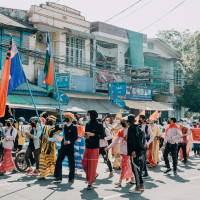
Photo credit Mon Land Institute
Mon farmers are facing many serious problems since the 2021 coup by the military State Administration Council (SAC: renamed State Security and Peace Commission in 2025). This commentary is based on recent conversations in farming communities in several townships in the Mon region. These were carried out towards the end of 2025, mostly with farmers living in areas under SAC-SSPC control, and reflects the challenges and worries of local people there.
The Immediate Crisis: Climate and Crop Damage
The immediate struggles of Mon farmers in Myanmar are centred on the weather and crop viability. Rice is the staple food in communities across the country, and many people eat it two or three times a day. Mon people are no exception to this. "We mainly eat rice," said one. "As for side dishes, it depends on the circumstances of our life. Sometimes these are good, but sometimes not so good. Now, with the unseasonal rains, it really breaks the hearts of ordinary farmers like us."
Normally, November marks the start of the cold season when the rain has stopped, and most farmers begin harvesting their rice crops when the grains are ripe. However, farmers report that since the rice has been exposed to unusual rain this year, the crops are damaged and only a portion will be salvageable.
A farmer over 60 years old from Paung township detailed the impact:
"I have never seen rain at this time of year in my entire life. Some of the rice, which was harvested but not yet collected, has started sprouting again in the rains. Already, we couldn't plant the paddy properly this year because of the heavy rain in July. So the lives of farmers are extremely difficult. We invest a lot of money in planting rice but, when we sell the resulting paddy, the price is very low. Now that the rice is also damaged, I don't know if we will be able to eat regularly next year."
Labour Shortage, Migration and Economic Hardship
Adding to the difficulties of farmers, the poor political and security situation following the SAC coup has triggered a severe labour shortage in the region, with many people leaving the country in search of employment opportunities abroad. Due to the spread of conflict, young people especially are seeking to migrate from their homeland of Mon State through both legal and illegal channels. Parents often feel that they have no choice but to allow them to go. Since Thailand borders Mon State, many people have gone this way. But this exodus of youth also adds to the labour shortage, making farming necessities like capital-raising or finding agricultural workers difficult for those who choose to remain.
Nai Soe Oo, age 63, a farmer from Mawlamyine township, explained the economic consequences:
"In the past, when we grew rice, we worked with our own capital. Nowadays, many young to middle-aged people go abroad, and their parents' farms have to hire labourers. In hiring labourers, there is a serious difficulty due to the scarcity of workers. Since labourers are scarce, machinery is being used. However, smaller farmers have difficulty finding the capital to rent machinery, and the fuel needed to run the machines is expensive. Sometimes there are also difficulties in getting enough fuel because it is scarce. If we don't cultivate our fields, we also worry that the authorities will confiscate them. But since there are no other options, the farmers' livelihoods are always operating at a loss."
Another mother from Mudon township echoed the security fears:
"I don't want my children to leave. But if they stay here, I'm afraid they will be conscripted for military service. They also do not want to work in farming. We now have a rubber plantation, but I can't tap the latex myself. We have to hire labour, and it's scarce. Only the elderly and children remain in the village. So when we hire someone, for example, if we get ten sheets of rubber, the hired worker gets six sheets and we get four. We have invested in the rubber for about eight to nine years. To tap the rubber, we also have to clear the weeds ourselves. But presently we can't do anything about it. If we plant paddy again, the price of rice is very low. Then if we don't plant, we are afraid our farmlands will be confiscated by the government. So we keep planting."
A farmer in Paung township summarized the necessary struggle:
"I am now 36 years old with two children, and I have been farming for over ten years. It's a real struggle. Since the price of rice is low, I have to cultivate both the monsoon paddy and the summer paddy. The money earned from the monsoon paddy has to be invested to plant the summer paddy to make any profit for ourselves. And the profit we make must be reinvested for the next year. But now the times are bad, and labourers are scarce. There aren't many people my age left in the village; everyone is abroad. I continue to farm because this is the land my parents worked, and I want to keep it going. I hope the political situation improves quickly so we can make a decent living."
The economic strain forced on families is immense, as detailed by Mi Cho Aye, 45, from Thanbyuzayat township:
"I have my husband and two sons. The eldest is 20, and the younger one is only 13. After the military coup, the issue of conscription emerged, and my eldest son wanted to go abroad to work. Since others his age were leaving, he also wanted to go and kept asking us. So we allowed him to go. But he didn't end up going to Japan or Korea; he went to Malaysia instead. Both my husband and I had to work. On top of that, commodity prices keep rising, which is frightening. We have a hard time struggling to make ends meet while working. To cover his travel expenses, we had to borrow money from a wealthy person in the village. To get the loan, we had to mortgage the plot of land we owned. When he arrived in Malaysia, the job didn't work out. It didn't work out for one year, and it didn't work out after two years. As the interest accumulated, we eventually had to sell the plot of land we owned.”

Photo credit Kun Wood
Land Commodification and Policy Failure
Mon farmers, in general, believe that conditions in the agricultural sector have significantly worsened since the 2021 coup. A major concern is the shift in how land is treated, turning it into a market commodity.
Nai Mon Htaw age 45, a farmer from Ye township, explained the problem:
"After the military takeover, in addition to the rise in commodity prices, land has become like a market commodity. The belief of us local farmers is that land is our lifeblood. But in this era, land has become a tradable commodity. We see this happening in Ye township, Mon State, where plots of land are bought and resold as residential plots. Some are known to be working in collaboration with the local authorities. Some of the people buying the land are not even locals. We don't know who they are, or where they are from."
A farmer from Paung township added: "Land prices have increased exorbitantly since the coup. There are also outsiders coming to buy the land."
Another farmer pointed out that many of the problems are due to failed and long-standing policies by the central government which support outside businesses but not local small-holder farmers:
"Land is the lifeblood for ethnic nationalities. However, the policies and laws that came from successive authoritarian systems do not provide protection for us farmers. In our circles, there is a case in Kawkareik township where a company aims to plant about 5,000 acres of palm oil. In other areas, the people carrying out antimony mining are Chinese nationals. They buy land, and the Mon people sell it because of the good price, not knowing how the land will be affected. In land purchases, they don't buy under Chinese names but use local names. The power to control this rests only with the public. If people cooperate with one another, it can be stopped. There are also many similar land purchases in Mawlamyine, the state capital. Outsiders are buying land using local identity cards."
Environmental and Land-Use Changes
Besides ownership and price, farmers also face environmental and land use changes. A major concern relates to water. According to a farmer from Kyaikmaraw:
"In our area, there are deep water fields where rice cannot be grown. Sometimes farmers are threatened if they don't plant the rice – they are told the land will be seized. But if they plant it, then it gets flooded. So for the farmer, it's always a loss. There are many such lands. After the military takeover, the difficulties have increased compared to before."
Another farmer from Paung township added: "In our township there are many quarrying operations now. When the stone is quarried, water sources disappear, and polluted water enters the fields. We don't know whom to report to. Even if we report it, who will take responsibility and solve this crisis?"
Other land-use issues include environmental and land use changes in the coastal region of Ye township where waterways have shifted, allowing opportunists to buy up land. Worsening the situation, the present-day practice of converting paddy fields into rubber plantations has become a serious concern because natural resources are diminishing. In the past, streams and mountains were protected. But recently destructive actions are increasing due to people's greed.
The present landscape is thus very worrying. Mon State was once a major rice cultivation region. But today rubber is widely grown and grafted durian is also increasing. Rice remains the daily staple food for the people, but the market for these new crops is volatile and highly uncertain.
Conclusion
Despite the political crisis and difficult circumstances, most farmers still have no choice but to cultivate rice fields for their daily sustenance. The Mon people are hit hard by the country's multi-faceted and deteriorating situation. The majority of the farmers and working class in Mon State are struggling in various ways for their livelihoods, and some are also rebelling against the military dictatorship. Thus the rapid increase in commodity prices has become a “double nightmare” in the lives of ordinary farmers and workers.
Faced with these challenges, the political aspirations and activism of farmers have declined, with those openly involved in land issues and rights notably decreasing since the SAC coup due to the repression by the Myanmar military. As a result, many farmers are struggling in a situation where they do not know who to turn to for help. Farming communities have no support, they must resolve issues on their own, and there is virtually no help from the national level. For this reason, farmers complain that the electoral political party in Mon State – the Mon Unity Party which claims to represent the Mon people – has yet to provide any assistance regarding the farmers' issues.
Amidst widespread rejection and resistance, the military regime is presently seeking to hold a general election around the country. But, as a Mon farmer said in these interviews, "no political party has been seen yet that guarantees a better life for the farmers". Their dream, he said, is “the emergence of political forces that will protect their interests in achieving a better future.”
In summary, farmers remain the lifeblood of the nation, providing our rice and food crops. No matter the challenges they face, we must trust that these essential farmers, our food providers, will continue to survive.
*“Kun Wood” is the pseudonym for an activist engaged in Mon national and political affairs. She has been working on community development and the right to land for ethnic nationality peoples since 2006. She has carried out research on customary tenure in different parts of the country.
Credits
More like this
-
Publication date:
-
The Current Crisis in Myanmar: The Different Political Position of the Mon People A Myanmar Commentary by Min Naing SoonPublication date: