
Proposal for an EU Observatory on Agricultural Land
Topics
Unequal access to land is one of the biggest barriers to a fair, sustainable, and productive agricultural future in Europe. This new policy brief outlines why a dedicated European Land Observatory is crucial to improving transparency in land markets, tracking land concentration and speculation, and shaping more equitable land governance across the EU. It makes the case for better data, stronger policy tools, and coordinated action to support smallholders, new farmers, and rural communities.
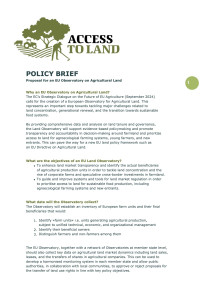
Download PDF
Why an EU Observatory on Agricultural Land?
The EC’s Strategic Dialogue on the Future of EU Agriculture (September 2024) calls for the creation of a European Observatory for Agricultural Land. This represents an important step towards tackling major challenges related to land concentration, generational renewal, and the transition towards sustainable food systems.
By providing comprehensive data and analysis on land tenure and governance, the Land Observatory will support evidence-based policymaking and promote transparency and accountability in decision-making around farmland and prioritize access to land for agroecological farming systems, young farmers, and new entrants. This can pave the way for a new EU land policy framework such as an EU Directive on Agricultural Land.
What are the objectives of an EU Land Observatory?
- To enhance land market transparency and identify the actual beneficiaries of agricultural production units in order to tackle land concentration and the rise of corporate farms and speculative cross-border investments in farmland.
- To guide and improve systems and tools for land market regulation in order to prioritise access to land for sustainable food production, including agroecological farming systems and new entrants.
What data will the Observatory collect?
The Observatory will establish an inventory of European farm units and their final beneficiaries that would:
- Identify »farm units« i.e. units generating agricultural production, subject to unified technical, economic, and organizational management
- Identify their beneficial owners
- Distinguish farmers and non-farmers among them
The EU Observatory, together with a network of Observatories at member state level, should also collect key data on agricultural land market dynamics including land sales, leases, and the transfers of shares in agricultural companies. This can be used to develop a harmonised monitoring system in each member state and allow public authorities, in collaboration with local communities, to approve or reject proposals for the transfer of land use rights in line with key policy objectives.
How should the Observatory be governed?
The Land Observatory will be housed within the European Commission.
The European Access to Land network strongly urges the creation of a task force involving EU institutions (DG AGRI, DG ENVI), peasant farmers’ unions, civil society organizations, rural development agencies, municipalities and local authorities, to guide the work of the Observatory. This task force will undertake policy research and issue regular flagship reports on major trends concerning European farmland to inform land policy reform and innovation.
This policy brief outlines a proposal for the creation of an EU Observatory on Agricultural Land. It provides the rationale for such Observatory, its core objectives, what data it should collect, and how it should function and be governed. It has been prepared by the European Access to Land network together with the support of key strategic partners including AGTER, ECVC, and TNI. The brief serves as a reference document and invitation to dialogue with policymakers, farmers, practitioners and civil society organisations throughout Europe.
Credits
In collaboration with
- Access to Land network (A2L)
- AGTER
- European Coordination Via Campesina (ECVC)
Download PDF
More like this
