
Against the Stage Towards a Politics Beyond Performance
Topics
Fascism has exploded through a culture of spectacle and performance, most of all in the digital sphere. If the left competes on the same stage, it is doomed to failure. Real politics needs to be based on relationships of care, mutuality and everyday resistance.
Longread by


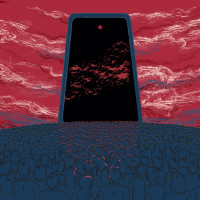
Illustration by Sana Nasir
Fascism today doesn’t stomp in jackboots or torch libraries; it scrolls, tweets, and livestreams. It speaks fluent meme. It knows how to weaponise irony, how to turn outrage into oxygen. Its strength is not found in persuasion. In fact, the far-right has mastered what much of the left still fumbles with: in a world ruled by images, attention is power, and attention, once captured, becomes control.
The French theorist Guy Debord saw this coming decades ago. In The Society of the Spectacle, written back in 1967, he warned that ‘everything that was directly lived has moved away into a representation.’ Life, he said, was becoming a movie about itself. Capitalism no longer just sold us things but sold us the feeling of being someone. What Debord glimpsed in the static of television has now metastasised into the infinite scroll, where our sense of reality flickers between dopamine hits and sponsored posts. Algorithms have replaced priests and kings as the new arbiters of truth, deciding not only what we see, but what we can imagine seeing at all. We no longer live in the world so much as look at it, performing our existence in high definition.
Debord’s prophecy was that the spectacle would become total. He was right. The spectacle is not simply propaganda or social media addiction. Consequently, the image has become capitalism’s favourite commodity and therein lies the genius, and the danger, of our current moment. Power no longer rules as it once did. It does not ask for obedience. Rather, it floods our perception until resistance feels pointless. The spectacle has colonised not only space, but imagination, and in this new ecology, fascism has found a perfect home.
State of Power 2026

The Spectacle and its Mutations
Guy Debord called the spectacle, a social order where ‘the tangible world is replaced by a selection of images which exist above it, and which simultaneously impose themselves as the tangible par excellence.’ Essentially, a condition of life under late capitalism, where reality itself is experienced primarily as representation.
In this sense, one might observe that from Mussolini’s staged marches to Hitler’s filmic rallies, fascism has always been an aesthetic project. Today, it wears new masks. Trump, Bolsonaro, Modi: each translates fascism into the native dialect of the digital age: virality, outrage, and performance. The French theorist Jean Baudrillard once remarked that in the age of simulation, ‘the Gulf War did not take place.’ Obviously, he did not mean it literally. He meant that it was experienced primarily as an image, sanitised for mass consumption. Trump’s presidencies followed that same logic; a constant loop of televised outrage, simulating politics while displacing its substance. What mattered was not governance but the optics of dominance, the theatre of grievance, the memeable moment.
Donald Trump understood that democracy had mutated into a streaming service. Politics had become entertainment where every tweet he made was a flare into the media’s bloodstream; every insult, a headline; every scandal, a marketing campaign. If we look closely, we may realise his chaos was not a flaw. His genius, if one dares call it that, was semiotic. He recognised that to be ‘effective’ in this new age, persuasion was unimportant. After all, in this algorithmic economy, engagement is consent.
And mainstream journalism, obsessed with clicks and neutrality, became his unwitting amplifier. Coverage that sought to expose him only deepened his myth. The press couldn’t look away, and in not looking away, it became part of the performance. As Michael Gerson wrote in The Washington Post, his ‘authenticity’ wasn’t honesty but moral laziness, the performance of rawness mistaken for truth. His shamelessness was his armour, and the more vulgar he was, the more ‘real’ he appeared. The more the establishment winced, the stronger his followers’ devotion grew. Outrage, visibility, legitimacy all fused into one.
Trump’s spectacle was carnival: grotesque, captivating, endlessly replayable. It was democracy binge-watched to death. And like any successful franchise, it invited sequels.
If Trump was the carnival barker of post-truth America, Jair Bolsonaro was its evangelical preacher. His 2018 campaign in Brazil was not fought in the open arena of television debates but in the shadowy intimacy of WhatsApp chats. While mainstream media wrung its hands over policy, Bolsonaro’s digital troops unleashed an untraceable deluge of misinformation: doctored photos of left-wing politicians defiling Christian symbols, conspiracy theories about ‘gender ideology’, apocalyptic sermons warning that Satan had infiltrated the state.
The strategy was devastatingly simple. Convert alienation into moral panic, fear into faith. As The Guardian reported, these private messaging networks reached millions daily, forming a subterranean propaganda machine beyond the reach of regulation. Each message arrived from a friend or a pastor, not from ‘the media’, which distrusted abstraction and thus felt more intimate, more real. Bolsonaro’s genius was to sacralise the spectacle. His rallies mixed nationalist nostalgia with Pentecostal ecstasy. Consequently, his followers did not simply vote for him. They believed in him. In this novel landscape, power spread laterally, not vertically. From phone to phone, pew to pew; a digital Pentecost, so to speak.
Now, if Trump’s performance was carnival and Bolsonaro’s was crusade, Narendra Modi’s is a perfectly choreographed commercial. His regime fuses Hindu myth with Silicon Valley polish: ‘Digital India’, ‘Make in India’, ‘New India’. Drone-shot rallies, devotional anthems, choreographed humility. You know, the humble tea-seller reborn as global technocrat. His image glows with the clean confidence of a brand campaign; capitalism rebranded as destiny, as fate.
The spectacle surrounding Modi is sustained by a tireless digital army. Through Twitter, Facebook, and especially WhatsApp, the Bharatiya Janata Party (BJP) has constructed one of the most sophisticated propaganda machines on earth. As a 2021 TIME investigation revealed, Facebook repeatedly ignored internal warnings about Islamophobic content and ‘love jihad’ conspiracies circulating through Indian networks. These weren’t fringe messages. They were systemic, algorithmically boosted narratives binding religion to nationalism, rumour to truth. Political memes became weapons, and digital propaganda sustained the illusion of unity by feeding a steady diet of fear: fear of Muslims, fear of dissenters, fear of imagined traitors. Modi’s India hums with the smooth confidence of a start-up while enacting the slow violence of erasure.
And this spectacle of Hindu pride did not stop there. Under Modi, nationalist infrastructure has bulldozed forests, accelerated mining concessions, weakened environmental protections, and opened Indigenous territories to extractive industries dressed as development. Hindutva is not only a spiritual fantasy; it is an ecological project, one that ties ethno-nationalism to industrial expansion and treats the land as expendable in the service of a mythic India.
Across Trump’s America, Bolsonaro’s Brazil, and Modi’s India runs a single thread: the spectacle as emotional architecture. Fascism doesn’t conquer through arguments; it seduces through feelings. It gives shape to emptiness and transforms pain into content. And in doing so, it keeps it profitable.
This is fascism’s emotional genius. It does not abolish misery, but it eroticises power and sells submission as self-expression. It markets cruelty as candour, paranoia as patriotism. It turns the loneliness of the digital subject into a communal high.
It’s no coincidence that these movements emerge from societies saturated with screens and stripped of meaning. When every emotion is filtered, when community collapses into comment sections, people hunger for intensity, in whatever form that may be. Fascism supplies it. It offers identity as spectacle, the same structure capitalism uses to sell us sneakers or lifestyles, only now branded as nationalism.
In this sense, fascism is not capitalism’s antithesis but its logical mutation, its ecstatic culmination. It fuses consumer desire with political devotion, producing citizens who consume their own servitude as content. It takes the capitalist script, ‘you are what you buy’, and rewrites it as ‘you are what you hate’. And the spectacle provides the soundtrack. Fascism thrives in this algorithmic sea because the spectacle rewards its methods. Hate is efficient. Nuance isn’t. The platform economy does not care about truth, and to be frank, outrage, unlike reason, never runs out of fuel.
The new fascist doesn’t need a Ministry of Truth when there’s already a marketplace of distraction. ‘Flood the zone with shit-’, said the MAGA propagandist Steve Bannon, and he meant it.
In the fog of spectacle, fatigue itself becomes a form of consent. The left keeps trying to fact-check its way out of emotional warfare, but fascism is not a theory to be disproven. Its power lies in the way it feels right, even when it’s wrong, and in how it offers coherence to a disoriented self. This is why every scandal makes the strongman stronger. Scandal confirms his myth of persecution. Meanwhile, the economic order that breeds this anxiety remains intact. This is the quiet terror of our century.
What we are witnessing globally, then, is not simply a political shift but a spiritual one. The neoliberal subject, starved of belonging and haunted by precarity, finds in fascism the spectacle of certainty. The flags, chants, and digital crusades provide a temporary reprieve from the unbearable ambiguity of freedom, a politics that doesn’t so much promise change as it anaesthetises the masses. And until we confront the psychic and material conditions that make such longing so pervasive, we will remain vulnerable to fascism’s next reincarnation, however it chooses to brand itself in the spectacle to come.
When Resistance Becomes Content
If fascism thrives through spectacle, the left too often withers in it. Resistance has become another aesthetic: earnest, righteous, and algorithmically legible. Every protest is pre-packaged for the feed, and every slogan is designed to trend. The street has become a stage. The revolution is now a livestream, and if it’s not filmed, it might as well not have happened.
Visibility, in this regard, promises empowerment but often delivers capture. The more the left insists on being seen, the more it becomes raw material for the very systems it opposes. What is apparent is that the spectacle does not fear dissent. Consider how quickly the radical energy of Black Lives Matter was aestheticised. In the wake of George Floyd’s murder, millions took to the streets demanding justice. A cry for abolition, for transformation, for breath. Yet within weeks, the language of abolition had been hollowed out by marketing departments and PR firms. Corporate ‘solidarity’ statements flooded social media, offering hashtags instead of reparations. Police departments painted ‘Black Lives Matter’ on streets they continued to patrol with impunity. Rage became a mural, and pain, once again, became content. The system didn’t fight the spectacle; it joined it. The demand for transformation was replaced by the gesture of awareness, making the radical, decorative.
The same logic haunts the climate movement. Extinction Rebellion, with its striking costumes and choreographed die-ins, understood that to capture media attention, one must stage the apocalypse. Its protests looked revolutionary: color-coded masses, artful banners, theatrical arrests. But as The Guardian reported, those images dominated headlines without producing corresponding positive policy shifts. The performance of rebellion became the rebellion itself.
Even though the left’s spectacular moments often emerge from real structural pain and righteous fury, once they are translated into the circuitry of the spectacle, their power is drained.
You see, the spectacle rewards those who perform well within it, and corporations are no strangers to such nuanced choreography. During moments of upheaval, they temporarily borrow the language of the streets, equity, inclusion, solidarity, while continuing to exploit labour, pollute ecosystems, and bankroll authoritarian politics. As The Guardian observed, tech giants like Apple, Amazon, and Facebook eagerly aligned themselves with Black Lives Matter even as their internal practices perpetuated surveillance, union-busting, and systemic inequality. Capitalism’s quiet brilliance lies in its unending ability to metabolise opposition. Anti-capitalist aesthetics circulate through the same infrastructures that profit from them. Activist art drives ad revenue; radical essays boost engagement metrics. Frustratingly, what was once subversive becomes merch.
Even queerness, born from defiance, has been rendered safe and consumable. Pride month arrives like a global sale: rainbows slapped on the logos of weapons manufacturers, banks, and soda companies. Queer liberation is now a brand category, marketed with slogans about authenticity by corporations that fund politicians who are hostile to trans rights. Similarly, feminism has been reimagined as empowerment chic. Yet another commodity to be sold under fluorescent lights.
And then there’s Palestine. Every few months, its suffering goes briefly viral, an algorithmic flare of conscience, before fading back into the endless scroll. Online solidarity seemingly burns bright, then disappears under the next trending catastrophe. This is the digital ouroboros of modern resistance.
Spectacle works for the right because it is an extension of their ideology. The mythos, grievance, and emotional blunt force are all rewarded in this myopic sphere, which, in essence, reduces complexity into fear. The left, seeking visibility, ends up producing content because the spectacle is a betrayal of what it stands for. The very tools we use to organise inadvertently neutralise us because these platforms are not neutral arenas. Therefore, every act of digital resistance enriches the empire of surveillance. We, the unpaid labour of our own subversion.
This is why even the most radical moment risks becoming a moodboard. The global protests of 2020 were monumental in their courage, but their imagery, the raised fists, the burning cop cars, the lines of riot shields, also fed the machine. Each image circulated endlessly, framed by headlines and hashtags, until the rebellion itself felt cinematic. The uprising was archived as spectacle, and its urgency flattened into aesthetic memory. Yes, the revolution was televised, but it was also commodified and finally tranquilised.
In this theatre of rebellion, the algorithm decides which struggles trend and which vanish. It dictates the tone: moral outrage yes, structural analysis, no, and the result is a politics of reaction; fast, furious, forgettable.
However, the spectacle is not the enemy of activism. Rather, it is its parasite. It feeds on the moral energy of the left while draining its capacity for strategy. To resist it requires more than purity; it requires refusal. Withdrawal, in this case, is not defeat but discipline: the courage to act where cameras can’t follow and to build power not dependent on applause. The task ahead is to learn invisibility as a political skill. To know when not to post, when not to explain, and when to work in silence. Real movements do not need the algorithm’s validation. The abolitionists of the nineteenth century didn’t have Instagram stories, yet their message endured over centuries. Today, we risk confusing reach with depth, relevance with effect, and that seems to be the more compromising mistake.
Real resistance will not be televised because it will not need to be. It will exist in the spaces beyond performance. The task ahead is to rediscover the politics of doing rather than displaying.
The work of liberation, after all, was never meant to be pretty.
Beyond the Stage
To move beyond performance, we must unlearn the spectacle’s first commandment: to matter, you must be seen. Liberation begins in the places the algorithm can’t find. Politics, if it is to mean anything again, must be rebuilt as infrastructure. We must rebuild the quiet circuits of care that sustain life when the systems meant to do so have collapsed under their own narcissism. The pandemic exposed this mercilessly. Governments fumbled, markets froze, and yet life continued. Not because of the state, but because of the neighbour. As the machinery of the world stalled, people improvised: food deliveries, rent relief, mental-health check-ins, mutual care.
Mutual aid, in its simplest sense, is the voluntary and reciprocal exchange of resources and care for mutual benefit. Yet its significance runs deeper than mere generosity. It is a collective refusal to wait for institutions that have already withdrawn their support. When the state abandons them, people turn back to one another, rebuilding the social bonds capitalism has spent centuries eroding. As Simon Springer observed during the COVID-19 crisis, these networks are not spontaneous charity but enduring infrastructures of care, political in their tenderness, revolutionary in their refusal of isolation. Mutual aid is not a safety net; it’s a blueprint for another world.
In Cape Town, for instance, neighbourhood-level Community Action Networks (CANs) emerged to meet urgent needs: distributing food, sharing health information, caring for those in quarantine, supporting people whose livelihoods had abruptly vanished. These networks operated largely outside formal state channels, relying on improvisation, trust, and local knowledge to ensure help reached where it was most needed. Mutual aid resists the spectacle precisely because it operates on a scale the algorithm cannot monetise.
Similarly, if mutual aid restores human relation, Indigenous land defence restores relation with the Earth. From Wet’suwet’en to the Maasai, from the Amazon to Standing Rock, Indigenous movements resist both extraction and exposure. They refuse the colonial gaze that turns their struggle into tragic content for distant viewers. They resist erasure not by performing their pain but by cultivating endurance.
Their time is not our time. Their movements operate with the rhythm of the seasons, the cycles of harvest and ceremony, rather than the tempo of social-media outrage. As Penados et al. note in their study of Indigenous resistance in the Caribbean, these communities confront what the scholar Rob Nixon calls ‘slow violence’. The drawn-out, cumulative harm of colonialism and capitalist extraction. Their answer is a politics of persistence and a refusal to conform to neoliberal urgency. They assert temporal sovereignty: the right to live, resist, and renew within their own temporal frameworks.
This endurance is not passivity but insurgent patience. It’s a refusal of the spectacle’s tyranny of immediacy. The infatuating demand that every struggle be instantly legible, visually gripping, and shareable. To endure is to reject that demand and reclaim time as a site of decolonial power. Indigenous resistance reminds us that invisibility can be a form of protection. Because the most enduring acts of freedom are often those least visible: the village replanting its crops after a cyclone; the grandmother teaching her language in secret; the youth collective fixing a community water pump without permission or press coverage. The revolution we need may not be glamorous, but it may be necessary maintenance.
And then there is the everyday; the quiet, unremarkable revolution of living differently. When you cook instead of consume, repair instead of replace, listen instead of scroll, you’re already breaking the spell. Everyday resistance dismantles alienation from the inside out. It builds coherence where capitalism breeds fragmentation by refusing to let life be outsourced to the feed. These gestures seem small, even apolitical, but they strike at the very heart of the spectacle’s logic.
Moreover, these actions are reminders that the digital is not immaterial. Therefore, our collective decision to ‘do differently’ means we recognise that the spectacle rests on a foundation of extraction. Take, cobalt mined under violent conditions, rare earth minerals torn from Indigenous lands, server farms devouring rivers of electricity, and e-waste dumped into the Global South in toxic heaps. The immateriality is the illusion, and it is one of which we must disabuse ourselves.
Guy Debord, writing amid the neon chaos of the 1960s, called for the creation of such situations. Those moments of direct, lived encounter that rupture the passivity of the spectacle. For the Situationists, art and politics were not separate domains but interwoven practices for awakening life to itself. A “situation” was not an event to be filmed but an experience to be shared: a temporary space where people could imagine and act together, free from mediation. In the decades since, capitalism has worked tirelessly to neutralise this insight, turning ‘experience’ into a product and ‘authenticity’ into a brand. We now pay for curated ‘moments’, rent ‘authenticity’ as décor, and call it self-expression. But Debord’s idea still endures. It insists that meaning cannot be outsourced to images but must be made in relation.
Therefore, to live otherwise today is to heed that call. It is to create spaces of shared life that cannot be commodified. Worker cooperatives, communal gardens, neighbourhood art projects, care networks, as has been described above. These are not retreats from politics but its reinvention. They are messy, local, and embodied, which is precisely why they work.
In the end, this is where the next politics will be born. Away from performance.
The Politics of the Unseen
The world will not be saved by better optics. Liberation will not come from the algorithm’s mercy, nor from another trending hashtag drenched in moral urgency. The revolution we need will be unphotogenic, and it will require us to remember how to look one another in the eye. Withdrawal here means withdrawing from the platforms engineered to addict us, from the feeds that algorithmically prioritise outrage, from the interfaces that flatten our politics into content, and from the metrics that turn solidarity into performance. It is the slow, stubborn act of reclaiming our attention from the devices that have colonised it. It is choosing to inhabit time differently, to think outside the cadence of notifications, to organise beyond the reach of platforms that render every political act consumable.
Power wants us to believe that only what’s visible matters. But the next world will be made in the shadows, by those who know that the unseen is where life regenerates. Every empire of illusion eventually chokes on its own noise. We know this to be true. The spectacle cannot feed itself forever because it needs our attention to live. Withdrawing that attention to redirect it towards one another is the most dangerous gesture imaginable. And yet it’s how the invisible begins to move.
Let fascism have its floodlights, its rallies, its endless scroll of grievance. Let the spectacle exhaust itself in its theatre of self-importance. Meanwhile, we will be elsewhere building the quiet architectures of survival, joy, and care. The real avant-garde now is maintenance. The true rebellion is continuity. Because when the lights finally burn out, it won’t be the most visible who remain, but the most connected. Those who chose relation over representation, presence over performance. And from their patient hands, the world will begin again.
Further reading
To State of Power 2026-
Lifeboats, steampunk and colonialism – fascism today A conversation with Alberto Toscano and Harsha WaliaPublication date:
-
Publication date:
-
Follow the money: The business interests behind the far right Interview with Théo BourgeronPublication date:
-
Authoritarian Extractivism in India Land, Energy, and the Making of a Far-Right Development RegimePublication date:
-
Fascist by design Italy’s Lessons for Neoliberal DemocraciesPublication date:
-
Mirror and Mismatch China and the global politics of the far-rightPublication date:
-
Techwashing and fascist politics A case study of Israel’s ‘Start-Up Nation’Publication date:
-
The Rise of the Techno-Tyrants Silicon Valley’s right-wing past, present and futurePublication date:
-
Weaponising Gender How gender became the perfect scapegoat for far-right and authoritarian actorsPublication date:
-
‘For some of us, it was always like this’ Anti-migrant politics as a fascist touchstonePublication date:
-
The New Blood and Soil Nature, culture, and eco-fascism on the identitarian rightPublication date:
-
Is Our Homeland the Other? Care as a response to hatePublication date:
-
Against the Stage Towards a Politics Beyond PerformancePublication date:


Credits
Authors
Ylkye is a Kenyan student of psychology, a writer, and seeker with a deep commitment to thinking critically, feeling deeply, and imagining otherwise. Drawn to the intersections of political theory, media analysis, and the hidden architectures of power, their work explores how systems shape not only the world around us but also the interior landscapes of self and spirit.
ACKNOWLEDGEMENTS: Thank you to NOOR for financial support and to the following for reviews and comments on drafts: Anuj Vaidya, Francesco Martone, Ilias Alami, Josephine Solanki, Max Haiven and the Editorial Advisory Board
EDITORIAL ADVISORY BOARD: Abigail Taylor, Anuradha Chenoy, Deborah Eade, Helen Lackner, Naureen Shameem, Nuria del Viso
ILLUSTRATOR: Sana Nasir
SUPPORTED BY: NOOR – www.wearenoor.org