
Weaponising Gender How gender became the perfect scapegoat for far-right and authoritarian actors
Topics
Anti-gender politics has become integral to the far-right organising globally, because it offers offer emotionally charged justifications for centralising power and suppressing civil society. Behind it lies a powerful network of religious fundamentalists, right-wing thinktanks, reactionary politicians and elites.
Longread by
-
Julisa Tambunan

-
Aminah Jasho

-
Esme Abbott


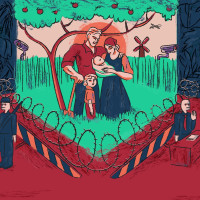
Illustration by Sana Nasir
Anti-gender mobilisation has become a defining feature of far-right movements since around 2015; and is now a tactic widely adopted by authoritarian governments across the political spectrum. From overturning abortion rights in the United States (US) to rescinding protection against domestic violence in Türkiye, institutions that defend women’s rights are being systematically dismantled. These patterns align with a global decline in democracy, with over 75% of the world’s population now living under restricted freedom. The correlation is not coincidental. As democratic institutions weaken, attacks on gender-based rights accelerate the decline and provide a roadmap for it.
Understanding this dynamic requires distinguishing between authoritarianism, a political mode that concentrates power and erodes democratic checks; and the far-right, defined by ultranationalism, rigid social hierarchies, and the belief that progressive values threaten civilisation. The two increasingly converge through shared anti-gender politics. Although anti-gender ideology is rooted in far-right worldviews, its tactics are attractive to authoritarian leaders of varying orientations because they offer emotionally charged justifications for centralising power and suppressing civil society.
For the far-right, patriarchal control is foundational. Fascist and ultranationalist movements have long treated the heteronormative family as a microcosm of the hierarchical society they seek to build. Women’s reproductive role, the policing of sexuality, and the ideal of demographic renewal are not peripheral policies but core ideological commitments. Yet the political convenience of anti-gender positions extend beyond this. For authoritarian leaders and other opportunistic actors, ‘gender ideology’ functions as an empty signifier: a deliberately ambiguous term into which diverse groups can pour their grievances while mobilising around a shared enemy.
This dual nature – an ideological bedrock for some, opportunistic tool for others – helps explains the power of the backlash. Framing gender justice as a threat to ‘tradition’ simultaneously mobilises far-right constituencies, supplies authoritarian leaders with a convenient wedge issue, and legitimises the dismantling of institutional checks and the protection of minorities. Once it becomes possible to restrict the rights of women and lesbian, gay, bisexual, trans, queer and other non-binary (LGBTQ+) people in the name of protecting families or children, the precedent is set for targeting any group that challenges authority.
This dynamic has enabled an unusually broad coalition. Religious fundamentalists provide moral legitimacy, mobilising believers through claims of divine order and their transnational networks. Far-right populists and authoritarian leaders weaponise the language of tradition to portray themselves as defenders of ‘ordinary people’ while using state power to erode rights. Gender-critical activists offer insider credibility, laundering extreme positions through the language of women’s safety. At the cultural level, social media influencers romanticise women’s domestic submission, while the online manosphere radicalises young men via viral misogyny and unfounded conspiracies. Underpinning these currents are billionaire funders and oligarchs who channel resources into think tanks, legal campaigns, and media ecosystems, transforming moral panic into concrete policy outcomes.
These narratives resonate because they redirect public anxieties during a period of overlapping crises, from economic precarity to declining political trust, towards convenient scapegoats. Rising inequality has created fertile ground for reactionary thinking, and demagogues both capitalise on these sentiments and actively cultivate them. Rather than confronting capitalism and democratic decay, they channel public frustration into moral panic, casting women, LGBTQ+ people, and the activists who defend them, as the source of social breakdown. The result is a systematic assault on the foundations of an open society, with women’s rights serving both as the initial target and the testing ground for broader authoritarian strategies.
This essay maps the contemporary anti-gender playbook: who is using it, the myths they deploy, and the tactics that move it from meme to ministry. It also traces the consequences for democracy and examines how feminist movements are building counterpower to resist its advance.
State of Power 2026

The Myths and The Machine
Across disparate political movements, three core myths have emerged, casting gender justice as a danger to the traditional family, the innocent child, and to ethnonationalism. These narratives overlap and reinforce each other, giving different actors a common vocabulary of fear without any need for coordination.
The Natural Family
A common myth across all anti-gender movements is that the nuclear family is the foundation of civilisation and is under systematic attack from feminism, LGBTQ+ rights, and progressive reforms.
Religious fundamentalists provide the ideological foundation for this myth, framing heterosexual, cisgender, nuclear families as the only ‘natural’ family structure. In the 1990s, the Vatican and conservative evangelical groups began advancing the spectre of ‘gender ideology’, the term used to describe ideas that separate gender from biological sex, challenge the ‘natural’ complementarity of men and women, and undermine a God-ordained family structure. Anti-trans and gender-binary arguments flow from this because they insist that ‘real men and women’ are fixed, binary, and essential for reproducing the natural family. Today, transnational networks like the World Congress of Families and their digital campaign allies such as CitizenGo coordinate messages from Eastern Europe to countries across the African continent: pumping money into Romania's 2018 referendum to ban same-sex marriage and lobbying for harsh anti-LGBTQ laws in Ghana, Nigeria, Kenya, and Uganda.
Populist ‘strongmen’ exploit the myth of the ‘family under siege’ to justify authoritarian measures as the defence of tradition. Leaders such as Hungary’s Viktor Orbán promote pro-natalist, ‘family-first’ policies, weaponising social security by rewarding heterosexual married couples for having children. Yet he bans gender studies, undermines educational freedom, and stops funding women’s shelters, thus increasing women’s economic dependence on men and the home, all under the guise of protecting tradition.
In Kenya, for example, a rising campaign against gender and sexual minority rights has been framed as defending ‘African values’ and protecting children, even as it follows a script written by US evangelical organisations such as Family Watch International and the American Center for Law and Justice (ACLJ), both active across East Africa. During the 2025 Pan-African Conference on Family Values, Kenyan officials and ultra-conservatives decried ‘gender ideology’ and sexual rights as an assault on African culture.
This ‘natural gender hierarchy’ is promoted and amplified online. On social media tradwife influencers romanticise ultra-traditional gender roles such as submission, domesticity, and motherhood as aspirational lifestyles, aestheticising conservative ideology using the imagery of care and femininity. They tap into people’s frustrations with capitalism; the overwork, isolation, and devaluation of care by retreating into dependency on men and framing patriarchy as the illusion of stability, while leaving the economic and gender inequalities that produced the crisis untouched.
Meanwhile, the manosphere tells disaffected young men that feminists and ‘modern women’ are to blame for their problems. Male influencers, sometimes called ‘alpha males’ or ‘red-pilled’ gurus, offer a steady diet of misogyny and conspiracy theories, from rants about women being intrinsically manipulative to claims that society oppresses men and favours women.ix They prey on economic anxieties (unemployment, frustrations about being unable to find a long-term partner) and redirect this anger towards feminism as the villain, encouraging a return to male dominance as the answer.
The manosphere and ‘tradwives’ reinforce the same political goal: retraining citizens in patriarchal hierarchy. As the seventeenth-century philosopher Thomas Hobbes argued, people must be conditioned to accept unquestioning authority through the paterfamilias – the father as absolute head of the household. This extends to democratic participation itself – echoing sentiments like those recently amplified by Trump's Defence Secretary Pete Hegseth, where pastors argue that votes should be made by fathers for their household, further silencing women and eroding democratic values.
The Innocent Children
Building on the narrative of the natural family, anti-gender movements whip up moral panic by portraying children as being under constant threat. Few myths are more emotionally resonant: after all, who would oppose protecting children? This narrative claims that only traditional patriarchal families can properly safeguard children from external corruption, making the family structure a matter of child survival. Religious and populist movements have strategically and deliberately elevated parenthood as a political identity and the child as a sacred figure around which coalitions can be built. While this framing also fuels racialised panics, such as recent attacks on migrants in the United Kingdom (UK) under the banner of ‘protecting children’, here it functions to recast women’s reproductive rights as a battle over children’s safety. Access to contraception and abortion gets framed not as health care or autonomy, but as selfish women ‘killing babies’ or betraying motherhood. Anti-abortion campaigns frequently deploy images of infant faces and hearts, implying that women who do not wish to or might be advised against, or are unable to carry a pregnancy to term are cruelly choosing their career or convenience over a child’s life. In this way, women’s bodily autonomy is painted as a form of callousness towards innocent life.
The flipside is that forced childbirth is promoted as ‘rescuing’ the unborn child – regardless of the cost to the real, living woman. In countries from the US to Poland to El Salvador, where abortion laws are among the most restrictive, proponents explicitly invoke ‘saving children’ to justify banning abortion, even when this threatens women’s lives.
Psychoanalysts such as Erica Komisar popularise a more subtle version of this myth, arguing that mothers who return to work too soon after giving birth harm their children’s mental health. By cloaking traditional gender roles in the language of psychology and child development, such narratives guilt-trip women for seeking autonomy and blame feminism for family breakdown.
Once the narrative of endangered children is established, it can expand in multiple directions. Autocrats have revived the archaic homophobic conflation of homosexuality with paedophilia, systematically painting LGBTQ+ people as inherent threats to children. Hungary’s government made adoption illegal for same-sex couples and effectively outlawed trans people from legally changing gender, claiming these measures keep children safe. Poland’s government deployed a propaganda film splicing a child’s cry for help directly after footage of Warsaw’s mayor signing the LGBT+ Charter. The implicit message was that queer rights are a direct danger to children. We see similar tactics elsewhere: sex education in schools is labelled as ‘grooming’ or ‘sexualisation’ of children; inclusive children’s books are denounced as pornography and banned, transforming abstract policy debates into visceral parental concerns.
The Great Replacement and Its Global Mirrors
Another persistent myth circulating in far-right discourse is the claim that white populations are being systematically replaced through declining birth rates and immigration. While it is true that birth rates are declining in almost every country, this shift is not itself a crisis. It reflects multiple factors, including the increase of women’s bodily autonomy, as well the conditions that shape people’s decisions about having children, such as economic precarity, inadequate care systems, and climate breakdown. Rather than confronting the structural causes, far-right movements misattribute falling birth rates to feminism, LGBTQ+ rights, and (non-white) immigration, reframing demographic change as evidence of social ‘decay’ or even a coordinated plot to destroy white civilisation. Within the digital ecosystem, the manosphere amplifies these conspiracies, feeding racialised and gendered fears and, in their most extreme forms, inciting violence in the name of ‘defending’ national or cultural purity.
This conspiracy has become a strategic link between anti-gender politics and white nationalist agendas, revealing how attacking women's rights functions as a gateway to attacking other minorities. Governments and populist or authoritarian leaders have contributed to its mainstreaming. In Italy, for example, politicians such as Matteo Salvini deploy replacement rhetoric to justify anti-migration agendas and to discredit feminist movements. During the ‘Unite the Kingdom’ rally in September 2025, a mobilisation of hundreds of thousands of far-right supporters, Tommy Robinson (whose real name is Stephen Yaxley-Lennon) and his allies frequently used language about ‘losing’ Britain (essentially England), being ‘taken over’ or ‘changed’ in ways that are irreversible. The adaptability of this narrative heightens its policy relevance.
Paradoxically, this narrative also operates in reverse in Global South countries, while keeping ‘replacement’ logic at its centre. As we saw in the example of Kenya, feminism is recast as Western or a white ideological project that threatens ‘African values’, and a similar narrative is used in countries across the North Africa and Middle East (MENA) region, such as Algeria and Egypt, as well as in religious nationalist movements like Hindutva in India.
The money behind the machine
How did these narratives and the concrete changes in policies become so prevalent worldwide? Hidden behind them is a sophisticated yet shadowy funding infrastructure, transforming the narratives from fringe ideas into mainstream policy. In the US, conservative foundations began building this apparatus in the 1970s and 1980s, but the effort intensified dramatically in the 2000s, both in response to United Nations declarations advancing gender equality and as part of broader far-right mobilisation following Obama's election. The infrastructure spans from universities to courtrooms, creating what amounts to an ideological assembly line. In the US, networks like the Koch foundation, Heritage Foundation, and Federalist Society have systematically captured institutions through decades of strategic funding. The majority of federal judges appointed by President Trump are products of the Federalist Society, including six Supreme Court justices who overturned Roe v. Wade. These networks fund law schools, groom conservative legal scholars, and create the intellectual scaffolding that makes reversing rights seem legally sound rather than ideologically motivated. The Alliance for Defending Freedom – a US-based conservative Christian legal group instrumental in the overturning of Roe v. Wade – set up a UK branch in 2015, where its expenditure surged by 187% between 2019 and 2023 (to £3.9 million).
Outside the US, the anti-gender ecosystem is bankrolled by a mix of religious networks, far-right oligarch philanthropy, and even mainstream corporate and government budgets. In Latin America, for example, core streams include the Catholic Church, private wealth and companies such as Mexico’s Grupo Bimbo, and spending through ministries of health or education, while significant European funders also resource campaigns across the region. Spain’s HaxteOir/CitizenGo has become a global petition and mobilisation hub with its Africa office based in Nairobi. The Brazilian-founded Tradition, Family and Property (Tradição, Família, Propriedade) operates an international network of groups advancing ultra-conservative family and property doctrines. Russian donors aligning with the Orthodox Church, such as the oligarchs Vladimir Yakunin and Konstantin Malofeev, financed transnational advocacy against gender justice. In the Gulf, the Qatari government funds the Doha International Family Institute, part of a broader pattern of Organisation of Islamic Cooperation that linked investments in ‘pro-family’ research and lobbying. Overall, the global revenue reached an estimated $3.7 billion between 2013-2017 alone, channeled to countries across Africa, Asia-Pacific, Europe and Latin America and the Caribbean, highlighting how non-US donors and venues are equally central and deeply embedded in the global infrastructure.
From Myths to Mobilisation
When anti-gender actors gain government influence, they systematically dismantle human rights infrastructure. Agencies and laws to protect women’s and minority rights are defunded, rebranded, or abolished. Domestic violence initiatives are reframed as ‘anti-family’ and defunded on the grounds that they promote divorce. Brazil’s former president, Jair Bolsonaro, closed the national women’s ministry and LGBTQ+ councils as part of his crusade against ‘gender ideology.’ The goal is clear – remove gender from the policy agenda by erasing the machinery that enforces it and eliminate spaces that empower women or question patriarchy.
Simultaneously, other actors co-opt the language of rights to legitimise exclusionary agendas. Sweden’s far-right deploys ‘femonationalism’, using gender equality rhetoric to attack immigration, claiming to protect white women from dangerous immigrant men. France invokes feminism to oppose Islamic dress. Groups identifying as gender-critical or TERF (trans-exclusionary radical feminists) increasingly distance themselves from the feminist language of women’s liberation altogether. Instead, they frame their positions through vocabularies of ‘rights’ and ‘protection’ – claiming to defend ‘women’s rights,’ ‘free speech,’ or ‘child safety’. This rhetorical shift mirrors the far-right and religious fundamentalist tactics of invoking protection to justify oppression. By appropriating the moral and legal language of human rights, these actors blur the boundaries between liberation and restriction. What sounds like the defence of rights becomes, in practice, the defence of hierarchy – a linguistic sleight of hand allowing authoritarian politics to masquerade as common sense.
Educational materials face heavy monitoring, with books being rewritten or banned if they acknowledge transgender people or historical sexism. Gender, race and sexuality studies, as well as comprehensive sex education, are being banned from primary schools to universities. The strategy is twofold: suppress knowledge that challenges patriarchal and majoritarian narratives and send a chilling message that even discussing gender or sexual diversity is unacceptable and dangerous. This is a direct assault on intellectual freedom, inclusive education and pluralism, the key pillars of any democracy.
Perhaps the most rapidly evolving tactic is the use of digital platforms and information warfare. Far-right actors exploit social media algorithms that amplify the most extreme, polarising material, creating radicalisation pipelines whereby users progress from seemingly harmless memes to hardcore misogynist beliefs. The manosphere churns out viral content attacking ‘feminazis’ and glorifying male dominance, while disinformation campaigns conflate sex education with pornography and homosexuality with paedophilia to stoke moral panic. What begins as memes framed as jokes or edgy contrarianism quickly becomes a channel to harder ideology.
Particularly vicious is the use of deepfakes and AI-generated sexual imagery to silence women and gender-diverse activists, especially those engaged in critique of powerful actors. One in six US congresswomen and over 30 female politicians in the UK have faced AI-generated sexual imagery designed to humiliate and silence them; 73% of women journalists worldwide experience online violence, with women of colour facing the worst abuse. An Amnesty International ‘Troll Patrol’ study found that female public figures received over one million abusive tweets in a single year – roughly one every 30 seconds. Many of these attacks are highly coordinated, suggesting the involvement of organised ‘troll farms’ often aligned with extremist or state interests. These attacks do not harm only the individual victims (and their families) but create a broader ‘chilling effect’, undermining democracy by intimidating half the population into withdrawing from public debate.
These digital tactics – algorithmic radicalisation, disinformation, harassment, and deepfakes – are not random but part of a broader authoritarian strategy: to bypass democratic deliberation and rule through fear and confusion. By ‘flooding the zone’ with emotionally charged falsehoods, they ensure that public discourse revolves around invented threats (e.g. ‘Save our kids from gay paedophiles!’) rather than real policy issues. By targeting and terrorising dissenters, they drastically narrow whose voices are heard, creating skewed ‘common sense’ where many citizens genuinely believe that legislation on domestic violence is anti-family or that feminism has made men the real victims. Once hate and misinformation are normalised, it becomes easier for authoritarians to take the next concrete steps, which are indeed their objectives: passing laws that majorities might otherwise question, and dismantling checks and balances that seem abstract compared to the fiery cultural battles consuming public attention.
The Toll of Anti-Gender Politics
The repercussions of this coordinated backlash are felt intimately in people’s lives and broadly in political systems. One of the clearest effects of the attack on gender has been the constriction of who participates in politics and civic life. Numerous women politicians around the world have resigned or retired early citing unbearable levels of harassment, including Finland’s former prime minister, Sanna Marin. Outspoken women journalists like Michelle Mendoza from Guatemala and Rana Ayyub from India have retreated from social media or investigative reporting after rape threats against them or their families. In some places, female activists must operate anonymously or risk arrest under religious morality laws.
When more than half the population is silenced or side-lined, driven out through online abuse, legal barriers, or physical threats, decision-making spaces lose not only those individuals but also the perspectives and priorities they represent, and democracy itself is weakened. Parliaments and councils become less representative. Policies that might have addressed women’s needs or rights are never considered, because fewer advocates remain at the table. The result is a thinner democracy, a system with fewer people heard, fewer rights secured, and fewer limits on those in power.
Rolling back protections correlates with increases in gender-based violence and attacks on the rights of marginalised groups. Indeed, countries that have tightened abortion restrictions or weakened domestic violence laws often see spikes in femicides and assaults, as reported in Indonesia by the Indonesia Femicide Watch. LGBTQ+ people, when stigmatised by law, face surging hate crimes – such as recent horrific attacks on queer spaces in Kenya, Nigeria and Uganda. When leaders signal that women’s rights are not a priority (or suggest that domestic abuse is not a crime), it emboldens abusive behaviour at home and in the streets.
Health systems suffer too. Restrictions on access to reliable contraception combined with abortion bans drive higher maternal mortality and trauma. Women with pregnancy complications may delay seeking care for fear of the legal consequences, sometimes dying as a result (as has happened in Poland, El Salvador, Ireland, and some ). HIV prevention and treatment programmes have been disrupted – clinics serving gay men have been raided or shut, outreach workers arrested, and trust between providers and patients destroyed. Even where medical care is still available, trans people avoid seeking it for fear of mistreatment or being outed.
At the same time, as civic space shrinks, it becomes harder for communities to respond to these challenges. If an authoritarian government won’t address a rise in domestic violence, normally non-government organisations (NGOs) or grassroots groups would step in with hotlines, shelters, and awareness campaigns. But if those organisations are defunded or criminalised (accused of ‘promoting divorce’ or ‘spreading Western ideas’), then there’s no one left to tackle the problem. In open societies, women’s organisations and local governments expanded services and ran public messaging to help. In more repressive settings, activists struggle to even get permission to keep shelters open, and some have been arrested for violating public-order rules when they tried to protest against femicides.
Societies grow harsher and more divided under these conditions. Trust between groups declines because the authoritarian narrative thrives on pitting ‘us’ against ‘them’. And so social cohesion frays, making it even easier for authoritarians to push the notion that only a strong hand (theirs) can maintain order.
The impact on the lives and bodies of women and girls is immediate and intimate. Traditionalist policies and cultural pressure channel women back into unpaid care roles, undermining their economic independence and reducing household incomes. Pronatalist incentives and restrictions on reproductive autonomy strip away choice, binding women’s futures to demographic or political agendas rather than personal aspirations. Violence and harassment, both online and offline, exacerbate these constraints, silencing voices and constricting possibilities. LGBTQ+ communities face exclusion from jobs, education, and health care, which in turn produces poverty, marginalisation, and heightened vulnerability to abuse.
The Counterpower: Feminist Resistance
The backlash is global, but so is the counter-mobilisation. Operating under severe constraints, from chronic underfunding, legal harassment, to blatant violence, feminist movements continue to defend and expand freedoms. They are not only resisting but also adapting and innovating. Understanding this resistance is crucial as it offers a blueprint for countering far-right actors and authoritarianism. In coalition with other social justice movements, feminist actors show what it takes to confront an existential threat to open society and human rights.
Equal Measures 2030 (EM2030) has tracked how democratic backsliding and setbacks to gender equality reinforce each other: 44 countries have stagnated or regressed. The direct attacks on feminist movements are real. Over 70% of United Nations Trust Fund grantees reported experiencing a backlash in 2024, ranging from systemic obstruction (budget cuts, policy freezes) to denial and distortion (token reforms, misinformation) and outright repression (evictions, criminalisation, cyber-attacks). In Bangladesh, groups that led the creation 2010 Domestic Violence Act faced shrinking civic space and were forced into safer service roles, while Nicaraguan feminists continue advocacy and care work in exile after mass crackdowns on activists and organisations. In Zimbabwe, years of repressive laws and volatile funding have fragmented what was once a strong women’s movement.
Far-right attacks are persistent and well-resourced. This is in stark contrast to the scarcity of resources for feminist resistance: only 3.9% of Official Development Assistance (ODA) has gender equality as a principal objective, and just 0.2% goes directly to feminist movements. Combined with shrinking civic space, sustained resistance can seem nearly impossible. Yet, as history has proven, feminist movements persist. Grassroots groups, lawyers, health workers, students, unions, and survivor-led networks build a repertoire blending lawfare, mass mobilisation, mutual aid, and transnational coordination. This is anchored in evidence because data and stories drive policy traction. These forces demonstrate that even under repression, feminist movements keep innovating strategies to safeguard not only rights but open society itself.
Legal and Judicial Resistance
The far-right's greatest success is in building permanent institutions beyond election cycles. Pro-democracy and feminist movements have begun to adopt similar long-term thinking. Legal advocacy has produced some of the most durable countermeasures. In Latin America, a region facing a strong backlash from religious conservatives, feminist litigation has fuelled landmark court rulings: a strategic lawsuit by coalition led to Colombia’s Constitutional Court decriminalising first-trimester abortion in 2022, citing women’s rights and equality; Mexico’s Supreme Court followed in 2023, striking down all criminal penalties for abortion. These victories expanded rights and set precedents inspiring activists elsewhere (the so-called ‘Green Wave’ for abortion rights across Latin America).
In France, women’s rights groups successfully pushed for a constitutional amendment in 2024 to enshrine the right to abortion and safeguard this against future far-right governments. In Indonesia, women’s legal aid organisations played a crucial role in drafting and passing the Sexual Violence Crimes Law in 2022; and now focus on training police and assisting survivors to ensure the law is implemented, effectively using the system to force reluctant authorities to act.
EM2030 case studies show that when movements are resourced, they build systems that outlast election cycles: In Canada, feminist coalitions secured a 10-year National Action Plan on Gender-based Violence (GBV) and the first national survey of trans and gender-diverse people, ensuring evidence-backed budgets. Traditional leaders in Malawi allied with girls’ rights groups to annul 3,500 child marriages and align the Constitution to set 18 as the legal minimum. Activists in Nepal managed to push women’s quotas to over 40% in local elections, and in Uruguay, the National Integrated Care System reframes care as a right and has expanded access, thanks to years of feminist coalition-building.
These legal efforts, while slow, technical, and under-recognised, create durable change. They outlast a given administration and affirm that women and men are equal citizens and that violence is unacceptable, influencing social norms over time.
Protest and mobilisation
The tradition of feminist street protest remains strong. For example, Spain’s 8M marches continue to tie reproductive justice, care, and labour equality together. In Kenya, the largest anti-femicide protests in the country’s history forced femicide onto the national agenda, despite violent police crackdowns. In Türkiye, the We Will Stop Femicides Platform documents killings and continues its protests despite government withdrawal from the Istanbul Convention, detentions, and a looming closure case. And in Argentina, Ni Una Menos (Not One (Woman) Less) redefined the discourse on violence, forcing femicide and state accountability into the mainstream, even as the Milei government dismantles gender institutions.
Where authoritarianism closes civic space, resistance adapts. After the Taliban banned girls’ education and women’s work, Afghan women ran underground schools and online classes. Despite new surveillance and penalties for unveiled women, Iranian women and girls persist in ‘Woman, Life, Freedom’ defiance. Ugandan feminists and queer activists document and challenge the sweeping 2023 Anti-Homosexuality Act, even as it raises the risks of public organising.
These protests visibly manifest public support for equality. They inspire people, draw in the unconverted, and make it harder for leaders to pretend that opposition is just a few ‘NGO feminists’.
Direct service provision
When states abandon services, feminist groups step in, providing care and building forms of mutual aid that function as political resistance. The US, since the overturn of Roe v. Wade, exemplifies this: with abortion banned or severely restricted in many states, a network of abortion funds and practical support groups expanded overnight to secure access through travel and medication sent by mail. They raised millions through grassroots donations, set up hotlines, and coordinated volunteer drivers and hosts across state lines. By 2023, medication-induced abortions accounted for 63% of all US abortions, much of it enabled by these networks quietly working around new laws.
In Poland, cross-border pill-sharing networks and hotlines run by Abortion Without Borders keep care accessible under a near-total ban. Feminist groups also keep domestic violence shelters and rape crisis centres open when governments defund them. In many countries, the only services for survivors are run by women’s NGOs. In parts of sub-Saharan Africa or South Asia, feminist NGOs operate the only hotline or shelter in an entire region, scraping by on foreign grants or donations, especially when governments either do not allocate funds or actively cut them. This kind of work does not make the international headlines, but it is lifesaving and community-building. It quietly builds a constituency – every woman who gets help becomes a potential supporter for the cause, even if silently. Some feminist scholars call ‘the resilience of the infrastructure of dissent’.
Transnational Solidarity
While authoritarian leaders and far-right movements promote nationalism and isolationism, feminists leverage international connections to outflank them. As the anti-gender groups coordinate globally, the resistance does too, albeit with far less money.
Some of the starkest resistance come from cross-border organising. In The Gambia, coalitions of survivors and rights groups successfully defeated a 2024 parliamentary attempt to repeal the national ban on female genital mutilation/cutting (FGM/C). In neighbouring Sierra Leone, activists and survivors took their case to the ECOWAS Court, which in July 2025 ordered the government to criminalise FGM, declaring it a form of torture. These regional rulings show how feminist actors use transnational forums and solidarity networks to block or reverse regression. ODI Global’s research shows that transnational civic space and support from diaspora activists enable women’s voices to be heard despite domestic constraints.
These examples show that just as authoritarian and far-right actors build coalitions to erode rights, feminist movements build alliances to defend gains, support those being harmed, and resist backsliding. The intensity of anti-gender mobilisation is itself evidence of progress: patriarchal and far-right actors push harder when feminist ideas have taken root, and real political change has begun.
Feminist movements recognise that authoritarianism and fascism do not falter through symbolic representation or superficial inclusion, but through sustained struggles for justice, material security, and equality. Far-right ideas thrive on division, scapegoating, and manufactured fear – they weaken when people have rights, protections, and the social conditions that make solidarity possible. If the rights of one group can be dismantled, all are at risk. Resisting this therefore requires strengthening the political, social, and economic foundations that allow every group, every woman, to live with dignity and without fear. Feminist resistance that is diverse, intersectional, and grounded in care and justice, offers a clear path to confronting far-right movements.
Further reading
To State of Power 2026-
Lifeboats, steampunk and colonialism – fascism today A conversation with Alberto Toscano and Harsha WaliaPublication date:
-
Publication date:
-
Follow the money: The business interests behind the far right Interview with Théo BourgeronPublication date:

-
Authoritarian Extractivism in India Land, Energy, and the Making of a Far-Right Development RegimePublication date:
-
Fascist by design Italy’s Lessons for Neoliberal DemocraciesPublication date:

-
Mirror and Mismatch China and the global politics of the far-rightPublication date:
-
Techwashing and fascist politics A case study of Israel’s ‘Start-Up Nation’Publication date:
-
The Rise of the Techno-Tyrants Silicon Valley’s right-wing past, present and futurePublication date:
-
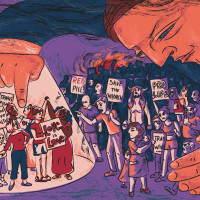
Weaponising Gender How gender became the perfect scapegoat for far-right and authoritarian actorsPublication date:
-
‘For some of us, it was always like this’ Anti-migrant politics as a fascist touchstonePublication date:
-
The New Blood and Soil Nature, culture, and eco-fascism on the identitarian rightPublication date:
-
Is Our Homeland the Other? Care as a response to hatePublication date:

-
Against the Stage Towards a Politics Beyond PerformancePublication date:



Credits
Authors
-
Julisa Tambunan
-
Aminah Jasho
-
Esme Abbott
Julisa Tambunan (she/they) is the Deputy Executive Director and Head of Partnerships and Learning at Equal Measures 2030, a global feminist coalition advancing gender equality through the power of data. For nearly two decades, she has worked across the Majority World alongside marginalized communities, holding power to account through journalism, humanitarian response, feminist organizing and movement building.
Aminah Jasho (she/her) is the Head of Strategic Communications at Equal Measures 2030 and the founder of Unmothering the Woman, a feminist storytelling platform reimagining motherhood, care, and reproductive justice. For over 15 years, Aminah has led transformative communications across movements, coalitions, and campaigns, working at the intersection of gender justice, narrative change, and data-driven advocacy.
Esme Abbott (she/her) is the Communications Lead at Equal Measures supporting the development and implementation of communications and advocacy strategies for EM2030. She has experience supporting youth-focused organisations and using data-driven advocacy to advance gender equality and the Sustainable Development Goals. Esme is also the Co- Founder of Postcolonial Encounters, an awareness-raising project aimed at dismantling colonial structures in our global systems.
ACKNOWLEDGEMENTS: Thank you to NOOR for financial support and to the following for reviews and comments on drafts: Anuj Vaidya, Francesco Martone, Ilias Alami, Josephine Solanki, Max Haiven and the Editorial Advisory Board
EDITORIAL ADVISORY BOARD: Abigail Taylor, Anuradha Chenoy, Deborah Eade, Helen Lackner, Naureen Shameem, Nuria del Viso
ILLUSTRATOR: Sana Nasir
SUPPORTED BY: NOOR – www.wearenoor.org