
Is Our Homeland the Other? Care as a response to hate
Topics
Could feminist care ethics provide a framework for listening and engaging with far-right supporters, that could build understanding, relationship and ultimately undermine fascist support?
Longread by


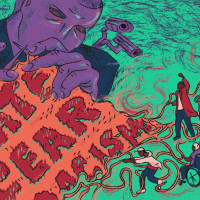
Illustration by Sana Nasir
In July 2025 a few Telegram and Instagram accounts connected to the organisation ‘Deport them Now’ called for an immigrant ‘hunt’ in Torre Pacheco, a municipality in the Spanish regionof Murcia. They set the dates for the 16, 17, and 18 July, but the fascists could not wait, and the police therefore had to activate security protocols before that. The violence lasted for several days, leading to numerous victims and several detentions. These events are, to some extent, new in Spain, but the number of hate crimes was already high: almost 2,300 in 2023.
The situation is no different in other countries. In the United States (US) alone, more than 300 acts of extreme violence are inspired by the far right every year, including a rising number of cases considered as right-wing terrorism. We all remember the fascist attack on the US Capitol on 6 January 2021. Far right violence has also been rising in Argentina (310 recorded cases sdince 2020), as part of the wave that brought Javier Milei to the presidency. The trend includds the attempted assassination of the former president Cristina Fernández in 2022.
This violence is only the tip of the iceberg - hate has become part of ‘the new normal’. Elon Musk makes a Nazi salute. Javier Milei wields a chainsaw. Far-right politicians say ‘immigrants steal our jobs’, ‘blacks ask for special treatment’, ‘trans people destroy family values’, and the crowds go crazy, especially online. Hate has become one of the central pillars of far-right discourse and practice. A recent publication by CLACSO explains that in many Latin American countries, including Argentina, ‘the rapid expansion of the far right has the aim of turning violence into a permanent feature of social life and presents a real threat to democracy’.
Our societies are fracturing, and we can clearly see this in these three countries. While the far right is describing immigrants, LGBTQ people, and racialised communities as unwanted company, and receiving rising levels of support, they also accuse ‘wokes’, intellectuals, activists, and any left-wing politician of facilitating ‘the great replacement’, disseminating ‘gender ideology’ and a whole range of ‘dangerous’ societal changes.
On the left of this political divide, we often see far-right supporters as morally twisted and/or stupid, and maybe it is true. But it is also true that in practice, the social bonds between the two poles are being burned down daily by the way our lives are organised both online and offline. We do not even spend time with ‘them’, we do not talk to each other, we listen even less. Yet democracies are based on the opinions of everyone, so even if we believe some people are losing touch with the real world, who is benefiting from this situation? The far right.
The rising support for extremism has allowed it to reach the presidency of two of the three countries I examine in this essay. Those who would previously vote for political options not based on (explicit) hate are now giving it a chance. My question is the following: what do we – those on the left – do with these new supporters of hate politics? Should we just focus on defending their target populations (the weak and disadvantaged) and on building alternatives and hope on this side? Should we merely focus on strengthening our own communities and collectives? These are certainly fundamental tasks, but neither are preventing the rise of the far right nor reducing polarisation. Do we even have a plan? Should we merely accept the growing separation and strengthen one side while giving up on the other?
My answer is no. We need to respond to hate with care, from the perspective of Feminist Care Ethics. If we hate back, or if we cancel or lecture far-right supporters, then we are only making things worse and also reacting in ways that are essentially patriarchal. I am perfectly aware that many readers will not support this conclusion, and that is fine. I also know that the talk about care, listening, relationships, and interdependence might sound repetitive, superficial, and too ‘woo-woo’ for some. In my experience, we are increasingly using these terms too often and too superficially. But there are strong feminist arguments in favour of moving beyond patriarchal standards of rationality, truth, duality, independence, and confrontation. Such a radical shift in our ways of thinking and doing will generate resistance and will be hard to put into practice, but the stakes are high, and I suggest that we should try.
State of Power 2026

We Respond in Patriarchal Ways
The discussions about how to respond to the rising support for the far right have been ongoing for some time. Proposals range from the French cordon sanitaire to fact-checking by journalists and politicians, offering the material security that has been lost, taking legal action, improving media literacy, etc. But what about progressive activism? How are we responding? Are we merely reacting, or do we have a plan?
A couple of decades ago, to be an ‘antifa’ would typically (although not exclusively) mean to confront extremist groups, mainly on the streets; to have a presence that would outnumber haters, to dissuade them. Today, such a practice might no longer make much sense: it is often seen as a macho response that does not reflect the spirit of our times. Also, it could be too risky in some countries like the US, where guns are in anyone’s hands and dangerous militias have been linked to the president. Finally, most hate – arguably – happens online, and strategies need to be more nuanced.
The far right operates under dualistic patriarchal assumptions of us vs. them, and we on the left often buy into this way of thinking. In this essay I am deliberately replicating that view to illuminate the point. As social movements, political parties, and individuals we often have an adversarial discourse towards the far right. When we hear, or see, or suffer something harmful, racist, homophobic, unjust, discriminatory, etc., we often hit back. We accuse them (not just the leaders, but also their supporters) of being immoral, mean, stupid, and so on. We openly confront, criticise, say how morally sick they are. We engage in heated discussions claiming that their views are unacceptable. We do as Hillary Clinton did, when she called Trump supporters ‘a basket of deplorables’.
On other occasions, we cut ties with them, including family members or friends. Both online and offline, we cancel, we unfollow, we block, we stop talking to them. We break relationships and build our own cordons sanitaires. That makes total sense because we become tired and afraid. This type of reaction is, however, also rooted in dualistic and punitive views of our societies, which are also fundamentally patriarchal.
Yet we sometimes feel stronger and find our centre to offer rational arguments: we do fact-checking, explain the same argument over and over again. We talk about injustice and discrimination, trying to convince or educate by assuming recourse to the truth. Again, this kind of response is based on a patriarchal view or morality where impartiality is the only valid criterion.
All three types of reaction are more than understandable, and often necessary: the discourses and practices of the far right may trigger us in many ways. We do what we can and what we have learned to do. However, we need to distinguish between how we feel and how we should act. It is only human to feel anger, fear, or self-righteousness. But if we respond with confrontation, cancellation, or rely on rational justifications, we are also using patriarchal tools: all of them assume all-or-nothing situations, separation between us and them, disconnection, lack of understanding, the existence of a moral or empirical truth.
If instead we were to adopt the perspective of Feminist Care Ethics, we would argue that social relations matter, in addition to being right. Through this lens, we can also start to understand why our responses to the far right are not working.
By this I do not mean that the left are not focusing their energy on more feminist ways of doing politics: we practise care, we dedicate our energies to strengthening our communities and collectives, we join forces with other progressive groups, we imagine innovative strategies to build collective power through cooperation, we sustain those who are in need. We know how important political reproduction is for long-term political action, and sadly (but also luckily) often the harshest situations increase our creativity and our imagination: our communities are building strength in new ways against the threats of the far right. So why does this approach stop when we relate to those on the other side? Do we even want to expand our care?
A Feminist Care Ethics
In a White-dominated Euro-centric culture, we are used to associating what is right (ethics) with justice, at both a personal and at a political level. As activists, we often articulate our discourses, practices, and strategies in response to an injustice that needs to be dismantled or a specific harm that needs to be addressed or prevented. In most cases, the reason why we become activists is that we have a deep sense of justice. This way of thinking is extremely useful, but it is not problem-free. To understand why, we need to track where it comes from.
This kind of moral talk comes from two main theories: deontologism (famously defended by Immanuel Kant) and consequentialism (Jeremy Bentham and John Stuart Mill), which were developed by many others after them. They are based on the idea that we need to take an impartial, general, and rational perspective in order to see what is right and wrong in the world; and that justice is based on respecting rights or maximising positive consequences. This applies to liberal theories, including egalitarian as well as to Marxist and republican ones, where the aim is to break alienation and/or relationships of domination. Some strands of feminism are also based on these assumptions.
But this is just one possible way of seeing the world. From the perspective of care-based feminist ethics, we take a particular perspective in which emotions, necessity, and responsibility are central. Even more importantly, this ethical perspective is based on relational ontologies: we exist only in relation to others and we are only because they are. This kind of view is defended – with differences – by some popular feminisms in the Global South, such as by certain ecofeminists in Latin America. In addition to social and gender justice, they are grounded in a relational praxis and narratives, centred on communities and territories. In this specific case, they associate some of their central claims, including food and territorial sovereignty, not only with justice, but also with the daily work of caring for what is around us, ancestral spirituality and emotion – challenging colonial ways of thinking and being, which are based on the perspectives of privileged white cis-men (who seldom assume these reproductive roles).
In the 1980s, some US feminist writers such as Carol Gilligan and Virginia Held started to question mainstream justice-centred accounts, arguing that these were not neutral ethical positions, because they were based on the experience of (certain) men who occupy a restricted public sphere; and ignored other ways of evaluating what is right or wrong in daily life. In contrast, (and similar to the popular feminisms mentioned above) a Feminist Care Ethics relies on the experience of those who are commonly responsible for care and social/political reproductive work. Here, we are all seen as vulnerable, partial, and interdependent; and that is intrinsically valuable, in addition to being a better depiction of reality. No one, not even ideally, can live on their own. These feminists argue that justice is important, but that there is no need for justice if no one does the care work of sustaining life. We are all interrelated and interdependent in myriad ways (even privileged white men, who probably do not see it). According to these feminists, our actions need to take into account relationships, needs, and emotions into account, and pay attention to how we all depend on each other. This does not mean no longer thinking and acting in terms of justice. But we also need to think and act in ways that are guided by care, and there will be many tensions between the two.
What is the meaning of this kind of ethics for activist practice? We need to include this care-based perspective in our work in general, thinking, feeling, and doing. To organise not only because of what is just or what will bring about the best outcomes, but also looking at the relationships of interdependence within our collectives/organisations, with the rest of society, and – probably the most difficult – with our political opponents.
In particular, when addressing the far right, but mainly their supporters, we need to realise that we all co-exist; we exist only because they do. We depend on each other in complex ways and on numerous levels, and none of us can escape this kind of interbeing. We take our children to the same schools, we walk or drive along the same streets, we pay taxes (or not), we eat what they cook, transport or plant, they buy what we sell, we vote in the same electoral systems. But more importantly, we define ourselves as activists in opposition to how they define themselves. We adjust our discourses, thoughts, and practices depending on what they do – and they do the same. They support right-wing supremacists because they feel unsafe in the face of numerous causes and conditions, most of them beyond their individual control. They vote for the far right because it speaks to those feelings, but also because the left does not take them seriously, and sometimes even humiliates them in different ways, treating them as intellectually and morally inferior.
What would it mean, then, to care for far-right supporters? According to Held, a care ethic is based on the values of sensitivity, empathy, responsiveness, and taking responsibility. This can be applied not only to the private domain, but also to public contexts and institutions, even at the global level. We can choose to be guided by these values and foster caring relations while limiting actions that undermine them at all levels. We need to see ourselves as immersed in multiple communities, including a global one that is both responsible for and vulnerable to the current and future climate crisis. We need to take responsibility – if we can – not only for those who think like us, but also for those who do not, especially once we can see that failing to do so only deepens the fractures in our societies, with all sorts of electoral and policy-related consequences.
Maybe these statements sound too obvious or too naïve. But is it weak or incredibly bold to use care as a medicine to repair our broken societies? These are deep and complex questions, and I can only sketch some answers here, because we need broad collective reflections. Nevertheless, I propose three starting points.
We Listen to Understand
First, we need to listen. How can we convince far-right supporters to view others as equals worthy of respect and care if we fail to understand them? The first time that I read a serious defence of this kind of proposal was in Valarie Kaur’s book, See No Stranger. After suffering violence committed by white supremacists and by a male member of her own Sikh community, and also researching racist violence in the US after 9/11, she says that the way out includes listening to our opponents. If she can do that– I thought – I must at least try.
Left-wing activists, politicians, and analysts are often quick to classify right-wing supporters as people who have been alienated, convinced, co-opted, and manipulated by far-right leaders. Communication strategies are in fact manipulative; they can help normalise discourses that should not be acceptable and can even lead people to use physical violence. Nevertheless, we need to understand why people are so frustrated, and why they feel so vulnerable and hateful. This does not mean legitimising the arguments that they offer, but also not lecturing them. We need to assume that they can change their opinions in the future and first we need to listen with an open mind.
I am not saying that the emotions or opinions of a white angry guy who votes for far-right parties are more important than the suffering of others, especially those who are more vulnerable because of their positionality. Of course, he has certain privileges, and he should try to dismantle them. He is also responsible for addressing his own trauma rather than holding opinions that hurt others. But my point is that if we see him only in terms of justice or consequences, we are missing an important point related to the embeddedness of his reality and the impossibility of disentangling him from the relationships of which he is a part. Are we – the left – doing or saying things that humiliate him? Are we ignoring his needs and assuming he is fully autonomous? Do we share any kind of suffering with him?
The key challenge is the following: Can we listen to people who defend racist, or misogynist, or homophobic views, not to lecture, but to understand? Valarie Kaur says that this deeper listening can give us insights that we otherwise lack. Studies have included this as a key element of ‘deep canvassing’ (respectful and non-judgemental conversations in order to influence people’s voting intentions), and show that it is effective. Maybe it could also help us start seeing the world through another’s eyes, and to start mending broken social relationships.
Some might say that it is not the role of victims to listen to the perpetrators or oppressors, and I agree. We need to be in a certain place, emotionally and structurally (and this is deeply related to the next point about trauma and care, below). But, from an intersectional perspective, not all left-wing activists are victims themselves, and in any case we cannot describe our positionality in dualistic terms. The polarisation that we see in Argentina, Spain, and the US is not between the privileged and the dispossessed, and maybe not everyone can start listening – but some of us do, in some contexts. The claim that none of us has the responsibility to listen because we already hold the truth is based on a perspective that misses the multiple ways in which we inter-exist with far-right supporters. If we practise generative listening, maybe we can even start seeing ourselves and our collective future possibilities with new eyes.
Finally, in order to listen to others, we need not only to not only pay attention when they are speaking, but also to create the spaces and conditions for everyone to feel safe to speak their minds. We need to ask real questions – not make passive-aggressive statements ending with a question mark. Perhaps we can start by changing our approach when we come across people we already know, like friends and family. But more generally, we need to open physical spaces of encounter to break down the media echo chambers, where we can spend time with others who hold views different from our own. What this means more concretely is necessarily a local question.
We Take Care to Find Strength
Having the curiosity and the will to be with people we strongly disagree with and to listen to them is really hard for most of us. Depending on our positionality, it can be even harder and sometimes also too dangerous, for instance, if we are undocumented and/or racialised.
But even if that is not the case, we might be emotionally unprepared. As activists, we sometimes feel that things are too much to even think of listening. We are already helpless and hopeless; we already have a sense that we can never do enough; we are already hypervigilant; when things become difficult, we can already see how our creativity diminishes; we are sometimes unable to embrace complexity; we minimise other people’s suffering in order to keep on going, because it can be too much; we are sometimes chronically tired and we have all sorts of physical ailments; we already feel guilt, anger, cynicism; we already feel difficulty with empathising; we already feel that our work is too important to stop or change course. As common as they seem, according to Laura van Dernoot Lipsky, these can all in fact be signs of activist secondary trauma: a set of transformations suffered by people who work in environments where they deal with the suffering of other beings or the planet.
But again, if we are unable to move away from these mental or physical spaces (and maybe many of us cannot, which is fine), it means to a certain extent that we are giving up on those on the other side, and we are not addressing the widening gap that separates us from them. What do we need, collectively and individually, to be able to open our minds, hearts, and will so we can listen to and connect with those who support extreme right-wing views?
From the perspective of the nervous system, it is very hard to care about someone if we are in a fight-or-flight mode: when the sympathetic nervous system is active and the para-sympathetic one shuts down. We just want to run away, or we are so angry that we cannot hold back our rage and we offload all these feelings on the person in front of us. If we want to be with people and to listen to them, if we want to care for them, we need to shift our system to a rest-and-digest mode, because only then are we able to connect with others.
Does this mean that we should start skipping activist meetings so we can just do yoga and breathing work? No. This is not a call for spiritually bypassing or a defence of cheap individualistic and consumerist self-care choices where everything is solved with bubble baths and baking.
In reality, what we are asked to do is much harder than what we are used to. We need to tackle our trauma and burnout individually but also collectively if we want to be in a place of openness and solidity. We need to check that our collective practices do not contribute to stressing us, exciting our rage and self-righteousness, so that we can feel more at ease and can have a more nurturing attitude towards ourselves and the world. Instead of suppressing our emotions, we need to be present to our own suffering and the suffering of others. This is a huge source of energy to address the deep challenges of our times.
Some years ago, together with Irene Zugasti and Alejandra de Diego we published the Feminise Politics Now! handbook, listing practices that activists were already implementing in order to make their organisations more feminist, many of which can be useful in this context. However, what it means to practise (individual and collective) self-care to open our minds and hearts is a question to which, again, we need to respond from the embedded positions that we currently occupy as people and as organisations/communities.
We Realise Interdependence to Build Power
Even if we were able to cancel all our far-right friends and family members, and all other members of our community who support fascists, we still depend on each other in multiple ways, as I have already outlined. We could move to another country, but hate politics is rising almost everywhere. We cannot escape it. Is it possible to resist this basic feature of our current reality?
I suggest that before (or while) we begin to question our individual and communal roles in relation to right-wing supporters, we need to realise our interdependence. The challenge is that, even if we rationally understand that we all depend on each other, we need a deeper understanding for it to work. We all remember how clearly we saw our interdependence when the COVID-19 pandemic took us by surprise. Suddenly, we were aware of those who transported things that we needed, cleaned our streets, took care of our children while we were working, grew our food, and far more. We already knew this, but then we actually felt it, and something clicked. And we acted accordingly at many levels. We can start by realising interdependence rationally, but we cannot stop there.
bell hooks explains in her book All about love that the commitment to thinking and behaving, honouring the principles of inter-being and interconnectedness, is first and foremost a spiritual task. But she explains that spirituality is not a New-Age commodity; it has to do with the practice of love within the community. It is a deeply political practice connected to ending domination and oppression and is intimately connected to the practice of building power. She believes that love is the principle and the destiny, and that we need to embrace ‘a global vision wherein we see our lives and our fate as intimately connected to those of everyone else on the planet’ (p. 88) – including far-right supporters, we might add.
Realising interdependence is the ground on which we need to step to even want to start rebuilding our broken societies. Maybe it can also be a motivation to do the necessary personal and collective self-care that is needed to centre and open ourselves up to views that are opposite to our own. As Joanna Macy explains, once we realise that our self has different layers and we are able to widen our sense of self to include others, then maybe we no longer see our actions towards them as altruistic, but as normal: like doing things for ourselves.
Becoming aware of our interdependence is key to building power. But here, we are not talking about power over others, this is, the patriarchal notion that tells us that power is an all-or-nothing game where some rule and others are ruled. The word power comes from the Latin verb potere, which means to be able. When we are able to broaden our sense of self, we sometimes feel the emergence of something bigger than the sum of its parts, and we can do new things. Joanna Macy calls it emergence, while Otto Scharmer calls it presencing, and both have spent decades developing concrete practices, based on the wisdom of Indigenous peoples, to gain that kind of collective perspective through The work that reconnects and Theory U. Here, power is a verb, rather than a resource. When we emerge as a collective self, then we can do things that we could not do before.
Even if they use other terms, these reflections and notions might sound familiar to experienced activists in some parts of the world. However, at least in my experience, we often tend to see them as possible only within our own circles. Again, what this would mean in terms of reconnecting to the other side is a big question that we need to ask locally, based on our own circumstances and possibilities.
Conclusion
As one of my friends likes to say, the most basic form of care is ‘to give a shit’ about someone. In that sense, my main claim here is that we need to give a shit about far-right supporters if we want to stop this wave of hate. We will not be able to achieve that by merely speaking to them (especially not by attacking or lecturing them), but by deeply listening to understand, so we can then imagine new pathways. And we will only be able to listen if we collectively find a place of security and solidity where we can open our minds to what we are so far unable to get.
As I said at the beginning, in a democracy we count everyone’s vote. This is how it works. We cannot build democracies only for those who agree with us, even if left-wing discourses sometimes seem to imply that. And this is not a weak or naïve position to take, but a very radical one. Many people think that activism means mainly fighting to win and doing good stuff, because we are right. This only shows the extent to which we are embedded in the patriarchal and capitalist logics that rule the world.
If we look deeply, we will see that we are all ‘inter-are’ with far-right supporters, and we cannot run away. We will see that we are because they are. We will see that our own ways of doing things are part of the system that we want to dismantle. But if we build the personal and collective strength to connect with each other, we will also find the space to practise care; we can perhaps expand our notion of the self to include our immediate communities, and also our opponents. And maybe then we can perceive the others as our homeland – as the former Argentinian president Cristina Kirchner said in 2023.
Further reading
To State of Power 2026-
Lifeboats, steampunk and colonialism – fascism today A conversation with Alberto Toscano and Harsha WaliaPublication date:
-
Publication date:

-
Follow the money: The business interests behind the far right Interview with Théo BourgeronPublication date:

-
Authoritarian Extractivism in India Land, Energy, and the Making of a Far-Right Development RegimePublication date:

-
Fascist by design Italy’s Lessons for Neoliberal DemocraciesPublication date:

-
Mirror and Mismatch China and the global politics of the far-rightPublication date:

-
Techwashing and fascist politics A case study of Israel’s ‘Start-Up Nation’Publication date:

-
The Rise of the Techno-Tyrants Silicon Valley’s right-wing past, present and futurePublication date:

-
Weaponising Gender How gender became the perfect scapegoat for far-right and authoritarian actorsPublication date:

-
‘For some of us, it was always like this’ Anti-migrant politics as a fascist touchstonePublication date:
-
The New Blood and Soil Nature, culture, and eco-fascism on the identitarian rightPublication date:

-
Is Our Homeland the Other? Care as a response to hatePublication date:

-
Against the Stage Towards a Politics Beyond PerformancePublication date:



Credits
Authors
Laura Roth is a feminist researcher and activist based in Argentina. She holds a PhD. from Universitat Pompeu Fabra and has been a postdoctoral researcher at Universitat Autònoma de Barcelona. As an activist at Barcelona en Comú, she co-founded the international Fearless Cities network, the Feminisation of Politics network, and the Minim municipalist observatory.
ACKNOWLEDGEMENTS: Thank you to NOOR for financial support and to the following for reviews and comments on drafts: Anuj Vaidya, Francesco Martone, Ilias Alami, Josephine Solanki, Max Haiven and the Editorial Advisory Board
EDITORIAL ADVISORY BOARD: Abigail Taylor, Anuradha Chenoy, Deborah Eade, Helen Lackner, Naureen Shameem, Nuria del Viso
ILLUSTRATOR: Sana Nasir
SUPPORTED BY: NOOR – www.wearenoor.org