
The rise of global reactionary authoritarianism
Topics
The rise of authoritarian leaders worldwide is the result of an economic and political system of neoliberalism running out of steam and unable to tackle the crises of inequality, precarity, climate collapse and social anxiety that it has created.
Longread by


Illustration by Sana Nasir
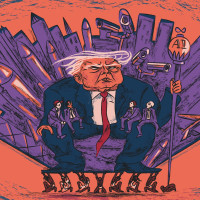
President Donald Trump’s 2024 election makes him only the second US president since 1892 to be re-elected after a previous defeat. His victory offers insights for a clearer understanding of the new cycle we are in, propelled by the race to the bottom that marks the systemic crisis of capitalism.
We should not view Trump solely as the Republicans’ Frankenstein, but rather as the embodiment of a phenomenon – reactionary authoritarianism – that is spreading beyond US borders. It is essential to analyse the victories of Bukele, Bolsonaro, Milei, and Trump not as accidents in the politics of their respective countries, but more broadly, as a political outcome of the attempt to stabilise the structural crisis of capitalism. A crisis marked by the impasse of neoliberal governance and its authoritarian variations, the climate emergency, and the decline of US global hegemony, which, in turn, gives it certain idiosyncratic traits and a planetary scope.
Trump’s ‘Make America Great Again’ (MAGA) slogan is indicative of the current historical moment: the decline of empire. The world in which the US has long dominated global culture and politics is slowly giving way to a new one. Destabilisation is now so severe that we may well be at a turning point in world history. The neoliberal policies that have prevailed since the 1980s are floundering, and the balance between the world powers established following World War II is now broken.
To continue serving the interests of the dominant classes, neoliberalism has taken an authoritarian turn. The structural crisis of capitalism has worsened, pushing aside more progressive neoliberalism and the various colourful waves of globalisation and reinforcing the dynamics of coercion over seduction. The balance between seduction and coercion, which has been a constant in the historical development of capitalism, has clearly moved towards the authoritarian side. Owners have capital have stepped up their offensive to take over all forms of government in order to ensure the restoration of a savage capitalism in which the laws of the market prevail over social rights. In short, this is an attempt to abolish what Marx described as the ‘victories of the political economy of labour’ to reinstate the political economy of capital.
With each passing day, there is increasing evidence – scientific and empirical – of the ecological emergency we are facing, from the major floods in Porto Alegre in Brazil to those in Valencia in Spain, among many other catastrophes related to global heating. These do not merely herald a grim future, but are the current reality, in which ‘the tension between the development of an industrial market society and the biological limits of nature has reached a point where the forces of production have become forces of destruction’. This growing authoritarianism is part and parcel of the ecological crisis, which has profoundly changed the meaning of Francis Fukayama’s ‘end of history’ – from a utopian future of perpetual progress and democracy to a threatening future of unsustainability in the ‘Capitalocene’.
The gap between the ever-fewer who are integrated into the global economy and the growing numbers who are excluded from it is one of the main characteristics of our time. The result is an accelerated process of concentration and ‘oligarchisation’ of power (political, economic, symbolic) and an exponential increase in inequality to a point where it stigmatises and even criminalises people – such as migrants or those living in poverty – who are shunted aside in this savage competition.
This makes it abundantly clear that the existing political blocs have run out of steam, incapable of responding to and/or channelling the distress of growing sectors of society that have been ‘dislocated’ in the structural crisis of capitalism. This is fuelling the radicalisation of the newly impoverished middle classes along with the already displaced working classes, who vent their discontent through a new form of authoritarianism that focuses not on the future, but on the past – a sort of reactionary nostalgia that offers reactive security in an insecure world.
State of Power 2026

The oligarchisation of politics
Since the 1960s, the wealthy have invested vast sums in a tight net of foundations, lobbies and think tanks that have laid the cultural and programmatic foundations of the conservative revolution, all based on their growing financial power. This trend has intensified since the 2010 US Supreme Court decision that made it easier to increase campaign spending. This ruling ushered in the era of mega-donors and a cycle of unprecedented political expenditure in which billionaires and corporations influence politics as never before in an accelerated process of oligarchisation and plutocracy.
Trump’s 2016 election took the oligarchisation of US politics one step further. The exponential rise in campaign spending was accompanied by what Dylan Riley calls ‘political patrimonialism’ – in which there is little or no distinction between public and private interests, and where Trump ran his first presidency as if it were one of his own companies:
Trump’s notion of government is precisely patrimonial, in this sense. For him, the relationship of the staff to the leader is not an impersonal commitment to the office of state but “a servant's loyalty, based on a strictly personal relationship”. In short, it is familial’.
In the 2024 US presidential campaign, an additional factor was the direct involvement of Elon Musk, the world’s richest man. Musk invested an estimated US$ 300 million in supporting Trump’s candidacy – and even bought votes in key states such as Pennsylvania. He also used X (formerly Twitter), the social media platform he purchased in 2022, as a powerful electoral weapon in the Republican candidate’s favour. This illustrates that Elon Musk uses his privilege to pay to make the world more to his liking, in terms of both his financial interests and his ideological beliefs. Anti-democracy tech multi-millionaires are investing billions and using their companies to sway electoral results in a genuine revolt of the mega-privileged.
Faced with mediocre growth of profits and lower capital accumulation, a sector of the capitalist class has seized direct control of the state apparatus with the aim of using public resources for its own enrichment. Dylan Riley and Robert Brenner refer to this process as ‘political capitalism’:
‘Under political capitalism, raw political power, rather than productive investment, is the key determinant of the rate of return. This new form of accumulation is associated with a series of novel mechanisms of politically constituted rip-off. These include an escalating series of tax breaks, the privatization of public assets at bargain-basement prices, quantitative easing plus ultra-low interest rates, to promote stock-market speculation—and, crucially, massive state spending aimed directly at private industry, with trickledown effects for the broader population’.
In this context, the state apparatus seems to be the only way for transnational capital to survive in the protracted structural crisis of global capitalism. This is where the accelerated process of oligarchisation and plutocracy comes into play, with the ultra-rich and huge corporations intervening and making decisions in the political arena as never before. Francisco Louça brings an interesting nuance to Riley and Brenner’s concept of ‘political capitalism’. He points out that it is precisely a specific fraction of capital, namely the big tech corporations, that most benefit from these politics – and which also control the (re)production of hegemony that seeks to distracts us, and, even more so, through narcissistic alienation. This is the only way to explain why it is precisely the super-oligarchs who own communication and social media networks that control people’s lives and who will never relinquish this supreme power. This has given rise to a form of social control unparalleled in human history.
In light of this, Donald Trump’s second inauguration, where the front seats that are usually reserved for former presidents and distinguished figures were occupied by the owners of big tech corporations, makes even more sense, and signals a new era. Not only because of the role of lieutenant to the US president played by the world’s wealthiest tech oligarch, Elon Musk, who was omnipresent as the head of the Department of Government Efficiency (DOGE) during the first months of Trump’s second term, although less so after an impetuous initial spurt; but also because of the definitive inclusion of big tech’s corporate power in steering global capitalism.
In less than a decade between Trump’s first and second term in office, we have seen the far right grow in strength and, perhaps more importantly, gain new legitimacy around the world. Trump and other members of the reactionary wave are now viewed as legitimate – often privileged – spokespersons for the global elite. They all stand with Trump. Silicon Valley’s spectacular switching from pro-Democrat to pro-Trump Republican is a crucial development in contemporary US politics.
This super-oligarchy is expanding its power through so-called ‘platform capitalism’, which has reconfigured economic, labour, and social relations and consolidated a means of accumulation based on massive data extraction, the power of algorithms, and the dismantling of labour rights. Corporations such as Alibaba, Amazon, Google, Meta (Facebook, Instagram, Messenger, Threads, and WhatsApp),Uber and the rest are clear examples of a paradigm in which the centralisation of platform capitalism and related technology is becoming an instrument of control and surveillance, often beyond the reach of state regulation.
The authoritarian nature of platform capitalism can be seen in many dimensions. In relation to labour, the ‘work on demand’ model heightens job insecurity, eliminates social benefits, weakens trade unions, and fragments the workforce. These platforms essentially redefine the terms of democratic debate, as they have the power to shape public visibility. Facebook, YouTube, X and all the rest control the algorithms that determine which content will be circulated, when and how. This has significant impacts on public opinion – at least for the growing number who rely on social media for their information and opinions. Cases of electoral manipulation such as the Cambridge Analytica scandal in the UK’s 2016 Brexit vote, the disinformation campaigns during the COVID-19 pandemic, and X’s modification of its algorithm to favour content that Musk himself wants to promote illustrate how these platforms are used to deliberately erode democratic debate.
Authoritarian capitalism, illiberalism and the asphyxiation of liberal democracy
Nancy Fraser’s concept of ‘authoritarian capitalism’ describes the growing disconnect between capital and democratic institutions, whereby the state no longer acts as a mediator of social and economic interests, but rather as a facilitator of corporate capital by repressing resistance and externalising social and ecological costs. As the economist Dani Rodrik argues, ‘either you have globalization or you have democracy’, pointing to the impact of decades of financial globalisation on democratic institutions. In the words of Francisco Louça:
‘If globalisation goes unchecked, sovereignty and democracy will be limited … One of the effects of this crisis of democracy is the rise of the far right. But the destruction of the state’s economic capacity also undermines democracy. The financial economy destroys the possibility of people defining their future’
Karl Polanyi had long predicted that in a market economy, freedom would degenerate ‘into a mere advocacy of free enterprise’, which means ‘the fullness of freedom for those whose income, leisure and security need no enhancing, and a mere pittance of liberty for the people, who may in vain attempt to make use of their democratic rights to gain shelter from the power of the owners of property’. This is why the utopian liberal vision can be sustained only through force, violence, and authoritarianism. ‘Liberal or neoliberal utopianism is doomed’, in Polanyi’s view, ‘to be frustrated by authoritarianism, or even outright fascism’.
Authoritarian capitalism is not, therefore, a simple regression to earlier forms of domination. It is a new variant, in line with Polanyi’s approach to late capitalism, which combines neoliberal elements with centralised, exclusionary and punitive state practices. Governance is shifting towards technocratic and private networks, in which economic criteria are replacing political debate.
The rise of Trump, Bolsonaro, Bukele, Erdoğan, Milei, Meloni, Modi, Netanyahu, Orbán and Putin are just some of the major expressions of a global reactionary wave of authoritarian capitalism, which has contributed to the spread of a new concept: illiberalism. This authoritarianism is expanding across the entire political map, far beyond the confines of the far right. As the sociologist Cas Mudde argues, the new far right is a radicalisation of mainstream views, not in opposition to them.
The US political scientist Fareed Zakaria coined the concept of illiberalism back in 1997. He defined it as a form of government somewhere between traditional liberal democracy and an authoritarian regime, a system in which certain aspects of democratic practice are respected, such as elections, for example; but other equally fundamental principles, such as the separation of powers – legislative, executive, and judicial – are ignored, along with the violation of civil rights. In recent years, in which the far right has been brought to power in various liberal democracies, we have seen how it has gone down the illiberal path, attacking the independence of judges and the media, disregarding minority rights, and undermining the separation of powers.
Attacks on the rule of law and the freedoms of minorities have been a constant in all far-right governments. Government leaders such as Trump and Orbán have all made the assault on democracy their leitmotif. The illiberal regime that the far-right parties seek to establish has one specific characteristic: basically ethnocracy – nominally democratic but in which the domination of a particular ethnic group or identity is structurally determined. Here, all the anti-migration or anti-foreigner and anti-minority rhetoric takes on strategic importance for the far right, as it is no longer a matter of xenophobia that might be broadly based on economic concerns. It also involves a form of nativism that seeks to safeguard a national identity linked not only to a single ethnicity but also to a whole litany of cultural, religious or social ‘values’.
To understand the emergence, internationalisation, and force of this global wave of reactionary authoritarianism, we need to analyse the expansion of the neoliberal model of governance for over 40 years, and its influence on the formation of a deeply anti-democratic political culture. The relentless efforts of neoliberalism to expand the state’s role in commodification – as well as private economic actors moving to ensure that public authorities and institutions serve their interests – has led to replacing regulation and the most minimal distribution mechanisms with the ‘free’ market and protection of property rights. Together, they have constituted an assault on political life, the concept of equality, and the commons. In this accelerated process of the oligarchisation of democracy, neoliberal ‘anti-politics’ is driving the spread of anti-democratic authoritarianism.
It has become commonplace for staunch neoliberal conservatives to question the concept of social justice. An obvious example is Javier Milei in Argentina, who regards the family as the central plank in his social reorganisation plan. We can’t forget the ‘ordoliberal’ dream is of a market-based order, governed by an economic constitution and guided by technocrats, in which the family is an essential element of social organisation because it makes workers more resilient to economic downturns and more competitive in the face of economic adjustments.
When the mechanisms of social cohesion cease to function and it becomes clear that the former prosperity of the middle classes cannot be sustained, authoritarian measures are reinforced to preserve order. At the same time, there is a need for scapegoats (certain minorities, migrants and asylum seekers, feminist movements, LGTBQI+ people) to channel the rage of the declining middle classes towards those just below them. This phenomenon is not entirely new, but it is accelerating and evolving in parallel to the demise of the belle époque of blissful globalisation.
The ‘crisis imperialism’ of the twenty-first century is no longer just about plundering resources. It also strives to isolate the centres hermetically from the ‘superfluous’ humanity produced by the dying system. Protecting the few remaining havens of relative wellbeing is a key element in imperialist strategies, which involves reinforcing measures of security and control that feed a rise in authoritarianism. Good illustrations include the increased tightening of migration legislation in the European Union (EU) as ‘Fortress Europe’ and the policy of offshore migration centres, , which Trump is also promoting in conjunction with Bukele in El Salvador. These are just two examples of ‘necropolitical’ neo-colonial ways of controlling migration.
The global wave of reactionary authoritarianism has not emerged in a vacuum. It is deeply marked by the neoliberal radicalisation resulting from the 2008 global financial crisis and its consequences, namely the brutal increase in inequality, the accelerated destruction of social welfare, and the ‘dislocation’ of people, businesses, and even ecosystems from their places and ways of life. A series of profound economic and social developments have brutally upended politics by destroying old party-based loyalties and consensus and producing tectonic movements and unpredictable realignments. Neoliberal anti-politics are at the basis of the rise of anti-democratic authoritarianism championed by the far right.
The ‘dislocated’ and reactionary rage
Globalisation has created winners and losers not only on the global gameboard, between the centre and the periphery, but also within the supposedly ‘winning’ countries, where there is a profound split between those who are positively integrated into globalisation and those who have been displaced by it. The spread of neoliberalism has generated a growing social divide in the labour market, whereby large sectors of society can no longer find their place, which in turn forces them into even more insecurity and lower living standards. Hence, the surge in discontent:
‘Displacement does not determine that one will vote for the progressive disruptive option or the reactionary disruptive one. Instead, it tends to steer people towards the protest vote or abstention out of disillusionment [...] Similar to the working class, young adults, another large sector of this dislocated group, are in conflict with their relation to work. But in their case, it is because of their inability to enter the labour market or because they do so in conditions well below their qualifications and social background.
The votes of the dislocated are therefore decisive for winning elections because they are found across different social classes and their numbers continue to swell amid rising precarisation. The Brexit vote in the UK and Donald Trump’s first election will be forever linked as two electoral earthquakes that marked 2016 and that political analysts were unable – or unwilling – to see. They occurred within months of each other and were driven by a similar electorate: voters displaced by globalisation who turned their anger into a protest vote.
In the wake of the 2024 US elections, a CNN exit poll revealed a very telling piece of information: 72% of those who voted said they were dissatisfied or angry about how things were going in the US. Once again, anger was key to the success of Donald Trump, who reprised his 2016 formula to attract and mobilise protest votes from across essentially white working-class and middle-class voters. A year earlier, Javier Milei had won the elections in Argentina thanks to a real protest vote, in a reactionary revival of the crisis of 2021, with no masses on the streets, but with a lot of social frustration’. This frustration gave rise to ‘authoritarian neoliberal individualism’, in which Milei’s perceived virtue was that he represented anti-politics and anti-politician sentiments.
This anger gradually turns into a reactionary rage, as people believe that they will never be rewarded in the same way as their parents and grandparents were. According to a recent survey of young people in Australia, Brazil, Finland, France, India, Nigeria, the Philippines, Portugal, the United Kingdom (UK) and the US, ‘[a]round 75% of the interviewees agreed with the statement “the future is frightening”, and more than half felt that they would have fewer [sic] opportunities than their parents’. Similarly, a 2021 survey undertaken by Fondation Jean-Juarès indicated that 76% of French citizens believed that France was in decline, and 70% affirmed that ‘things were better before’.
The far right feeds on the states of mind captured in these surveys, based on the trope of scarcity – ‘there isn’t enough for everyone’ – to justify a proposal that no longer aims to improve most people’s lives, but to simply prevent them from getting worse. This perverse logic pits the poorest against those just above them: who should be protected by the broader society and who should be deprived of this protection? In its current phase of authoritarian neoliberalism, late capitalism is characterised by what the sociologist Saskia Sassen calls a dynamic of expulsions. The expulsion from the ‘welfare state’ of many sectors of society who had previously been integrated but who are now ‘too many’. Expulsions that for some, in particular migrants and those seeking asylum, also mean physical borders.
The model of expulsion and the questioning of the very right to have rights ensure that the reactionary rage caused by neoliberal policies is directed at the weakest (migrants, foreigners, or simply ‘the other’), exonerating the political and economic elites, the real culprits of the pillaging. Because if ‘there isn’t enough for everyone’, it is because there are too many people: ‘we don’t all fit’. A thin line connects the fiction of the policy requirement for austerity to that of exclusion, gradually going from the incriminating visibility of vagrant beggars to the calm invisibility of confined poverty; and from addressing the latter through the welfare state to fighting it by deepening the police state, which stigmatises and criminalises people living in poverty. Exclusion from society at large is legitimised by the energy of resentment and reactionary rage, which are key to understanding the current rise in xenophobia.
The ecological crisis and the (retro)utopian promise of a ‘return to the past’
The rise of authoritarianism is, as we said earlier, part and parcel of the ecological crisis, which has changed the very meaning of ‘the end of history’. This ‘end’ is no longer understood as a utopian future of perpetual progress and democracy, but as a threatening one marked by anthropocenic unsustainability. Immanuel Wallerstein has long argued that the cyclical crises of capitalism would become increasingly frequent as they collide with the planet’s limits. We can now see this collision in the increase in extreme climate events – such as droughts, floods, heat waves, or famines – caused by the ecological crisis.
The awareness of the fact that nature is finite and that there are limits to how much we can transform, disrupt, and squeeze out of it has thrown into crisis the very paradigm of ‘progress’ on which modernity has been built. While classic fascism proposed a vision for the future, the current far-right manifestation, faced with growing fears of an uncertain future marked by climate breakdown and a world in crisis, proposes a return to an ‘abundant’ past, at least for the ill-named ‘Western civilisation’; a reactionary proposal that connects with the capitalist utopia of unlimited growth; and of authentic (retro-)utopias, those nostalgic for the state as the protector of the native population. If we can no longer aspire to have a better life than our parents, at least we can hope to live like they did. The expectation is no longer to improve, but to avoid getting worse.
The current reactionary moment revolves around the promise of a return to the past to bring back a way of life that was supposed to be guaranteed and that now appears as though it is being denied. The anger at this loss generates a sentiment of grievance, of their rights being ignored, among sectors that had historically enjoyed relative privileges. In fact, the great triumph of this reactionary wave, which Trump exemplifies, is its resuscitation of an authoritarian view of the aspirational lifestyle promoted mainly in the US, based on consumption, stable employment, and access to material goods: the so-called ‘American way of life’, which seemed to be on its last legs.
Just when the promise of the American dream is becoming more difficult to fulfil as the assumed US way of life is further eroded, figures who incarnate the image of US success in all its splendour and excess appear. Trump’s MAGA slogan and its European adaptation, ‘Make Europe Great Again’, clearly reflect this idea of a return to the past. It is an essentially decadent message, the expression of power and grandeur that have been lost and that will never return. Thus, the far-right glorification of the past is also a strategy to suppress the possibility of imagining a different future.
While most people around the world are aware of climate change, it is telling that the more the climate worsens, the more climate denial grows. This is because when people are faced with the fears and uncertainties raised by the planet’s limits and the ecological crisis – which is ultimately the outcome of the systematic crisis of capitalism that fosters an increasingly reactionary subjectivity – the far right offers both a response and an alternative: an (impossible) return to an ‘abundant’ past, a promise to restore a way of life that people currently believe they are being denied, while blaming climate policies for the loss of ‘our way of life’.
This is where Milei’s war cry ‘Long live freedom, damn it!’ takes the form of a Hayekian appeal. It articulates an ‘authoritarian freedom’ that expands the private sphere to limit the scope of the political; and calls into question the very existence of the social. It also seeks to intensify reactionary and social sentiments that care nothing about tomorrow, the planet or future generations. This aim to revive a growth-based ‘way of life’ in the face of an ecological crisis is, as Wendy Brown explains, ‘inflected by humiliation, rancor, and the complex effects of nihilism’ […] ’spurred to aggressions unfettered by concerns with truth, with society, or with the future’.
Climate denialism thus feeds the discontent of those who feel threatened by policies to mitigate global warming. -from farmers’ tractor protests across rural Europe to people who oppose low-emission zones in urban centres. The concept of ‘authoritarian freedom’ is used as an ideological tool to justify nihilistic stances: ‘I’ll pollute what I want’, ‘when I want’, ‘because it’s mine’ and ‘it’s my individual freedom’. It is where, as Herbert Marcuse explained, the market acts simultaneously as both the reality principle and the moral truth.
Climate denialism has become one of the weapons in the so-called culture wars, in which different discourses are woven together to form an ideology of denialism. Words are not used to describe what exists. Rather, we are witnessing the spread of denialism as an ideology, as an irrational way of being and seeing the world, which the far right propounds and exploits to mobilise passions and voters.
Denialism refutes the existence of climate change and its anthropogenic nature, questions the need for green policies, and minimises the risks of ‘business as usual’. It also associates climate policies with supposed elitist or globalist interests to tap into the current anti-establishment revolt that is fuelling the rise of the far right. This allows them to direct farmers’ discontent about climate-related policies rather than against free trade agreements (FTAs), and drivers’ opposition to low-emission zones rather than cuts in public transport.
A good example is how the former Bolsonaro government used climate denial as the perfect alibi to denounce the supposed ‘globalist’ attacks on Brazil, represented by international organisations. It allowed it to develop a discourse defending ‘national’ sovereignty over the Amazon region to fend off international criticism of deforestation, violence against Indigenous peoples, or the entry of agroindustry and agribusiness interests. Mining and agri-food transnationals were delighted by this denialist policy, which violates the rights of Indigenous peoples in the region.
The exponential growth of far-right forces at the international level has inspired a wealth of literature – articles, books, and analysis – on the parallels between the current global reactionary wave and the fascism of the past. This is understandable: the analogy takes us to familiar terrain to analyse the unfamiliar, or at least the new. But this is precisely the problem: we get caught up in the meaning and analysis of the metaphor.
It is true that many of the passions that mobilised older forms of fascism are seen in the new radical right, but there are also important differences that point to a new phenomenon. Whereas fascism proposed a plan for the future, today’s reactionary authoritarianism responds to growing fears about an uncertain future marked by climate change and a world in crisis by proposing a return to the past that seems to promise security in an increasingly precarious world. But this security is built and sustained on the insecurity of those defined as ‘the other’.
Hence, in the face of the fears, uncertainties, planetary limits, and the ecological crisis, the far right offers an answer and an alternative to regain control: authoritarianism, predominated by a few ‘hyper-predatory super-monopolies’, as Cédric Durand defines them,whose leading representatives are Donald Trump and Elon Musk. Far from being viewed as an anomaly, the rise of far-right authoritarian forces should be understood precisely as a logical consequence of the systemic crises we are experiencing. These forces signal a new era: one of reactionary authoritarianism, in which nostalgia for an idealised past becomes the lifeline to cling to in a world in flames.
Further reading
To State of Power 2026-
Lifeboats, steampunk and colonialism – fascism today A conversation with Alberto Toscano and Harsha WaliaPublication date:
-
Publication date:
-
Follow the money: The business interests behind the far right Interview with Théo BourgeronPublication date:

-
Authoritarian Extractivism in India Land, Energy, and the Making of a Far-Right Development RegimePublication date:
-
Fascist by design Italy’s Lessons for Neoliberal DemocraciesPublication date:

-
Mirror and Mismatch China and the global politics of the far-rightPublication date:

-
Techwashing and fascist politics A case study of Israel’s ‘Start-Up Nation’Publication date:
-
The Rise of the Techno-Tyrants Silicon Valley’s right-wing past, present and futurePublication date:
-
Weaponising Gender How gender became the perfect scapegoat for far-right and authoritarian actorsPublication date:
-
‘For some of us, it was always like this’ Anti-migrant politics as a fascist touchstonePublication date:
-
The New Blood and Soil Nature, culture, and eco-fascism on the identitarian rightPublication date:
-
Is Our Homeland the Other? Care as a response to hatePublication date:

-
Against the Stage Towards a Politics Beyond PerformancePublication date:



Credits
Authors
Miguel Urbán Crespo is a former Member of the European Parliament for The Left (2015-2024). He has written several books of essays, including El viejo fascismo y la nueva derecha radical (Sylone, 2014) and Disparen a los refugiados. The Construction of Fortress Europe (Icària, 2016). His latest book is Trupismos, Neoliberales y Autoritarios (Trupisms, Neoliberals, and Authoritarians).
ACKNOWLEDGEMENTS: Thank you to NOOR for financial support and to the following for reviews and comments on drafts: Anuj Vaidya, Francesco Martone, Ilias Alami, Josephine Solanki, Max Haiven and the Editorial Advisory Board
EDITORIAL ADVISORY BOARD: Abigail Taylor, Anuradha Chenoy, Deborah Eade, Helen Lackner, Naureen Shameem, Nuria del Viso
ILLUSTRATOR: Sana Nasir
SUPPORTED BY: NOOR – www.wearenoor.org