
Authoritarian Extractivism in India Land, Energy, and the Making of a Far-Right Development Regime
Topics
Regions
Fascism does not only express itself in nationalist rhetoric, persecutions of minorities or the undermining of democracy, but also in how it transforms land, water and energy systems. India under the BJP has intensified a system of authoritarian extractivism that dispossesses marginalised communities behind a rhetoric of civilisational ascent.
Longread by


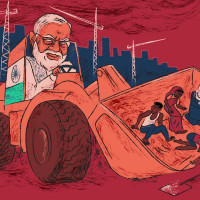
Illustration by Sana Nasir
Authoritarianism is often described through familiar institutional markers such as weakened courts, executive dominance, media capture, police impunity, and the shrinking of civic space. These dimensions matter, but they do not tell the whole story. Authoritarian projects are sustained not only by nationalist rhetoric or electoral strength but by material transformations of land, water, forests, and energy systems. What distinguishes the contemporary Indian moment is that extractive statecraft is being reorganised within a far-right political formation. Procedural acceleration under previous regimes was framed as technocratic growth; the far-right adds an identity grammar that transforms technical projects into moral imperatives. Development becomes proof of Hindu civilisational ascent; dissent becomes disloyalty not only to the state but to the Hindu nation; and specific groups – Adivasis (Indigenous peoples) who resist, Muslims who occupy contested land, ‘outsiders’ framed as threats – are marked as impediments to national destiny. This identity-centred justification intensifies the delegitimisation of dissent and expands the moral license for coercive extraction.
India is a critical site for understanding this dynamic. Since independence, major infrastructure projects – dams, steel plants, ports, mines, special economic zones (SEZ) – have been justified in the name of national development. But over the last 40 years, the relationship between extraction and politics has sharpened in distinct ways. Land acquisition has become more central to statecraft; dissent is more frequently recast as obstructionist or ‘anti-national’; public finance increasingly protects private investors; and new forms of surveillance and policing shape how communities resist. These trends pre-date the present government but have intensified under it, producing what can reasonably be described as authoritarian extractivism: a development regime that combines accelerated appropriation of land and resources with the political logic of majoritarian nationalism.
This essay aims to show that the Hindutva variant differs in practice from neoliberal forms of accelerated extraction associated with centrist or technocratic governments. While procedural compression, investor de-risking and fast-tracking clearances have been features of many developmental states, the far-right adds an ideological and organisational scaffolding that changes both effects and targets. The far-right inflection works by (1) sacralising certain projects within a majoritarian cultural narrative so that opposition is delegitimised as betrayal; (2) prioritising dispossession that simultaneously reorders citizenship and belonging; and (3) enabling networks of state and extra-state actors – vigilantes, corporates with political clout, sympathetic judicial interventions – to close off democratic redress in ways that earlier neoliberal projects did not systematically institutionalise.
This Indian trajectory has more than domestic implications. The historical durability of the Rashtriya Swayamsevak Sangh (RSS) networks, India’s economic footprint, and dense diasporic and institutional ties with English-language policy circuits make its far-right model a potential source for lessons, templates, and instruments for other states and corporate actors worldwide.
State of Power 2026

What is ‘Authoritarian Extractivism’?
India’s contemporary conflicts over land, forests, water, and energy unfold within longer histories of resource-led development, but they are now shaped by a political logic that earlier literature on ‘extractivism’ or ‘authoritarianism’ treats only partially. Classic accounts of extractivism emphasise the appropriation of land and commons, the restructuring of institutions to enable capital flows, and the displacement of environmental costs onto marginalised groups and populations. They help explain why dams, mines, industrial corridors, and now renewable energy parks, consistently produce dispossession. Yet these accounts often bracket the political cultures and ideological forms through which dispossession becomes legitimate.
Conversely, work on authoritarianism focuses on electoral manipulation, institutional capture, media control, and the repression of dissent. It illuminates how coercive power is consolidated but tends to treat infrastructures, land acquisition, and ecological transformation as secondary rather than constitutive.
Bringing these strands together clarifies something that neither captures alone – the way large-scale resource projects can become a primary vehicle for producing authoritarian authority itself. When megaprojects are framed as national destiny, as climate necessity, or as civilisational renewal, resisting them becomes politically risky. Protestors are recast as obstacles to development, as agents of external influence, or as threats to social cohesion. This discursive reframing is not rhetorical excess; it is a political technology that enables states and corporations to reorganise territory while narrowing the legitimate space for democratic contestation.
The term authoritarian extractivism therefore refers to a political configuration in which infrastructures, regulatory reforms, investment pipelines, and public narratives are aligned to expand state–corporate control over land and resources, while simultaneously contracting the space for democratic negotiation. Extractivism supplies the material project; authoritarianism supplies the enabling political environment; and each deepens the other. This is not a regime type but a mode of governance that can arise within formally democratic settings, provided that institutions, finance, and ideology converge to privilege accumulation-by-dispossession.
In this sense, authoritarian extractivism is a useful lens for India today because it makes visible the linkages across what appear to be disparate conflicts. Disputes over dams, solar parks, Indigenous territories, ports, conservation enclosures, and urban demolitions often share the same pattern, of discursive delegitimising of dissent, procedural shortcuts, financial de-risking for private actors, and the increasing involvement of security, intelligence, or judicial bodies in matters that were once considered developmental or environmental. In far-right projects, these structural mechanisms are ideologically weaponised to produce moral clarity on who belongs, and who does not, thereby legitimising dispossession in a way that aligns with a majoritarian political programme.
Gujarat as Template: How Development Became a Cultural Project
Gujarat’s experience with the Sardar Sarovar dam on the Narmada River is useful because it shows how developmental conflict can be reframed as a cultural and moral question. During the 1980s and 1990s, resistance to the dam, led by the Narmada Bachao Andolan (NBA), collided with a political project that sought to define Gujarati identity around pride, modernisation, and Hindu unity. This convergence would later shape national politics, but in Gujarat it first became visible.
What makes Gujarat foundational is that the Bharatiya Janata Party (BJP) transformed a conflict about development into a vehicle for consolidating a Hindu majoritarian bloc – something qualitatively different from earlier Congress-era developmental authoritarianism. The dam was not only an infrastructural promise; it was woven into a far-right narrative of Hindu resurgence, Muslim exclusion, and regional pride. This linking of territory, identity, and infrastructure became a hallmark of India’s far right extractivism.
The Sardar Sarovar Project (SSP) was promoted as a civilisational undertaking, a lifeline that would irrigate drought-prone regions and lift the state into a new era of prosperity. State agencies, business associations, and regional media repeatedly portrayed it as the embodiment of Gujarati aspiration. Questioning the dam was therefore recast as questioning the future of Gujarat itself. This moralisation of development made the cost of dissent unusually high, long before coercive measures were deployed.
The NBA’s critique – which focused on displacement of Adivasi communities, submergence of forests, flawed environmental assessments, and inequitable resettlement – ran headlong into this cultural scripting. Activists were branded ‘anti-Gujarat’, ‘anti-development’, or simply outsiders manipulated by urban non-governmental organisations (NGOs). Ground-level accounts show that dissent was reframed as betrayal, closing political space. This rhetorical move mattered because it blurred the line between disagreement and disloyalty, allowing the state to treat legitimate democratic protest as obstruction.
The political climate of Gujarat in this period made such delegitimising easier. The decades-long reorganisation of caste coalitions had weakened the Congress Party’s KHAM alliance (Kshatriya–Harijan–Adivasi–Muslim), which previously gave marginalised groups leverage in the state. As this coalition frayed, the BJP positioned itself as the representative of Gujarati pride, offering a unifying Hindu identity that transcended caste divisions. Developmental projects like the SSP became symbolic anchors for this identity. They allowed the BJP to articulate modernisation, cultural assertion, and territorial transformation within a single narrative.
Institutional power followed. Over time, courts, police, and administrative bodies increasingly approached the dam as an unquestionable imperative. Critics describe how hearings became formalities, environmental conditions were waived, and accountability mechanisms were weakened. The state maintained a procedural façade – impact assessments, resettlement packages, legal appeals – but these processes often concluded with the affirmation of the project, even when evidence suggested otherwise. This combination of administrative narrowing and rhetorical delegitimising effectively closed space for dissent, pushing opposition into smaller pockets of civil society and among affected households.
Internal fissures within the NBA further reduced its leverage. Some Adivasi communities viewed the movement’s urban leadership with suspicion; others found state compensation insufficient but saw few viable alternatives. The movement’s heavy reliance on legal strategies – operating within the language and timelines of state-defined proceduralism – meant that once courts favoured the project, pathways for resistance narrowed further. The result was not simply defeat but fragmentation, as communities faced difficult choices shaped by coercion, inducement, or fatigue.
None of this was unique to Gujarat. Displacement struggles have long confronted similar dynamics across India. What made Gujarat distinctive was the tight fusion of cultural nationalism with the politics of development. The dam became a symbol of collective pride, a vehicle for reconfiguring caste alliances, and an instrument for marking political insiders and outsiders. State coercion and non-state vigilantism operated alongside this ideological framing, reinforcing a climate in which development projects could be pursued with limited accountability.
When Narendra Modi became Chief Minister in 2001, these dynamics intensified. The SSP featured prominently in his political rhetoric, framed as evidence of decisive leadership and Gujarat’s exceptionalism. Administrative reforms centralised authority, accelerated clearances, and curtailed spaces for negotiation. These practices later travelled with him to Delhi – not as a blueprint to be copied wholesale, but as a political sensibility. Gujarat, in this sense, functions as an early crystallisation of a political logic that now shapes conflicts across India.
The following section shifts from this regional narrative to the national landscape, where these patterns appear not as isolated incidents but as recurrent features of India’s resource politics.
India’s National Landscape: A Resource Politics of Everyday Dispossession
If Gujarat revealed a political logic, the national picture shows its scale. Across India today, struggles over land, water, forests, and urban space form a dense map of conflict. Land Conflict Watch, a national database maintained by a research collective tracking land and resource disputes, shows hundreds of ongoing conflicts involving infrastructure, power projects, mining, conservation zones, and industrial corridors. They reveal what development looks like on the ground, with competing claims over territory, the defence of the commons, and the incremental shrinking of political space for those already at the edge of citizenship – Adivasi communities, pastoralists, small farmers, informal workers, and urban residents without formal tenure.
Across these conflicts, several recurring features stand out. First is the centrality of infrastructure. Highways, logistics hubs, industrial corridors, ports, and urban re-development projects account for a large share of land acquisition. In many regions, these projects are promoted as evidence of a country moving forwards – proof of modernisation and global competitiveness. But the lived experience is more ambivalent. Infrastructure often re-routes rivers, fragments grazing lands, or displaces neighbourhoods that lack formal titles. In peri-urban areas, residents may be served eviction notices only after construction fences appear. The legal status of land, whether it is recorded as public, private, forest, pastoral, or ‘wasteland’, frequently decides whose rights count and whose can be overridden. For many affected communities, development arrives not as opportunity but as a tightening circle of enclosure.
Second is the growing weight of energy projects, especially renewable energy. India’s energy transition has been framed as both a global climate responsibility and an economic opportunity. Wind parks in coastal districts and solar installations in semi-arid regions have expanded rapidly. Yet these projects often require large tracts of contiguous land, and the burden of acquisition falls on pastoralists, Dalit agrarian labourers, and Adivasi farmers whose livelihoods depend on common lands. In Rajasthan’s desert districts, for example, solar parks overlap with grazing routes used by nomadic herders. In Kutch, on India’s western coast, wind turbines have been erected on lands historically used by Maldhari pastoralists; the installation of security posts and fencing alters not only access but the symbolic meaning of the landscape. Research has shown that renewable energy can reproduce many of the same patterns associated with mining or large dams, such as land conversion without adequate consultation, uneven distribution of benefits, and the creation of new fault lines between local people and state–corporate consortia.
A third national pattern concerns the commons used collectively for grazing, firewood, seasonal farming, fishing, or cultural practices. These landscapes seldom appear in official land records or are classified generically as ‘wastelands’, a term historically used to designate anything not formally under cultivation. This bureaucratic label has profound political consequences. Once land is marked as ‘wasteland’, it becomes easier for the state to transfer it to corporations or parastatal agencies for plantations, solar parks, industrial projects, or compensatory afforestation. In many cases, these ‘waste’ areas are integral to household survival, especially for women whose everyday labour in gathering fuel, fodder or minor forest produce sustains families. When the commons are enclosed, shared spaces where communities meet, graze animals, perform rituals, or maintain ecological knowledge are replaced by sites to which they no longer have access.
The fourth recurring feature is violence and intimidation, sometimes overt and sometimes administrative. Forced evictions – often carried out with police presence – are frequent in both rural and urban contexts. Arrests and detentions of activists are regularly recorded in disputes involving forests or conservation zones. In regions with high Adivasi populations, such as central India, the Forest Rights Act (FRA), which was meant to secure community claims over forestland, has been unevenly implemented; rejections of claims or evictions from ‘encroached’ forest areas often coincide with new mining proposals or tiger reserves. In cities, informal settlements are demolished under the banner of ‘beautification’ or environmental restoration, sometimes days before court hearings that might have stayed the demolition.
Taken together, these patterns show that resource conflict in India is a story of layered vulnerability. Who is displaced, who is heard, and who is allowed to remain depends on intersecting identities – caste, tribe, class, gender – and on the bureaucratic categories under which land is recorded. An Adivasi household farming a forest edge, a pastoralist community grazing livestock on salt flats, a Dalit or Muslim settlement without formal titles on the outskirts of a city – each faces different pathways of exclusion, but the underlying mechanisms look remarkably similar.
Urban demolitions, often called ‘bulldozer actions’, extend this pattern into city ecologies. Presented as enforcement against ‘encroachments’ or as post-violence punishment, they overwhelmingly target Muslim neighbourhoods and informal settlements lacking documentary tenure. These demolitions operate through the same mechanisms: administrative speed that pre-empts legal challenge, discursive reframing that casts residents as outsiders or security threats, and the conversion of city space into a terrain for asserting majoritarian order. They also constitute a form of extractivism as they are clearing land for redevelopment, raising property values, and reconfiguring who is permitted to inhabit urban space. In the far-right political landscape, bulldozers become both an instrument of dispossession and a performative symbol of Hindu majoritarian authority.
At the same time, it is important not to romanticise resistance as a series of heroic uprisings. Many communities engage in slow, everyday negotiation. They file objections, produce documents, appeal to sympathetic officials, or organise locally to delay acquisition. Others prefer compensation because agricultural incomes are low and climate variability makes farming difficult. Still others resist until the last possible stage, only to find that roads have been built around them or construction has already begun. The politics of land is rarely a simple yes/no binary. It is a terrain of unequal bargaining power shaped by decades of state practices, legal categories, and economic pressures.
The national landscape, then, reveals two things. First, that India’s developmental pathway is deeply extractive, even when wrapped in the language of sustainability; and second, that conflicts over land and resources are not exceptions but expressions of a political economy in which dispossession is a recurring mode of governance.
How Dispossession is Made Legitimate: The Mechanisms of Authoritarian Extractivism
Across India, the expansion of infrastructure, energy, conservation, and industrial projects succeeds because a set of discursive, legal, financial, and administrative practices work together to make dispossession appear inevitable, reasonable, or even virtuous. These practices do not always originate with authoritarian rule. Their power lies in the way they convert contested transformations of land and livelihoods into routine acts of governance. Four mechanisms recur across diverse conflicts.
The first is discursive normalisation: the reframing of projects as national imperatives that lie beyond debate. Large dams were once called ‘temples of modern India’. Today, solar parks, expressways, ‘smart cities’, and deep-water ports are described as essential to India’s emergence as a global power or to meeting planetary climate goals. These narratives structure how officials write environmental assessments, how newspapers report protests, and how courts weigh competing claims. When a transhipment port is presented as critical to India’s strategic presence in the Indian Ocean, or when a solar park is described as indispensable to decarbonisation, objections raised by local communities are reframed as obstacles to national progress rather than legitimate political positions.
In Rajasthan’s solar districts, for example, state agencies describe pastoral lands as ‘barren’ or ‘wasteland’, implying that converting them into solar enclosures is an environmental gain rather than an ecological transformation. In Gujarat’s coastal regions, wind turbines are celebrated as symbols of clean energy, with little acknowledgement that their foundations often sit on common grazing lands on which pastoralist women depend for daily subsistence. The power of these narratives lies in their ability to convert a political process (who loses land, who gains access, who bears risk) into a technocratic story of efficiency, climate responsibility, and national pride.
The second mechanism is bureaucratic streamlining, where rules designed to protect land rights or ecological systems are weakened, bypassed, or narrowly interpreted. The institutional choreography behind many major projects follows a similar script of accelerated environmental clearances, fragmented public hearings, hurried impact assessments, and rapid handovers of land to state-backed corporations or public–private partnerships (PPPs). This is not only about the weakening of regulatory institutions but about the reorientation of bureaucracy itself. Agencies tasked with environmental oversight frequently see their role as facilitating investment rather than scrutinising it. Officials may conduct a single-season ecological survey where a multi-year baseline is required, or schedule public consultations at short notice, often in languages that affected communities do not speak.
The third mechanism is financial de-risking, the use of public resources to insulate private actors from the political and economic uncertainties of land acquisition. In coal, renewables, ports, or logistics corridors, concessional land leases, guaranteed offtake agreements, viability-gap funding, and preferential access to credit are the norms. These arrangements transfer risk away from investors, who may not have long-term stakes in local ecologies, and onto communities who face displacement, livelihood loss, or environmental degradation. In the renewable energy sector, de-risking takes the form of state-backed guarantees that allow corporations to secure vast tracts of land with limited up-front costs. Public utilities are required to purchase the power generated, while residents bear the consequences of land conversion. In industrial corridors, the creation of special-purpose vehicles allows state governments to take on debt or legal liability on behalf of private partners. From the perspective of affected communities, financial de-risking often looks like financial externalisation – imposing the financial costs on them. While corporations receive protection from risk, those who depend on the land lose their buffers against drought, climate variability, or market volatility.
The fourth mechanism is security framing, where land and environmental conflicts are recast as threats to national security, territorial integrity, or public order. This framing is not uniform across India. It varies by region and project type. But when invoked, it reshapes the legal environment. In border states, hydro and road projects are justified as military necessities; in coastal zones, ports and container terminals are cast as strategic assets; in forested regions, protests are sometimes linked rhetorically to insurgency or ‘anti-national’ activity. This security lens raises the threshold for democratic scrutiny whereby courts adopt deferential postures, police treat dissent as potential disorder, and bureaucrats frame approvals as patriotic acts. Security framing does not always involve explicit militarisation. Sometimes it takes subtler forms, such as the use of surveillance technologies in conservation zones or the sealing of judicial inquiries.
These mechanisms – discursive normalisation, procedural compression, financial de-risking, and security framing – are present in many developmental regimes. What distinguishes far-right authoritarian extractivism is how these mechanisms are welded to an identity politics that restructures both targets and remedies. First, the discursive framing does more than justify speed or efficiency; it casts opposition as a form of cultural betrayal, which raises the political cost of dissent and narrows routes for solidarity. Second, administrative and legal instruments are selectively deployed so that dispossession reproduces patterns of social exclusion (targeting communities coded as minority, marginal, or ‘outsider’) rather than being neutral redistributive failures. Third, non-state actors and corporate allies are incorporated into governance ecosystems in ways that create juridical enclaves and extra-legal pressure – from vigilante intimidation to juridical sealing of inquiry reports – making institutional remedies less effective. In consequence, far-right authoritarian extractivism reorders the stakes of land politics by making territorial transformation part of a project that also recasts belonging, loyalty, and citizenship.
Case Studies: Great Nicobar and Vantara
The cases of Great Nicobar and Vantara show how authoritarian extractivism takes shape. One is a state-led megaproject justified through national security while the other is a corporate-run conservation estate justified through ecological care.
The ‘Holistic Development of Great Nicobar’ plan is an enormous transhipment port in Galathea Bay, an international airport, a new township and energy infrastructure. It is framed as a strategic intervention that would enhance India’s maritime presence near the Malacca Strait. Its scale is staggering, with close to a million trees slated for felling; more than 130 square kilometres (km2) of tropical evergreen forest to be transformed; and the island’s population projected to increase 40-fold within a generation. On paper, these interventions are packaged as developmental uplift and national security. In practice, they involve the reorganisation of island ecologies and Indigenous territories at a speed that leaves little room for democratic challenge.
The environmental assessments were conducted at an implausible pace with consultants claiming they could study 130 km2 of dense rainforest in four days, covering terrain that typically requires multi-season fieldwork. Their reports undercounted species, offered superficial descriptions of habitat conditions, and ignored well-established scientific evidence about the island’s fragility. Yet none of these shortcomings slowed the clearances. Instead, the state treated the absence of data as an administrative inconvenience rather than a substantive warning. The Environmental Impact Assessment (EIA) became a procedural hurdle to be crossed, not a deliberative exercise meant to shape decision-making.
At the same time, the project involved the denotification of the Galathea Bay Wildlife Sanctuary, one of the most important nesting grounds for the giant leatherback turtle in the northern Indian Ocean. This decision had already been taken before any credible feasibility assessment was made public. By the time the broader public learned of the denotification, the legal status of the land had been quietly altered. This tactic of administratively redefining ecologically critical areas before proper scrutiny can take place is a recurring move in contemporary Indian land governance. The transformation of land categories precedes the political debate, pre-shaping what counts as ‘reasonable’ planning.
The consequences for Indigenous communities are profound. The Nicobarese and the Shompen, the latter a Particularly Vulnerable Tribal Group, stand to lose ancestral territory, foraging grounds and coastal habitats deeply tied to their cultural life. Their earlier displacement after the 2004 tsunami had already forced them into temporary settlements far from their traditional coastal villages. Their formal withdrawal of consent for the new project, submitted in writing, was set aside. Their territorial rights are acknowledged on paper but rendered irrelevant when they come into conflict with developmental urgency or geopolitical rhetoric.
The most consequential legitimising move has been the project’s framing as a national security imperative. Because Great Nicobar sits on a key maritime route, the language of strategic competition especially vis-à-vis China has been deployed to justify sweeping ecological and social interventions. Once the project is framed in this way, the terms of debate shift. Courts and regulatory bodies tend to defer to the executive. Indeed, in 2023, the National Green Tribunal acknowledged that the clearances were flawed but nonetheless refused to intervene, noting the ‘larger public interest’. This logic reclassifies environmental and Indigenous concerns as secondary risks in a securitised landscape.
Together, the rushed assessments, administrative reclassification, side-lining of Indigenous consent, and securitised justification constitute a textbook case of authoritarian extractivism. They reveal how a project can be moved through the system because the architecture of governance was reoriented to ensure its inevitability. The Nicobar project also reflects the far-right’s civilisational geopolitics, where territorial expansion and maritime presence are narrated as part of Hindu resurgence and national destiny. This civilisational framing converts technical objections into questions of strategic loyalty, diminishing judicial appetite for intervention and strengthening political incentives to prioritise project completion over consent. This rhetorical layer heightens the moral sanction for overriding Indigenous rights.
Vantara, a sprawling private conservation project operated by Reliance Industries in Jamnagar (Gujarat), reveals a very different but equally significant form of exercising power. On the surface, Vantara presents itself as an animal rescue and rehabilitation centre, the largest of its kind in Asia, spanning approximately 12-14 km2. It hosts endangered species, builds veterinary facilities, expands green cover, and uses the language of care and stewardship. Nothing about it looks like extractivism in the conventional sense. Yet the governance surrounding the project shows how corporate-controlled spaces can become sites of enclosure when regulatory systems bend around them.
When two Public Interest Litigations were filed in 2025 alleging the illegal acquisition of animals, violations of wildlife regulations, and opaque import procedures, the Supreme Court took the unusual step of constituting a Special Investigation Team (SIT) led by a former judge. Within weeks, the SIT submitted its report (which was never made public) clearing Vantara of all allegations. The Court not only accepted the report in full but also barred any future litigation on the matter and granted Vantara the legal right to pursue action against journalists or activists who questioned its operations.
This moment is telling because of how institutional power was exercised. The sealing of the report, the pre-emptive closure of future legal avenues, and the implicit threat of defamation action collectively shift Vantara from a conservation site into a juridical enclave, a space insulated from ordinary forms of public accountability. It produces a kind of extractivism without material extraction, one in which the resource being consolidated is not land or minerals but regulatory discretion, legal shielding, and narrative control.
For communities around Jamnagar, the implications are significant. A private corporation now controls vast tracts of land whose governance is effectively removed from democratic oversight. The authority to define what counts as legitimate conservation lies not with public institutions but with the corporation itself, backed by judicial imprimatur. This mirrors, in a different register, the process by which extractive companies in other parts of the world acquire de facto sovereign powers over territory. Vantara is not a mine, but it is a form of spatial control legitimised by ecological virtue. It reveals how conservation can become a political technology of enclosure. Vantara illustrates another far-right dynamic. The deep entanglement of corporate conglomerates with majoritarian political power, producing legally insulated corporate territories that function as extensions of a political-economic bloc aligned with the ruling party.
Conclusion
What marks this moment is the convergence of multiple justificatory languages – security, efficiency, virtue, care – into a single mode of governance that both accelerates territorial transformation and narrows democratic contestation. What follows from this is not a call for a single grand alternative but for recognising that struggles over land and energy are now central to the defence of democratic life itself. Recognising the far-right inflection matters because it alters the terrain of defence: remedies that rely solely on procedural or technocratic fixes will be insufficient if extractivism is embedded in an identity-based project that delegitimises opponents as enemies of the nation.
India’s experience matters beyond its borders because the tools of authoritarian extractivism – legal reclassification of land, procedural compression, investor de-risking, securitised narratives, and the juridical insulation of corporate projects – are portable. The long institutional history of the RSS has produced cadres, discourses and organisational practices that are resonant with other far-right movements; the BJP’s governmental reach, India’s role in global supply chains, and the international networks of conglomerates and diasporic actors mean that methods of governance developed in India (tactical use of courts, strategic securitisation, public–private special purpose vehicles, and conservation-branded enclosures) can be observed, adapted, and normalised elsewhere.
Moreover, India’s prominence in global climate, infrastructure and development finance creates two linked risks and opportunities. The risk is that the language of ‘green growth’, climate urgency, and strategic infrastructure can be used elsewhere to justify rapid territorial transformation while bypassing safeguards – effectively exporting an extractivist playbook under the guise of transition or security. The opportunity is that this visibility also enables international scrutiny and transnational solidarity: funders, multilateral institutions, researchers, and civil society can identify the governance patterns in time, conditional finance, and support alternative ways of decision-making– community-rooted transitions, robust implementation of free and prior informed consent, and accountability mechanisms – that contest the global diffusion of authoritarian extractivism.
Across India, communities have shown that extractive inevitability is never total – from the halting of bauxite mining in Niyamgiri to local expressions of resistance that slow or reshape projects on the ground. These moments remind us that authority is never secured only from above; it is also contested in everyday negotiations over territory, rights, and survival. Authoritarian extractivism endures by appearing natural, necessary, and uncontestable. Naming it makes its operations visible. Challenging it requires insisting that development can serve people and ecologies rather than subordinating both to speed, security, and spectacle.
Further reading
To State of Power 2026-
Lifeboats, steampunk and colonialism – fascism today A conversation with Alberto Toscano and Harsha WaliaPublication date:

-
Publication date:

-
Follow the money: The business interests behind the far right Interview with Théo BourgeronPublication date:

-
Authoritarian Extractivism in India Land, Energy, and the Making of a Far-Right Development RegimePublication date:
-
Fascist by design Italy’s Lessons for Neoliberal DemocraciesPublication date:

-
Mirror and Mismatch China and the global politics of the far-rightPublication date:

-
Techwashing and fascist politics A case study of Israel’s ‘Start-Up Nation’Publication date:

-
The Rise of the Techno-Tyrants Silicon Valley’s right-wing past, present and futurePublication date:

-
Weaponising Gender How gender became the perfect scapegoat for far-right and authoritarian actorsPublication date:

-
‘For some of us, it was always like this’ Anti-migrant politics as a fascist touchstonePublication date:

-
The New Blood and Soil Nature, culture, and eco-fascism on the identitarian rightPublication date:

-
Is Our Homeland the Other? Care as a response to hatePublication date:

-
Against the Stage Towards a Politics Beyond PerformancePublication date:



Credits
Authors
Rohith Jyothish is an Assistant Professor at the Jindal School of International Affairs. He has research interests in India's federal political economy, technology & labour process, welfare regimes and political ecology.
ACKNOWLEDGEMENTS: Thank you to NOOR for financial support and to the following for reviews and comments on drafts: Anuj Vaidya, Francesco Martone, Ilias Alami, Josephine Solanki, Max Haiven and the Editorial Advisory Board
EDITORIAL ADVISORY BOARD: Abigail Taylor, Anuradha Chenoy, Deborah Eade, Helen Lackner, Naureen Shameem, Nuria del Viso
ILLUSTRATOR: Sana Nasir
SUPPORTED BY: NOOR – www.wearenoor.org
References
Gabor, D. (2023) ‘The (European) derisking state’. Stato e mercato, 1: 53–84. https://doi.org/10.1425/107674
Girard, B., Shokrgozar, S. and Sareen, S. (2025) ‘The meaning of solar energy: Political imaginaries of solar energy in contemporary India’. Environment and Planning E: Nature and Space, 8(1): 476–496. https://doi.org/10.1177/25148486241302185
Hamouchene, H. and Sandwell, K. (Eds.) (2023) Dismantling Green Colonialism: Energy and climate justice in the Arab Region. London: Pluto Press.
Indian Express (2025) ‘Reliance’s Vantara cleared of PIL allegations: What SC’s investigation team found’, 17 September. https://indianexpress.com/article/explained/explained-law/reliance-vant…
Jaffrelot, C. (2024) Gujarat Under Modi: Laboratory of today’s India. London: Hurst Publishers.
Land Conflict Watch (2020–2023) Annual reports and datasets.
Land Conflict Watch (2023) 2023 India Land Conflict Monitoring Report. https://angoc.org/wp-content/uploads/2021/08/India_Monitoring_Report.pdf
Lang, M. and Mokrani, D. (Eds.) (2013) Beyond Development: Alternative visions from Latin America [trans. S. Shields and R. Underhay of Más allá del Desarrollo, 2011]. Amsterdam: Rosa Luxemburg Foundation and Transnational Institute.
Oza, N. (1997) ‘Marginalisation, protests and political action: Tribals and Sardar Sarovar Project’. Economic and Political Weekly, 32(29): 1790–1793. http://www.jstor.org/stable/4405643
Sekhsaria, P. (Ed.) (2024) The Great Nicobar Betrayal. Frontline Magazine, 20 June. https://frontline.thehindu.com/environment/the-great-nicobar-betrayal/a…
Singh, D. (2023) ‘When “green” becomes “saffron”: Wind extraction, border surveillance, and citizenship regime at the edge of the Indian state’. Journal of Political Ecology, 30(1), 765–789. https://doi.org/10.2458/jpe.5490
Sud, N. (2012) Liberalization, Hindu Nationalism and the State: A biography of Gujarat. Oxford: Oxford University Press.
Transnational Institute (2024) Power Switch: Building a just energy transition in an age of corporate and imperial power. State of Power 2024. Amsterdam: Transnational Institute.
Whitehead, J. (2007) ‘Submerged and submerging voices: hegemony and the decline of the Narmada Bachao Andolan in Gujarat, 1998–2001’. Critical Asian Studies, 39(3): 399–421.https://doi.org/10.1080/14672710701527527